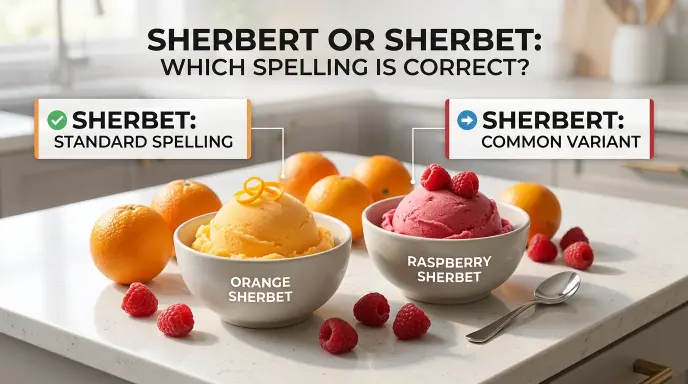
Have you ever wondered whether the correct spelling is sherbert or sherbet? You may have heard people use both words when talking about a refreshing, fruit-flavored frozen dessert, but the extra “r” often creates confusion. If you are writing a recipe, preparing an English assignment, or simply trying to improve your spelling, knowing which version to use can help you communicate more clearly. The good news is that the difference is easier to understand than you might think.
Sherbet is the standard spelling used for the frozen dessert in American English, while sherbert is a widely recognized variant spelling that many people use because of how they pronounce the word. According to major dictionary references, including Cambridge Dictionary and Merriam-Webster, pronunciation and regional usage help explain why these forms are often confused. Understanding this distinction also helps English learners recognize the difference between standard spelling and everyday speech.
In this guide, you will discover sherbert vs. sherbet meaning, correct spelling, pronunciation, origin, and practical examples to make the distinction easy to remember. You will also learn why people add an extra “r,” whether sherbert is considered a real word, and how sherbet differs from sorbet and ice cream. By the end, you will know which spelling is best for formal writing, everyday conversations, recipes, and online content, so you can use the word confidently whenever the question comes up.
Sherbert or Sherbet: What Is the Difference?
The difference between sherbert and sherbet is primarily a matter of spelling, pronunciation, and standard usage. Both forms refer to the same frozen dessert in everyday conversation. However, sherbet is the standard spelling, whereas sherbert is a widely used variant that is generally considered nonstandard in edited English.
The confusion often begins when people hear the word spoken aloud. Since some speakers naturally pronounce an extra “r” in the middle, they assume that the letter belongs in the written word as well. Consequently, the alternative spelling has become familiar in restaurants, family conversations, and informal recipes.
Nevertheless, when writing a menu, preparing a school assignment, or publishing a recipe, sherbet is the safer choice. It is the established spelling in standard English dictionaries and formal writing.
What Does Sherbet Mean?
Sherbet is a noun that describes a frozen dessert made from sweetened fruit juice or fruit puree, often with a small quantity of dairy ingredients.
For example, lemon sherbet offers a refreshing combination of sweetness and citrus flavor. Similarly, raspberry sherbet provides a fruity taste with a smooth, slightly creamy texture.
In culinary terminology, sherbet generally contains some dairy, unlike traditional sorbet, which is typically dairy free. However, recipes differ, and ingredient requirements can vary between countries.
Example sentence: We served raspberry sherbet after dinner because everyone wanted a light, refreshing dessert.
In this sentence, sherbet names the food being served. Therefore, it functions as a noun.
What Does Sherbert Mean?
Sherbert is a commonly used alternative spelling of sherbet. Although it appears in everyday speech and informal writing, it is generally not the preferred form in standard written English.
The extra letter usually reflects how some people pronounce the word rather than a meaningful difference between the two terms.
For example, someone might say, “I bought orange sherbert at the grocery store.” The intended meaning is understandable, but a formal recipe would normally use sherbet instead.
Consequently, writers should distinguish between a familiar pronunciation and the conventional spelling. A word can be common in conversation without being the recommended choice for edited writing.
Sherbert vs Sherbet: Comparison Table
| Feature | Sherbet | Sherbert |
|---|---|---|
| Part of speech | Noun | Noun |
| Meaning | A frozen dessert | Same intended dessert |
| Standard spelling | Yes | Generally nonstandard |
| Pronunciation | Often varies by speaker | Reflects an extra pronounced “r” |
| Formal writing | Recommended | Usually avoided |
| Informal conversation | Common | Common in some communities |
| Example | Lemon sherbet | Lemon sherbert |
Quick recap
Sherbet is the preferred spelling in standard English.
Sherbert is a familiar variant that usually refers to the same dessert.
Neither spelling identifies a separate flavor or a different category of frozen treat.
Therefore, choose sherbet when accuracy matters, especially in professional or academic writing.
Is Sherbert vs Sherbet a Grammar, Vocabulary, or Usage Issue?
The sherbert versus sherbet question is primarily a spelling and usage issue, rather than a grammatical distinction.
Both words function as nouns when they refer to the frozen dessert. Moreover, neither spelling changes the intended meaning in ordinary conversation.
However, standard written English favors sherbet. This distinction matters because formal documents generally follow established dictionary spellings, even when informal alternatives are widespread.
Are Sherbert and Sherbet Interchangeable?
In everyday conversation, people will usually understand both forms. Nevertheless, they are not equally appropriate in every writing situation.
For instance, a friend might understand a request for strawberry sherbert without difficulty. In contrast, a professional food writer would normally choose strawberry sherbet to maintain conventional spelling.
Thus, the intended meaning is generally interchangeable, but the standard spelling is not.
Formal vs Informal Usage
In informal settings, pronunciation often influences spelling. Consequently, sherbert appears in conversations, personal messages, and casual social media posts.
In formal writing, however, consistency and accepted spelling conventions become more important. Therefore, sherbet is the preferred form for menus, cookbooks, educational assignments, and published articles.
Academic vs Casual Usage
Students should use sherbet in essays, examinations, and vocabulary exercises. Similarly, teachers and editors would generally expect the standard spelling.
Meanwhile, casual speakers can use either form and still communicate their meaning. Even so, learning the standard version helps prevent avoidable spelling errors.
How to Use Sherbet Correctly
Since sherbet is the conventional spelling, it should be your first choice whenever you refer to this frozen dessert in writing.
Workplace Example
In a restaurant, a manager might write:
“We will offer lemon sherbet as the dessert option for Friday’s special menu.”
This sentence uses the standard spelling in a professional context. Furthermore, it communicates the menu item clearly to customers and staff.
Academic Example
In a culinary studies assignment, a student could write:
“Sherbet is a frozen dessert that commonly combines fruit ingredients, sugar, and some dairy.”
Here, the spelling is appropriate for educational writing. Additionally, the sentence gives a straightforward description without confusing sherbet with sorbet.
Technology Example
Suppose a food business enters its products into an online ordering system. The product name might appear as:
“Fresh mango sherbet, available in individual cups.”
Using the standard spelling helps maintain consistency across product descriptions, digital menus, and inventory records.
Usage recap: Use sherbet in formal documents, schoolwork, professional menus, and online product listings. It is also the most reliable choice for ordinary everyday writing.
How to Understand Sherbert in Everyday Usage
Although sherbert is generally considered nonstandard, understanding why people use it can help explain the confusion.
Workplace Example
A coworker might say:
“Could you add orange sherbert to the shopping list?”
The intended dessert is clear. However, if you are preparing the official shopping list, writing orange sherbet is preferable.
Academic Example
A student might write:
“My favorite summer dessert is raspberry sherbert.”
Although readers will probably understand the sentence, an instructor may mark the spelling as incorrect or recommend the standard form.
Technology Example
A customer might search an online grocery store for “lime sherbert.” Depending on the search system, the results could include products listed under the standard spelling, sherbet.
Search engines and shopping platforms may account for spelling variations, but that does not make both spellings equally suitable for publication.
Usage recap: Recognize sherbert when you encounter it, but use sherbet when composing polished written content.
When You Should NOT Use Sherbert or Sherbet
Although both terms are associated with the same dessert, several situations require extra care.
When Writing a Formal Menu
Avoid sherbert in an official restaurant menu. Instead, use sherbet to follow standard spelling conventions and maintain a professional appearance.
When Completing an English Examination
Do not assume that a familiar pronunciation determines the correct spelling. Unless the question specifically concerns regional variants, sherbet is the safer answer.
When Writing a Culinary Definition
Avoid treating sherbet and sorbet as exact synonyms. Sherbet commonly includes some dairy, whereas sorbet is typically made without dairy ingredients.
When Editing a Published Recipe
Do not alternate between sherbet and sherbert throughout the same recipe. Instead, choose the standard spelling and use it consistently.
When Creating Product Labels
Avoid using sherbert as the default product name in a professional catalogue. Consistent terminology makes product descriptions easier to understand.
When Explaining Pronunciation
Do not claim that every speaker pronounces sherbet identically. Pronunciation varies by region, accent, and individual speech habits.
When Discussing Frozen Desserts
Do not assume that every sherbet recipe contains the same ingredients. Some varieties differ in their dairy content, fruit composition, and texture.
When Correcting Someone’s Speech
Avoid suggesting that every person who says sherbert is unable to speak English correctly. Informal pronunciation varies, and a spelling preference does not justify criticizing a speaker.
Common Mistakes: Sherbert or Sherbet
The following examples demonstrate how to select the preferred spelling in different contexts.
| Correct sentence | Incorrect or less suitable sentence | Explanation |
|---|---|---|
| We bought lemon sherbet. | We bought lemon sherbert. | Sherbet is the standard spelling. |
| The restaurant serves raspberry sherbet. | The restaurant serves raspberry sherbert. | The extra “r” is unnecessary in standard writing. |
| Please add mango sherbet to the menu. | Please add mango sherbert to the menu. | Professional menus should use the conventional form. |
| Sherbet is often made with fruit and sugar. | Sherbert is often made with fruit and sugar. | Sherbet is preferred in formal educational writing. |
| I prefer sorbet to sherbet. | I prefer sorbet to sherbert. | Sherbet is the standard spelling of the dessert being compared. |
| The recipe calls for orange sherbet. | The recipe calls for orange sherbert. | Standard spelling improves consistency in recipes. |
The sentences in the second column remain understandable in most cases. Nevertheless, the first column demonstrates the preferred written form.
Decision Rule Box
Which spelling should you choose?
Use sherbet
Choose this spelling for the frozen dessert in formal writing, educational work, recipes, and professional communication.
Recognize sherbert
Understand that it is a common alternative spelling, but avoid it when standard written English is expected.
Unlike some confusing word pairs, this distinction does not involve choosing between an action and a person. Both terms are nouns in this context, so the key decision is whether to use the standard spelling.
Sherbert and Sherbet in Modern Technology and Digital Tools
Digital communication has helped familiar spelling variants remain visible. For example, people may type sherbert because that spelling matches their pronunciation, while online menus and recipe databases often use sherbet.
Spellcheckers may flag sherbert or suggest sherbet, although the exact response depends on the software and its dictionary. Likewise, predictive keyboards can learn a user’s typing habits without necessarily identifying the most appropriate formal spelling.
For accurate digital publishing, use a consistent dictionary based on the intended variety of English. In addition, review food names manually instead of relying entirely on automated corrections.
The Etymology of Sherbet
The word sherbet has a long history that connects food, language, and cultural exchange.
English acquired the term through forms associated with Turkish and Persian, ultimately tracing back to the Arabic word sharbah, meaning a drink or a draught. Related words historically referred to sweetened beverages and refreshments.
Over time, the meaning developed differently across languages and culinary traditions. Consequently, the modern English word sherbet refers to a frozen dessert rather than simply a sweet drink.
The alternative spelling sherbert is generally explained as a pronunciation influenced variant. In other words, speakers inserted an additional “r” sound into the established word, and that pronunciation became reflected in writing.
This history helps explain why the longer spelling remains familiar even though sherbet is the conventional written form.
An Expert Style Explanation of Sherbert vs Sherbet
A useful editorial principle is:
“Choose the spelling recognized by standard dictionaries, then use it consistently throughout your writing.”
This is a general writing principle rather than a quotation attributed to a specific linguist.
Applied to this word pair, it means selecting sherbet for a recipe, academic assignment, or professional menu. Meanwhile, recognizing sherbert as a familiar variant allows writers to understand everyday speech without confusing it with the preferred written form.
Two Practical Case Studies: Choosing the Right Spelling
The following examples illustrate realistic editing situations. They are hypothetical scenarios, not documented research findings.
Case Study One: A Restaurant Menu
A restaurant is preparing a seasonal menu featuring lemon, mango, and raspberry desserts. During editing, the manager notices that one draft uses sherbet while another uses sherbert.
The manager checks a standard dictionary and chooses sherbet for all three products.
Result: The menu follows conventional spelling, the dessert names remain consistent, and staff can reuse the wording across printed menus and online listings.
The important lesson is that a single editorial choice can prevent inconsistent spelling across several customer facing materials.
Case Study Two: A Student’s Culinary Assignment
A student writes a report about frozen desserts and repeatedly uses sherbert. The teacher recommends checking a dictionary and revising the spelling.
The student replaces sherbert with sherbet throughout the assignment and separately explains the difference between sherbet and sorbet.
Result: The revised report uses the standard spelling consistently and communicates the culinary distinction more clearly.
This example highlights two separate skills: accurate spelling and accurate terminology. Both contribute to stronger educational writing.
Error Prevention Checklist: Sherbert or Sherbet
Before publishing a sentence containing this dessert name, review the following points.
Always use sherbet when:
- Writing a formal menu or restaurant description.
- Preparing an academic assignment or examination.
- Editing a cookbook or dessert recipe.
- Creating a professional food catalogue.
- Writing an article that explains frozen desserts.
Never use sherbert when:
- You are required to follow standard English spelling.
- An editor or style guide specifically requires sherbet.
- You are trying to distinguish sherbet from another frozen dessert.
- You are proofreading a formal document and can replace the nonstandard variant.
Remember that recognizing a variant and choosing it for publication are two different things. Therefore, use context to determine whether you are discussing informal pronunciation or producing polished written English.
Related Grammar Confusions You Should Master
Once you understand sherbert versus sherbet, learning other commonly confused words can improve your everyday writing.
- Sorbet vs Sherbet: Learn how dairy content and culinary definitions distinguish these desserts.
- Dessert vs Desert: Distinguish a sweet course from a dry geographical region.
- Advice vs Advise: Understand the difference between a noun and a verb.
- Affect vs Effect: Identify the usual distinction between an action and a result.
- Their vs There: Separate possession from references to a place.
- Everyday vs Every Day: Distinguish an adjective from a phrase describing frequency.
- Compliment vs Complement: Tell praise apart from something that completes or enhances another thing.
- Principal vs Principle: Separate a person or primary element from a rule or belief.
- Fewer vs Less: Learn the conventional distinction between countable items and quantities.
- Definitely vs Defiantly: Avoid confusing certainty with deliberate resistance.
These distinctions involve different linguistic issues, including spelling, meaning, grammatical function, and usage. Consequently, identifying the specific source of confusion is often the fastest way to correct an error.
Frequently Asked Questions
Is sherbert or sherbet the correct spelling?
Sherbet is the standard spelling in English. Sherbert is a common alternative that usually refers to the same frozen dessert, but it is generally avoided in formal writing.
Why do people say sherbert instead of sherbet?
Some speakers pronounce an additional “r” sound in the middle of the word. Over time, this pronunciation has influenced spelling, making sherbert familiar in informal conversation.
Is sherbert a real word?
Sherbert is a recognized spelling variant in some dictionaries and references, although sherbet is the conventional spelling. Its acceptance and labeling can differ between dictionaries.
Is sherbet pronounced with an R?
The word sherbet contains an “r” in its first syllable. However, the standard spelling does not contain another “r” before the final syllable. Pronunciation varies among English speakers.
Are sherbert and sherbet the same thing?
In everyday usage, both terms generally refer to the same frozen dessert. The difference is primarily spelling, rather than a separate ingredient list or dessert category.
What is the difference between sherbet and sorbet?
Sherbet commonly contains a small amount of dairy, such as milk or cream. Sorbet is typically dairy free and relies on fruit, water, and sugar. However, recipes and labeling practices can vary.
Which spelling should I use in a recipe?
Use sherbet in a recipe because it is the standard spelling. Furthermore, keep the spelling consistent in the ingredient list, preparation instructions, title, and serving suggestions.
Is sherbet the correct spelling in American English?
Yes. Sherbet is the conventional spelling in American English, although sherbert is also encountered in informal speech and writing.
Can I use sherbert in a school assignment?
It is best to use sherbet in schoolwork. Although readers may understand sherbert, teachers generally expect the conventional spelling unless the assignment specifically discusses spelling variants.
Conclusion:
When choosing between sherbert or sherbet, sherbet is the correct standard spelling for formal and general written English. Both forms usually refer to the same frozen dessert, but the extra “r” in sherbert reflects a common pronunciation variant rather than a different meaning.
Therefore, use sherbet in school assignments, restaurant menus, recipes, professional documents, and published articles. Although sherbert remains familiar in everyday conversation, choosing the standard spelling will help keep your writing accurate, clear, and consistent.
Ultimately, the easiest way to remember the distinction is to associate sherbet with the conventional spelling used in dictionaries. Once you recognize this pattern, you can avoid a frequent spelling mistake without changing the meaning of your sentence.