Have you ever paused while writing a question because you could not decide whether to use “which” or “what”? You are not alone. These two English question words often seem interchangeable, but choosing the right one can make your sentences clearer and more natural. Whether you are learning English, preparing for an exam, writing professionally, or improving everyday communication, understanding the difference between which and what can help you avoid common grammar mistakes.
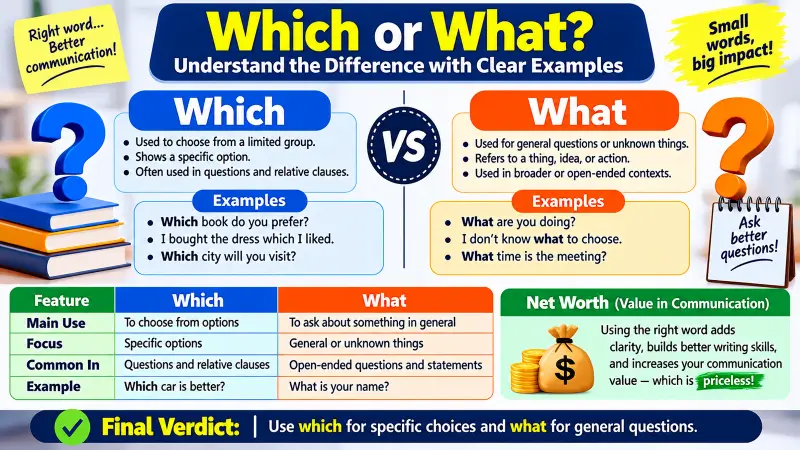
The main difference depends on the choices available. “Which” is generally used when selecting from a known or limited set of options, while “what” is usually used when the possible answers are open or unknown. For example, “Which color do you prefer, blue or green?” presents specific choices, whereas “What is your favorite color?” allows for a wider range of answers. However, context also matters, and real English usage can be more flexible than a simple rule suggests.
In this guide, we will explain which or what with straightforward grammar rules, practical examples, sentence comparisons, and common mistakes. You will learn when to use each word in questions, conversations, academic writing, and professional situations. The goal is to provide an accurate, beginner-friendly explanation that helps you apply the rules confidently rather than memorize them without understanding. By the end, you will be better prepared to choose the right word and communicate your meaning clearly.
Which or What: What’s the Difference?
Although which and what are interrogative words, their meanings and practical uses are not identical. Both help speakers request information, but the expected answer often determines which expression sounds more natural.
Definition of Which
Which is a determiner or pronoun used to identify a particular person, object, choice, or possibility from a group of alternatives.
For example, “Which book belongs to you?” asks someone to identify one book among the books under consideration. Similarly, “Which is your favorite?” requests a selection from an understood collection.
Furthermore, which frequently appears when the speaker and listener already know the available options. Those alternatives may be stated directly or understood from the conversation.
Examples:
- Which route should we take?
- Which student answered correctly?
- Which of these shirts fits better?
- Which is your preferred subject?
Definition of What
What is an interrogative pronoun or determiner used to ask about information, identity, nature, characteristics, or possibilities.
For instance, “What is your favorite book?” invites the listener to name a preferred book without necessarily restricting the answer to a specified collection.
Likewise, “What happened yesterday?” asks about an event without identifying a limited set of possible answers.
Examples:
- What is your name?
- What do you need?
- What kind of music do you enjoy?
- What happened during the meeting?
Comparison Table
| Feature | Which | What |
|---|---|---|
| Main purpose | Identifying or selecting an option | Requesting information |
| Typical context | Known or limited alternatives | Open or unspecified possibilities |
| Part of speech | Determiner or pronoun | Determiner or pronoun |
| Example question | Which color do you prefer? | What color do you like? |
| Expected answer | Often a selection | Often a broader response |
| Formal writing | Appropriate | Appropriate |
| Casual conversation | Common | Common |
Quick recap: Use which when the available alternatives matter. Choose what when the question is more open ended. However, the distinction is not absolute because either word can be correct in certain contexts. Consequently, consider the intended meaning instead of relying on a rigid rule.
Is Which or What a Grammar, Vocabulary, or Usage Issue?
The difference between which and what involves grammar, vocabulary, and usage. Although both words are grammatically correct in many similar sentence structures, their meanings influence which choice communicates the intended question most clearly.
Are Which and What Interchangeable?
Sometimes, yes. Nevertheless, they are not always interchangeable.
Consider these examples:
“Which subject do you study?”
“What subject do you study?”
Both sentences are grammatical. The first may suggest a selection among subjects already being discussed, whereas the second can invite a more general answer about the person’s studies.
Similarly, “Which city would you like to visit?” often suggests a known list of destinations. In contrast, “What city would you like to visit?” can invite the speaker to name any destination.
Therefore, context matters more than the sentence pattern alone.
Formal Versus Informal Usage
Both expressions are acceptable in formal and informal English. Neither word is inherently more professional or more polite.
For example, a manager might ask, “Which proposal should we approve?” when discussing three submitted proposals. Alternatively, the manager could ask, “What changes should we make?” when inviting general recommendations.
In everyday conversation, people use both expressions naturally. However, choosing the appropriate one makes the question more precise and reduces misunderstandings.
Academic Versus Casual Usage
Academic writing requires clear, specific questions. Consequently, which often appears in research questionnaires that offer defined responses.
For example, “Which research method did the participants select?” works well when respondents choose from established methods.
Meanwhile, “What factors influenced the participants’ decisions?” invites a broader explanation. This distinction is particularly useful in essays, examinations, interviews, and research projects.
In casual conversations, speakers may use either word according to their intention. Even so, the difference remains useful whenever a question needs a precise answer.
When to Use Which
Use which when you want someone to identify, compare, or select an option from an understood group. The alternatives may be explicitly listed, visually available, or established by an earlier conversation.
Workplace Example
Imagine that a team has prepared three marketing proposals. A supervisor asks, “Which proposal should we present to the client?”
Here, which is appropriate because the team is choosing among specific proposals.
Another example is, “Which employee will lead the presentation?” The question requests identification from a relevant group of employees.
Academic Example
A teacher asks, “Which answer is correct, A, B, C, or D?”
Because the possible answers are specified, which communicates the intended selection clearly.
Similarly, a researcher might ask, “Which of the two experiments produced more reliable results?” The comparison involves two identified experiments.
Technology Example
A user asks, “Which browser should I use for this website?”
The question requests a recommendation from possible browsers, perhaps based on speed, privacy, or compatibility.
Likewise, “Which file should I upload?” is appropriate when several files are available.
Usage Recap
Choose which when identifying a particular alternative, comparing known possibilities, or selecting from a limited group. However, the options do not always need to be physically listed. They only need to be understood from the situation.
When to Use What
Use what when asking for general information, discovering possibilities, identifying something without a defined selection, or requesting an explanation.
Workplace Example
A supervisor asks, “What improvements would make this process more efficient?”
The question encourages employees to suggest different ideas rather than choose from a fixed list.
Similarly, “What is the purpose of this meeting?” requests an explanation about the meeting’s objective.
Academic Example
A student asks, “What causes changes in the Earth’s climate?”
This question seeks an explanation of causes rather than a selection from a predefined set.
Likewise, “What does the author mean in this paragraph?” asks for interpretation and understanding.
Technology Example
Someone asks, “What software can help me organize my projects?”
The question allows the respondent to recommend different tools without restricting the answer to known options.
Another example is, “What does this error message mean?” The user wants an explanation of an unfamiliar message.
Usage Recap
Use what when the answer can be broad, descriptive, explanatory, or unexpected. Nevertheless, if the conversation establishes a limited group of alternatives, which may communicate the intended question more precisely.
When You Should NOT Use Which or What
Understanding incorrect or confusing usage can make your writing more accurate. Although some sentences remain grammatically possible, they may not communicate the intended meaning clearly.
Common Misuse Scenarios
1. Asking for an unrestricted suggestion with an unnecessarily narrow question
Less suitable: “Which career should I choose?” when no careers have been discussed and the speaker wants completely open suggestions.
Better: “What career might suit my interests?”
The original sentence is not grammatically wrong. However, the revised version better communicates the desire for broad recommendations.
2. Asking someone to choose from a clearly stated list with an unnecessarily broad question
Less precise: “What of these three jackets do you prefer?”
Better: “Which of these three jackets do you prefer?”
The word which works naturally with the specified alternatives.
3. Using which without a clear reference
Confusing: “Which is happening?”
Clearer: “What is happening?”
Unless the listener knows which events are being compared, the first question may sound incomplete or confusing.
4. Treating what as incorrect whenever the answer is limited
Consider “What is your blood type?” The question is correct even though the possible answers belong to a limited set.
Therefore, a restricted answer does not automatically require which. The speaker’s intended meaning and established context still matter.
5. Assuming which always requires a short answer
A question such as “Which explanation best accounts for the results?” may require a detailed response.
Consequently, the expected answer’s length does not determine the correct interrogative word.
6. Assuming what cannot be used for selection
“What color would you like?” is perfectly natural when a customer chooses a color. The expression can invite a choice without presenting a formal list.
7. Using the wrong structure with of
Incorrect: “What of these options is correct?” when the intended question is a direct selection from a specific group.
Better: “Which of these options is correct?”
In ordinary selection questions, which of is the standard construction.
8. Ignoring the conversational context
If a colleague has already presented two plans, “What plan do you prefer?” may still be understandable. Nevertheless, “Which plan do you prefer?” more directly refers to the established alternatives.
Thus, the best choice depends on the situation, not simply on whether a sentence is technically grammatical.
Common Mistakes and Decision Rules
The following examples show how small word choices can change the focus of a question.
| Correct sentence | Incorrect or less suitable sentence | Explanation |
|---|---|---|
| Which of these phones is yours? | What of these phones is yours? | Use which of for selection from a group. |
| What happened at school? | Which happened at school? | Use what when asking generally about an event. |
| Which route should we take? | What route of these two should we take? | Which naturally identifies a route from known alternatives. |
| What do you want to learn? | Which do you want to learn? | The second version needs an established set of choices. |
| Which candidate received the highest score? | What candidate of the three received the highest score? | Which is more natural when comparing specified candidates. |
| What kind of food do you enjoy? | Which kind of food do you enjoy? | Both can be correct, but what kind is often more open ended. |
| What is your occupation? | Which is your occupation? | What is standard when asking someone to state their occupation. |
| Which color looks better, red or blue? | What color looks better, red or blue? | Both are possible, although which highlights the two stated choices. |
The Decision Rule
Use which when the question focuses on identifying or selecting from known alternatives.
Use what when the question focuses on discovering information, naming something, describing a situation, or exploring possibilities.
For example, if a friend asks you to choose between two restaurants, “Which restaurant should we visit?” is a natural question. Conversely, if no restaurants have been suggested, “What restaurant would you recommend?” is often more appropriate.
However, remember that this is a practical guideline rather than an absolute grammatical law. English allows overlapping uses, particularly in ordinary conversation.
Which and What in Modern Technology
Digital products frequently use both words in menus, search boxes, help systems, and customer support conversations. Their effectiveness depends on the information a user needs to provide.
For instance, “Which operating system are you using?” works well when a support agent is identifying a user’s platform from known alternatives, such as Windows, macOS, or Linux.
By comparison, “What problem are you experiencing?” invites the user to describe a situation in their own words.
Similarly, an application might ask, “Which notification settings would you like to change?” when several settings are visible. Meanwhile, “What would you like to accomplish?” allows the user to explain a broader goal.
These distinctions help make digital instructions more understandable. Furthermore, carefully worded questions can reduce ambiguity and make forms easier to complete.
The Etymology of Which and What
Both words have deep roots in the history of English. Their development helps explain why they share certain functions while maintaining different meanings.
Which comes from Old English hwilc, a form related to earlier Germanic expressions used to distinguish or identify a person or thing. Over time, it developed into the familiar word used for selecting or identifying alternatives.
What comes from Old English hwæt, which served as a question word for asking about identity, nature, or information. Its descendants appear in related Germanic languages as well.
Although their historical forms are related, their modern uses have become specialized through centuries of everyday communication. As a result, contemporary speakers generally use which to emphasize identification among possibilities and what to request information more broadly.
An Expert Perspective on Which and What
A useful principle for clear English is that grammar should serve meaning rather than force every question into a rigid formula.
As a practical editorial guideline:
“Choose the question word that best reflects the information you want your reader to provide. When alternatives are central to the question, consider which. When discovery or explanation is the main goal, consider what.”
This is an instructional principle, not a quotation attributed to a named linguist. It reflects the central distinction that learners can apply to everyday writing.
For students, editors, professionals, and English language learners, the most effective approach is to examine the context before deciding which word to use.
Two Practical Case Studies
The following illustrative case studies demonstrate how choosing the right question word can improve communication. Their outcomes are examples, not findings from published experiments.
Case Study One: Improving a Customer Survey
A fictional online clothing store wants to understand customers’ preferences. Its original survey asks, “What of these three jacket colors do you prefer?”
Although readers may understand the intention, the wording sounds unnatural. The team changes the question to “Which of these three jacket colors do you prefer?”
The revised question identifies the available alternatives clearly. For example, customers can select black, navy, or beige without wondering whether they should suggest another color.
Suppose the store tests the revised wording with 100 participants and finds that 96 complete the question without requesting clarification. This hypothetical result illustrates how clear wording can improve usability, although it does not establish a universal improvement rate.
Case Study Two: Clarifying a Classroom Assignment
A fictional English teacher notices that students misunderstand an assignment asking, “Which factors contributed to the character’s decision?”
Some students assume that they must select from a list, even though the assignment expects an explanation based on the story.
The teacher revises the question to “What factors contributed to the character’s decision?”
Now students are encouraged to identify relevant influences and explain their reasoning.
Suppose 24 of 30 students initially provide incomplete answers, while 24 of 30 provide explanations that meet the assignment’s criteria after the wording is clarified. These hypothetical figures demonstrate the potential value of matching a question word to the intended task, not verified educational research.
Error Prevention Checklist
Before submitting an assignment, sending a professional email, or publishing an article, review the following questions.
Always Use Which When
- You want someone to identify an option from a known group.
- You are comparing two or more established alternatives.
- You are asking someone to select from a list.
- You use a structure such as “which of these” or “which one.”
- You need to refer clearly to choices already discussed.
Avoid Which When
- The word would imply alternatives that the listener cannot identify.
- You want an unrestricted explanation and no selection is intended.
- The sentence sounds incomplete because the reference group is unclear.
Always Consider What When
- You are asking for general information.
- You want someone to explain a cause, event, meaning, or situation.
- You are inviting open suggestions.
- You want someone to name a category, describe something, or share an opinion.
- You use common structures such as “what happened,” “what kind,” or “what does this mean?”
Never Assume What Is Wrong When
- The answer happens to come from a limited set.
- The speaker is asking about a color, occupation, location, or preference.
- A conversational question allows more than one reasonable interpretation.
Ultimately, read the entire sentence rather than judging one word in isolation. If the intended answer is clear, the question is likely to communicate effectively.
Related Grammar Confusions You Should Master
Learning similar word pairs can strengthen vocabulary and improve sentence construction. In addition to understanding which and what, consider these common distinctions.
Who versus whom: Who generally functions as a subject, whereas whom commonly functions as an object in formal English.
Who versus whose: Who asks about a person, while whose asks about ownership or possession.
That versus which: Both can introduce clauses, but their use depends on sentence structure, meaning, and the variety of English being followed.
This versus these: This refers to one item, while these refers to multiple items.
Each versus every: Both concern individual members of a group, although their grammatical patterns differ.
Few versus a few: Few emphasizes a small number, often suggesting insufficiency, while a few generally indicates some.
Less versus fewer: Less is traditionally associated with uncountable quantities, while fewer is generally used with countable items.
Affect versus effect: Affect is commonly a verb meaning to influence, while effect is commonly a noun meaning a result.
Then versus than: Then relates to time or sequence, whereas than introduces comparisons.
Can versus may: Can commonly expresses ability, while may often expresses permission or possibility.
By studying these distinctions alongside question words, learners can recognize how small grammatical choices affect meaning, clarity, and tone.
Frequently Asked Questions
What is the difference between which and what?
Which generally identifies or selects an option from a known group, while what asks for information more broadly. Nevertheless, context can allow both words in similar questions.
When should I use which instead of what?
Use which when the available alternatives are established or important to the question. For example, “Which dress should I buy?” naturally asks someone to choose among dresses under consideration.
Can which and what be used interchangeably?
Sometimes. For instance, “What color do you prefer?” and “Which color do you prefer?” are both grammatical. However, which may emphasize a particular selection, while what can sound more open ended.
Is which more formal than what?
No. Both words are appropriate in formal writing, professional communication, academic work, and casual conversation. Their suitability depends on the question’s intended meaning rather than the level of formality.
Should I use which or what when asking a question about a person?
Either word may be appropriate, depending on the intended question. “Which student won the award?” identifies someone from a group, whereas “What kind of person is she?” asks about characteristics.
Should I say which one or what one?
Use “which one” when selecting from known alternatives, as in “Which one belongs to you?” In standard English, “what one” is less common in many comparable situations, although it can occur naturally in certain regional or conversational expressions.
Is what kind or which kind correct?
Both are correct. “What kind of music do you enjoy?” invites a broad answer, while “Which kind of music do you prefer?” may suggest a comparison among known categories.
How do I teach children the difference between which and what?
Start with familiar examples. Show children three toys and ask, “Which toy do you want?” Then ask, “What do you want to play?” Explain that the first question focuses on a selection, while the second invites a broader answer.
How can I avoid mistakes with which and what in writing?
First, identify the information you need. Next, determine whether the question focuses on known alternatives or invites a broader response. Finally, read the complete sentence to check that the intended meaning is clear.
Conclusion:
Choosing between which and what becomes simple when you understand the purpose of your question. Generally, use which when identifying or selecting from known options, while what is better for asking open ended questions, exploring ideas, or requesting information. However, both words can be correct in certain situations, depending on the context and intended meaning.
By practicing these rules with everyday conversations, academic tasks, and workplace examples, you can avoid common mistakes and express your thoughts more clearly. Ultimately, focus on the answer you expect, and choosing the right word will become a natural part of your English communication.