Have you ever wondered whether reed and songbird mean the same thing? These terms can be confusing because they are both associated with nature and birds, but they do not have the same meaning. Understanding the difference helps you use the correct word when writing about wildlife, bird species, or natural habitats.
A reed is a tall, grass-like plant that commonly grows in wetlands, marshes, and along the edges of lakes. A songbird, on the other hand, is a type of bird known for its vocal abilities and often musical calls. According to the bird classification explained by Audubon, songbirds belong to the Passeri group of perching birds and include thousands of species.
In this guide, we will explain the meanings of reed and songbird, highlight their key differences, and provide simple examples to make each term easier to understand. You will also learn how reeds support wetland habitats and why songbirds are important in the natural world. Whether you are an English learner, a student, a writer, or a nature enthusiast, this comparison will help you distinguish the two terms accurately and confidently.
Reed vs Songbird: What’s the Difference?
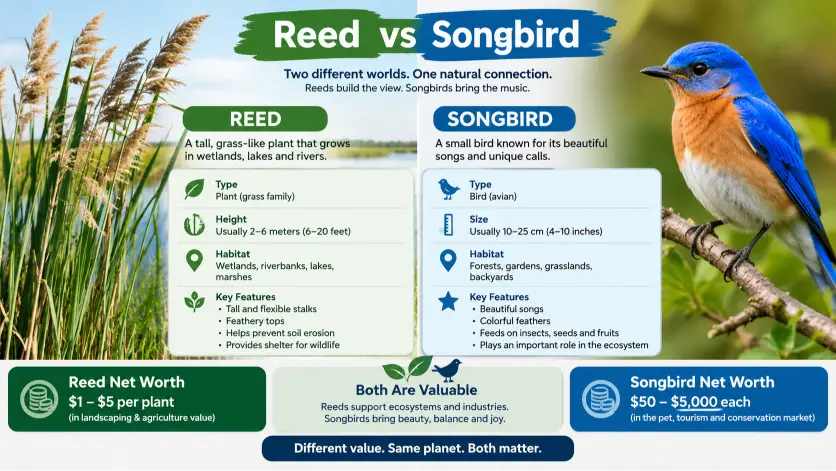
Although reed and songbird may appear in discussions about nature, they do not generally mean the same thing. A reed is usually a plant, whereas a songbird is a bird belonging to a group known for its vocalizations.
Nevertheless, the word reed can appear in bird names, including reed warbler, which may explain why these terms seem connected. Consequently, identifying the intended meaning helps prevent inaccurate descriptions and confusing sentences.
Quick Comparison Table
| Feature | Reed | Songbird |
|---|---|---|
| Part of speech | Noun | Noun |
| Main meaning | A tall, slender plant | A bird associated with vocal song |
| Category | Plant or material | Animal |
| Typical habitat | Wetlands, riverbanks, ponds | Forests, gardens, grasslands, wetlands |
| Common examples | Common reed, reed beds | Robins, thrushes, finches |
| Main function or trait | Provides shelter, structure, and nesting material | Produces songs and calls for communication |
| Correct usage | “Reeds grow beside the pond.” | “The songbird sang at sunrise.” |
Mini recap: A reed is generally a plant, while a songbird is an animal. Although the words can appear in the same nature related discussion, they describe different things. However, a reed warbler is a bird that lives among reeds, so the full name matters. Therefore, always consider the surrounding sentence before deciding which word is appropriate.
Is Reed vs Songbird a Grammar, Vocabulary, or Usage Issue?
Primarily, this is a vocabulary and meaning issue, rather than a grammatical problem. Both terms are nouns, and both can be used correctly in formal writing, academic assignments, and everyday conversation.
However, their meanings differ substantially. As a result, substituting one for the other can make a sentence factually incorrect even when its grammar remains perfect.
Are Reed and Songbird Interchangeable?
No, these words are not interchangeable when referring to a plant and a bird.
For example, consider these sentences:
- Correct: “A reed grew near the water.”
- Correct: “A songbird perched on the branch.”
- Incorrect: “A songbird grew near the water,” when the writer intends to describe a plant.
The third sentence is grammatically possible, since birds can live near water, but it doesn’t communicate the intended meaning about a growing plant.
Likewise, describing a bird as a reed would be misleading unless Reed is a person’s name or the writer is using a clearly established name or metaphor.
Formal Versus Informal Usage
In formal writing, including scientific reports and school assignments, use reed for the plant and songbird for the bird when those are the intended meanings.
In casual conversation, people sometimes use broader descriptions such as “little bird,” “wetland plant,” or “marsh grass.” Nevertheless, those expressions are not always precise synonyms.
Academic Versus Casual Usage
Academic writing benefits from precise terminology. For instance, a biology student discussing a reed bed should identify the vegetation, whereas a student studying bird behavior should name the relevant bird group.
Meanwhile, casual storytelling may use more descriptive language. A writer might call a bird “a cheerful singer,” for example, although songbird is more direct when referring to the bird category.
Ultimately, context determines the best choice, but the basic distinction remains unchanged.
How to Use Reed Correctly
The noun reed usually refers to a tall, slender plant that grows in damp soil or shallow water. Many reeds belong to grasslike plant groups, although the word is also used for various plants with similar appearances.
Furthermore, reeds can provide shelter for wildlife, help stabilize wetland soils, and supply material for traditional crafts and musical instruments.
Workplace Example
In landscaping, environmental management, or construction, the word reed may describe vegetation used in a wetland project.
Example: “The environmental team planted reeds along the pond to improve the habitat.”
Here, reeds refers to plants, not birds. Consequently, the sentence makes sense in a professional report about habitat restoration.
Academic Example
In a biology assignment, a student might write:
“Common reeds grow in wetland environments and provide cover for numerous small animals.”
In this case, the noun identifies vegetation being studied. However, students should verify the exact plant species when scientific precision is necessary, because the everyday word reed can describe different plants.
Technology Example
In technology, reed can also refer to a component used in a reed switch, an electrically operated switch that responds to a magnetic field.
For example: “The engineer installed a reed switch in the door sensor.”
This usage has a different meaning from the wetland plant. Therefore, the surrounding technical context is especially important when interpreting the word.
Usage Recap
Use reed when referring to the plant, a component of certain musical instruments, a reed switch, or a person whose name is Reed. Although these meanings differ, each is established in its own context.
How to Use Songbird Correctly
A songbird is a bird belonging to a group of perching birds known as the oscine passerines, classified within the suborder Passeri. Many familiar garden birds belong to this group.
For example, robins, finches, and many thrushes are songbirds. Their vocalizations help them communicate, defend territories, and attract mates. However, not every sound they make is a melodious song.
Workplace Example
A wildlife conservation worker might write:
“The conservation team recorded songbird activity throughout the morning.”
Here, songbird describes the birds being monitored. Consequently, the word fits a report about bird populations, vocal behavior, or habitat conservation.
Academic Example
A student studying animal behavior could write:
“Many songbirds use vocal signals to communicate with potential mates and competing birds.”
This sentence uses the term to describe a group of birds rather than a particular species. Nevertheless, a research paper should identify the species when the study focuses on a specific bird.
Technology Example
Bird monitoring systems can use microphones and sound recognition software to record and classify bird vocalizations.
For instance: “The monitoring system identified several songbird calls in the recorded audio.”
In this example, the term refers to the animals producing the sounds, while the technology records or analyzes their vocalizations. However, automated classifications can be mistaken when calls overlap or environmental noise interferes.
Usage Recap
Use songbird when referring to a bird in the relevant vocal songbird group. If you know the species, naming it directly may provide greater accuracy. Meanwhile, use reed warbler when that specific bird is intended, rather than using reed alone.
When You Should NOT Use Reed or Songbird
Although both terms are useful, choosing the wrong one can confuse readers. Therefore, review these common situations before using either word.
1. Do not use reed when you mean a bird.
Incorrect: “A reed flew across the garden.”
Correct: “A songbird flew across the garden.”
Why it matters: A plant cannot fly. However, if you mean a bird called a reed warbler, use its complete name.
2. Do not use songbird when you mean a plant.
Incorrect: “Songbirds lined the edge of the pond,” when describing plants growing along the bank.
Correct: “Reeds lined the edge of the pond.”
Why it matters: The first sentence describes birds, not vegetation.
3. Do not assume every bird near reeds is a reed warbler.
A reed bed attracts different birds. Therefore, location alone cannot establish a bird’s identity.
4. Do not confuse a reed with a reed switch.
In an electronics manual, reed switch names a specific component. By contrast, reed in a botanical description refers to a plant.
5. Do not call every bird that sings a songbird without considering its classification.
Everyday language is often broad, but scientific classification is more specific. Consequently, identify the species or group when accuracy matters.
6. Do not shorten an established bird name carelessly.
For instance, reed warbler identifies a bird. Calling it simply a reed could mislead readers into imagining a plant.
7. Do not confuse a person’s surname with a common noun.
In “Mr. Reed studied birds,” Reed is a proper noun. In “A reed grew beside the stream,” it is a common noun.
8. Do not rely on sound alone to identify a bird.
Several species produce similar calls. Therefore, a bird’s appearance, location, behavior, and recording quality may all matter during identification.
Common Mistakes and Decision Rules
The following examples demonstrate how a small vocabulary choice can change the meaning of an otherwise understandable sentence.
| Correct sentence | Incorrect sentence | Explanation |
|---|---|---|
| Reeds grew beside the lake. | Songbirds grew beside the lake. | Plants grow from the ground, whereas birds hatch and develop. |
| A songbird sang in the tree. | A reed sang in the tree. | A reed plant cannot sing. |
| The engineer tested the reed switch. | The engineer tested the songbird switch. | The established electronic component is called a reed switch. |
| A reed warbler nested among the reeds. | A reed nested among the reeds. | The full bird name distinguishes the animal from the plant. |
| The researcher observed several songbirds. | The researcher observed several reeds. | The second sentence describes plants unless a different contextual meaning is intended. |
| Reed is the author’s surname. | reed is the author’s surname. | A person’s surname requires capitalization in standard English. |
Decision Rule Box
If you mean the plant, use reed.
If you mean a bird in the songbird group, use songbird.
If you mean a particular bird associated with reeds, identify the species when possible, such as a reed warbler.
If you mean a technical component, use the established term, such as reed switch.
Unlike pairs such as affect and effect, these two words do not represent alternative grammatical forms of the same concept. Instead, their meanings belong to different categories, although specific contexts can connect them.
Reed and Songbird in Modern Technology and Digital Tools
Modern technology provides several ways to study plants and birds. For example, environmental monitoring equipment can measure wetland conditions, while digital cameras help researchers observe vegetation and wildlife.
Similarly, acoustic monitoring devices record bird songs and calls. Depending on the equipment, software can compare recordings with reference libraries and suggest possible species identifications.
However, the terminology must remain accurate. A system that records a bird’s vocalization is studying the bird, not the reed plants nearby. Conversely, a sensor monitoring wetland vegetation is not necessarily studying songbirds.
Digital dictionaries and writing assistants can also help users distinguish related terms. Nevertheless, context matters because a single word can have several meanings. Therefore, review the complete sentence rather than accepting a suggested correction automatically.
Etymology: Where Do Reed and Songbird Come From?
Understanding word origins can make vocabulary easier to remember.
The word reed comes from Old English hrēod, referring to a reed or similar plant. Over time, the term continued to describe slender plants that often grow in wet environments. It also became part of the names of musical instrument components and other objects made from or resembling reed material.
Meanwhile, songbird combines two familiar English words: song and bird. The compound describes a bird associated with singing. In zoological usage, the word also refers to the oscine passerines, a group distinguished by specialized vocal organs and learned vocal behavior in many species.
Although these origins explain the words’ general meanings, modern usage depends on context. For example, reed can refer to a surname or an electronic component, while songbird can also be used metaphorically to describe a person with a beautiful singing voice.
Consequently, etymology helps explain a term’s development, but it doesn’t replace the need to understand its current meaning.
An Expert Style Explanation
“Accurate nature writing begins by identifying what a word describes: a plant, an animal, or a specific feature of either. Clear terminology allows readers to understand the subject without guessing.”
This is an explanatory quotation written for this article, not a statement attributed to a named researcher.
The principle is straightforward. When a writer distinguishes a reed from a songbird, readers can picture the intended subject more easily. Furthermore, precise wording makes educational materials, field notes, and wildlife reports more useful.
Two Practical Case Studies
The following illustrative case studies show how context helps writers choose between these terms. They are teaching examples, not reports of independently verified research projects.
Case Study One: A Wetland Conservation Report
A conservation volunteer prepares a report describing a pond surrounded by dense vegetation. In the original draft, the volunteer writes, “Songbirds were planted along the shoreline to provide shelter for wildlife.”
Although the sentence contains recognizable vocabulary, it communicates the wrong meaning. Birds are not planted along a shoreline, and the writer actually intends to describe vegetation.
The revised sentence reads: “Reeds were planted along the shoreline to improve habitat structure and provide cover for wildlife.”
As a result, the report identifies the intended plants and describes their role more clearly. The concrete improvement is the correction of one factual and vocabulary error, making the sentence suitable for a wetland management report.
Case Study Two: A School Birdwatching Assignment
A student observes a small bird moving among tall plants beside a stream. The first draft says, “I photographed a reed near the water.”
However, the photograph shows a bird, not a plant. Since the student has not identified its species, calling it a reed warbler would be premature.
The revised sentence reads: “I photographed a small songbird among the reeds beside the stream.”
This version distinguishes the animal from its habitat without making an unsupported species identification. Consequently, the description becomes clearer and more scientifically cautious.
In both examples, the improvement comes from understanding the subject and selecting a word that accurately represents it.
Error Prevention Checklist
Before submitting an article, assignment, or report, use this checklist to confirm that the terminology is accurate.
Always Use Reed When
- You are describing a tall, slender plant growing in a wet environment.
- You are referring to a plant used in traditional crafts or certain musical instruments.
- You are discussing a reed switch in an electronics context.
- You are using Reed as a person’s surname and have capitalized it correctly.
- Your sentence clearly identifies a plant rather than an animal.
Never Use Songbird When
- You intend to describe wetland vegetation.
- You are naming an electronic component called a reed switch.
- You are describing a plant growing along a riverbank.
- You have not established that the term accurately describes the animal in a scientific context.
Likewise, never use reed alone when you intend to identify a particular bird such as a reed warbler. Instead, retain the complete species name or use a broader term that accurately describes the animal.
Related Grammar Confusions You Should Master
Once you understand this vocabulary distinction, consider studying these related topics. Each one illustrates how context, word choice, or grammatical function can affect meaning.
- Affect vs Effect: Understand the difference between a commonly used verb and noun.
- Plant vs Flower: Learn how a broad botanical category differs from a specific plant structure.
- Bird vs Animal: Understand the relationship between a specific biological category and a broader group.
- Song vs Sing: Distinguish a noun describing a musical composition or vocal performance from a verb describing an action.
- Their vs There: Separate possession from a word indicating a place.
- Its vs It’s: Distinguish a possessive form from a contraction.
- Principal vs Principle: Identify the difference between a person or primary element and a fundamental rule.
- Compliment vs Complement: Separate praise from something that completes or enhances another thing.
- Species vs Specimen: Understand the difference between a biological classification and an individual example used for observation.
- Reed Warbler vs Other Warblers: Learn why complete bird names matter when identifying species.
These distinctions become easier with practice. Moreover, reading reliable examples and checking unfamiliar terminology can help prevent similar mistakes in professional and academic writing.
Frequently Asked Questions
What is the difference between a reed and a songbird?
A reed is generally a plant that grows in damp environments, whereas a songbird is a bird belonging to a group known for its vocal abilities. Therefore, the words describe different categories of living things.
Is a reed a type of bird?
No, a reed is generally a plant. However, the word appears in bird names such as reed warbler. In that compound name, the complete expression identifies a bird rather than vegetation.
Is a songbird a specific species of bird?
No, songbird is a broader term for a group of birds, particularly oscine passerines. Robins, finches, and many thrushes belong to this group, although the exact species varies by region.
Why is a reed warbler called a reed warbler?
A reed warbler is named partly for its association with reed beds and similar vegetation. These habitats provide places for feeding, shelter, and nesting for many species. Nevertheless, the bird’s full name is essential because a reed alone is a plant.
Can reed and songbird be used interchangeably?
No, not when their ordinary meanings are intended. A reed describes a plant, while a songbird describes a bird. Consequently, replacing one with the other can change the meaning of a sentence.
Is reed a noun or a verb?
Reed is primarily a noun in ordinary usage. It can identify a plant, a surname, or a component used in certain instruments and electronic devices. Its grammatical role depends on the sentence, but its common botanical meaning is a noun.
Is songbird a noun or an adjective?
Songbird is a noun. For example, “The songbird perched on a branch” identifies an animal. Although the word can appear before another noun in a compound expression, such as songbird population, it remains a noun functioning as a modifier.
How can I remember the difference between reed and songbird?
Associate reed with a plant growing beside water and songbird with a bird producing vocalizations. For example, reeds might surround a pond while a songbird sings from a nearby branch. This simple mental image helps separate the two concepts.
Which word should I use in a birdwatching report?
Use songbird when the bird belongs to the relevant group and you do not need a more specific identification. However, if you know the species, its established common name is usually more informative. Use reed when describing the surrounding vegetation.
Conclusion:
The distinction between reed and songbird becomes simple once you identify the subject of your sentence. A reed generally refers to a plant, while a songbird refers to a bird belonging to a group associated with vocal song.
Although these words can appear together in discussions of wetlands and wildlife, they are not interchangeable. For example, a reed warbler may nest among reeds, but the bird and the plants remain different things.
Ultimately, choose the word that accurately describes what you mean. By checking the context, using complete species names when necessary, and avoiding assumptions based on habitat alone, you can write more clearly and confidently.