Have you ever wondered whether to write practice or practise? You are not alone. These two words look almost identical and sound the same, but their correct usage depends on the type of English you are writing. Choosing the wrong spelling can make an otherwise clear sentence look inconsistent, especially in school assignments, professional emails, blog posts, and academic writing.
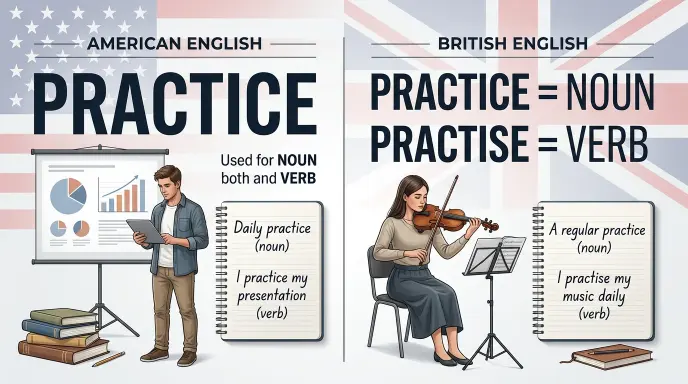
The main difference between practice and practise is their grammatical function in British English. Practice is a noun, while practise is a verb. For example, you might attend football practice, but you practise football skills every day. In American English, however, practice is used for both nouns and verbs, making the distinction easier to understand once you know which spelling convention applies.
In this guide, you will discover the meanings of both words, their grammatical differences, and practical examples that show how to use them correctly. You will also learn the spelling rules followed in American and British English, explore common mistakes, and find simple tips for remembering the difference. Whether you are a student, teacher, professional writer, or English learner, this explanation will help you write with greater accuracy, confidence, and consistency.
Practice or Practise: What’s the Difference?
Although these words look and sound almost identical, their grammatical roles depend on the English variety you use. Understanding that distinction helps you write accurately in school assignments, professional emails, and everyday conversations.
What Does Practice Mean?
Practice is a noun in both American and British English. It refers to repeated activity intended to improve a skill, a customary way of doing something, or the work carried out by a professional.
In American English, however, practice also functions as a verb. It describes the act of rehearsing, training, or repeatedly performing an activity to improve ability.
Examples:
- Noun: Regular practice improves your pronunciation.
- Noun: The medical practice serves hundreds of patients.
- Verb in American English: I practice the piano every evening.
What Does Practise Mean?
Practise is a verb used primarily in British English and other varieties that follow British spelling conventions. It describes performing an activity repeatedly to develop a skill or applying a profession or discipline.
Examples:
- I practise speaking English every morning.
- She practises the violin after school.
- The solicitor practises law in London.
In these sentences, practise describes an action rather than naming an activity.
Comparison Table
| Feature | Practice | Practise |
|---|---|---|
| Part of speech in American English | Noun and verb | Generally not used |
| Part of speech in British English | Noun | Verb |
| Meaning as a noun | Training, habit, professional work | Not applicable |
| Meaning as a verb | Rehearse or train in American English | Rehearse or train in British English |
| Example | I practice daily. | I practise daily. |
| Common spelling system | American English | British English |
Quick recap: Use practice as a noun in both varieties. In American English, use practice as a verb as well. In British English, use practise for the verb. Above all, maintain one spelling convention throughout your document.
Is Practice or Practise a Grammar, Vocabulary, or Usage Issue?
The distinction between practice and practise is primarily a matter of spelling conventions and grammatical function. Although both words communicate similar ideas, the correct choice depends on whether you’re using American or British English.
Are Practice and Practise Interchangeable?
Not entirely. In American English, practice works as both a noun and a verb. In British English, the two spellings serve different grammatical purposes.
Consider these examples:
- American English: He practices football every weekend.
- British English: He practises football every weekend.
- Both varieties: Football practice begins at nine.
Notice that the noun remains practice in both examples, while the verb changes according to the spelling system.
Formal Versus Informal Usage
The distinction applies equally to formal and informal writing. It isn’t a rule that disappears in casual conversation or social media posts.
For example, an American employee might write, “I need to practice my presentation.” Meanwhile, a British colleague would normally write, “I need to practise my presentation.”
Both sentences are correct within their respective conventions.
Academic Versus Casual Writing
Academic writing requires consistency because spelling choices contribute to clarity and editorial accuracy. Consequently, students should follow the spelling guidelines specified by their school, university, or publication.
Likewise, professional writers should follow the style guide used by their organization. Although readers will usually understand either spelling, mixing conventions can make a document appear insufficiently edited.
Which Spelling Should International Writers Choose?
If you’re writing for American readers, use American English conventions. Conversely, if your audience primarily uses British English, choose British spelling.
For international audiences, consistency matters most. Nevertheless, when a publisher specifies a particular variety, follow that requirement rather than switching between forms.
How to Use Practice Correctly
Practice has two grammatical roles in American English and one primary role in British English. Therefore, identifying the function of the word helps you select the appropriate spelling.
Workplace Example
In a workplace, practice can refer to preparation, a repeated activity, or a professional establishment.
Examples:
- Our team needs more practice before the presentation.
- I practice my interview answers every evening.
- The dental practice opens at eight in the morning.
The first and third examples use practice as a noun. In the second sentence, it functions as an American English verb.
In British English, the second example would use practise instead.
Academic Example
Students frequently encounter this word when discussing learning, revision, and skill development.
Examples:
- Daily practice helps students improve their writing.
- American students practice mathematical problems before examinations.
- British students practise mathematical problems before examinations.
The spelling of the noun remains unchanged. However, the verb follows the convention associated with the writer’s variety of English.
Technology Example
Digital platforms often include practice exercises, typing lessons, language activities, and musical training tools.
Examples:
- The application offers pronunciation practice.
- American users can practice vocabulary with interactive exercises.
- British users can practise vocabulary with interactive exercises.
In the first sentence, practice names an activity. In the remaining examples, it describes an action.
Practice Usage Recap
Use practice when naming an activity, training session, habit, or professional establishment. Additionally, use it as a verb when writing American English. For British English verbs, choose practise instead.
How to Use Practise Correctly
Practise is the standard British English verb spelling. It communicates the action of rehearsing, training, or carrying out a professional activity.
Workplace Example
British professionals may use practise when discussing preparation or the application of specialist skills.
Examples:
- I practise my presentation before every meeting.
- The accountant practises professionally in Manchester.
- Our employees practise emergency procedures twice a year.
In each example, practise describes an action. Therefore, it functions as a verb.
Academic Example
Students and teachers use practise when referring to repeated activities intended to improve performance.
Examples:
- She practises spelling words every afternoon.
- They practise solving algebra problems before examinations.
- He practises reading aloud to improve fluency.
In these sentences, the word explains what someone does rather than naming the activity itself.
Technology Example
Educational websites and mobile applications frequently encourage learners to repeat exercises.
Examples:
- Practise your pronunciation with the speaking exercise.
- The student practises typing using an online lesson.
- Users can practise vocabulary through digital flashcards.
The spelling remains practise when the sentence follows British English conventions.
Practise Usage Recap
Use practise as a verb when writing British English. In particular, remember that its spelling doesn’t change when the subject changes: I practise, you practise, and she practises. By contrast, the noun remains practice.
When You Should NOT Use Practice or Practise
Several common situations make the distinction easier to understand. However, confusion can persist when writers overlook grammatical function or switch between regional conventions.
Using Practise as a Noun
Incorrect: I need more practise before the examination.
Correct: I need more practice before the examination.
Even in British English, practice is the noun. Therefore, practise cannot replace it in this sentence.
Using Practise in Standard American English
Incorrect for standard American English: She practises every morning.
Correct: She practices every morning.
American English uses practice as both the noun and verb. Consequently, practise is generally inappropriate in American English prose.
Using Practice as a British English Verb
Incorrect in standard British English: He practice football every weekend.
Correct: He practises football every weekend.
The correct form also reflects subject agreement. With he, she, or it in the present simple, the verb takes an s ending.
Mixing American and British Spellings
Inconsistent: I practice daily, but my sister practises weekly.
Consistent American version: I practice daily, but my sister practices weekly.
Consistent British version: I practise daily, but my sister practises weekly.
Although the mixed sentence remains understandable, consistent spelling creates a more polished document.
Confusing Practice With Professional Registration
The verb practise can describe working in a profession, but it doesn’t automatically mean that someone has the required licence or legal authorization.
For example, “She practises medicine” describes professional activity. Whether she is properly licensed depends on separate facts and regulations.
Treating Practice as an Adjective
In expressions such as practice test or practice session, practice acts as a noun modifying another noun. It doesn’t need to become practise simply because another word follows it.
Correct: We completed a practice test.
Incorrect: We completed a practise test.
Assuming Pronunciation Solves the Problem
Both words are generally pronounced identically. Therefore, listening to a sentence won’t reliably tell you which spelling is correct.
Instead, identify the grammatical role and determine which English convention applies.
Changing the Spelling Without Checking the Audience
A British publication may expect practise as a verb, while an American publication generally expects practice. Before editing a document, establish its intended audience and follow the appropriate spelling convention.
Common Mistakes With Practice or Practise
The following table highlights frequent errors and explains how to correct them.
| Correct sentence | Incorrect sentence | Explanation |
|---|---|---|
| I need more practice. | I need more practise. | Practice is the noun in both varieties. |
| I practice daily. (US) | I practise daily. (US) | American English uses practice as the verb. |
| I practise daily. (UK) | I practice daily. (UK) | British English uses practise as the verb. |
| She practices piano every day. (US) | She practise piano every day. (US) | The present tense requires practices with she. |
| He practises speaking clearly. (UK) | He practise speaking clearly. (UK) | The present tense requires practises with he. |
| The practice opens at nine. | The practise opens at nine. | A professional establishment is a practice. |
| We attended a practice session. | We attended a practise session. | Practice identifies the type of session. |
Decision Rule
If you mean an activity, training session, habit, or professional establishment, use practice.
If you mean the action of rehearsing or training in British English, use practise.
If you’re writing American English, use practice for both the noun and the verb.
This simple distinction handles most everyday situations. Nevertheless, remember to check subject agreement, such as practices or practises with he, she, and it.
Practice and Practise in Modern Technology and Digital Tools
Modern technology has made the distinction particularly visible in educational applications, online courses, and writing software. For example, an American language learning platform might display “Practice your English,” whereas a British platform might display “Practise your English.”
Both instructions are correct because the verb spelling follows the platform’s chosen variety of English.
Similarly, a digital product may offer “speaking practice,” “typing practice,” or “grammar practice.” In each phrase, practice functions as a noun and retains the same spelling in both varieties.
Although spelling checkers can identify some regional inconsistencies, their suggestions depend on the language settings and dictionaries they use. Therefore, writers should confirm that their document is set to the intended variety of English rather than accepting every automated correction.
Ultimately, understanding the grammatical function remains more reliable than memorizing isolated examples.
The Etymology of Practice and Practise
The distinction has historical roots in English spelling conventions. Both words ultimately derive from forms of the Greek word praktikos, associated with action and practical activity, through Latin and French influences.
Over time, English developed different spelling conventions for the noun and verb in British usage. The spelling distinction became established in modern British English, where practice names an activity and practise describes performing it.
American English generally standardized practice for both grammatical functions.
Consequently, the difference reflects a regional spelling convention rather than a difference in the underlying action or concept.
An Expert Rule for Remembering Practice or Practise
A useful editorial principle is:
“Choose the spelling by grammatical function first, then confirm that it matches your intended variety of English.”
This rule captures the two essential decisions. First, determine whether the word names an activity or expresses an action. Next, establish whether you’re following American or British spelling conventions.
For example, a British writer would use practice in “Regular practice builds confidence” but practise in “She practises every day.” Meanwhile, an American writer would use practice in both sentences, changing the verb to practices when the subject is she.
The result is a straightforward method that works across academic, professional, and everyday writing.
Two Practical Case Studies
The following illustrative case studies demonstrate how the distinction works in realistic editing situations. Their outcomes are examples of applying the rule, not claims about measured research results.
Case Study One: A Student Preparing an Assignment
A university student in the United Kingdom writes the following sentence:
“I practice my academic writing every evening.”
The meaning is clear, but the verb spelling doesn’t match standard British English.
The corrected sentence is:
“I practise my academic writing every evening.”
The student then writes, “Regular practise improves confidence.” Because the word now names an activity, the correct sentence becomes “Regular practice improves confidence.”
Result: Two spelling decisions are corrected by identifying the grammatical role of each word.
Case Study Two: A Business Updating Its Website
An American company publishes a page containing these sentences:
“Our team practises customer service techniques. Each practice session includes role playing.”
The first sentence uses the British verb spelling, while the second correctly uses the American noun spelling.
For a consistent American English version, the company changes the first sentence to:
“Our team practices customer service techniques.”
The second sentence remains unchanged because practice is the noun.
Result: The revised copy follows one spelling convention without changing the intended message.
Error Prevention Checklist
Before publishing an article, submitting an assignment, or sending a professional email, review these points.
Always Use Practice When
- The word names an activity, exercise, habit, or training session.
- You refer to a medical, legal, dental, or other professional practice.
- You’re writing American English and need a verb.
- You describe a practice test, practice exercise, or practice session.
Never Use Practise When
- You need the noun in British English.
- You’re writing standard American English and want to use the verb.
- The sentence requires the noun practice before another noun.
- You’re changing spelling without checking the intended regional convention.
Final Proofreading Steps
- Identify the word’s grammatical role.
- Determine whether the document follows American or British English.
- Check verb agreement, especially with he, she, and it.
- Search for inconsistent spellings throughout the document.
- Read the sentence again to confirm that the intended meaning remains clear.
By following these steps, you can avoid the most common errors without memorizing every possible example.
Related Grammar Confusions You Should Master
Once you understand practice and practise, several other spelling and usage distinctions become easier to learn.
- Advice or Advise: Advice is a noun, while advise is a verb.
- Licence or License: British English distinguishes the noun licence from the verb license. American English generally uses license for both.
- Device or Devise: Device names an object, whereas devise means to create or plan something.
- Affect or Effect: Affect is usually a verb, while effect is commonly a noun.
- Principal or Principle: Principal can describe a leader or something important; principle means a rule or belief.
- Compliment or Complement: A compliment expresses praise, while a complement completes or enhances something.
- Stationary or Stationery: Stationary means not moving, whereas stationery refers to writing materials.
- Your or You’re: Your indicates possession, while you’re means you are.
- Its or It’s: Its indicates possession, while it’s means it is or it has.
- Then or Than: Then relates to time or sequence, whereas than introduces comparisons.
Learning these distinctions helps writers improve accuracy across emails, essays, articles, and workplace documents.
Frequently Asked Questions
1. Is practice or practise correct in English?
Both spellings are correct, but their grammatical roles differ by regional convention. Practice is a noun in both American and British English. In American English, it is also a verb, while British English uses practise as the verb.
2. Should I use practice or practise in American English?
Use practice for both the noun and the verb. For example, “I need more practice” and “I practice every day” are both correct in American English.
3. Should I use practice or practise in British English?
Use practice when naming an activity or professional establishment. However, use practise when describing an action, such as rehearsing a presentation or improving a skill.
4. Is practice a noun or a verb?
Practice can function as either a noun or a verb in American English. In British English, it is primarily a noun. The British verb form is practise.
5. Why do British people spell practise differently?
British English traditionally distinguishes the noun from the verb through spelling. This convention helps identify grammatical function in writing, although both forms have the same general pronunciation.
6. Is it practice makes perfect or practise makes perfect?
The standard expression is “Practice makes perfect” in both American and British English. Here, practice is a noun referring to repeated effort that helps improve performance.
7. Is it medical practice or medical practise?
The correct expression is medical practice in both varieties of English. The word names a professional activity or establishment, so it functions as a noun.
8. Is it practice test or practise test?
The standard expression is practice test. The word practice identifies the type of test and functions as a noun modifying another noun.
9. How do you remember the difference between practice and practise?
Remember that practice is always the noun in standard British English, while practise is its verb form. In American English, practice performs both roles. When in doubt, identify the grammatical function and check the intended regional convention.
Conclusion:
The difference between practice and practise becomes simple once you understand the conventions of American and British English. Both varieties use practice as a noun, including expressions such as practice test, regular practice, and medical practice.
However, American English uses practice as a verb, while British English uses practise for the same action. Therefore, the correct spelling depends on your audience and the grammatical role of the word.
Before finalizing your writing, check the sentence, choose the appropriate regional convention, and remain consistent throughout the document. With this straightforward rule, you’ll be able to distinguish the two forms confidently in academic assignments, professional communication, and everyday English.