Have you ever wondered whether the correct spelling is expresso or espresso? You may have seen both versions on café menus, coffee websites, or social media, making it difficult to know which one to use. Although the words look almost identical, one spelling is the standard choice in English. Understanding this small difference can help you write more confidently and avoid common spelling mistakes.
Espresso is the standard English spelling for a concentrated coffee prepared by forcing hot water through finely ground coffee under pressure. The word comes from Italian, and its spelling is widely used in coffee shops, recipes, and professional writing. Although expresso is often treated as a misspelling, some dictionaries recognize it as a variant, so the distinction is more nuanced than many people realize.
In this guide, you will learn the meaning of both spellings, why people confuse them, and how to use the correct word in everyday conversations and formal writing. You will also discover simple examples, pronunciation tips, and an easy memory trick to help you remember the standard spelling. Whether you are a student, blogger, coffee enthusiast, or English learner, this practical comparison will help you make the right choice with confidence.
Main Query and Search Intent
The main query is “expresso or espresso,” a common spelling and vocabulary question. Readers want to understand which word is correct, why the confusion exists, and whether both spellings can be used interchangeably.
The distinction matters because incorrect spelling can appear on restaurant menus, professional documents, product descriptions, and coffee related assignments. Fortunately, the difference is easy to remember once you understand the word’s origin and everyday usage.
Expresso vs Espresso: What’s the Difference?
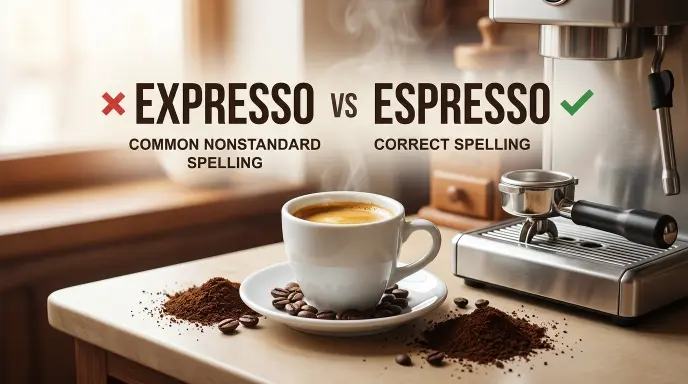
Although expresso and espresso sound similar in everyday conversation, they don’t have the same standing in standard English. Espresso is the accepted spelling of the coffee beverage, whereas expresso is a common misspelling or nonstandard variant when referring to that drink.
| Feature | Espresso | Expresso |
|---|---|---|
| Part of speech | Noun | Noun when used for coffee |
| Standard spelling | Correct | Nonstandard |
| Meaning | A concentrated coffee beverage | Usually an attempted spelling of espresso |
| Pronunciation | Commonly /eˈspres.oʊ/ in American English | Often pronounced similarly |
| Formal writing | Recommended | Generally avoided |
| Café menus | Appropriate | Not recommended |
| Academic writing | Preferred | Usually marked as incorrect |
| Everyday conversation | Standard | Sometimes heard |
What Does Espresso Mean?
Espresso is a concentrated coffee beverage made by forcing pressurized hot water through finely ground coffee. It typically has a rich flavor, a relatively small serving size, and a layer of foam called crema.
For example:
“I ordered a double espresso before starting work.”
Here, espresso functions as a noun because it names a beverage.
What Does Expresso Mean?
Expresso is commonly used by speakers who pronounce or spell espresso with an additional “x” sound. However, it is not the recommended spelling in standard English when referring to the coffee drink.
For instance, writing “I would like an expresso” on a formal menu would generally be considered a spelling error.
Nevertheless, the spelling may appear in proper names, brand names, or specialized contexts. Such cases should be evaluated individually rather than automatically treated as references to the standard coffee term.
Quick Recap
Espresso is the correct standard spelling for the coffee beverage.
Expresso is a common nonstandard variant in this context.
Both forms may sound similar in casual speech.
For professional writing, menus, and educational content, choose espresso.
Is Expresso vs Espresso a Grammar, Vocabulary, or Usage Issue?
The difference between expresso and espresso is primarily a spelling and vocabulary usage issue, rather than a grammatical distinction.
Grammar concerns how words function together in sentences. Spelling concerns how individual words are written. In this example, the central problem is choosing the accepted written form.
Are Espresso and Expresso Interchangeable?
In standard English, the two spellings should not be treated as equally acceptable alternatives for the beverage.
For example:
Correct: “She ordered an espresso after lunch.”
Nonstandard: “She ordered an expresso after lunch.”
Both sentences communicate the intended meaning. However, the first follows conventional spelling, making it suitable for formal and informal writing.
Formal Versus Informal Usage
In casual conversation, listeners will usually understand what someone means when they say expresso. Therefore, the pronunciation difference rarely prevents communication.
However, written language follows established conventions. Restaurant owners, editors, teachers, students, and content creators should use espresso to maintain accuracy and professionalism.
Academic Versus Casual Usage
In academic writing, spelling accuracy helps demonstrate attention to detail. Consequently, students should write espresso in essays, research papers, hospitality assignments, and culinary reports.
Meanwhile, casual conversations may include different pronunciations without causing confusion. Even so, recognizing the standard spelling helps learners improve their vocabulary.
How to Use Espresso Correctly
Espresso is the appropriate word whenever you mean the concentrated coffee beverage. Because it is a noun, it commonly appears after articles, adjectives, and verbs that describe ordering, preparing, serving, or drinking coffee.
Workplace Example
Suppose an employee visits the office café before an important meeting.
Correct: “I bought an espresso before presenting the quarterly report.”
In this sentence, espresso identifies the beverage the employee purchased.
Similarly, a café manager might write, “Please prepare two espresso drinks for the visiting clients.”
The word is suitable for professional communication because it follows standard English usage.
Academic Example
Consider a student preparing a hospitality assignment about coffee preparation.
Correct: “Espresso is commonly used as the foundation for cappuccinos and lattes.”
This sentence communicates a factual statement using the accepted spelling. Moreover, the terminology is appropriate for educational and professional culinary writing.
Technology Example
Coffee machines frequently display drink names on their digital interfaces.
Correct: “Select espresso on the machine’s touchscreen to prepare a concentrated coffee.”
Likewise, a mobile coffee ordering application might offer espresso, cappuccino, and latte as separate menu options.
In both situations, the standard spelling helps maintain consistency across interfaces, product descriptions, and customer instructions.
Espresso Usage Recap
Use espresso when naming the beverage.
Place it naturally within sentences as a noun.
Choose this spelling for menus, workplace messages, academic papers, and digital interfaces.
How to Use Expresso Correctly
Because espresso is the accepted spelling for the drink, expresso requires additional care. Although the word appears in everyday speech and some written contexts, it generally should not replace espresso in standard English.
Workplace Example
Incorrect for standard coffee terminology: “The manager ordered three expressos for the team.”
Preferred: “The manager ordered three espressos for the team.”
The plural form of espresso is commonly espressos. Therefore, adding an “x” does not make the beverage’s spelling more accurate.
Academic Example
Incorrect: “Expresso originated as a traditional Italian coffee preparation.”
Correct: “Espresso originated as a traditional Italian coffee preparation.”
The corrected sentence uses the accepted spelling, making it appropriate for a classroom assignment or research paper.
Technology Example
Incorrect: “The application allows customers to customize their expresso.”
Correct: “The application allows customers to customize their espresso.”
However, if Expresso is the official name of a particular product, business, or software tool, its spelling may be intentional. Proper names should retain their established spelling.
Expresso Usage Recap
Avoid expresso when referring to the standard coffee beverage.
Do not use it simply because the pronunciation seems natural.
Check whether the term is a genuine proper name before correcting it.
When You Should NOT Use Expresso or Espresso
Although the difference appears straightforward, several situations can lead to errors. Understanding these examples makes the distinction easier to apply.
1. When Writing a Professional Menu
Do not write expresso when naming the conventional coffee beverage. Instead, use espresso to present a polished and accurate menu.
2. When Preparing an Academic Assignment
Avoid the nonstandard spelling in essays, reports, and research papers. Otherwise, a simple spelling mistake may affect the perceived quality of your work.
3. When Creating Product Descriptions
Coffee equipment manufacturers and retailers should use espresso when describing machines, accessories, and preparation methods.
4. When Writing Customer Instructions
If you’re explaining how to operate a coffee machine, use the standard term so customers can easily recognize the intended drink.
5. When Editing Published Content
Don’t preserve expresso merely because it appears in an original draft. Instead, correct it unless the word is intentionally part of a name or quotation.
6. When Teaching English Vocabulary
Avoid presenting the two spellings as equally standard. Learners benefit from knowing which form is accepted in conventional writing.
7. When Naming Coffee Orders
If you’re writing a café order, use espresso. For example, “One double espresso, please” is the preferred written form.
8. When Assuming Every Similar Sound Means Correct Spelling
Pronunciation can vary across regions and speakers. Therefore, hearing an “x” sound doesn’t establish that the word should be spelled with an x.
Common Mistakes: Expresso or Espresso
The following examples illustrate frequent errors and show how to correct them.
| Correct sentence | Incorrect sentence | Explanation |
|---|---|---|
| I ordered an espresso. | I ordered an expresso. | Espresso is the standard spelling of the drink. |
| She drinks espresso every morning. | She drinks expresso every morning. | The accepted spelling remains espresso. |
| We ordered two espressos. | We ordered two expressos. | The regular plural is espressos. |
| This machine makes espresso. | This machine makes expresso. | Use the standard beverage name. |
| Espresso has a concentrated flavor. | Expresso has a concentrated flavor. | The incorrect form should be replaced. |
| He prepared an espresso for his guest. | He prepared an expresso for his guest. | The sentence needs the conventional spelling. |
Decision Rule
If you mean the coffee beverage, use espresso.
If you see expresso in a coffee related sentence, check whether it should be corrected to espresso.
If the spelling is part of an official brand or proper name, preserve the documented name instead of automatically changing it.
This rule works for most everyday situations, including restaurant menus, educational writing, workplace communication, and digital products.
Expresso and Espresso in Modern Technology and Digital Tools
Digital technology has made coffee ordering easier, but it has also created more places where spelling mistakes can appear. For example, restaurant websites, delivery applications, touchscreen coffee machines, and online product catalogs all display beverage names.
Therefore, consistency matters when publishing coffee related information.
Spell checking tools may identify expresso as a possible error, although suggestions can vary depending on the software’s dictionary and settings. Furthermore, predictive text may occasionally reproduce a nonstandard spelling if it appears frequently in a user’s writing.
Consequently, writers should review important text rather than relying entirely on automatic corrections. For businesses, maintaining a consistent product vocabulary across menus, ordering screens, receipts, and promotional materials also improves clarity.
The Etymology of Espresso and Expresso
The history of espresso helps explain why its spelling differs from expresso.
The word espresso comes from Italian. It is associated with coffee prepared specifically for an individual order and with the Italian verb esprimere, meaning “to express” or “to press out.”
This association fits the preparation method, which uses pressure to force hot water through finely ground coffee.
Meanwhile, expresso appears to be influenced by the familiar English word express. Because express can suggest speed or something provided promptly, speakers may naturally associate the coffee drink with the similar sounding word.
Nevertheless, this association doesn’t change the standard spelling of the beverage. The Italian origin and established culinary usage support espresso as the conventional written form.
An Expert Style Explanation of Expresso vs Espresso
“Accurate spelling begins with recognizing established usage, not simply reproducing the way a word sounds. When a familiar term has a standard written form, using that form improves clarity and consistency.”
This is an editorial principle rather than a quotation attributed to a named expert.
In practical terms, the lesson is simple: pronunciation may vary between speakers, but professional writing should follow accepted spelling conventions. Therefore, espresso remains the preferred form when discussing the beverage.
Two Practical Case Studies
The following hypothetical examples demonstrate how the spelling distinction can matter in everyday work. They illustrate plausible outcomes rather than reporting measured research results.
Case Study 1: A Café Corrects Its Menu
Imagine a neighborhood café that prints a menu containing the phrase “Double Expresso.”
Although customers can probably understand the intended order, the spelling may appear careless to some readers. The owner decides to replace it with “Double Espresso” on the printed menu and digital ordering screen.
As a result, the café establishes consistent spelling across both customer touchpoints. The measurable outcome is that the two menu locations now use the same standard term. Whether this change increases sales would require separate evidence.
Lesson: Correct spelling supports consistency and presents a more professional appearance.
Case Study 2: A Student Revises a Hospitality Report
Consider a student writing a report about popular coffee beverages. The original draft repeatedly uses expresso because that is how the student has heard the word pronounced.
During proofreading, the student checks the spelling and replaces the incorrect form with espresso throughout the report.
The final document uses consistent terminology in its introduction, comparison table, and conclusion. The student has also learned to distinguish spoken pronunciation from conventional spelling.
Lesson: A brief review can correct repeated mistakes and strengthen vocabulary knowledge.
Error Prevention Checklist
Before publishing or submitting a document, use this checklist to confirm that the spelling is appropriate.
Always Use Espresso When
- Naming the standard concentrated coffee beverage.
- Writing restaurant menus or café advertisements.
- Preparing school assignments or academic reports.
- Describing coffee machines and drink preparation.
- Creating digital ordering interfaces.
- Writing product descriptions or professional correspondence.
Never Use Expresso When
- You intend to write the standard name of the coffee beverage.
- You are preparing formal educational content.
- You are proofreading a conventional coffee menu.
- You are describing a drink in a product catalog.
- You are unsure of the accepted spelling and haven’t checked it.
However, don’t automatically alter expresso when it is part of a verified proper name, a direct quotation, or a context where the spelling is deliberately used.
Related Grammar Confusions You Should Master
Learning the difference between espresso and expresso can also encourage better spelling habits. Similarly, these common word pairs illustrate why sound, meaning, and written conventions should be considered separately.
- Affect vs Effect: Understand the difference between an influence and a result.
- Practice vs Practise: Learn the noun and verb distinction in American and British English.
- Advice vs Advise: Distinguish a recommendation from the act of recommending.
- Principal vs Principle: Separate a person or primary item from a fundamental rule.
- Their vs There: Recognize possession and references to places.
- Lose vs Loose: Distinguish failure to retain something from a lack of tightness.
- Accept vs Except: Understand receiving something versus excluding it.
- Complement vs Compliment: Separate something that completes another item from an expression of praise.
- Everyday vs Every Day: Recognize the difference between an adjective and a time expression.
- Definitely vs Definately: Remember the standard spelling of a frequently misspelled adverb.
Consequently, reviewing these distinctions can improve written communication and reduce avoidable errors.
Frequently Asked Questions
1. Is it expresso or espresso?
Espresso is the correct standard spelling for the concentrated coffee beverage. Although expresso is commonly heard or written, it is generally considered nonstandard when referring to coffee.
2. Why do people say expresso instead of espresso?
Some speakers use expresso because its sound resembles the familiar English word express. Additionally, pronunciation habits and repeated exposure can influence how people say or spell unfamiliar words.
3. Is expresso ever a correct word?
Expresso may appear as a proper name, brand name, or intentional spelling in a particular context. Nevertheless, espresso is the accepted spelling for the conventional coffee beverage.
4. How do you spell espresso correctly?
Spell the word E S P R E S S O. Remember that it begins with “es” and does not contain an “x.”
5. Is espresso pronounced expresso?
Some speakers pronounce espresso with a sound resembling “expresso.” However, the standard spelling remains espresso regardless of individual pronunciation habits.
6. What is the plural of espresso?
The usual plural is espressos. For example, “We ordered three espressos after dinner.”
7. Is espresso an Italian word?
Yes. Espresso comes from Italian and is the established name for the concentrated coffee beverage. Its history is associated with expressing or pressing something out.
8. Why is espresso spelled without an x?
The accepted spelling reflects its Italian origin and established usage. The additional x in expresso is not part of the conventional spelling of the beverage.
9. Should I write espresso or expresso on a coffee menu?
Write espresso on a standard coffee menu. This spelling is widely recognized and appropriate for cafés, restaurants, hospitality businesses, and online ordering systems.
Conclusion:
When deciding between expresso or espresso, choose espresso for the standard coffee beverage. Although both forms may sound similar in everyday speech, espresso is the conventional spelling used in professional writing, educational materials, restaurant menus, and product descriptions.
Furthermore, understanding the word’s Italian origin helps explain why the accepted form doesn’t include an x. Expresso may occur in casual usage or as part of a specific name, but it shouldn’t replace espresso in ordinary coffee related writing.
Ultimately, remember one simple rule: when you’re talking about the concentrated coffee drink, spell it espresso. This small correction can make your writing clearer, more consistent, and more professional.