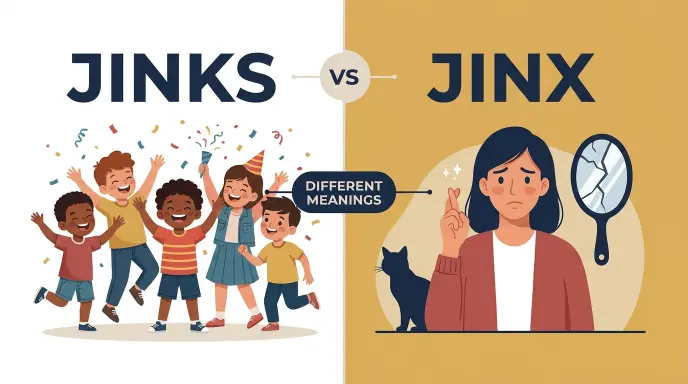
Have you ever wondered whether to write “jinks” or “jinx” when talking about bad luck? These two words sound exactly alike, so it is easy to confuse them in everyday conversations, text messages, social media posts, and written content. However, their meanings and usage are different. Choosing the right spelling helps you communicate clearly and avoid common English mistakes.
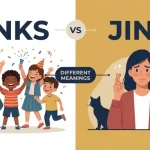
The word jinx refers to bad luck, something believed to cause misfortune, or the act of bringing bad luck to someone or something. For example, “I hope I do not jinx our chances of winning.” In contrast, jinks is commonly used in the expression “high jinks,” which describes playful, lively, or mischievous behavior. Dictionaries such as Oxford Learner’s Dictionaries and Collins English Dictionary recognize this distinct use of jinks.
Understanding the difference between jinks and jinx is useful for students, bloggers, English learners, and anyone who wants to improve their spelling and vocabulary. In this guide, we will explain both words with simple definitions, practical examples, and common mistakes to avoid. You will also learn which spelling to choose in everyday and professional writing. By the end, you will have a simple rule to remember: use “jinx” for bad luck and “jinks” in expressions such as “high jinks.”
Jinks vs Jinx: What’s the Difference?
The difference between jinks and jinx depends on meaning, context, and grammatical function. Although both are valid English words, they aren’t interchangeable in ordinary sentences.
What Does Jinx Mean?
Jinx is a noun or verb that refers to bad luck, a person or thing believed to cause misfortune, or the act of bringing bad luck to someone.
For example, when someone says, “Don’t jinx it,” they mean that talking too confidently about a positive outcome might somehow cause it to fail.
The word also appears in popular expressions, sports conversations, games, and casual discussions. For instance, friends might jokingly accuse someone of being a jinx when something goes wrong after that person makes an optimistic prediction.
Examples:
- “I hope I don’t jinx our chances of winning.”
- “That old superstition says the broken mirror is a jinx.”
- “She believes her bad luck has been jinxed away.”
The first two examples demonstrate common noun and verb usage. However, the third sentence is less natural in everyday English. A clearer version would be, “She believes the bad luck has finally ended.”
What Does Jinks Mean?
Jinks is a legitimate English word, although it’s much less common than jinx. It can refer to playful or mischievous activity, particularly in the expression “high jinks,” which describes lively, sometimes noisy or unruly behavior.
For example, a group of friends might engage in high jinks during a weekend celebration. In this expression, jinks refers to playful antics rather than bad luck.
The word can also appear as a verb form of jink, which means to make a quick, evasive movement, particularly to avoid an obstacle or opponent.
Examples:
- “The children were up to their usual high jinks.”
- “The footballer jinks past a defender.”
- “The pilot jinks sharply to avoid the approaching object.”
Therefore, the meaning of jinks depends on the sentence. It isn’t simply an alternative spelling of jinx.
Comparison Table
| Feature | Jinx | Jinks |
|---|---|---|
| Part of speech | Noun and verb | Noun in a fixed expression; verb form of jink |
| Main meaning | Bad luck or causing bad luck | Playful antics or evasive movement |
| Common expression | Don’t jinx it | High jinks |
| Everyday frequency | Common | Less common |
| Suitable for describing a curse | Yes | No |
| Suitable for describing mischief | Not usually | Yes, especially in high jinks |
Quick recap: Use jinx when discussing bad luck or the act of bringing misfortune. Conversely, use jinks when describing playful antics or movements associated with the verb jink. Although the words look similar, their meanings are different.
Is Jinks vs Jinx a Grammar, Vocabulary, or Usage Issue?
The confusion between jinks and jinx is primarily a vocabulary and spelling issue. However, understanding their grammatical functions also helps you choose the correct form.
Are Jinks and Jinx Interchangeable?
No. Although both words are recognized in English, they serve different purposes.
For example, “Don’t jinx the game” is a natural sentence because jinx describes the act of supposedly bringing bad luck.
By contrast, “Don’t jinks the game” is incorrect in this context because jinks doesn’t carry the intended meaning.
Similarly, “The party was full of high jinks” is correct, whereas replacing jinks with jinx would change the meaning and make the expression unnatural.
Formal vs Informal Usage
In everyday conversation, jinx commonly appears in humorous expressions and superstitious remarks. People might say it after someone predicts a successful result or accidentally mentions something they hope won’t go wrong.
Meanwhile, high jinks can describe mischievous behavior in both informal conversation and narrative writing. Nevertheless, it may sound playful or slightly old fashioned in contemporary professional communication.
In formal writing, choose precise language according to the intended meaning. For example, misfortune, superstition, or mischievous behavior may be more appropriate when the audience needs a literal explanation.
Academic vs Casual Usage
In academic writing, avoid treating jinx as evidence that an event caused another event. Instead, explain the concept as a superstition or cultural belief.
For example:
“The participants believed that mentioning a successful outcome might jinx their performance.”
This sentence describes a belief without presenting supernatural causation as an established fact.
In casual conversation, however, “Don’t jinx it!” is perfectly natural.
Ultimately, grammar determines how a word functions in a sentence, while vocabulary knowledge helps you select the correct word in the first place.
How to Use Jinx Correctly
Because jinx is the more common word, understanding its everyday applications is particularly useful.
Workplace Example
Imagine that a sales team is close to achieving its monthly target. One employee says, “We’ve definitely secured the biggest contract of the year.”
Another colleague responds, “Don’t jinx it until the client signs.”
Here, jinx is a verb referring to the supposed act of bringing bad luck by making an overly confident statement.
In a professional report, however, a more precise sentence might be:
“The team avoided declaring success until the agreement was finalized.”
This version communicates the same practical caution without relying on superstition.
Academic Example
A student preparing for an examination might say, “I don’t want to jinx my chances by celebrating before the results arrive.”
The word functions naturally as a verb because it describes the perceived act of inviting misfortune.
For formal academic work, a researcher could instead write:
“Some students believe that expressing excessive confidence before an examination may bring bad luck.”
Consequently, the best choice depends on whether the writer wants a conversational tone or an objective explanation.
Technology Example
In gaming communities, people frequently use jinx when discussing a winning streak.
For instance, a player might say, “Don’t jinx our winning streak by predicting another victory.”
Likewise, someone discussing a software release could joke, “I hope this announcement doesn’t jinx the launch.”
In these cases, the term adds humor rather than describing a measurable technical process.
Usage recap: Use jinx as a noun when referring to supposed bad luck and as a verb when describing the act of supposedly bringing it about. In formal communication, consider replacing it with more precise wording when necessary.
How to Use Jinks Correctly
Although jinks is less common, it remains useful in particular expressions and contexts.
Workplace Example
Suppose colleagues organize an office celebration after completing a major project. Someone might describe the evening as “an event filled with high jinks.”
The phrase suggests lively, playful, or mischievous behavior. Depending on the context, it might refer to harmless jokes, energetic celebrations, or amusing antics.
Nevertheless, the phrase wouldn’t be suitable for every professional situation. For example, a formal performance review would normally use wording such as unprofessional conduct or playful behavior, depending on what actually happened.
Academic Example
In literature, a writer might use high jinks to describe the mischievous activities of fictional characters.
For example:
“The novel’s early chapters are filled with high jinks as the young characters explore the abandoned estate.”
Here, the expression helps establish a playful tone and suggests that the characters are behaving in lively or mischievous ways.
However, an academic essay analyzing serious misconduct would require a more exact description.
Technology Example
The verb jinks can describe a sudden evasive movement in a game or simulation.
For instance:
“The virtual aircraft jinks to the left to avoid the incoming projectile.”
In this sentence, jinks is the third person singular present tense of jink. It doesn’t refer to bad luck.
Similarly, a sports commentator might describe an athlete who quickly changes direction to evade an opponent.
Usage recap: Use jinks when the context supports playful antics or the verb jink. For bad luck, a curse, or the expression “Don’t jinx it,” choose jinx instead.
When You Should NOT Use Jinks or Jinx
Choosing the wrong spelling can change your intended meaning. Therefore, check the context before deciding which word belongs in your sentence.
When Discussing Bad Luck
Don’t write “I hope I don’t jinks the match” when you mean that you might bring bad luck.
Correct: “I hope I don’t jinx the match.”
The intended meaning determines the spelling.
When Describing Playful Antics
Don’t automatically use jinx when describing lively mischief.
Incorrect: “The children were enjoying their usual high jinx.”
Correct: “The children were enjoying their usual high jinks.”
The established expression uses jinks.
When Writing Formal Reports
Avoid using jinx as a literal explanation for a failed project.
Instead of writing, “A jinx caused the launch to fail,” explain the actual problem, such as a software defect, delayed approval, or equipment failure.
When Describing an Evasive Movement
Don’t use jinx when you mean a sudden movement described by the verb jink.
Correct: “The player jinks around the defender.”
The word describes movement rather than misfortune.
When Writing Academic Definitions
Avoid defining jinks as another spelling of jinx. Such a definition ignores the distinction between the two words.
Instead, explain their separate meanings and provide examples.
When Editing Automated Spelling Suggestions
Don’t accept every suggested correction without checking the sentence. A spellchecker might recognize both words while failing to understand which meaning you intended.
For example, both jinx and jinks can be legitimate spellings, depending on context.
When Using the Expression “Don’t Jinx It”
Don’t replace jinx with jinks in this familiar expression.
Correct: “Don’t jinx it!”
The expression is established in everyday English.
When Describing Mischievous Behavior in Precise Language
Don’t assume that high jinks always conveys the seriousness of an incident. If the behavior involved damage, harassment, or safety violations, describe those actions directly.
In short, context matters more than superficial spelling similarity.
Common Jinks vs Jinx Mistakes
The following examples demonstrate common errors and explain how to correct them.
| Correct sentence | Incorrect sentence | Explanation |
|---|---|---|
| Don’t jinx our chances. | Don’t jinks our chances. | Jinx is the verb meaning to supposedly bring bad luck. |
| The children were up to high jinks. | The children were up to high jinx. | The conventional expression is high jinks. |
| She thinks the losing streak is a jinx. | She thinks the losing streak is a jinks. | The singular noun for supposed bad luck is jinx. |
| The player jinks past the defender. | The player jinx past the defender. | Here, jinks is a form of the verb jink, describing movement. |
| I hope I don’t jinx the result. | I hope I don’t jinks the result. | The verb following don’t takes its base form, jinx. |
| Their evening was full of high jinks. | Their evening was full of high jinx. | The standard phrase uses jinks to mean lively antics. |
Notice that the correct choice depends on both meaning and grammar. In particular, the verb after don’t must remain in its base form.
Decision Rule Box
If you mean bad luck or the act of supposedly causing it, use jinx.
If you mean playful antics in the expression “high jinks,” or a sudden evasive movement described by jink, use jinks when grammatically appropriate.
This distinction will resolve most everyday spelling questions involving these words.
Jinks and Jinx in Modern Technology
Digital communication has made expressions such as “Don’t jinx it” especially visible in gaming chats, social media posts, livestreams, and group messages.
For example, a player who is close to winning might ask teammates not to jinx the match. Likewise, a sports fan might use the word after predicting a championship victory.
Meanwhile, high jinks may appear in online storytelling, entertainment reviews, and gaming discussions about humorous or mischievous behavior.
Modern writing assistants and spelling checkers can identify many spelling errors. However, because both words are legitimate English forms, automatic correction may not always select the intended word.
Therefore, read the entire sentence before accepting a suggestion. The intended meaning, rather than the spelling alone, determines which word fits.
Etymology: Where Do Jinks and Jinx Come From?
The history of these words helps explain why their spellings resemble each other.
The word jinx entered English in the nineteenth century and became associated with bad luck, curses, and people or things believed to cause misfortune. Its precise historical development is uncertain, although it is often connected with the name jynx, used for the wryneck bird in classical references to magical practices.
By contrast, jink is associated with quick, evasive movements. Its form jinks can therefore describe someone or something making such movements.
The expression high jinks developed as a term for lively, mischievous, or boisterous activity.
Although the spellings overlap, the words have distinct histories and meanings. Their similarity doesn’t make them interchangeable.
An Expert Style Explanation
“Accurate word choice begins with meaning, not appearance. When two words look similar, examine the sentence’s intended message, grammatical structure, and established expressions before selecting a spelling.”
This principle applies to many English word pairs. In practice, learning a word through meaningful examples is often more reliable than memorizing its spelling in isolation.
For jinx and jinks, the most useful habit is to associate jinx with bad luck and high jinks with playful antics.
Two Practical Case Studies: Choosing Jinks or Jinx
The following hypothetical examples show how the distinction works in everyday writing.
Case Study One: A Sports Team’s Winning Streak
A sports blogger writes the sentence:
“Our team has won five games in a row, but I don’t want to jinks their chances of winning the next match.”
The sentence contains a word choice error. The intended meaning concerns supposedly bringing bad luck, so jinx is the appropriate verb.
Corrected version:
“Our team has won five games in a row, but I don’t want to jinx their chances of winning the next match.”
The correction improves grammatical accuracy and makes the sentence sound natural to English readers.
Practical result: The blogger communicates the intended superstition without distracting readers with an incorrect spelling.
Case Study Two: A School Newsletter
A school newsletter describes a celebration:
“The students enjoyed plenty of high jinx during the end of term party.”
Although the intended meaning is clear, the conventional expression is high jinks.
Corrected version:
“The students enjoyed plenty of high jinks during the end of term party.”
Depending on the school’s style guide, the writer could also use playful activities for a more neutral tone.
Practical result: The corrected expression preserves the playful meaning while improving the newsletter’s language accuracy.
These examples demonstrate how context can resolve spelling uncertainty without requiring complicated grammatical analysis.
Error Prevention Checklist
Before publishing a sentence containing either word, use this checklist.
Always Use Jinx When
- You mean bad luck or a supposed curse.
- You want to say, “Don’t jinx it.”
- You are describing the act of supposedly bringing misfortune.
- You are using jinx as a noun for a person or thing believed to cause bad luck.
Never Use Jinks When
- You mean bad luck in the familiar expression “Don’t jinx it.”
- You intend to describe a curse or a supposed cause of misfortune.
- You are replacing jinx merely because jinks looks similar.
However, don’t assume that jinks is always incorrect. Use it in the established expression high jinks or when the grammar calls for the verb form of jink.
For an additional accuracy check, read the sentence aloud and ask whether the selected word conveys the meaning you intended.
Related Grammar Confusions You Should Master
Understanding similar word pairs can improve spelling, vocabulary, and confidence in everyday English. The following distinctions are particularly useful.
1. Affect vs Effect: Affect is usually a verb meaning to influence, whereas effect is usually a noun meaning a result.
2. Their vs There: Their indicates possession, while there refers to a place or introduces certain expressions.
3. Your vs You’re: Your indicates ownership, whereas you’re means you are.
4. Its vs It’s: Its indicates possession, while it’s is a contraction of it is or it has.
5. Then vs Than: Then relates to time or sequence, whereas than is used in comparisons.
6. Lose vs Loose: Lose means to misplace something or fail to win, while loose means not tight.
7. Compliment vs Complement: A compliment is praise, while a complement completes or enhances something.
8. Principal vs Principle: Principal can mean a head or something most important, while principle means a rule or belief.
9. Advice vs Advise: Advice is a noun referring to a recommendation, whereas advise is the verb meaning to recommend.
10. Jinx vs Jinks: Jinx relates to bad luck, whereas jinks appears in expressions about mischief or as a verb form of jink.
By studying these distinctions in context, you can build a stronger vocabulary and avoid recurring mistakes.
Frequently Asked Questions
Is Jinks or Jinx the Correct Spelling?
Both spellings are correct English words, but they have different meanings. Use jinx for bad luck or supposedly causing misfortune. Use jinks in expressions such as high jinks or as the verb form of jink.
What Does Jinx Mean in Simple English?
A jinx is a person, thing, or situation believed to bring bad luck. As a verb, to jinx means to supposedly bring misfortune to someone or something.
What Does Jinks Mean in English?
Jinks commonly appears in high jinks, meaning lively, playful, or mischievous activity. It can also be the third person singular present form of jink, a verb describing a quick evasive movement.
Is Jinks a Real Word?
Yes. Jinks is a recognized English word. It appears in the expression high jinks and in sentences where it functions as a form of the verb jink.
Why Do People Say “Don’t Jinx It”?
People say “Don’t jinx it” when they worry that speaking too confidently about a positive outcome might bring bad luck. The expression is generally humorous or superstitious rather than a statement of proven cause and effect.
Is It High Jinks or High Jinx?
The standard expression is high jinks. It describes lively antics, mischief, or boisterous behavior. Writing high jinx is generally considered incorrect when you intend to use this established expression.
Can Jinx Be Used as a Verb?
Yes. Jinx functions as both a noun and a verb. For example, “That prediction might jinx our chances” uses it as a verb, while “He believes he has a jinx” uses it as a noun.
How Do You Use Jinks in a Sentence?
You can write, “The children were up to high jinks at the party.” Alternatively, “The player jinks past the defender” uses jinks as a verb describing a quick evasive movement.
Is Jinx a Formal or Informal Word?
Jinx is used mainly in everyday and informal communication, although it can appear in literature, journalism, and discussions of superstition. In formal analytical writing, terms such as misfortune or superstitious belief may be more precise.
Conclusion:
The difference between jinks or jinx becomes straightforward once you understand their meanings. Use jinx when referring to bad luck, a supposed curse, or the act of supposedly bringing misfortune. Conversely, choose jinks when discussing lively antics in the expression high jinks or when describing a quick evasive movement using the verb jink.
Ultimately, neither spelling is universally wrong. The correct choice depends on context, grammatical function, and intended meaning. By remembering these distinctions and checking your sentence before publishing it, you can communicate clearly and avoid a common English vocabulary mistake.