Florence, Italy, is famous for its Renaissance architecture, historic streets, beautiful gardens, and unforgettable views. But before planning your trip, understanding the weather in Florence can make a big difference to your experience. Whether you want to explore the Uffizi Gallery, walk across the Ponte Vecchio, or enjoy an outdoor café, the weather can influence what you do and what you pack. Knowing what conditions to expect helps you plan your days with greater confidence.
The weather Florence experiences changes throughout the year. Spring and early autumn often bring comfortable temperatures for sightseeing, while July and August can become very hot. Winter is generally cooler, and rainfall becomes more important to consider during autumn and certain spring months. Florence’s inland valley location also contributes to its hot summers and cooler winter conditions.
In this guide, you will discover Florence’s weather month by month, average temperatures, rainfall patterns, seasonal clothing recommendations, and the best time to visit. The information is designed to help travelers compare seasons and prepare for different conditions without relying on assumptions about the forecast. Since average climate conditions cannot predict the weather on a specific day, check an up-to-date local forecast before departure. With the right preparation, you can make the most of Florence in every season.
Weather Florence OR: What Does the Search Phrase Mean?
The search phrase combines three elements that work together to identify a particular forecast.
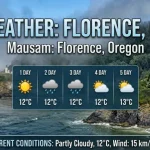
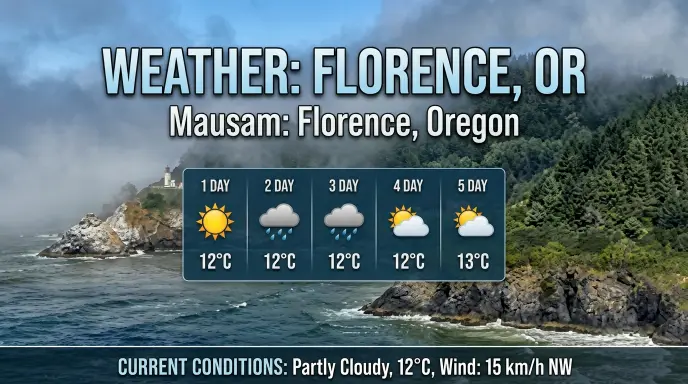
First, weather refers to current atmospheric conditions, including temperature, rain, wind, humidity, and cloud cover. Next, Florence identifies the city being searched. Finally, OR is the official postal abbreviation for Oregon.
Consequently, someone entering this phrase usually wants to know whether Florence, Oregon, is sunny, rainy, windy, cloudy, or comfortable enough for outdoor activities.
However, the phrase isn’t a complete grammatical sentence. Instead, it’s a shortened search query that removes unnecessary words while preserving the user’s intention.
For example, the full question might be, “What is the weather like in Florence, Oregon, today?” Nevertheless, search engines can understand the shorter version because the location and subject are clear.
This distinction matters when planning coastal trips, checking road conditions, selecting clothing, or deciding whether a beach visit is worthwhile.
Weather Florence OR vs. Other Weather Searches: What’s the Difference?
Although several weather searches may look similar, each can communicate a slightly different intention. Understanding these differences helps people choose more precise search terms.
| Search phrase | Meaning | Best use |
|---|---|---|
| Weather Florence OR | Weather in Florence, Oregon | Finding a local forecast |
| Florence Oregon forecast | Expected future conditions in Florence | Planning upcoming activities |
| Florence OR hourly weather | Conditions at different hours | Choosing the best time to go out |
| Florence Oregon 10 day forecast | Predicted conditions over ten days | Planning a longer trip |
| Florence Oregon weather today | Current day conditions | Deciding what to wear |
| Florence Italy weather | Weather in Florence, Italy | Planning a European trip |
| Florence OR climate | Typical weather patterns over time | Understanding seasonal conditions |
The main difference is the level of detail. While a general weather search identifies a location, an hourly forecast focuses on short term changes. Similarly, a climate search explores long term patterns rather than today’s conditions.
Quick recap:
Weather Florence OR normally means a forecast for Florence, Oregon.
An hourly search helps with immediate scheduling.
A long range forecast supports broader travel planning.
A climate search explains typical seasonal conditions.
Is Weather Florence OR a Grammar, Vocabulary, or Usage Issue?
The phrase is primarily a matter of search usage rather than a grammar problem. In ordinary writing, people generally use a complete sentence, whereas search queries often omit articles, prepositions, and auxiliary verbs.
For instance, a person might write, “Please check the weather in Florence, Oregon, before we leave.” By contrast, typing “weather Florence OR” into a search engine communicates the same basic request more quickly.
Is the phrase grammatically correct?
Strictly speaking, the phrase is a fragment rather than a complete sentence. Nevertheless, that doesn’t make it incorrect for a search box, weather application, or navigation tool.
Search phrases are designed to communicate meaning efficiently. Therefore, their structure often differs from standard written English.
Is it formal or informal?
In a professional email, a complete sentence sounds more natural. For example, “Could you send me the latest forecast for Florence, Oregon?” is clearer than using the search phrase by itself.
On a phone, however, the shorter wording is perfectly practical. Likewise, weather applications frequently accept abbreviated location searches.
Is it appropriate for academic writing?
In academic prose, writers should generally use a complete expression such as “weather conditions in Florence, Oregon.” Meanwhile, the original phrase may appear in a discussion of search behavior, location queries, or digital information retrieval.
Usage recap: Use the short phrase when searching. In formal writing, expand it into a complete, clear expression.
Understanding Weather in Florence, Oregon
Location and geographical context
Florence is a coastal city in Lane County, Oregon, near the Pacific Ocean. Its coastal position influences local temperatures, cloud cover, humidity, and precipitation throughout the year.
Unlike many inland destinations, Florence experiences the moderating effects of the ocean. As a result, temperatures are often less extreme than those found farther inland.
However, coastal conditions can change quickly. A morning that begins with low clouds may become brighter later, while a sunny afternoon can still feel cool when ocean winds increase.
Why does Florence have coastal weather?
The Pacific Ocean absorbs and releases heat more slowly than land. Consequently, nearby coastal communities often experience cooler summers and milder winters than locations farther inland.
In addition, moist air moving inland from the ocean contributes to clouds, fog, and rain. Local terrain and changing wind patterns can also affect conditions.
What makes Florence different from inland Oregon?
Inland areas can experience hotter summer afternoons and colder winter nights. Florence, on the other hand, generally has a more moderate coastal climate.
Nevertheless, this doesn’t mean every day is cool or rainy. Summer can bring extended periods of relatively dry weather, while winter typically brings more frequent precipitation.
For visitors, the practical lesson is simple: prepare for changing conditions rather than relying entirely on the season.
How to Read the Weather Florence OR Forecast
A forecast provides several measurements that help you understand what conditions may feel like outside. Although the numbers are useful, interpreting them together produces a more realistic picture.
Temperature
Temperature indicates how warm or cold the air is expected to be. In the United States, weather forecasts commonly use Fahrenheit.
However, temperature alone doesn’t determine comfort. Wind, humidity, sunlight, and clothing can all affect how the weather feels.
Chance of precipitation
The precipitation percentage indicates the probability of measurable precipitation during the specified forecast period and location, according to the forecasting provider’s methodology.
For example, a forecast showing a 40 percent chance of rain doesn’t necessarily mean rain will fall for 40 percent of the day. Instead, it communicates a probability associated with the forecast area and period.
Therefore, check the expected timing and amount of precipitation before making outdoor plans.
Wind speed
Wind speed indicates how quickly air is moving. On the Oregon coast, wind can make an otherwise mild afternoon feel noticeably colder.
Furthermore, stronger winds may affect beach comfort, boating plans, and exposed coastal routes. When traveling, consider both sustained wind and gusts.
Humidity and cloud cover
Humidity describes the amount of moisture in the air relative to its temperature. Cloud cover indicates how much of the sky is obscured by clouds.
Together, these details help explain why a day may feel damp, cool, or less sunny than expected.
Practical tip: Review temperature, precipitation, wind, and cloud cover together rather than relying on one number.
Weather Florence OR by Season
Florence’s coastal climate changes throughout the year. Although actual conditions vary, understanding broad seasonal patterns can help you prepare for a visit.
Spring
Spring generally brings a gradual transition from the wetter winter season toward drier summer conditions. However, rain showers and cloudy periods remain possible.
Consequently, travelers should bring a light waterproof jacket and comfortable layers. Those planning beach walks may also appreciate wind resistant outerwear.
Summer
Summer is often the most favorable season for outdoor sightseeing because precipitation generally decreases and temperatures remain moderate.
Even so, coastal fog and cool breezes can occur, particularly near the ocean. Therefore, shorts and lightweight clothing may be suitable during warmer periods, but carrying an extra layer is sensible.
Autumn
Autumn begins with potentially pleasant conditions before rain becomes more frequent as the season progresses.
September can still offer opportunities for outdoor activities. Later in the season, however, changing weather may require waterproof footwear and rain protection.
Winter
Winter is generally the wetter part of the year. Rain, low clouds, damp conditions, and strong coastal winds may affect travel plans.
Accordingly, visitors should check current forecasts before long drives or outdoor excursions. Waterproof jackets and warm layers can make sightseeing more comfortable.
| Season | General pattern | Useful preparation |
|---|---|---|
| Spring | Changing conditions with occasional rain | Layered clothing and rain protection |
| Summer | Generally drier and moderate | Light layers and sun protection |
| Autumn | Transition toward wetter weather | Waterproof jacket and adaptable clothing |
| Winter | Frequent rain and damp conditions | Warm layers and waterproof footwear |
These descriptions reflect broad climatic tendencies, not a guarantee of the weather on a particular date.
Practical Uses of Weather Florence OR
Weather information supports several everyday decisions. The most useful forecast depends on what you plan to do and when you intend to do it.
Workplace example
Suppose a construction supervisor is organizing an outdoor maintenance project in Florence. Before scheduling workers, the supervisor checks expected rainfall, wind speed, and temperature.
If heavy rain is likely, the team may reschedule tasks that require dry conditions. Similarly, stronger winds may require additional precautions when working with equipment.
Thus, a local forecast can support safer scheduling and more efficient planning.
Academic example
A geography student researching coastal climates may compare Florence’s seasonal rainfall with conditions in an inland Oregon community.
For a meaningful comparison, the student would examine records covering comparable periods. Using only one day’s forecast would not provide enough evidence to establish long term climate patterns.
Therefore, the correct information depends on the research question.
Technology example
A traveler can enter Florence, Oregon, into a weather application and view current conditions, hourly predictions, and extended forecasts.
Location services may suggest nearby places, but users should confirm that the selected location is actually Florence in Oregon. This precaution becomes especially important when an application displays several places with the same name.
Usage recap: Check forecasts for immediate decisions, hourly predictions for scheduling, and historical climate records for research.
When You Should Not Rely on a General Weather Search
A basic search is useful, but certain situations require more specific information.
1. When you need an exact departure time. A daily forecast may hide important hourly changes. Instead, review conditions for the hours surrounding your trip.
2. When severe weather is possible. A general summary may not explain the seriousness of a warning. Check official alerts and follow relevant safety instructions.
3. When planning coastal activities. Beach visits, boating, and other exposed activities may depend on wind, surf, tides, and marine conditions as well as temperature.
4. When driving long distances. Weather can vary along the route. Consequently, check conditions for intermediate locations instead of looking only at Florence.
5. When researching climate. A forecast describes expected conditions over a limited period. For climate research, use long term observations and climate summaries.
6. When interpreting rain percentages. A probability of precipitation does not tell you precisely how long it will rain or how much rain will fall.
7. When choosing between similarly named places. Confirm the state or country before using a forecast. Florence, Oregon, and Florence, Italy, have different climates and weather patterns.
8. When conditions could change rapidly. A forecast is not a guarantee. Recheck it before leaving, especially when outdoor plans depend on safe conditions.
These precautions help prevent avoidable mistakes and make weather information more useful.
Common Mistakes When Searching for Florence Weather
People can find the wrong forecast or misinterpret useful information when they overlook small details.
| Correct approach | Common mistake | Explanation |
|---|---|---|
| Select Florence, Oregon | Select Florence, Italy | The names match, but the locations differ |
| Check the forecast date | Use an old forecast | Weather changes over time |
| Review hourly conditions | Rely only on a daily summary | Important changes may occur during the day |
| Check wind and rain | Consider temperature alone | Comfort depends on several factors |
| Use climate records for seasonal research | Treat one forecast as climate evidence | Short term conditions do not establish long term patterns |
| Read warning details | Assume a general summary covers every risk | Alerts may contain important location specific instructions |
Why does location accuracy matter?
Location accuracy is especially important when using voice assistants, mobile applications, or search engines. An abbreviated query may be interpreted correctly, but the selected result should still be verified.
For example, a traveler planning a trip to the Oregon coast should confirm that the forecast identifies Florence, Oregon, rather than a different city with the same name.
Likewise, someone checking a saved forecast should confirm its date and time. Otherwise, outdated information could lead to poor travel decisions.
Weather Florence OR in Modern Technology and Forecasting Tools
Modern forecasting tools combine weather observations, atmospheric measurements, and numerical prediction systems to estimate future conditions.
These tools can display current temperatures, expected rainfall, wind direction, cloud cover, and changing conditions throughout the day. However, their accuracy varies with the forecast period, available observations, and the type of weather involved.
How do weather applications identify Florence?
Many applications use place names, postal abbreviations, coordinates, and device location settings to identify the intended destination.
Nevertheless, location matching isn’t always perfect. Therefore, selecting the correct city and state is an important final check.
Why can two forecasts disagree?
Different providers may use different forecast models, update schedules, data sources, and methods of presenting uncertainty.
As a result, one application might predict light rain while another suggests mostly cloudy conditions. Such differences don’t automatically mean that either provider is unreliable.
Instead, compare forecast update times and consult authoritative local alerts when safety is involved.
Are long range forecasts dependable?
Forecast uncertainty generally increases as the prediction period extends. Short range forecasts are usually more useful for detailed decisions about specific hours, whereas extended forecasts are better for identifying broad trends.
For that reason, review longer range predictions as planning guidance and check again as the date approaches.
The Origin of the Words and Abbreviation
Understanding the individual terms helps explain why the search phrase works.
The word weather has Old English roots associated with atmospheric conditions. Today, it refers to short term states of the atmosphere, including temperature, precipitation, wind, and cloud cover.
Florence is a place name shared by multiple locations around the world. Its presence in a query identifies the destination, but it doesn’t independently establish which location is intended.
Finally, OR is the United States Postal Service abbreviation for Oregon. In a location search, it helps distinguish Florence, Oregon, from other places called Florence.
The phrase therefore combines a subject, a location, and a geographic identifier. Although the wording is abbreviated, each component contributes meaningful information.
Expert Perspective: How to Interpret Local Forecasts
“A useful forecast is not simply a temperature. It is a practical estimate of the conditions you may encounter, including their timing, variability, and uncertainty.”
This statement summarizes an important principle of everyday weather interpretation.
A temperature reading may tell you whether the air is cool or warm. However, it doesn’t tell you whether strong winds will affect a beach walk or whether rainfall is expected during your drive.
Consequently, effective planning involves interpreting multiple forecast elements together. For Florence, Oregon, the coastal environment makes wind, precipitation, and changing cloud cover particularly worth checking.
Likewise, a forecast should be treated as an estimate rather than a promise. Conditions can change as new observations become available.
Two Practical Case Studies
The following examples are illustrative scenarios showing how someone might use a Florence forecast. They are not reports of independently verified events or measured outcomes.
Case Study One: Planning a Coastal Family Trip
A family plans to spend an afternoon walking along the Oregon coast near Florence. Initially, they intend to bring only lightweight clothing because the seasonal outlook suggests mild temperatures.
However, they review the hourly forecast and notice that stronger winds and possible showers may coincide with their planned visit.
Instead of cancelling automatically, they pack waterproof jackets, bring an extra layer for children, and choose a flexible departure time.
Practical result: The family makes a better informed decision, prepares for changing conditions, and avoids relying on temperature alone.
The example demonstrates why hourly details can be more useful than a broad daily summary.
Case Study Two: Scheduling Outdoor Work
A small landscaping business has several outdoor jobs scheduled in Florence. Its manager checks the forecast before assigning employees and notices a period of expected rain.
The manager then rearranges the schedule so that suitable indoor tasks take place during the wetter period, while outdoor work remains flexible.
Later, the manager checks the updated forecast before confirming the revised schedule.
Practical result: The business has a clearer plan, fewer weather related scheduling surprises, and a more organized approach to outdoor work.
Although forecasts cannot eliminate uncertainty, using them consistently can improve preparation and decision making.
Error Prevention Checklist
Before acting on information from a Florence weather search, review the following checklist.
Always use these practices
- Confirm that the destination is Florence, Oregon.
- Check the forecast date and its latest update.
- Review hourly predictions when timing matters.
- Consider wind, precipitation, and temperature together.
- Check relevant warnings before exposed outdoor activities.
- Revisit the forecast when plans depend on changing conditions.
- Use historical records rather than daily predictions for climate research.
Never make these assumptions
- Never assume every location named Florence has the same weather.
- Never treat a rain probability as a prediction of rainfall duration.
- Never assume a mild temperature means calm coastal conditions.
- Never interpret an extended forecast as a guarantee.
- Never use a single day’s weather to describe an entire season.
- Never ignore official warnings when conditions may affect safety.
Following these steps makes weather searches more reliable and helps users distinguish general information from details needed for a particular decision.
Related Weather Terms You Should Understand
Weather terminology can seem confusing when different forecast products use similar words. Nevertheless, understanding the following distinctions makes it easier to interpret local conditions.
Weather vs. climate: Weather describes atmospheric conditions over shorter periods, while climate summarizes patterns observed over many years.
Forecast vs. observation: A forecast estimates future conditions, whereas an observation reports measured or reported conditions at a particular time.
Temperature vs. feels like: Temperature measures air warmth or coldness. The feels like value estimates perceived conditions using factors such as wind and humidity, depending on the provider.
Rain vs. precipitation: Rain is liquid water falling from clouds. Precipitation is a broader term that can include rain, snow, sleet, and other forms.
Wind speed vs. wind gust: Wind speed describes sustained movement of air, while a gust is a brief increase in wind speed.
Humidity vs. dew point: Relative humidity expresses moisture relative to the air’s capacity at its current temperature. Dew point indicates the temperature at which air would reach saturation if cooled at constant pressure and moisture content.
Cloudy vs. foggy: Cloudiness describes clouds covering the sky. Fog consists of tiny suspended water droplets near the ground that reduce visibility.
Hourly vs. extended forecast: An hourly forecast focuses on conditions at specific times, while an extended forecast offers a broader view of upcoming days.
Warning vs. watch: A warning generally indicates a hazardous condition occurring or expected, while a watch indicates that conditions are favorable for a hazard to develop.
Local forecast vs. regional forecast: A local forecast focuses on a particular place or nearby area. A regional forecast covers a broader geographic area and may not reflect every local variation.
Frequently Asked Questions
What does weather Florence OR mean?
It usually means the weather forecast for Florence, Oregon, in the United States. The phrase combines the subject of the search with the city’s name and Oregon’s postal abbreviation.
How can I check the weather in Florence, Oregon, today?
Select Florence, Oregon, in a reputable weather application or forecast service. Then review the current conditions, hourly outlook, precipitation probability, and any relevant weather alerts.
What is the best time of year to visit Florence, Oregon?
Summer is often attractive for outdoor sightseeing because conditions are generally drier. However, spring and autumn can also be enjoyable, while winter may suit visitors prepared for wetter weather.
Does Florence, Oregon, get a lot of rain?
Florence has a generally wet winter season and a drier summer season typical of much of the Oregon coast. Actual rainfall varies by year, so historical climate records provide a better long term picture than an individual forecast.
Is Florence, Oregon, colder than inland Oregon?
Florence often has cooler summers and milder winters than many inland locations because the Pacific Ocean moderates temperatures. However, conditions vary by location, elevation, and time of year.
Why does the weather in Florence, Oregon, change during the day?
Coastal weather can change as cloud cover, wind direction, marine air, and passing weather systems evolve. Therefore, hourly forecasts can provide useful details that a daily summary may not show.
Is Florence, Oregon, the same as Florence, Italy?
No. Florence, Oregon, is a coastal city in the United States, while Florence, Italy, is a city in Tuscany. Their geographical settings and seasonal weather patterns differ substantially.
What should I wear when visiting Florence, Oregon?
Choose clothing according to the forecast. Layers and a waterproof jacket are useful when rain or cool coastal winds are possible. During warmer, drier periods, lighter clothing may be comfortable, although an extra layer remains practical.
Is a ten day forecast for Florence, Oregon, accurate?
A ten day forecast can help identify general trends, but uncertainty increases farther into the future. For precise decisions, check the forecast again closer to your planned activity.
Where can I find reliable weather alerts for Florence, Oregon?
Consult the United States National Weather Service for official forecasts and relevant warnings. For marine activities, also check appropriate coastal and marine forecasts because conditions on the water can differ from those on land.
Conclusion:
The phrase weather Florence OR is a concise way to search for weather conditions in Florence, Oregon. Although it isn’t a complete sentence, its meaning is clear in a search context because each word helps identify the requested information.
For the best results, confirm the location, check the forecast date, and review temperature, wind, precipitation, and hourly changes together. Additionally, distinguish short term weather predictions from long term climate information when planning a trip or conducting research.
Ultimately, the most useful forecast is the one that matches your location, timing, and planned activity. By interpreting the details carefully, you can make more informed decisions about travel, clothing, outdoor recreation, and everyday plans.