Have you ever wondered whether the correct spelling is Donner or Donder? These two words look similar, making it easy to confuse them when writing, searching online, or reading unfamiliar names. However, choosing the right spelling depends on the context in which the word appears. Understanding the difference can help you avoid spelling mistakes and communicate more clearly.
The word Donner has several recognized uses, including as a German word associated with thunder and as a surname. It is also familiar from the name Donner in the traditional story of Santa Claus and his reindeer. Donder, meanwhile, appears in particular names and historical or regional contexts, so it should not automatically be treated as an interchangeable spelling of Donner.
In this guide, we will explore the meanings of Donner and Donder, explain where each spelling may appear, and provide practical examples to make the distinction easier to understand. By examining established word usage, naming conventions, and common spelling errors, this comparison will help readers choose the appropriate form for their intended meaning. Whether you encountered these terms in a book, online search, or conversation, you will have a clearer understanding of how to approach them.
Donner vs Donder: What’s the Difference?
When comparing donner vs donder, the first thing to understand is that spelling alone does not establish meaning. Although the words look similar, they aren’t interchangeable in every situation.
Donner appears in surnames, place names, and specialized vocabulary. For example, the Donner name is widely associated with the Donner Party, a group of nineteenth century American pioneers. In German, Donner also means thunder.
Donder, meanwhile, is a recognized word in Dutch and Afrikaans associated with thunder. It can also appear in names and regional expressions. Consequently, its meaning depends on the language and circumstances in which it is used.
| Feature | Donner | Donder |
|---|---|---|
| Word category | Noun or proper noun, depending on context | Noun or proper noun, depending on context |
| German meaning | Thunder | Not the standard German spelling for thunder |
| Dutch usage | May occur in names or other contexts | Means thunder |
| Afrikaans usage | May occur in names or other contexts | Means thunder |
| English usage | Commonly encountered in names and historical references | Less common in ordinary English |
| Interchangeable? | No, not universally | No, not universally |
Quick recap
Donner and donder can have different meanings depending on the language.
In German, Donner means thunder.
In Dutch and Afrikaans, donder means thunder.
Therefore, identify the language and intended meaning before choosing a spelling.
Is Donner vs Donder a Grammar, Vocabulary, or Usage Issue?
The comparison is primarily a vocabulary and spelling issue, although grammar can influence how either word functions in a sentence. In particular, proper names follow conventions that differ from ordinary nouns.
Are Donner and Donder interchangeable?
Not automatically. For example, if you’re writing about German vocabulary, Donner is the appropriate word for thunder. However, when discussing Dutch vocabulary, donder is the usual spelling.
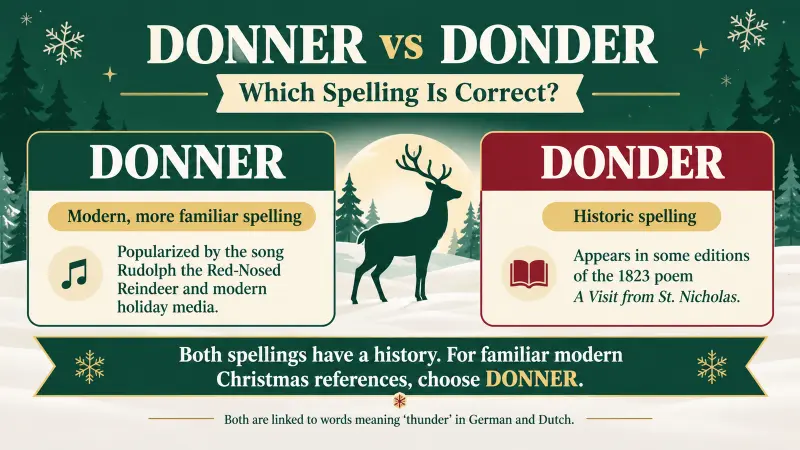
There’s another important context: Christmas traditions. Donner and Donder are associated with the name of one of Santa Claus’s reindeer. The older spelling Donder appears in the historical tradition, while Donner became a familiar modern spelling.
Formal versus informal usage
In formal writing, use the spelling recognized by the language or source you’re discussing. In casual conversation, people might use either spelling when recalling a reindeer name, but that flexibility doesn’t mean the words are universally equivalent.
Academic versus casual writing
For an academic assignment, historical discussion, or language lesson, identify the relevant source and preserve its spelling. Meanwhile, in a Christmas card or informal story, either version may be understandable when the reference is clearly a reindeer.
Therefore, context matters more than visual similarity.
Practical Usage of Donner
Although Donner is familiar in several contexts, its appropriate use depends on the intended reference.
Workplace example
Suppose you’re preparing a presentation about German vocabulary for international colleagues. You might write:
“Donner is the German noun for thunder.”
This sentence identifies the word and its meaning clearly. However, if your presentation concerns a Dutch language course, using the German spelling without explanation could confuse your audience.
Academic example
Consider a history paper discussing nineteenth century American exploration:
“The Donner Party became associated with a tragic winter in the Sierra Nevada.”
Here, Donner is part of a proper name. Changing it to Donder would incorrectly alter the historical name.
Alternatively, a paper about Christmas literature might use Donner when discussing the modern spelling of Santa’s reindeer.
Technology example
Imagine that you’re building a multilingual dictionary application. When a user enters Donner, the software should consider the selected language and surrounding text before displaying a definition.
For German, it could return “thunder.” In a historical search, it might instead identify the Donner Party. Thus, the correct interpretation depends on the user’s purpose.
Usage recap
Use Donner when it matches the relevant language, proper name, or established spelling. In particular, preserve it when referring to historical people, groups, or documented names.
Practical Usage of Donder
The spelling Donder also has legitimate uses, especially in Dutch, Afrikaans, and historical discussions of Christmas traditions.
Workplace example
Imagine a translator preparing a Dutch vocabulary sheet for international employees. The translator might include this example:
“In Dutch, donder means thunder.”
This usage is appropriate when the lesson concerns Dutch vocabulary. Nevertheless, substituting the German spelling would teach the wrong form for the intended language.
Academic example
Suppose a literature student is studying the evolution of Santa’s reindeer names. The student could write:
“The spelling Donder reflects an earlier version of the reindeer’s name in the Christmas poem tradition.”
This example highlights a historical spelling rather than a simple grammatical difference. To strengthen the discussion, the student should identify the specific edition or historical text being analyzed.
Technology example
A language learning platform could display donder as the Dutch word for thunder, alongside a pronunciation guide and an example sentence.
However, if a learner switches the selected language to German, the platform should display Donner instead. This distinction helps prevent learners from assuming that related vocabulary always has identical spelling across languages.
Usage recap
Use Donder when it matches the language or historical source. Above all, don’t change a documented spelling merely because another version looks more familiar.
When You Should NOT Use Donner or Donder
Several common situations make choosing between these spellings easier.
1. When translating German into English: Don’t present Donder as the standard German spelling for thunder. Use Donner.
2. When translating Dutch into English: Don’t automatically replace the Dutch word donder with Donner. Preserve the original form when discussing Dutch vocabulary.
3. When writing historical names: Don’t change the spelling of the Donner Party or another documented proper name to fit your preferred version.
4. When quoting an original poem: Don’t silently modernize Donder to Donner if the exact historical wording matters. Preserve the source spelling.
5. When completing a language examination: Don’t choose based only on which spelling looks familiar. Follow the language specified in the question.
6. When editing a quotation: Don’t correct a historical spelling unless you’re explicitly producing an edited version and following the appropriate editorial conventions.
7. When creating multilingual content: Don’t assume German, Dutch, and Afrikaans always use identical spellings. Check the target language.
8. When discussing Santa’s reindeer casually: Don’t claim that the two spellings have always been identical. Their history includes variation.
Ultimately, the safest choice is the one supported by the intended meaning and source.
Common Mistakes With Donner and Donder
Even experienced writers can confuse similar spellings, particularly when a word appears in several languages or historical traditions.
| Correct sentence | Incorrect sentence | Explanation |
|---|---|---|
| Donner means thunder in German. | Donder is the standard German word for thunder. | The standard German spelling is Donner. |
| Donder means thunder in Dutch. | Donner is the usual Dutch spelling for thunder. | The standard Dutch spelling is donder. |
| The Donner Party traveled westward. | The Donder Party traveled westward. | The historical group’s established name is Donner Party. |
| The historical poem uses the spelling Donder. | The original poem always spells the name Donner. | The older text contains the spelling Donder. |
| Modern references often use Donner. | Donner is the only spelling ever associated with the reindeer. | Historical variations exist. |
| Check the language before translating the word. | Both spellings are correct in every language. | The spelling depends on linguistic context. |
Decision rule
If you mean thunder in German, use Donner.
If you mean thunder in Dutch or Afrikaans, use donder.
If you mean Santa’s reindeer, check whether your source uses Donner or Donder.
If you mean a historical person or group, preserve the established proper name.
Notice that the choice isn’t simply a matter of grammar. Instead, the language, historical period, and intended reference determine the correct spelling.
Donner and Donder in Modern Technology and Language Tools
Digital dictionaries, translation software, and writing applications can help users distinguish similar words. Nevertheless, these tools may return several interpretations when a spelling appears in different languages or proper names.
For example, searching for Donner could produce a German vocabulary definition, information about the Donner Party, or references to a Christmas reindeer. Similarly, Donder could return Dutch vocabulary or historical literary material.
To improve accuracy, select the intended language, examine the surrounding sentence, and verify the spelling against the original source. Furthermore, when editing a quotation or historical document, retain the spelling used in that edition unless you have a clear reason to change it.
The Origin and History of Donner and Donder
The relationship between these words becomes clearer when their linguistic history is considered.
In German, Donner is the word for thunder. Dutch uses donder for the same natural phenomenon, while Afrikaans also uses donder. The difference reflects the spelling conventions of related but distinct languages.
The reindeer name has a separate historical dimension. In the poem commonly known as A Visit from St. Nicholas, published in 1823 and traditionally attributed to Clement Clarke Moore, the name appears as Dunder in the original text. Later versions used Donder, followed by Donner in the familiar modern tradition.
Consequently, these forms are not simply random spelling errors. They reflect changes in how a name was recorded and reproduced over time.
When writing about this history, distinguish between the German vocabulary word, the Dutch vocabulary word, and the reindeer’s name. Although these uses are related, their spelling conventions are not identical.
Expert Guidance on Choosing the Correct Spelling
A useful principle for language learners is:
“The right spelling is the one that fits the intended meaning, language, and source.”
This principle emphasizes accuracy rather than appearance. Similar words may share a linguistic origin without being interchangeable in every context.
For instance, a German student should learn Donner as the standard spelling for thunder. Conversely, someone studying Dutch should recognize donder. Meanwhile, a literature student examining an early Christmas poem should preserve the wording of the edition under discussion.
Therefore, before correcting an unfamiliar spelling, ask three questions: What does the word mean? Which language is being used? Is the spelling part of a historical name or quotation?
These questions offer a more reliable approach than relying on spellcheck alone.
Two Practical Case Studies
The following illustrative examples show how this distinction can prevent mistakes in everyday writing.
Case Study One: A Multilingual Classroom
A language teacher prepares a worksheet for students learning German and Dutch. The first draft includes the sentence, “Donder means thunder in German.”
Although the intended meaning is understandable, the spelling is incorrect for the German vocabulary lesson.
The teacher checks a German dictionary and changes the sentence to, “Donner means thunder in German.” In the Dutch section, the teacher retains donder.
Result: The revised worksheet correctly distinguishes the two languages and gives students a clear example of how related vocabulary can differ in spelling.
Case Study Two: A Historical Christmas Article
A writer prepares an article explaining the names of Santa’s reindeer. Initially, the writer states that Donner was the spelling used in the original 1823 poem.
After checking the historical text, the writer discovers that the original version used Dunder. The article is revised to explain the progression from Dunder through Donder to the familiar modern spelling Donner.
Result: The updated explanation avoids a historical error and gives readers a more accurate understanding of the name’s development.
Both examples demonstrate that a quick context check can improve clarity, accuracy, and reader confidence.
Error Prevention Checklist for Donner or Donder
Before publishing an article, submitting an assignment, or translating a sentence, use this checklist to verify the spelling.
Always use Donner when
- Writing the German word for thunder.
- Referring to the historical Donner Party.
- Following a modern source that spells the reindeer’s name Donner.
- Reproducing a proper name whose documented spelling is Donner.
Never use Donder when
- You specifically need the standard German word for thunder.
- You’re reproducing a documented name that uses Donner.
- You’re quoting a source that uses another spelling and have no reason to alter it.
- You’re assuming that Dutch and German share the same spelling conventions.
There is one important qualification: Donder is not inherently incorrect. It is a legitimate word in Dutch and Afrikaans, and it has historical significance in discussions of Santa’s reindeer. The checklist should therefore guide your decision rather than encourage you to reject one spelling in every situation.
Related Grammar Confusions You Should Master
Once you understand the distinction between Donner and Donder, you can apply the same context based approach to other confusing words.
- Affect vs Effect: Understand the difference between influencing something and the result of an action.
- Their vs There: Distinguish possession from a reference to a place or existence.
- Your vs You’re: Identify the difference between ownership and a contraction.
- Then vs Than: Use the appropriate word for time or comparison.
- Accept vs Except: Separate receiving something from excluding it.
- Principal vs Principle: Distinguish a person or primary item from a fundamental rule.
- Practice vs Practise: Learn the spelling conventions used in American and British English.
- Lose vs Loose: Avoid confusing a verb meaning to misplace something with an adjective meaning not tight.
- Traveler vs Traveller: Recognize the spelling differences between American and British English.
- Doner vs Donner: Distinguish the spelling commonly used for a type of kebab from the word Donner used in German vocabulary and proper names.
These comparisons illustrate an important lesson: familiar looking words can differ in meaning, grammatical function, spelling convention, or historical background.
Frequently Asked Questions
Is Donner or Donder the correct spelling?
Both spellings are legitimate, but their correctness depends on context. Donner is the German word for thunder, while donder is the Dutch and Afrikaans form. For Santa’s reindeer, the appropriate spelling depends on the historical source or modern convention being followed.
What does Donner mean in English?
In German, Donner means thunder. It also appears in proper names, including the Donner Party, and in the modern name of one of Santa’s reindeer. Therefore, its English interpretation depends on the context.
What does Donder mean in English?
In Dutch and Afrikaans, donder means thunder. Additionally, Donder appears in the historical tradition surrounding Santa’s reindeer. Its precise interpretation depends on the language and source.
Is Donder the original name of Santa’s reindeer?
Not exactly. The 1823 poem A Visit from St. Nicholas used Dunder in its original version. The spelling later appeared as Donder, while Donner became familiar in modern references. Thus, Donder is an important historical form, but it was not the spelling in the original text.
Why did Donder change to Donner?
The spelling evolved through the publication history of the Christmas poem and its later versions. The German word Donner, meaning thunder, also helps explain the familiar modern form. However, the precise development should be understood through the historical editions rather than a simple spelling correction.
Are Donner and Donder pronounced the same way?
Not necessarily. Pronunciation varies according to language, accent, and whether the word is used as a proper name. German Donner and Dutch donder have different language specific pronunciation patterns, so learners should consult pronunciation guidance for the relevant language.
Is Donder a misspelling of Donner?
No, not universally. Donder is a legitimate Dutch and Afrikaans word, and it also has a place in the history of Santa’s reindeer. It would be inappropriate, however, to use it as the standard German spelling for thunder.
Should I write Donner or Donder in a school assignment?
First, identify what the assignment asks you to discuss. For German vocabulary, use Donner. For Dutch or Afrikaans vocabulary, use donder. If the assignment concerns the reindeer’s historical name, follow the spelling required by the source or explain the historical variations.
How can I remember the difference between Donner and Donder?
Associate Donner with German vocabulary and the established name Donner Party. Remember donder as the Dutch and Afrikaans word for thunder. If you’re discussing Santa’s reindeer, remember that the name has appeared in multiple historical forms.
Conclusion:
Choosing between donner or donder requires understanding the intended meaning, language, and historical context. Although the spellings look similar, they aren’t universally interchangeable.
Use Donner for thunder in German, and use donder for thunder in Dutch and Afrikaans. Meanwhile, when discussing Santa’s reindeer, remember that the name developed through historical variations, including Dunder, Donder, and the familiar modern form Donner.
Ultimately, the best way to avoid mistakes is to check the original source before choosing a spelling. By considering the context instead of relying on appearance alone, you can write more accurately and explain the difference with confidence.