Have you ever wondered whether silver or gold is the better choice for jewelry, investment, or everyday use? Both precious metals have unique qualities, timeless appeal, and practical benefits, but choosing between them can be confusing. Gold is often associated with luxury, long-term value, and wealth preservation, while silver is popular for its affordability, versatility, and attractive appearance. The right option depends on your budget, personal style, and financial goals.
Understanding the differences between silver and gold can help you make a more informed decision. Factors such as price, durability, purity, maintenance, resale value, and market demand all play an important role. For example, gold jewelry often costs more because of its higher market value, while silver allows buyers to explore a wider range of designs at a lower initial cost. However, neither metal is automatically the best choice for everyone.
In this guide, we will compare silver vs. gold in simple terms, explaining their advantages, disadvantages, common uses, and key differences. You will also learn which metal may be more suitable for jewelry, daily wear, and investment purposes. By examining these factors carefully, you can choose the option that best matches your needs instead of relying on appearance or price alone. Keep reading to discover which precious metal makes the most sense for you in 2026.
Silver or Gold: What’s the Difference?
The main difference between silver and gold is their chemical composition, appearance, market value, and practical applications. Although both are naturally occurring precious metals, each serves different purposes depending on the buyer’s needs.
What Is Silver?
Silver is a chemical element with the symbol Ag and atomic number 47. It is a shiny, white metal known for its excellent electrical and thermal conductivity.
As a noun, silver refers to the metal itself, an object made from it, or a color resembling its appearance. As an adjective, it describes something with a silvery appearance.
For example, a person might purchase a silver necklace, invest in silver bullion, or describe a silver colored car.
Silver is widely used in jewelry, electrical components, solar panels, mirrors, and specialized industrial equipment. Nevertheless, it can tarnish when exposed to sulfur containing substances in the environment.
What Is Gold?
Gold is a chemical element with the symbol Au and atomic number 79. It is a naturally occurring yellow metal recognized for its resistance to corrosion, attractive appearance, and historical importance.
As a noun, gold refers to the metal or an object made from it. As an adjective, it can describe a yellow metallic color or something associated with exceptional quality.
For instance, someone might wear a gold ring, purchase gold coins, or receive a gold medal for an achievement.
Gold is commonly used in jewelry, investment products, electronics, and certain medical applications. Unlike silver, it generally resists tarnishing and maintains its appearance over long periods.
Silver vs Gold Comparison Table
| Feature | Silver | Gold |
|---|---|---|
| Chemical symbol | Ag | Au |
| Atomic number | 47 | 79 |
| Natural appearance | Bright white | Yellow |
| Density | Approximately 10.49 g/cm³ | Approximately 19.32 g/cm³ |
| Electrical conductivity | Excellent | Very good |
| Resistance to corrosion | Can tarnish | Highly resistant |
| Common jewelry forms | Sterling silver | Yellow, white, and rose gold alloys |
| Typical market value per gram | Generally lower | Generally higher |
| Industrial applications | Electronics, solar technology | Electronics, specialized equipment |
| Maintenance | May require polishing | Usually requires less tarnish related maintenance |
Mini recap: Silver is lighter in color and generally more affordable. Gold is denser, typically more expensive, and more resistant to tarnishing. Therefore, the right option depends on appearance, budget, intended use, and long term value.
Is Silver or Gold a Grammar, Vocabulary, or Usage Issue?
The comparison between silver and gold is primarily a vocabulary and meaning issue rather than a grammar problem.
Both words are correct English nouns, and both can function as adjectives. However, they refer to different metals and cannot always replace each other without changing a sentence’s meaning.
Are Silver and Gold Interchangeable?
No. Although both describe precious metals, they have distinct meanings.
For example:
Correct: She bought a gold wedding ring.
Different meaning: She bought a silver wedding ring.
Both sentences are grammatically correct. However, the first describes a ring made from gold or a gold alloy, while the second describes one made from silver or a silver alloy.
Consequently, substituting one word for the other changes the material being described.
Formal vs Informal Usage
In formal writing, silver and gold should identify the intended metal precisely. This distinction matters in financial reports, product specifications, scientific papers, and purchasing agreements.
In casual conversation, people sometimes use these words to describe colors rather than actual materials. For instance, someone might call a silver colored phone silver even when its body contains no silver.
Therefore, context determines whether the word identifies a material, a color, or a symbolic quality.
Academic vs Casual Usage
In academic writing, silver and gold may refer to chemical elements, economic commodities, historical artifacts, or industrial materials.
For example, a chemistry student might explain that gold resists oxidation under ordinary conditions, while silver has higher electrical conductivity.
In everyday conversation, however, a person might simply say that gold looks warmer than silver.
The words remain the same, but their intended meaning depends on the subject and situation.
How to Use Silver Correctly
Silver is appropriate when discussing the white precious metal, an object made from it, or a color resembling its appearance.
Because silver has several applications, it is useful to understand how the word works in different settings.
Workplace Example
A jewelry store employee might say:
“Our new silver bracelets are more affordable than our gold collection.”
Here, silver identifies the material used to make the bracelets. The sentence is suitable for customer service, product descriptions, and business communication.
Academic Example
A science student might write:
“Silver has higher electrical conductivity than gold at room temperature.”
This sentence uses silver in a scientific context. It makes a measurable comparison between two elements rather than expressing a personal preference.
Technology Example
A technology writer might explain:
“Silver is used in certain electrical contacts because it conducts electricity exceptionally well.”
In this example, the word identifies a material selected for its physical properties.
When Silver Is Used Figuratively
Silver can also communicate ideas beyond the physical metal. For instance, the expression “silver lining” refers to a positive aspect of an otherwise difficult situation.
Similarly, a “silver medal” represents second place in many sporting competitions.
Silver usage recap: Use silver when referring to the actual metal, its color, or an established figurative expression. In technical writing, specify whether a product contains silver or merely has a silver colored finish.
How to Use Gold Correctly
Gold is the appropriate word when describing the yellow precious metal, a gold containing product, or a recognized expression involving the color or symbolism of gold.
Since gold is associated with wealth, achievement, and durability, it appears frequently in financial, commercial, and everyday communication.
Workplace Example
A jewelry consultant might say:
“These gold earrings are available in several different weights.”
Here, gold identifies the material or gold alloy used to manufacture the earrings.
For accurate product descriptions, however, the seller should specify the purity, such as 14 karat or 18 karat gold, when applicable.
Academic Example
A chemistry student might write:
“Gold is a relatively unreactive metal that resists corrosion.”
This sentence uses gold as the subject of a scientific statement. Its meaning is factual rather than symbolic.
Technology Example
An electronics manufacturer might explain:
“Gold plating can improve the corrosion resistance of certain electrical connectors.”
In this context, gold refers to a material used in a specialized engineering application. The specific benefits depend on the component’s design and operating conditions.
When Gold Is Used Figuratively
Gold also appears in expressions such as “gold standard,” which describes a benchmark of excellence, and “golden opportunity,” which refers to an especially favorable chance.
Likewise, a “gold medal” commonly represents first place in a sporting event.
Gold usage recap: Choose gold when the intended meaning involves the metal, its characteristic color, or an established expression. For products, distinguish solid gold from gold plated, gold filled, and gold colored materials.
When You Should NOT Use Silver or Gold
Although silver and gold are both precious metals, several situations make it important to avoid confusing them.
When Describing a Specific Material
Do not use silver when the product is made from gold, or vice versa. Material accuracy matters when describing jewelry, coins, decorative objects, and industrial components.
When Discussing Metal Purity
Do not assume that every gold item is pure gold. Jewelry frequently contains alloys that improve hardness and alter color.
Similarly, sterling silver generally contains 92.5% silver, with the remainder consisting primarily of other metals, commonly copper.
When Identifying a Color Only
Do not claim that a silver colored object contains silver. Likewise, a gold colored accessory may contain no gold at all.
Instead, describe the finish accurately.
When Comparing Investment Prices
Do not assume that gold and silver have the same price per gram or follow identical market movements. Their prices respond to different supply, demand, and economic conditions.
When Describing Electrical Performance
Do not claim that gold is more electrically conductive than silver. Under ordinary reference conditions, silver has higher electrical conductivity.
However, gold’s resistance to corrosion can make it preferable for certain electrical contacts.
When Discussing Jewelry Durability
Do not automatically assume that pure gold is harder than every silver alloy. Pure gold is relatively soft, while alloy composition and manufacturing techniques influence the durability of finished jewelry.
When Writing Product Specifications
Do not use gold as a substitute for gold plated or gold colored. Those terms describe different material constructions.
Similarly, sterling silver should not be confused with silver plating.
When Making Investment Guarantees
Do not describe either metal as a guaranteed source of profit. Both can fluctuate in price, and transaction costs, storage, and resale conditions can affect returns.
Common Mistakes and Decision Rules
Confusion between silver and gold often occurs when people assume that similar purposes mean identical properties.
The following examples show how to recognize and correct common errors.
| Correct sentence | Incorrect sentence | Explanation |
|---|---|---|
| Silver has higher electrical conductivity than gold. | Gold has higher electrical conductivity than silver. | Silver conducts electricity better under ordinary reference conditions. |
| She bought a silver necklace. | She bought a gold necklace. | The second sentence changes the material being described. |
| The ring is gold plated. | The ring is solid gold. | Plating does not mean the entire item is made from gold. |
| Sterling silver typically contains 92.5% silver. | Sterling silver is pure silver. | Sterling silver is an alloy rather than pure silver. |
| Gold is generally more expensive per gram than silver. | Silver always costs more than gold per gram. | Gold generally commands a higher price per gram, although prices fluctuate. |
| The medal has a gold colored finish. | The medal must be made of gold. | A gold appearance does not establish its material composition. |
Decision Rule Box
Use these practical rules when choosing between the two words:
If you mean the white precious metal, use silver.
If you mean the yellow precious metal, use gold.
If you are describing color alone, specify “silver colored” or “gold colored” when the actual material is unknown.
If you are discussing investment value, compare current market prices, purity, fees, and the intended holding period instead of relying on appearance.
Unlike some commonly confused English words, silver and gold do not represent competing grammatical forms. Instead, they identify different materials with distinct properties.
Silver and Gold in Modern Technology and Digital Tools
Silver and gold continue to play important roles in modern technology because of their electrical, chemical, and physical properties.
Silver is especially useful in applications requiring excellent electrical conductivity. Consequently, it appears in selected electrical contacts, photovoltaic technologies, conductive materials, and specialized industrial components.
Gold, meanwhile, is valuable in electronics where corrosion resistance and reliable electrical connections are important. Therefore, certain connectors, contact surfaces, and high reliability components use gold plating.
Digital product catalogs and comparison tools can help consumers evaluate metal purity, weight, and listed prices. Nevertheless, product labels should be checked carefully because a metallic appearance does not prove that an object contains the metal it resembles.
For example, an online listing that describes a necklace as gold colored does not necessarily indicate that it contains gold.
Ultimately, understanding material specifications is more useful than relying on a product’s appearance alone.
Etymology of Silver and Gold
The words silver and gold have ancient linguistic histories that reflect the importance of these metals across different societies.
Silver comes from Old English seolfor. Related forms appear in other Germanic languages, although the deeper origin of the word remains uncertain.
Gold comes from Old English gold, which is related to similar Germanic words and ultimately traces back to an ancient Indo European root associated with the color yellow.
Over time, both terms became established names for chemical elements, precious materials, colors, and symbolic concepts.
For example, gold became associated with wealth and achievement, while silver acquired meanings connected with brightness, elegance, and second place in many award systems.
These historical associations continue to influence modern English usage.
An Expert Perspective on Silver vs Gold
A useful principle for understanding precious metals is to distinguish their appearance from their measurable properties.
“Choose a metal according to its composition, performance, and intended purpose rather than appearance alone.”
This practical statement reflects an important distinction in material selection. A gold colored product may not contain gold, and a silver colored surface may not contain silver.
Similarly, the most expensive metal is not automatically the best option for every application. Electrical conductivity, corrosion resistance, hardness, price, and manufacturing requirements all influence material selection.
Therefore, an informed comparison considers the characteristics that matter for the intended purpose.
Two Practical Case Studies: Choosing Silver or Gold
The following hypothetical examples demonstrate how the choice between silver and gold depends on real world requirements. The outcomes illustrate practical decision making rather than guaranteed financial results.
Case Study One: Choosing Jewelry for Everyday Wear
Consider a customer deciding between a sterling silver necklace and an 18 karat gold necklace.
The silver necklace costs less initially, making it attractive to someone working within a limited budget. However, sterling silver may tarnish and require occasional cleaning.
The gold necklace costs more, but it generally requires less tarnish related maintenance. Nevertheless, its durability still depends on alloy composition, construction, and how frequently it is worn.
The customer chooses sterling silver because affordability is the primary concern and occasional maintenance is acceptable.
Result: The customer meets the budget requirement while understanding the care needed to maintain the necklace’s appearance.
Case Study Two: Selecting Materials for Electrical Components
Imagine an engineering team comparing silver and gold for electrical contacts.
Silver offers excellent electrical conductivity, making it attractive for applications where low electrical resistance is important. However, environmental exposure and the specific operating conditions may affect its suitability.
Gold, by contrast, offers strong resistance to corrosion and can provide reliable contact surfaces in selected applications.
After reviewing conductivity, exposure conditions, component design, and maintenance requirements, the team selects gold plated contacts for a particular connector.
Result: The team prioritizes reliable connections and corrosion resistance rather than choosing a material based only on its price or conductivity.
These examples demonstrate that the best material depends on the performance requirements, not a universal ranking of one metal over the other.
Error Prevention Checklist
Before writing or speaking about silver and gold, review the following checklist.
Always Use Silver When
- The intended material is silver.
- You are describing sterling silver jewelry.
- You are discussing silver’s electrical conductivity.
- You are referring to an established expression such as “silver lining.”
- You are describing a silver colored finish and have made the color distinction clear.
Never Use Gold When
- The object is known to contain silver rather than gold.
- You are claiming that gold has higher electrical conductivity than silver under ordinary reference conditions.
- You are describing a gold plated item as solid gold.
- You are assuming that a gold colored finish proves the presence of gold.
- You are promising that an investment in gold cannot lose value.
Final Verification
Before publishing a product description or academic explanation, confirm the material, purity, intended meaning, and relevant properties.
When the material is uncertain, use a descriptive phrase such as “gold colored metal” rather than making an unsupported claim about composition.
Related Grammar Confusions You Should Master
Learning to distinguish silver from gold also offers an opportunity to improve vocabulary precision in other contexts.
Here are ten useful comparisons to explore:
- Gold vs Golden: Understand the difference between the metal and the adjective describing its color or qualities.
- Silver vs Sterling Silver: Learn how pure silver differs from a common silver alloy.
- Gold Plated vs Gold Filled: Recognize the differences between two jewelry construction methods.
- Metal vs Metallic: Distinguish a material from an adjective describing its appearance or properties.
- Affect vs Effect: Separate a commonly used verb from a noun describing a result.
- Fewer vs Less: Understand how countable and uncountable quantities are expressed.
- Its vs It’s: Distinguish possession from the contraction meaning “it is” or “it has.”
- Your vs You’re: Separate a possessive determiner from a contraction.
- There vs Their: Recognize the difference between a place related word and a possessive word.
- Principal vs Principle: Distinguish a person or primary element from a rule or fundamental belief.
Although these comparisons involve different language principles, they share one important lesson: selecting the correct word requires understanding its meaning and context.
Frequently Asked Questions
Is silver or gold better?
Gold is generally better for people who prioritize resistance to tarnishing and traditional precious metal jewelry. Silver may be preferable when affordability and electrical conductivity are more important. Ultimately, the best choice depends on the intended use, budget, and desired properties.
Is silver more valuable than gold?
Generally, no. Gold usually has a substantially higher market price per gram than silver. However, prices fluctuate, and collectible coins, designer jewelry, and unusual products may have values that differ considerably from the underlying metal price.
Which is better for jewelry, silver or gold?
Both can be suitable. Silver offers a bright appearance at a lower typical purchase price, while gold provides several color options and generally greater resistance to tarnishing. The best choice depends on personal style, budget, alloy composition, and maintenance preferences.
Why is gold more expensive than silver?
Gold typically commands a higher price because of its scarcity, established monetary role, investment demand, and diverse uses. However, market prices depend on global supply, demand, economic conditions, and investor sentiment. Therefore, the price difference can change over time.
Does silver conduct electricity better than gold?
Yes. Pure silver has higher electrical conductivity than pure gold at ordinary reference temperatures. Nevertheless, gold’s resistance to corrosion makes it useful for certain electrical contacts, where maintaining reliable connections is particularly important.
Does silver tarnish more easily than gold?
Yes. Silver can react with sulfur containing compounds in its environment, forming a tarnished surface. Gold is generally more resistant to corrosion and tarnishing, although the behavior of gold jewelry also depends on the other metals present in its alloy.
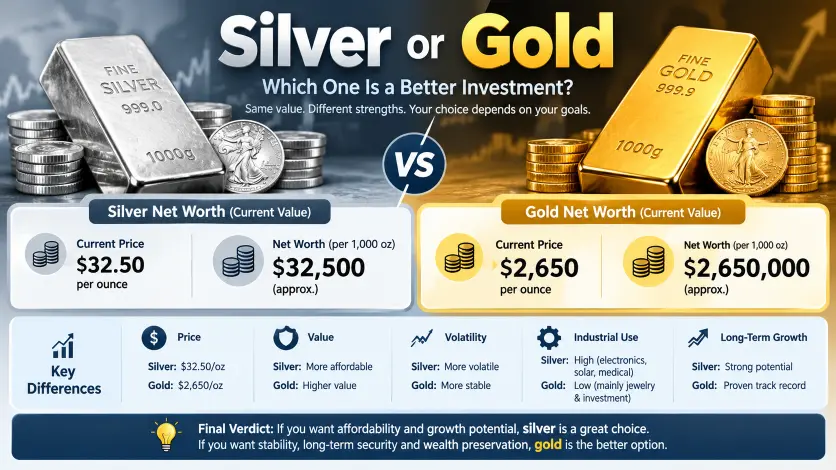
Is silver or gold better for investment?
Neither is universally better. Gold is widely used for wealth preservation and investment diversification, while silver also has substantial industrial demand. Investors should consider volatility, storage, transaction costs, taxation, and personal financial objectives before choosing either metal.
How can you tell whether something is real silver or gold?
Look for appropriate hallmarks, manufacturer information, and reliable documentation. However, markings alone are not definitive proof of authenticity. A qualified jeweler or precious metal testing professional can help verify composition when necessary.
What is the difference between gold and silver in chemistry?
Gold is the element Au, with atomic number 79, while silver is Ag, with atomic number 47. Silver has higher electrical conductivity, whereas gold is generally more resistant to corrosion. Their different atomic structures contribute to their distinct physical and chemical properties.
Conclusion:
The choice between silver or gold depends on what matters most to you. Silver offers excellent electrical conductivity, a bright appearance, and a generally lower purchase price. Gold, meanwhile, provides strong resistance to corrosion, established investment appeal, and a distinctive appearance that suits many jewelry styles.
For everyday accessories, consider your budget, preferred color, and willingness to perform maintenance. For technical applications, compare conductivity, corrosion resistance, and material specifications. For investments, evaluate market conditions, costs, and your financial goals.
Ultimately, neither metal is automatically the best choice in every situation. Understanding their differences allows you to choose the material that fits your needs with greater confidence.