Have you ever wondered whether fibre or fiber is the correct spelling? You may have seen fiber in American articles and fibre in British publications, leaving you unsure which version to use. The good news is that both spellings are correct. The difference comes down to regional English conventions, not meaning or grammar.
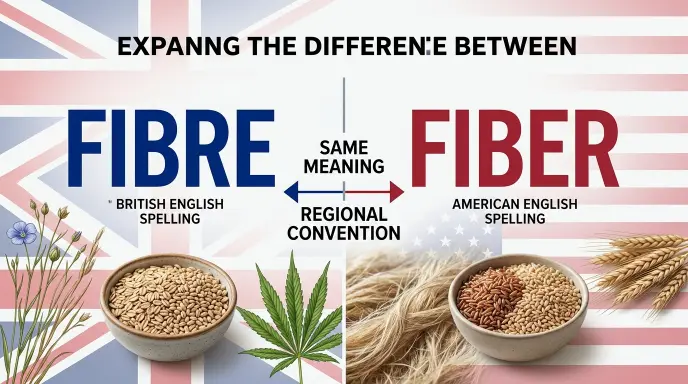
Fibre is the standard spelling in British English, commonly used in the United Kingdom and many other countries that follow British spelling conventions. Fiber is the standard spelling in American English, including in most US publications, educational materials, and websites. Both words refer to the same thing, whether you are discussing dietary fiber, textile fibres, or fiber-optic technology.
Understanding the difference helps you write more clearly and professionally. In this guide, you will learn when to use fibre or fiber, explore practical examples, and discover common spelling mistakes to avoid. Whether you are writing an academic assignment, a blog post, or a professional email, choosing the appropriate spelling for your audience will help keep your writing consistent and easy to understand.
Fibre or Fiber: What’s the Difference?
The primary difference between fibre and fiber is the regional spelling convention. Both are nouns, and both have the same meaning.
Fibre (noun): The British English spelling for a thin strand or threadlike structure, or a dietary component found in plant foods.
Fiber (noun): The American English spelling of the same word, used in contexts involving nutrition, clothing, biology, and materials.
| Feature | Fibre | Fiber |
|---|---|---|
| Part of speech | Noun | Noun |
| Main meaning | Threadlike material or dietary substance | Threadlike material or dietary substance |
| Preferred region | United Kingdom | United States |
| Common in | British English, Australian English | American English |
| Pronunciation | Generally the same | Generally the same |
| Example | Wholemeal bread contains fibre. | Whole wheat bread contains fiber. |
| Correctness | Correct in British conventions | Correct in American conventions |
Quick recap
Both spellings are correct in English.
However, British publications generally prefer fibre, while American publications prefer fiber.
Neither spelling is more grammatically correct than the other.
Therefore, your intended audience should determine which version you choose.
Is Fibre or Fiber a Grammar, Vocabulary, or Usage Issue?
Although people frequently search for this distinction as a grammar question, it is actually a matter of regional spelling and writing conventions. The words have identical meanings, so you don’t need to learn separate definitions.
Are fibre and fiber interchangeable?
Yes. In most contexts, the two spellings are interchangeable because they represent the same word.
For example, a British nutritionist might explain that vegetables contain dietary fibre. Meanwhile, an American nutritionist would probably describe those same vegetables as sources of dietary fiber.
Similarly, a British clothing manufacturer may discuss synthetic fibres, whereas an American manufacturer may refer to synthetic fibers. In both cases, the intended meaning remains unchanged.
Nevertheless, interchangeability doesn’t mean you should switch between the spellings randomly. Consistency helps readers recognize that your document follows a clear language convention.
Formal versus informal usage
Both forms are suitable for formal and informal communication. For instance, you can use fibre in a British university dissertation or fiber in an American business proposal.
Likewise, social media posts, personal emails, product descriptions, and everyday conversations can use either form, depending on the audience.
However, formal publications often follow an established style guide. Consequently, if a company, school, publisher, or government department specifies British or American English, follow that standard throughout the document.
Academic versus casual writing
In academic writing, regional consistency becomes especially important. A student submitting an assignment to an American university should generally use fiber, while a student following British English conventions should choose fibre.
Similarly, casual messages rarely require extensive consideration. Nevertheless, using the spelling familiar to your readers can make communication feel more natural.
The essential rule: Choose the spelling appropriate to your English variety, then use it consistently.
How to Use Fibre Correctly
The spelling fibre is standard in British English and is commonly found in British publications, Australian writing, and other varieties that follow British spelling conventions.
Moreover, it appears in several fields, including nutrition, medicine, biology, engineering, and fashion.
Workplace example
Consider a British food manufacturer preparing a product description.
Correct sentence: “Our breakfast cereal contains six grams of dietary fibre per serving.”
This spelling suits a product aimed at consumers who expect British English conventions. Similarly, a British textile company might advertise durable natural fibres in its clothing range.
Academic example
Suppose a student is writing a biology report for a British university.
Correct sentence: “Plant fibre contributes to the structural strength of many plant tissues.”
Here, fibre follows the expected spelling convention. Likewise, a nutrition student might explain how dietary fibre supports digestive health.
Technology example
In telecommunications, fibre optic technology transmits information through thin strands of glass or other suitable materials.
Correct sentence: “The provider is expanding its fibre optic network across rural communities.”
This spelling is appropriate for a British audience. Furthermore, a technical report prepared for a British engineering organization would ordinarily retain the same convention.
Usage recap
Use fibre when writing for readers who follow British English conventions. In particular, choose it for British academic papers, product packaging, professional reports, and technical documentation when that spelling standard applies.
How to Use Fiber Correctly
The spelling fiber is preferred in American English. Therefore, it is the natural choice for American publications, educational materials, commercial products, and professional communication.
Although its spelling differs from the British form, its meaning and grammatical function remain identical.
Workplace example
Imagine an American food company promoting a breakfast product.
Correct sentence: “Our breakfast cereal contains six grams of dietary fiber per serving.”
Because the intended customers are American, fiber is the appropriate choice. Similarly, an American clothing brand would generally advertise durable synthetic fibers rather than synthetic fibres.
Academic example
An American biology student might write the following sentence in a laboratory report:
Correct sentence: “Plant fiber contributes to the structural strength of certain materials.”
The spelling follows American English conventions. In addition, a research paper prepared for an American university would normally use fiber in its nutritional, biological, or material science discussions.
Technology example
American telecommunications companies commonly use the expression fiber optic when describing communication networks.
Correct sentence: “The provider is expanding its fiber optic network across rural communities.”
This spelling matches the expected convention in American technical documentation. Likewise, American technology publications generally use fiber in articles about broadband infrastructure.
Usage recap
Choose fiber for American English writing. Whether you’re preparing a school assignment, a professional report, or a product label, this spelling is generally the appropriate option for an American audience.
When You Should NOT Use Fibre or Fiber
Neither spelling is inherently incorrect. However, certain situations make one form unsuitable for your intended document.
1. Do not use fibre in American English publications that require American spelling. Instead, write fiber to follow the publication’s established conventions.
2. Do not use fiber in British English documents that require British spelling. In that context, fibre is generally the expected form.
3. Do not mix both spellings in the same document without a reason. For example, switching between dietary fibre and dietary fiber can make an otherwise polished report appear inconsistent.
4. Do not assume that one spelling is a grammatical error. Both forms are accepted English spellings, so the distinction depends on regional standards rather than grammar.
5. Do not change an official product name or quotation unnecessarily. If a company uses a specific spelling in its registered name or quoted material, preserve the original wording when accuracy matters.
6. Do not ignore an organization’s style guide. A publisher or employer may require a particular English variety even when your personal preference differs.
7. Do not confuse regional spelling with scientific meaning. Fibre and fiber refer to the same concepts in nutrition, textiles, and telecommunications, although the precise scientific meaning depends on context.
8. Do not apply a spelling rule without considering your readers. For international websites, determine whether the primary audience is British, American, or international before choosing your standard.
Ultimately, the goal is not to eliminate either spelling. Rather, it is to use the version that best suits the context.
Common Mistakes and Decision Rules for Fibre or Fiber
Even experienced writers sometimes make spelling mistakes when switching between regional varieties of English. Fortunately, most errors are easy to prevent once you recognize the difference.
| Correct sentence | Incorrect sentence | Explanation |
|---|---|---|
| This cereal contains dietary fibre. | This cereal contains dietary fiber. | The second spelling may be inconsistent in a document following British conventions. |
| This cereal contains dietary fiber. | This cereal contains dietary fibre. | The second spelling may be inconsistent in an American publication. |
| The company manufactures natural fibres. | The company manufactures natural fibers. | Use fibres when following British spelling conventions. |
| The company manufactures natural fibers. | The company manufactures natural fibres. | Use fibers when following American spelling conventions. |
| Fibre optic broadband is available here. | Fiber optic broadband is available here. | The second form may not match a British publication’s spelling standard. |
| Fiber optic broadband is available here. | Fibre optic broadband is available here. | The second form may not match an American publication’s spelling standard. |
Notice that the incorrect sentences above are not universally wrong. Instead, they are potentially inconsistent with the stated regional convention. That distinction is important because spelling preference and grammatical correctness are not the same thing.
The decision rule
If you are writing in British English, use fibre. If you are writing in American English, use fiber.
Unlike word pairs that describe different actions or people, these two forms do not require separate grammatical decision rules. They are regional variants of the same noun.
For example, you wouldn’t choose between them based on whether you’re describing a person, a tool, or an action. Instead, select the spelling according to your audience and the style guide you follow.
Fibre and Fiber in Modern Technology and Digital Tools
Modern communication has made regional spelling differences more visible than ever. Today, a single product description may appear on websites, mobile applications, international shopping platforms, and digital advertisements.
For example, an American internet provider may promote fiber optic broadband, while a British provider may advertise fibre broadband. Both expressions describe communication services that transmit data using optical technology.
Likewise, spelling suggestions in word processors and proofreading software may depend on your selected language settings. If a document is configured for American English, the software may flag fibre as a regional variation. Conversely, British English settings may prefer fibre over fiber.
However, a spelling suggestion does not automatically mean a word is universally incorrect. Rather, it indicates that the selected language settings favor another form.
Therefore, writers should check their document’s language settings before accepting every correction. This simple step helps preserve consistent spelling across professional documents, educational resources, and international publications.
The Origin of Fibre and Fiber
Both spellings ultimately derive from the Latin word fibra, meaning a thread or filament. The English word developed from this historical root and came to describe threadlike structures in different materials.
Over time, spelling conventions developed differently across English speaking regions. British English retained the spelling fibre, whereas American English generally adopted the shorter form fiber as part of broader spelling reforms associated with American English.
Similarly, other familiar regional differences include colour and color, centre and center, and theatre and theater.
These differences demonstrate that English spelling isn’t always uniform worldwide. Nevertheless, both forms remain established in modern usage.
An expert style principle
“Good writing follows the conventions of its intended audience while preserving clarity, accuracy, and consistency.”
This principle applies directly to fibre and fiber. Rather than treating one version as universally superior, a careful writer chooses the appropriate spelling for the publication’s readers.
Two Practical Case Studies: Choosing the Right Spelling
The following illustrative case studies show how regional spelling decisions can affect real writing workflows. Their results are hypothetical examples, not independently verified research findings.
Case study one: A British nutrition website
A nutrition website aimed at readers in the United Kingdom publishes articles about healthy eating, whole grains, and digestive health.
Initially, its editorial team uses both fibre and fiber across different articles. Consequently, the site develops an inconsistent writing style, particularly in headings, product descriptions, and nutritional explanations.
The team decides to adopt British English conventions and standardizes the spelling to fibre.
For example, the heading “Foods High in Fiber” becomes “Foods High in Fibre.” The same change is applied to relevant paragraphs, image captions, and other editorial materials.
Illustrative result: A review of 100 articles could show that all 100 follow the selected spelling standard after editing. This would demonstrate improved editorial consistency, although it would not establish an increase in search rankings or readership.
Case study two: An American telecommunications company
An American telecommunications company prepares a new educational page explaining broadband infrastructure to customers.
During editing, the team notices that some paragraphs refer to fiber optic networks, while others use fibre optic networks. Although readers can understand both expressions, the inconsistency may distract from the technical explanation.
The company chooses American English as its publication standard and updates the page accordingly.
The revised content consistently uses fiber, including in headings, image descriptions, and technical explanations.
Illustrative result: A final review could confirm that every occurrence on the page follows American spelling conventions. As a result, the document would have a consistent regional style, making editorial review simpler.
These examples highlight an important lesson: a spelling standard helps writers maintain a coherent voice, but spelling consistency alone does not guarantee better rankings, increased sales, or improved reader engagement.
Error Prevention Checklist
Before publishing an article, preparing an assignment, or submitting a professional report, use the following checklist.
Always use fibre when
- Writing in British English.
- Preparing a document that follows British spelling conventions.
- Writing for a British publication that specifies this form.
- Describing dietary fibre, textile fibres, or fibre optic technology in British English.
- Maintaining consistency with an existing British English document.
Always use fiber when
- Writing in American English.
- Preparing a document that follows American spelling conventions.
- Writing for an American publication that specifies this form.
- Describing dietary fiber, textile fibers, or fiber optic technology in American English.
- Maintaining consistency with an existing American English document.
Never use either spelling without checking when
- Your publisher has a mandatory style guide.
- You are reproducing an official product name or direct quotation.
- You are editing an international document that contains multiple English varieties.
- Your proofreading software flags a spelling that is valid in another English variety.
Ultimately, this checklist can prevent unnecessary corrections and help you make a confident spelling choice.
Related Grammar Confusions You Should Master
Once you understand fibre and fiber, you can apply the same regional spelling principle to other commonly confused word pairs.
1. Colour or color: British English generally uses colour, while American English uses color.
2. Centre or center: Centre is the conventional British form, whereas center is standard in American English.
3. Theatre or theater: Both are accepted, but regional preferences differ.
4. Organise or organize: British English commonly accepts organise, while American English generally uses organize. Some British style guides also prefer the ize ending.
5. Travelling or traveling: British English usually doubles the l, whereas American English generally uses one.
6. Favourite or favorite: British English favors favourite, while American English uses favorite.
7. Cheque or check: Cheque commonly refers to a payment document in British English, while check is the usual American spelling for that meaning.
8. Defence or defense: British English generally uses defence, whereas American English uses defense.
9. Grey or gray: Grey is more common in British English, while gray is preferred in American English.
10. Licence or license: British English generally uses licence as a noun and license as a verb. American English uses license for both grammatical roles.
These examples show why it helps to understand regional conventions instead of memorizing individual words without context.
Frequently Asked Questions
1. Is fibre or fiber the correct spelling?
Both spellings are correct. However, fibre is standard in British English, while fiber is preferred in American English. Therefore, the correct choice depends on your audience and the spelling conventions required by your publication.
2. Is fibre British or American English?
Fibre is the traditional British English spelling. It is also commonly used in Australia and other regions that follow British spelling conventions. By contrast, American English generally uses fiber.
3. Is fiber British or American English?
Fiber is the standard American English spelling. For example, American nutrition labels and technical publications generally use this form. Nevertheless, the spelling remains understandable to British readers.
4. What is the difference between dietary fibre and dietary fiber?
There is no difference in meaning. Both expressions refer to components of plant foods that the human digestive system does not fully digest. The distinction is regional spelling: British English generally uses dietary fibre, whereas American English uses dietary fiber.
5. Should I write fibre or fiber on my website?
Choose the form that matches your primary audience. If your website primarily targets British readers, use fibre. Conversely, if your audience is mainly American, use fiber. For an international website, select a consistent spelling standard and apply it throughout your content.
6. Is fibre or fiber correct in scientific writing?
Both forms are acceptable in scientific writing. However, researchers should follow the journal’s editorial requirements or the conventions of their institution. Consistency is particularly important when preparing manuscripts, research reports, and educational materials.
7. Do fibre and fiber have different pronunciations?
Generally, no. Both spellings have the same pronunciation in standard English varieties. The difference lies in written form rather than meaning or sound.
8. Is fiber optic or fibre optic correct?
Both expressions are correct. Fiber optic is standard in American English, while fibre optic is common in British English. However, certain technical expressions may have established spellings within particular industries or organizations, so check the relevant style requirements.
9. Why does British English use fibre instead of fiber?
British English retained the spelling fibre, which reflects the word’s historical development. American English adopted fiber as part of spelling conventions that favored certain simplified forms. Consequently, both versions became established in their respective English varieties.
Conclusion:
The difference between fibre or fiber is straightforward once you understand regional English spelling conventions. Both words have the same meaning, grammatical function, and pronunciation. However, British English generally prefers fibre, while American English uses fiber.
Therefore, consider your intended audience before making your choice. If you’re preparing a British academic paper, professional report, or product description, fibre is usually appropriate. Alternatively, use fiber when writing for an American audience.
Most importantly, remain consistent throughout your document. Once you’ve selected the appropriate spelling, apply it to headings, paragraphs, tables, and other relevant content. By following this simple rule, you can avoid unnecessary corrections and produce clearer, more professional writing.