Have you ever wondered whether develop or develope is the correct spelling? You are not alone. Many English learners and writers get confused by these two forms because adding a silent “e” to the end of a word can sometimes seem natural. However, choosing the right spelling is essential for clear, professional writing, whether you are preparing an email, writing an academic assignment, or creating website content.
The correct spelling is develop, while develope is a common misspelling. The word develop is a verb that means to grow, improve, create, or cause something to progress over time. For example, a student can develop new skills, a business can develop a marketing strategy, and a photographer can develop photographs.
Understanding the difference between develop and develope helps you avoid unnecessary spelling errors and communicate more confidently. In this guide, we will explain the correct spelling, define the word, explore practical examples, and highlight common mistakes. By the end, you will know exactly when and how to use develop correctly in everyday and professional English.
Develop vs Develope: What’s the Difference?
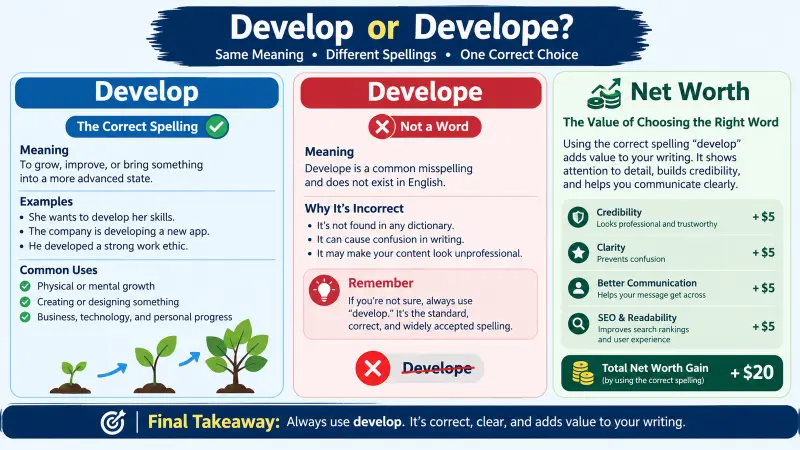
The main difference between develop or develope is that develop is the correct English spelling, whereas develope is an incorrect spelling in standard contemporary English. Understanding this distinction helps writers communicate clearly in professional, academic, and everyday situations.
What Does Develop Mean?
Develop is a verb that means to grow, progress, improve, build, or create something gradually. Depending on the context, it can describe personal growth, business expansion, software creation, or the emergence of a situation.
For example, a student can develop stronger writing skills through practice. Similarly, a company can develop a new product to meet customer needs.
The word also appears in several common expressions, including develop a strategy, develop an interest, develop a habit, and develop a relationship.
What Does Develope Mean?
Develope is a misspelling of develop in modern standard English. Although readers may recognize the intended meaning, the extra final letter creates a spelling error.
For instance, writing “We need to develope a better plan” is incorrect. The correct sentence is “We need to develop a better plan.”
Therefore, when writing in school, at work, or online, choose develop whenever you need this verb.
Quick Comparison Table
| Feature | Develop | Develope |
|---|---|---|
| Spelling status | Correct | Incorrect |
| Part of speech | Verb | Not a standard modern verb |
| Meaning | To grow, create, or improve | Intended meaning of develop |
| Formal writing | Accepted | Avoid |
| Academic writing | Accepted | Incorrect |
| Professional communication | Recommended | Spelling error |
| Example | Develop new skills | Develope new skills |
Mini recap
Develop is the correct spelling in contemporary English.
Develope is a common spelling mistake rather than a standard alternative.
Use develop in formal documents, everyday messages, and academic work.
Next, learn how to apply the correct form in different situations.
Is Develop vs Develope a Grammar, Vocabulary, or Usage Issue?
The difference between develop and develope is primarily a spelling issue, not a grammatical distinction between two valid words. Nevertheless, spelling accuracy affects grammar checking, readability, and the overall quality of written communication.
Are Develop and Develope Interchangeable?
No. Develop is the standard spelling, while develope is not an accepted alternative in contemporary standard English.
For example:
Correct: The team plans to develop a new training program.
Incorrect: The team plans to develope a new training program.
Although the intended meaning remains understandable, the incorrect version can distract readers from the message.
Formal vs Informal Usage
In formal communication, including business proposals, job applications, research papers, and official reports, always use develop.
Likewise, informal writing does not make develope correct. Even in text messages, social media posts, or personal notes, develop remains the appropriate spelling.
However, readers might overlook a minor typo in a casual conversation. That possibility does not make the alternative spelling acceptable.
Academic vs Casual Writing
Academic writing requires consistent spelling because errors can affect the perceived quality of an assignment. Therefore, students should write develop a hypothesis, develop an argument, or develop critical thinking skills.
Similarly, casual writers should use develop when discussing personal growth, hobbies, or future plans. Regardless of the setting, the spelling stays the same.
How to Use Develop Correctly
Develop works in numerous contexts because it can describe gradual change, deliberate creation, or the appearance of a condition. Consequently, understanding its meaning helps you choose the right expression.
Workplace Example
In professional communication, develop frequently describes creating strategies, improving employee abilities, and expanding business operations.
Example: Our department will develop a new customer service policy next month.
Here, develop means to create or prepare something through planning and effort.
Another example is, “Managers should develop their leadership skills through regular training.”
In both sentences, the verb communicates progress toward a practical objective.
Academic Example
In education, develop often refers to building knowledge, strengthening arguments, or improving research methods.
Example: Students must develop a clear argument before writing their final essays.
Similarly, “The researcher aims to develop a better understanding of language acquisition” uses the verb to describe advancing knowledge.
Therefore, develop is appropriate for assignments, dissertations, laboratory reports, and classroom discussions.
Technology Example
Technology professionals use develop when describing software, applications, digital products, and technical solutions.
Example: The company plans to develop a mobile application for online learning.
Likewise, “Engineers are developing a more efficient battery system” describes work that is currently in progress.
Notice that develop can change form according to the sentence. For instance, develops is used with a singular subject in the present tense, developed commonly describes the past, and developing can describe an ongoing process.
Usage recap: Use develop to describe creating, improving, growing, or advancing something. Choose the appropriate verb form according to the subject and tense, but never add an unnecessary final e.
How to Recognize and Correct Develope
Because develope looks similar to other English words, writers sometimes add an extra letter without noticing the error. However, a simple spelling check can prevent this mistake.
Why Do People Write Develope?
One reason is the influence of familiar spelling patterns. English contains verbs and related words with different endings, so writers may mistakenly assume that develop follows a similar pattern.
For example, envelope is a correctly spelled noun, while develop is a verb with a different ending. Their visual similarity may confuse beginners, even though they serve different grammatical purposes.
Another reason is typing too quickly. When writers focus on expressing an idea, they may overlook an extra letter at the end of a word.
How to Correct the Mistake
First, identify the intended meaning. If you mean to grow, create, improve, or bring something into existence, develop is usually the correct choice.
Next, check the sentence for tense and subject agreement. For example:
“The organization wants to develop new opportunities.”
“The organization develops new opportunities every year.”
“The organization developed new opportunities last year.”
Finally, proofread the complete sentence rather than checking only the individual word. This additional step can reveal other spelling or grammatical problems.
When You Should NOT Use Develop or Develope
Although develop is the correct spelling in this comparison, it is not appropriate for every situation. The intended meaning should determine your word choice.
Here are eight common scenarios to consider.
1. When you mean a person’s job title: Do not use develop to identify someone who creates software. Instead, use developer. For example, “She is a software developer.”
2. When you mean a completed product: If you want to name the result rather than the action, consider product, application, or creation. The correct noun depends on the context.
3. When you mean a physical discovery: If you simply found an existing object, discovered may be more accurate than developed.
4. When you mean immediate construction: Build may be more precise when describing the physical construction of a wall, house, or bridge.
5. When you mean learning a fact: Use learn or discover when the focus is gaining information rather than gradually improving a skill.
6. When you mean a sudden event: Occur or happen may better describe an event that takes place unexpectedly. Develop is more suitable when a condition emerges or changes over time.
7. When you mean a specific emotional reaction: Feel or experience may communicate the idea more naturally. For example, “I feel nervous” is more direct than “I develop nervousness.”
8. When you are tempted to write develope: Do not use this spelling as an alternative, even in a formal document, unless you are discussing the misspelling itself.
These distinctions help writers choose not only the correct spelling but also the most precise verb for their intended meaning.
Common Mistakes and Decision Rules for Develop vs Develope
The easiest way to master this distinction is to examine incorrect sentences and understand how to repair them.
| Correct sentence | Incorrect sentence | Explanation |
|---|---|---|
| We need to develop a new plan. | We need to develope a new plan. | Remove the unnecessary final e. |
| She wants to develop her communication skills. | She wants to develope her communication skills. | The verb keeps the spelling develop. |
| The company developed a new product. | The company develope a new product. | The incorrect version also fails to use the appropriate past tense. |
| He is developing a useful application. | He is developeing a useful application. | The correct form is developing, without an extra e. |
| This program develops problem solving skills. | This program develope problem solving skills. | A singular subject takes develops in the simple present. |
| They hope to develop stronger relationships. | They hope to develope stronger relationships. | The infinitive uses the base form develop. |
The Simple Decision Rule
If you mean the action of growing, creating, or improving something, use develop.
If you mean a person who performs development work, use developer.
If you mean a tool or product, name the specific item, such as an application or development tool.
Never use develope as the standard spelling of the verb.
This rule also corrects a common misconception: develop and develope do not represent an action versus a person or tool. Only develop is the standard verb in this comparison.
Develop and Develope in Modern Technology and Digital Tools
In contemporary technology, develop appears frequently in discussions about software engineering, product design, websites, and digital services.
For example, a development team might develop a website, test new features, and improve performance based on user feedback. Similarly, an educational organization might develop an online course to make learning more accessible.
Writing accuracy matters because technical documents often contain instructions, feature descriptions, and project updates that must be easy to understand.
Modern spelling and grammar checkers can flag develope as a likely error. However, automated checking should support, rather than replace, careful proofreading. Some tools may overlook a mistake if the surrounding sentence is unclear or if the error resembles a valid word.
Therefore, remember the correct spelling yourself instead of depending entirely on a correction tool.
The Etymology of Develop
The word develop entered English through French développer, meaning to unfold or reveal. Its historical sense is closely connected with the idea of bringing something into view or allowing it to grow.
Over time, the meaning expanded. Today, develop can describe the growth of a person, the creation of a business strategy, the formation of a relationship, or the production of a technological solution.
The spelling has become standardized as develop in modern English. Although older texts and historical documents may contain unusual spelling variations, that does not make develope an acceptable choice in contemporary standard writing.
Understanding this history also makes the word easier to remember. Think of development as a process in which an idea unfolds, a skill improves, or a situation gradually changes.
Expert Guidance on Correct Spelling
A useful editorial principle is that a word should communicate the intended meaning without introducing avoidable distractions.
“Clear writing begins with choosing the correct word and using it consistently.”
This is an editorial principle rather than a quotation attributed to a named linguist.
In practice, writers should distinguish spelling accuracy from grammatical accuracy. A sentence may have the correct structure but still contain a misspelled word. Likewise, a correctly spelled verb can appear in the wrong tense.
For example, “She develope a website” contains a spelling error and a subject agreement problem. The appropriate correction is “She develops a website.”
By checking both spelling and sentence structure, writers can improve clarity without making their writing unnecessarily complicated.
Two Practical Case Studies
The following case studies are illustrative examples showing how spelling corrections can improve written communication. They are not reports of independently measured experiments.
Case Study One: A Student Preparing an Assignment
A university student writes the sentence, “This research will develope a better understanding of reading habits.”
Although the intended meaning is clear, the misspelling makes the assignment look less carefully edited.
The student corrects the sentence to “This research will develop a better understanding of reading habits.”
The correction removes one spelling error while preserving the original meaning. After reviewing the rest of the assignment, the student also checks verb tense, punctuation, and subject agreement.
Result: The revised sentence follows standard spelling conventions and is more suitable for academic submission. No specific grade improvement can be guaranteed from correcting this single error.
Case Study Two: A Business Updating Its Website
Imagine a small business preparing a service page that states, “We develope customized solutions for our clients.”
The business owner notices the error during proofreading and replaces develope with develop.
The corrected sentence reads, “We develop customized solutions for our clients.”
The team then reviews the remaining page content to ensure that the same error does not appear in headings, service descriptions, or customer messages.
Result: The published wording follows standard English spelling and presents a more professional impression. The correction alone does not guarantee higher rankings, increased sales, or improved customer conversion.
Both examples demonstrate a practical lesson: a small spelling correction can improve the quality of communication, even when readers can already infer the intended meaning.
Error Prevention Checklist
Before submitting an assignment, publishing an article, or sending a professional message, use this quick checklist.
Always Use Develop When
- You mean to grow, improve, create, or advance something.
- You are writing about professional skills or personal growth.
- You are describing the creation of software, a website, or a business strategy.
- You need the base form after words such as to, will, can, or should.
- You are writing formal, academic, or casual English.
Never Use Develope When
- You intend to use the standard verb develop.
- You are preparing a résumé, report, presentation, or school assignment.
- You are describing a process of growth or improvement.
- You are editing public facing business content.
- You are relying on the appearance of a word rather than verifying its spelling.
Final Proofreading Tip
Remember that the spelling remains develop even when the word changes form.
| Verb form | Example |
|---|---|
| Base form | Develop a new skill. |
| Third person singular | She develops new skills. |
| Past tense | She developed new skills. |
| Present participle | She is developing new skills. |
| Noun form | Skill development takes time. |
| Person who develops something | The developer created an application. |
By memorizing these related forms, you can avoid the original spelling mistake and recognize the correct word in more complicated sentences.
Related Grammar Confusions You Should Master
Once you understand develop vs develope, consider learning these other common English spelling and usage distinctions.
- Affect vs Effect: Understand the usual difference between an action and its result.
- Advice vs Advise: Learn the distinction between a noun and a verb.
- Accept vs Except: Separate the meaning of receiving from the meaning of excluding.
- Their vs There: Distinguish possession from a reference to a place.
- Your vs You’re: Recognize the difference between possession and a contraction.
- Loose vs Lose: Avoid confusing something that is not tight with the act of misplacing something.
- Definitely vs Definately: Identify the correct spelling of a frequently misspelled adverb.
- Separate vs Seperate: Remember the correct spelling of a common word used in everyday writing.
- Develop vs Developer: Distinguish an action from the person or program that performs development work.
- Practice vs Practise: Understand how spelling and grammatical roles differ between American and British English.
These distinctions share one important lesson: similar looking words do not necessarily have the same meaning, spelling, or grammatical function.
Frequently Asked Questions
1. Is develop or develope the correct spelling?
Develop is the correct spelling in modern standard English. Develope is a misspelling and should not be used as an alternative. For example, write “We plan to develop a new strategy,” not “We plan to develope a new strategy.”
2. Why do people spell develop as develope?
People may add an extra e because of confusion with other English spelling patterns, typing mistakes, or uncertainty about word endings. However, the standard spelling is develop, with no final e.
3. Is develope ever correct in English?
Develope is not an accepted alternative spelling of the modern verb develop. You may encounter it in discussions of historical spelling or as an example of an error, but ordinary contemporary writing requires develop.
4. What does develop mean in simple English?
Develop means to grow, improve, create, or make something become more advanced over time. For example, a person can develop confidence, a student can develop knowledge, and a company can develop a product.
5. What is the past tense of develop?
The past tense is developed. For example, “The company developed a new application last year.” The spelling changes by adding ed to the base form, without inserting an extra e before the final d.
6. Is developing or developeing correct?
Developing is correct. The final e is not added when forming the present participle. For example, “She is developing a new skill” is correct, while “She is developeing a new skill” is incorrect.
7. What is the noun form of develop?
Common noun forms include development and developer. Development refers to the process or result of growing or creating something, while developer usually refers to a person or organization that develops something.
8. How do you use develop in a sentence?
You can use develop to describe progress, creation, or improvement. For example, “Students develop better writing skills through regular practice.” Here, develop describes the gradual improvement of a person’s abilities.
9. Is develop suitable for formal writing?
Yes. Develop is appropriate for professional reports, academic papers, business communication, and everyday writing. Because it is a standard English verb, you can use it whenever its meaning fits the sentence.
Conclusion:
When choosing between develop or develope, always use develop in modern standard English. It is the correct verb for describing growth, improvement, creation, and progress. In contrast, develope is a misspelling that should be avoided in academic assignments, professional documents, and everyday communication.
To remember the difference, focus on the correct spelling rather than adding an unnecessary final letter. Also, learn related forms such as developed, developing, develops, and development so you can use the word confidently in different contexts.
Ultimately, accurate spelling makes your writing clearer and more polished. Whenever you need to express the idea of creating or improving something, develop is the correct choice.