Have you ever wondered whether to write cancellations or cancelation in an email, report, or professional document? You are not alone. English spelling can be confusing, especially when similar words follow slightly different patterns in American and British English. Although both forms are used, understanding when and where they appear can help you write more clearly and confidently.
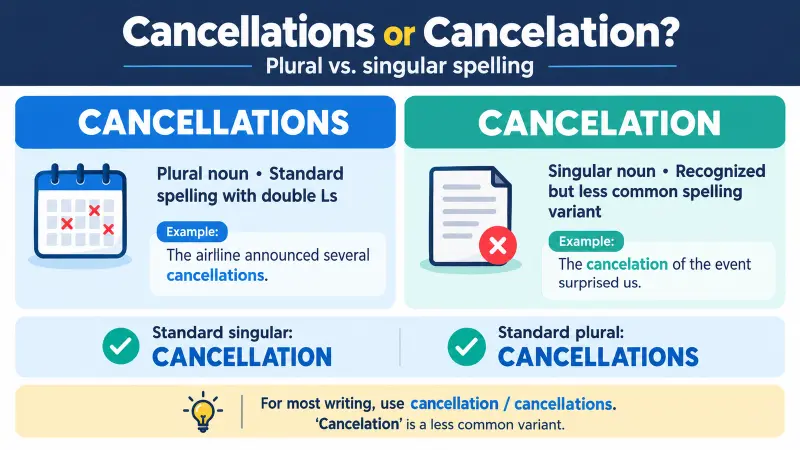
The key is to recognize the difference between cancellation and cancellations, as well as the less common spelling cancelation. In American English, cancellation is the standard and more widely accepted spelling, while cancelation is also a recognized variant. The plural form cancellations is created by adding an s to cancellation. These distinctions matter when writing business notices, booking updates, academic assignments, and everyday messages.
In this guide, we will explore the correct spellings, their meanings, practical examples, and common mistakes to avoid. Using established spelling conventions and clear grammatical explanations, this article will help you choose the right word for your audience and context. By the end, you will understand how to use each form accurately and make your writing more polished and professional.
Cancellations or Cancelation: What’s the Difference?
The main difference concerns spelling, grammatical number, and frequency of use. Although both words refer to the act of stopping, withdrawing, or calling something off, one is a plural noun and the other is a singular noun.
What Does Cancellation Mean?
Cancellation is a noun that describes the act or result of canceling an arrangement, event, order, reservation, subscription, or agreement.
For example, when a company decides not to hold a scheduled meeting, the decision may be described as a cancellation. Similarly, when a customer ends a recurring subscription, the process is called a cancellation.
The spelling cancellation is widely established in both American and British English. Furthermore, its plural form, cancellations, is the conventional choice in professional communication.
Examples include:
- The airline announced several cancellations because of severe weather.
- The cancellation of the meeting surprised everyone.
- Customers received notifications about their booking cancellations.
What Does Cancelation Mean?
Cancelation is an accepted variant spelling of the noun cancellation. It describes the same general action or outcome, but it uses one letter l after the first syllable rather than the doubled consonant found in cancellation.
Although American English sometimes permits this shorter spelling, cancellation remains much more common. Consequently, writers generally benefit from using cancellation unless a particular style guide or organizational standard specifies otherwise.
Examples include:
- The cancelation of the appointment was confirmed.
- The policy explains the cancelation procedure.
- A cancelation notice was sent to the customer.
These examples demonstrate that the meaning remains unchanged. However, because cancelation is less familiar to many readers, the traditional spelling is usually the safer option.
Comparison Table
| Feature | Cancellation | Cancelation |
|---|---|---|
| Part of speech | Noun | Noun |
| Grammatical number | Singular | Singular |
| Meaning | Act or result of canceling | Act or result of canceling |
| Regional usage | Standard in American and British English | Accepted American variant |
| Frequency | Much more common | Less common |
| Plural form | Cancellations | Cancelations |
| Professional suitability | Recommended | Depends on style requirements |
| Best general choice | Yes | Usually unnecessary |
Quick recap: Both words describe the same concept.
Cancellation is the preferred spelling for most situations.
Cancelation is a recognized alternative, especially in American usage.
For formal writing, choose cancellation unless your publication or institution requires a different spelling.
Is Cancellations or Cancelation a Grammar, Vocabulary, or Usage Issue?
The distinction is primarily a spelling and usage issue, rather than a difference in meaning. Both forms function as nouns, and neither represents a completely different action.
Nevertheless, understanding grammatical number is essential because cancellation and cancellations aren’t interchangeable in every sentence.
Are the Two Spellings Interchangeable?
At the level of meaning, cancellation and cancelation are interchangeable singular nouns. However, the plural forms are cancellations and cancelations, respectively.
For example:
Correct: The cancellation of the flight was announced.
Also acceptable: The cancelation of the flight was announced.
Plural example: Several cancellations occurred during the storm.
The first plural example is preferable because it follows the more widely established spelling.
Formal Versus Informal Writing
In formal communication, consistency matters more than choosing an unusual variant. Therefore, reports, contracts, policies, and professional correspondence generally benefit from using cancellation.
In casual messages, readers will usually understand either spelling. Even so, familiarity makes the conventional form easier to recognize.
For instance, a text message might say, “My appointment cancellation was confirmed.” However, a customer service policy should ordinarily use the same spelling throughout every section.
Academic Versus Casual Usage
Academic writers should follow the spelling conventions required by their institution or style guide. Although cancelation is a recognized variant, cancellation is the more dependable choice when no specific guidance exists.
Similarly, students should avoid switching between the two forms within the same essay. Such inconsistency can appear careless, even when both spellings are technically acceptable.
Ultimately, the distinction concerns conventional spelling and editorial consistency rather than a change in definition.
How to Use Cancellations Correctly
The word cancellations is the plural form of cancellation. Therefore, use it when referring to two or more canceled events, bookings, orders, services, or arrangements.
Workplace Example
Consider a travel company managing reservations during a period of bad weather.
Correct sentence: “We recorded twelve flight cancellations this morning.”
Here, cancellations identifies multiple flights that will not operate as scheduled. Because the sentence refers to several separate events, the plural noun is appropriate.
Another example is a project manager explaining changes to a schedule.
“The team reviewed all meeting cancellations before preparing the revised calendar.”
This wording is suitable because it communicates several canceled meetings in a clear, professional manner.
Academic Example
Suppose a researcher studies public transportation disruptions.
“The report examined seasonal flight cancellations across five major airports.”
The plural form works because the research considers multiple canceled flights. Furthermore, the sentence uses a precise noun that fits formal analytical writing.
Similarly, a student might write, “Unexpected cancellations affected the survey schedule.” This construction is appropriate when multiple planned activities were called off.
Technology Example
Digital platforms often display cancellation information in dashboards, notifications, and transaction histories.
For instance, an online booking system might report, “Your account contains three recent cancellations.”
Likewise, a subscription management application could show, “Review your cancellations to understand your recent account changes.”
In both examples, the plural noun describes several separate records or actions.
Usage recap: Choose cancellations when referring to multiple canceled arrangements. It is the conventional plural form and is suitable for workplace documents, academic reports, and digital interfaces.
How to Use Cancelation Correctly
The spelling cancelation is an accepted singular noun variant. Nevertheless, because it is less common than cancellation, writers should use it selectively and follow any applicable house style.
Workplace Example
Imagine a company whose internal documentation consistently uses the shorter spelling.
“The cancelation of the training session was approved by management.”
The sentence is understandable, and the noun refers to one canceled session. However, if the organization normally writes cancellation, the sentence should follow that convention instead.
Consistency is especially important in employee handbooks, contracts, and official announcements.
Academic Example
A writer discussing spelling variations might explain that cancelation is an accepted alternative to cancellation.
For example: “The dictionary records cancelation as a variant spelling of cancellation.”
Here, the shorter form is useful because the sentence specifically discusses that spelling. However, the writer should avoid switching between variants without a reason.
Technology Example
Suppose a software company has adopted cancelation throughout its interface.
“The cancelation request has been received.”
Although understandable, this wording may look unusual to users accustomed to the more common spelling. Therefore, product teams should evaluate familiarity, accessibility, and consistency before choosing a variant.
For most new applications, cancellation is the safer default.
Usage recap: Use cancelation when you have a specific reason to follow that spelling. Otherwise, cancellation is generally more familiar and widely accepted.
When You Should NOT Use Cancellations or Cancelation
Although the two spellings share a meaning, several common situations require a different word or grammatical form. Recognizing these cases prevents mistakes in everyday and professional writing.
1. Do Not Use a Plural Noun for One Event
Incorrect: “The cancellations of my appointment was confirmed.”
Correct: “The cancellation of my appointment was confirmed.”
Because the sentence describes one appointment, the singular noun is appropriate. Moreover, the singular subject requires a singular verb.
2. Do Not Use the Singular Form for Multiple Events
Incorrect: “The cancellation of three flights were reported.”
Correct: “The cancellations of three flights were reported.”
Here, the sentence refers to several canceled flights. Therefore, the plural noun and plural verb fit the intended meaning.
3. Do Not Confuse a Noun With a Verb
Incorrect: “We cancellation the order yesterday.”
Correct: “We canceled the order yesterday.”
The first sentence uses a noun where a verb is needed. Instead, use cancel, canceled, or cancelled, depending on the tense and spelling convention.
4. Do Not Confuse Cancellation With Cancelation in One Document
Switching between spellings without a reason can make a document look inconsistent. For example, using cancellation policy in one heading and cancelation terms in another creates an unnecessary variation.
Choose one spelling and apply it throughout the document.
5. Do Not Assume Every Shorter Spelling Is Better
A shorter word isn’t automatically more correct or easier to understand. Although cancelation contains fewer letters, its relative unfamiliarity may distract readers.
Consequently, the more common spelling is usually the better editorial choice.
6. Do Not Ignore a Required Style Guide
A publisher, university, employer, or legal organization may prescribe particular spelling conventions. Therefore, follow those requirements rather than imposing a personal preference.
7. Do Not Use Cancellation When You Mean a Different Action
Canceling an order differs from postponing it. Similarly, canceling a meeting is not necessarily the same as rescheduling it.
Use cancellation only when an arrangement is called off, withdrawn, or terminated in the relevant sense.
8. Do Not Forget the Plural Ending
Incorrect: “There were several cancellation.”
Correct: “There were several cancellations.”
The determiner several indicates more than one item. Accordingly, the noun must be plural.
Common Mistakes and Decision Rules
Spelling confusion often arises because English uses different patterns when forming nouns from verbs. In this case, the verb cancel generally produces the noun cancellation, with a doubled l.
However, the accepted variant cancelation follows a shorter spelling pattern. Although this explains why both forms exist, it doesn’t mean they are equally common.
Correct and Incorrect Sentence Table
| Correct sentence | Incorrect sentence | Explanation |
|---|---|---|
| The cancellation was announced. | The cancelation was announced, despite a required house style using cancellation. | The variant conflicts with the stated style requirement. |
| Several cancellations occurred. | Several cancellation occurred. | The plural determiner requires a plural noun. |
| The cancellation has been confirmed. | The cancellations has been confirmed. | A singular verb requires a singular subject. |
| We canceled the booking. | We cancellation the booking. | A verb is needed to describe the action. |
| The cancellations were unexpected. | The cancellations was unexpected. | The plural subject requires a plural verb. |
| One cancellation affected the schedule. | One cancellations affected the schedule. | The word one requires a singular noun. |
A Simple Decision Rule
If you mean one canceled event or action, use cancellation.
If you mean multiple canceled events or actions, use cancellations.
If you encounter cancelation, recognize it as a valid singular variant, but prefer cancellation for general writing.
This rule is more reliable than choosing a spelling based only on appearance. Furthermore, it accounts for the difference between singular and plural forms.
One additional clarification is important: the instruction to use one spelling for an action and another for a person or tool does not apply here. Both cancellation and cancelation are nouns describing an event or process, not a person or instrument.
Cancellations and Cancelation in Modern Technology
Modern booking platforms, payment systems, subscription services, and scheduling applications frequently use cancellation terminology. As a result, clear spelling is essential for customer communication.
For example, a travel application might display a cancellation confirmation after a passenger withdraws a reservation. Likewise, a subscription dashboard might record multiple cancellations in an account history.
Automated writing assistants and grammar checkers may recognize both spellings, although their recommendations can vary according to regional settings and dictionaries. Therefore, users should verify the selected language variety before accepting a suggestion.
For software developers, consistency is particularly valuable. If a platform uses cancellation policy, its buttons, help articles, emails, and confirmation messages should ordinarily follow the same convention.
Ultimately, familiar terminology improves readability and reduces avoidable confusion.
Etymology: Why Are Both Spellings Used?
The verb cancel entered English through French and ultimately derives from Latin cancellare, meaning to cross out or mark with a lattice like pattern.
Over time, English developed the noun cancellation, using the suffix ation to describe the act or result of canceling. The doubled l reflects an established spelling pattern associated with the word.
Meanwhile, cancelation emerged as a simplified variant that removes one of those letters. Although the shorter form is accepted in some American English references, cancellation remains the dominant spelling.
This historical development explains why the two forms coexist. Nevertheless, present day usage favors the traditional spelling in most contexts.
Expert Style Insight: Which Form Should Writers Choose?
“The clearest spelling is usually the one your readers recognize, your style guide supports, and your document uses consistently.”
This editorial principle captures the practical choice between the two variants. Rather than treating every spelling difference as a question of absolute correctness, writers should consider accepted usage, intended audience, and consistency.
For example, an American writer may encounter cancelation in a dictionary and reasonably understand it as valid. However, a publication that consistently uses cancellation should retain that form throughout its content.
Likewise, an international business should favor familiar terminology unless its internal standards specify otherwise. In this case, conventional spelling provides a straightforward solution.
Two Practical Case Studies
The following illustrative scenarios demonstrate how spelling consistency affects communication. They are examples for educational purposes, not reports of independently measured outcomes.
Case Study 1: An Airline Notification
Imagine an airline preparing a message about disruptions caused by severe weather.
Its original draft reads: “Multiple cancelations may affect your travel plans.”
Although readers can understand the sentence, the communications team decides to use the more familiar spelling.
The revised version reads: “Multiple cancellations may affect your travel plans.”
The updated message maintains the same meaning while following conventional spelling. Moreover, the airline can apply that choice across text messages, website announcements, and customer support scripts.
Practical result: The terminology becomes consistent across communication channels, reducing editorial variation.
Case Study 2: A Subscription Management Platform
Consider a software company that uses both cancellation and cancelation in different parts of its interface.
One screen displays “Cancellation successful,” while another displays “Cancelation history.” This inconsistency may lead users to wonder whether the labels refer to different functions.
The company standardizes its interface on cancellation and cancellations.
As a result, the terminology becomes more predictable across confirmation screens, account settings, and support documentation.
Practical result: The product uses a consistent vocabulary, making its interface easier to scan and maintain.
These examples show that choosing the conventional spelling is not merely a cosmetic decision. Instead, it supports a coherent writing system.
Error Prevention Checklist
Before submitting a document, review the following points.
Always Use Cancellations When
- You are referring to multiple canceled events, orders, reservations, or services.
- Your sentence requires the plural noun.
- You are following a style guide that specifies the conventional spelling.
- You want a familiar term for general professional communication.
- You need consistency across headings, reports, notifications, and support materials.
Prefer Cancellation Instead of Cancelation When
- You are referring to a single canceled event.
- Your audience expects conventional English spelling.
- You are preparing academic, business, or formal writing.
- You do not have a specific reason to choose the variant.
- You want to minimize unnecessary spelling variation.
Never Use Cancelation When
- Your publisher explicitly requires cancellation.
- You are using it as a verb instead of a noun.
- Your sentence requires the plural form but you have written the singular.
- You are switching between spellings without a deliberate editorial reason.
This checklist helps writers make a quick decision without memorizing unnecessary rules.
Related Grammar Confusions You Should Master
English contains many words that look or sound similar but differ in meaning, grammatical role, or regional preference. Understanding these distinctions improves writing accuracy.
- Canceled or Cancelled: Both spellings are accepted, with regional preferences differing.
- Traveler or Traveller: American English generally favors the shorter spelling, while British English often doubles the consonant.
- Center or Centre: These forms reflect American and British spelling conventions.
- Color or Colour: Both are correct within their respective regional standards.
- Organize or Organise: The preferred spelling depends on the variety of English and the applicable style guide.
- Judgment or Judgement: Both occur, although usage varies by region and context.
- Practice or Practise: British English distinguishes the noun from the verb, while American English generally uses practice for both.
- Advice or Advise: The first is a noun, whereas the second is a verb.
- Affect or Effect: These words have different grammatical roles and meanings in many common contexts.
- Fewer or Less: The choice usually depends on whether the noun is countable or uncountable.
These examples demonstrate that spelling and usage questions often require more than comparing individual letters. Context, grammar, and regional conventions all influence the correct choice.
Frequently Asked Questions
1. Is cancellations or cancelation the correct spelling?
Both are recognized forms, but they are not the same grammatical number. Cancellations is plural, while cancelation is a singular variant. For most writing, use cancellation for one event and cancellations for multiple events.
2. Is cancelation a real word in American English?
Yes. Cancelation is an accepted American English spelling variant. However, cancellation is much more common and is generally the preferred form in professional communication.
3. Why does cancellation have two l letters?
The spelling cancellation reflects an established English word formation pattern. It combines the base associated with cancel and the noun forming suffix ation, retaining the doubled l in the conventional spelling.
4. What is the plural of cancelation?
The plural is cancelations. Nevertheless, because cancellation is the more common singular form, its plural cancellations is generally the better choice for everyday and professional writing.
5. Should I write flight cancellations or flight cancelations?
Write flight cancellations in most cases. Although flight cancelations can be understood and follows the accepted variant spelling, the version with two l letters is more familiar and conventional.
6. Is cancellation British or American English?
Cancellation is standard in both American and British English. Therefore, it is a dependable choice for international audiences, academic work, and formal documents.
7. Is cancelation grammatically incorrect?
No. Cancelation is a recognized variant spelling, so it is not inherently grammatically incorrect. However, it may be inappropriate when a publication, institution, or organization requires the spelling cancellation.
8. What is the difference between cancellation and cancelation in a sentence?
There is generally no difference in meaning. Both refer to the act or result of canceling something. The distinction lies in spelling preference and frequency, rather than the action being described.
9. Should I use cancellations in formal writing?
Yes. Use cancellations when referring to multiple canceled events in formal writing. It is the conventional plural form and works well in business reports, academic assignments, policy documents, and customer notices.
Conclusion:
When deciding between cancellations or cancelation, remember that the difference concerns spelling conventions and grammatical number rather than meaning. Cancellation is the widely preferred singular form, while cancellations is its conventional plural. By contrast, cancelation is an accepted but less common singular variant.
For everyday writing, professional documents, academic assignments, and customer communications, choose cancellation for one event and cancellations for multiple events. Furthermore, follow your organization’s style guide and maintain consistency from beginning to end.
Ultimately, the simplest approach is also the most reliable: use the familiar spelling unless your specific writing requirements call for an alternative.