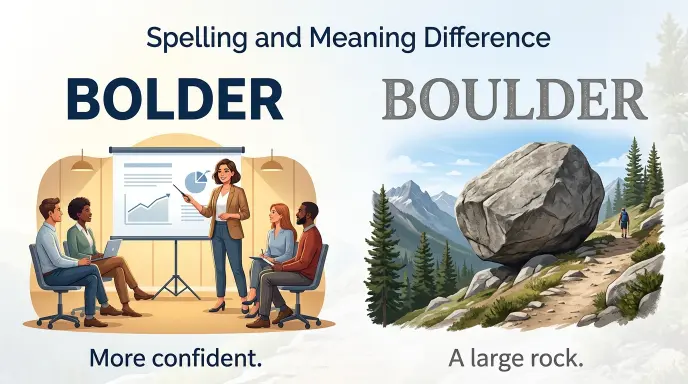
Have you ever wondered whether the correct word is bolder or boulder? These two words look and sound similar, but they have completely different meanings. Choosing the wrong one can change the meaning of your sentence and make your writing confusing. Whether you are learning English, improving your spelling, or writing content for school or work, understanding the difference is important. The good news is that you can learn to use both words correctly with a few simple explanations and practical examples.
The word bolder is the comparative form of bold and describes someone or something that is more confident, daring, noticeable, or courageous. For example, “She became bolder when speaking in public.” In contrast, boulder is a large rock, often found in mountains, rivers, forests, and other natural environments. For example, “A huge boulder blocked the path.” Understanding each word’s definition, grammatical role, and context makes it easier to choose the correct spelling when writing.
In this guide, we will explain bolder vs boulder in simple English, including their meanings, differences, pronunciation, and everyday usage. You will also discover example sentences, common spelling mistakes, and easy memory tricks to help you remember which word belongs in each situation. By examining standard definitions and practical examples, this guide aims to make the distinction clear for students, English learners, bloggers, and professional writers. By the end, you will be able to use bolder and boulder confidently and avoid confusing these commonly mixed-up words in your writing.
Bolder vs Boulder: What’s the Difference?
Although bolder and boulder have similar pronunciations, they serve entirely different purposes in English. Therefore, understanding their definitions is the easiest way to choose the correct word.
What Does Bolder Mean?
Bolder is an adjective used to compare two people, actions, ideas, colors, or objects according to their degree of boldness.
It means more courageous, confident, daring, striking, or noticeable than something else. For example, a person might become bolder when speaking in public, or a designer might choose a bolder color for a poster.
Examples:
- She became bolder after practicing her presentation.
- This red shade looks bolder than the previous one.
- The manager suggested a bolder approach to the problem.
In each example, the word describes a greater degree of a particular quality. Consequently, it does not refer to a physical object such as a stone.
What Does Boulder Mean?
Boulder is a noun that refers to a large rock. These natural formations commonly appear in mountains, rivers, forests, deserts, and other outdoor environments.
Boulders can be found on the ground, embedded in hillsides, or scattered across rocky landscapes. Moreover, climbers often use large rocks as surfaces for climbing activities.
Examples:
- A massive boulder blocked the narrow mountain trail.
- The children sat on a smooth boulder beside the river.
- Heavy rain caused a boulder to roll down the hillside.
In these sentences, boulder names a physical object rather than describing someone’s personality or an object’s appearance.
Comparison Table
| Feature | Bolder | Boulder |
|---|---|---|
| Part of speech | Adjective | Noun |
| Meaning | More courageous or noticeable | A large rock |
| Root word | Bold | Boulder |
| Common context | Confidence, design, decisions | Geology, nature, climbing |
| Example | He made a bolder choice. | The boulder was enormous. |
| Grammatical function | Describes a noun | Names an object |
Quick recap: Bolder describes a greater degree of boldness, while boulder identifies a large rock. Furthermore, bolder usually compares qualities, whereas boulder names something tangible. Therefore, consider whether your sentence describes a characteristic or refers to a physical object before choosing the spelling.
Is Bolder vs Boulder a Grammar, Vocabulary, or Usage Issue?
The confusion between these words is primarily a vocabulary and spelling issue, although grammar also helps distinguish them.
Are Bolder and Boulder Interchangeable?
No. These words are not interchangeable because they communicate different ideas.
For instance, the sentence “She became bolder during the interview” describes increasing confidence. However, “She climbed onto a boulder during the hike” describes a physical action involving a large rock.
Replacing one word with the other changes the meaning entirely. Therefore, writers should never choose between them simply because they sound similar.
Formal Versus Informal Usage
Both terms are acceptable in formal and informal English. Nevertheless, their suitability depends on the intended message.
In a professional report, bolder might describe a more ambitious strategy. Meanwhile, boulder could appear in a geological assessment describing the size and position of rocks.
In casual conversation, someone might say, “Be bolder when sharing your ideas,” or “Watch out for that boulder.” Neither word is restricted to a particular level of formality.
Academic Versus Casual English
Academic writing often uses boulder in geology, geography, environmental science, and outdoor safety discussions. Similarly, bolder appears in literary analysis, psychology discussions, design criticism, and comparative descriptions.
In everyday conversation, the same distinctions apply. Although the setting changes, the meanings remain consistent.
Why Pronunciation Causes Confusion
Both words are commonly pronounced similarly in English, making them examples of homophones for many speakers. Homophones are words that sound alike but have different meanings and spellings.
As a result, speech recognition and hurried typing can sometimes produce the wrong spelling. Nevertheless, the surrounding sentence usually reveals which word belongs there.
How to Use Bolder Correctly
Use bolder whenever you want to express increased courage, confidence, intensity, or visual prominence.
Because it is the comparative form of bold, it often appears alongside the word than. However, the comparison can also be understood from the surrounding context.
Workplace Example
Consider a marketing team deciding how to introduce a new product.
“The director recommended a bolder advertising strategy.”
Here, bolder means more daring or attention grabbing than the existing strategy. Consequently, the sentence communicates a change in approach without referring to any physical object.
Another example is: “During the meeting, the junior employee became bolder about sharing suggestions.”
This sentence describes growing confidence in a professional environment.
Academic Example
In a literature assignment, a student might write:
“The author adopts a bolder tone in the final chapter.”
The adjective describes a stronger or more daring writing style. Similarly, an art student might observe that one painting uses bolder colors than another.
In both cases, the word communicates a comparison involving a characteristic.
Technology Example
Suppose a designer is improving a mobile application’s interface.
“The updated dashboard uses bolder headings to improve readability.”
Here, bolder describes headings that appear more prominent, often because of heavier font weight, stronger contrast, or greater visual emphasis.
However, the word does not automatically mean that text is larger. A typeface can look bolder because its letter strokes are thicker, even when its size remains unchanged.
Usage Recap
Use bolder for increased confidence, stronger visual emphasis, or a more daring quality. Furthermore, check whether your sentence compares a characteristic with an earlier version, another person, or an alternative choice.
How to Use Boulder Correctly
Use boulder when referring to a large rock, whether it appears in a natural landscape or forms part of a constructed environment.
Unlike bolder, this word names an object. Therefore, it commonly appears with descriptive adjectives such as large, massive, jagged, smooth, or weathered.
Workplace Example
A construction supervisor might report:
“A large boulder was discovered beneath the proposed building site.”
In this situation, the rock could affect excavation plans, equipment requirements, or project costs. Accordingly, the word identifies a physical obstacle that workers need to assess.
Academic Example
A geography student might write:
“Glacial movement can transport large boulders across a landscape.”
This sentence describes a geological process. In addition, researchers may examine the shape, composition, and location of a boulder to understand the environmental conditions that influenced its movement.
Technology Example
In a mapping application, a developer might record a large boulder as a landmark along a hiking route.
For example, “The navigation system marks the boulder near the northern trail entrance.”
Here, the word identifies a physical feature that may help hikers recognize their location. Likewise, outdoor mapping software can record rocks, cliffs, streams, and other landmarks.
Usage Recap
Choose boulder when your sentence refers to a large rock. If the object can be described as something a person could see, approach, climb, or move around, boulder may be the appropriate term.
When You Should NOT Use Bolder or Boulder
Although the difference is straightforward, several situations can lead to mistakes. Therefore, examine the meaning of the complete sentence rather than relying on sound alone.
- Do not use boulder to describe confidence. Write “She became bolder during discussions,” not “She became boulder during discussions.” The intended meaning concerns a personal quality, not a rock.
- Do not use bolder to identify a stone. Write “The boulder blocked the road,” rather than “The bolder blocked the road.” The sentence refers to a physical object.
- Do not confuse comparative and base forms. If you are comparing two designs, bolder may be appropriate. However, when no comparison is intended, bold might be more natural. For example, “The headline is bold” does not necessarily require bolder.
- Do not assume every description needs a comparative. The sentence “The boulder is large” is complete without bolder. The noun identifies the object, while the adjective describes its size.
- Do not rely exclusively on pronunciation. Since the words sound similar for many speakers, spelling from memory can introduce errors. Instead, identify the intended meaning first.
- Do not substitute one word during proofreading without checking context. Automatic spelling tools may miss a real word used incorrectly. Consequently, a sentence can contain a correctly spelled word that communicates the wrong idea.
- Do not use boulder as a synonym for boldness. A person may show courage, but that quality is not a boulder. Use boldness for the characteristic and boulder for the rock.
- Do not assume bolder always means visually larger. In design, it can refer to stronger contrast, heavier lettering, or a more striking appearance. Therefore, specify the intended visual characteristic when precision matters.
Common Mistakes and Decision Rules
The following examples demonstrate how a small spelling change can alter the intended message.
| Correct sentence | Incorrect sentence | Explanation |
|---|---|---|
| She made a bolder decision. | She made a boulder decision. | The intended meaning concerns a more daring choice, so the adjective is required. |
| A boulder fell onto the path. | A bolder fell onto the path. | The sentence identifies a rock, so the noun is necessary. |
| The second design is bolder than the first. | The second design is boulder than the first. | A comparison of visual qualities requires the comparative adjective. |
| The hikers climbed over a boulder. | The hikers climbed over a bolder. | The hikers encountered a physical rock. |
| He became bolder after training. | He became boulder after training. | Training increased his confidence, not his physical resemblance to a rock. |
| The boulder rested beside the stream. | The bolder rested beside the stream. | The sentence names a natural object rather than describing a characteristic. |
A Simple Decision Rule
If you mean greater boldness, use bolder. If you mean a large rock, use boulder.
For additional accuracy, ask yourself two questions:
First, am I describing someone or something as more confident, daring, or visually prominent? If so, bolder is likely correct.
Second, am I referring to a physical rock? If so, choose boulder.
This simple test resolves most everyday spelling problems involving these terms.
Bolder and Boulder in Modern Technology
Digital communication has made spelling accuracy increasingly important because people frequently write through voice dictation, messaging applications, predictive keyboards, and automated editing tools.
For example, someone might dictate “Make the heading bolder,” but a speech recognition system could produce the wrong word if the surrounding context is unclear.
Similarly, a hiking application may use boulder to describe a landmark or potential trail obstacle. In contrast, a graphic design application may offer controls that make text appear bolder.
Although spelling checkers can identify many mistakes, they may not detect every incorrect word substitution. Both terms are valid English words, so the sentence’s meaning remains essential.
Therefore, proofread according to context rather than accepting every automated suggestion.
Etymology: Where Do Bolder and Boulder Come From?
Understanding the origins of these words can make their differences easier to remember.
Origin of Bolder
Bolder comes from the adjective bold, which developed from older Germanic forms associated with courage, confidence, and daring.
The ending er forms the regular comparative adjective in this case. For example, bold becomes bolder, just as cold becomes colder and old becomes older.
Consequently, the spelling reflects a grammatical relationship rather than the name of a physical object.
Origin of Boulder
Boulder is an English noun historically associated with large stones or rounded rocks. Its precise historical development is less straightforward than the modern spelling might suggest.
Today, the term is widely used in geology, geography, mountaineering, and everyday descriptions of rocky landscapes.
Although the words resemble one another, their histories and grammatical functions are distinct.
An Expert Style Explanation
A useful language principle is that a word should be selected according to its meaning and grammatical function, not merely its pronunciation.
As a practical editorial guideline:
“Accurate word choice begins with the meaning a sentence needs to communicate. Similar sounds should never outweigh context, grammar, and clarity.”
This principle applies beyond the present comparison. For example, writers must distinguish brake from break, principal from principle, and complement from compliment.
Likewise, recognizing the difference between bolder and boulder helps prevent avoidable confusion in academic work, workplace documents, and everyday messages.
Two Practical Case Studies
The following illustrative examples demonstrate how choosing the right word improves communication.
Case Study 1: A Marketing Presentation
A marketing employee prepares a presentation comparing two advertising concepts. The first design uses muted colors, while the second uses brighter shades and stronger typography.
Initially, the employee writes, “The second design is boulder than the first.”
However, the sentence refers to visual prominence rather than a physical rock. After correction, the sentence reads, “The second design is bolder than the first.”
Result: The revised wording accurately communicates the intended comparison and prevents readers from misinterpreting the sentence.
Case Study 2: A Hiking Safety Report
A hiking guide documents a large rock that has fallen near a mountain trail. The initial report states, “A bolder is blocking the eastern route.”
Because the sentence describes a physical object, the correct version is, “A boulder is blocking the eastern route.”
Result: The corrected report identifies the obstacle accurately and makes the safety information easier to understand.
These examples are illustrative scenarios rather than measured experiments. Nevertheless, they show why context based proofreading is useful in practical communication.
Error Prevention Checklist
Before publishing or submitting a sentence, use the following checklist to verify your word choice.
Always Use Bolder When
- You mean more courageous or confident.
- You are comparing two personalities, decisions, or actions.
- You describe stronger visual emphasis in typography or design.
- You mean more daring, noticeable, or striking.
- Your sentence compares a quality with another example.
Never Use Boulder When
- You intend to describe confidence or courage.
- You are comparing colors, designs, personalities, or writing styles.
- You mean a greater degree of boldness.
- The sentence requires a comparative adjective rather than the name of an object.
Always Use Boulder When
- You are describing a large rock.
- You are writing about geology, mountains, hiking, or landscapes.
- You identify a stone as an obstacle or landmark.
- Your sentence names a physical object rather than a personal quality.
Finally, read the sentence aloud and replace the disputed word with its definition. If the meaning no longer makes sense, reconsider your spelling choice.
Related Grammar Confusions You Should Master
Learning to distinguish similar sounding words can improve spelling, reading comprehension, and professional writing. Therefore, consider studying these related pairs as well.
- Bold vs Bolder: Understand the difference between a base adjective and its comparative form.
- Boulder vs Stone: Learn how a large rock differs from a general term for a piece of rock.
- Braver vs Brave: Recognize how comparative adjectives express differences in degree.
- Break vs Brake: Distinguish damage or interruption from a device used to slow a vehicle.
- Principal vs Principle: Separate a person or main item from a fundamental rule.
- Affect vs Effect: Understand the common distinction between influencing something and the resulting outcome.
- Compliment vs Complement: Differentiate praise from something that completes or enhances another thing.
- Loose vs Lose: Separate an adjective meaning not tight from a verb meaning to misplace or fail to retain.
- Than vs Then: Use than for comparisons and then for time or sequence.
- Their vs There: Distinguish possession from a reference to a place or existence.
By mastering these distinctions, you can improve sentence accuracy and reduce common writing errors.
Frequently Asked Questions
1. What is the difference between bolder and boulder?
Bolder is the comparative form of bold, meaning more confident, daring, or noticeable. Meanwhile, boulder is a noun referring to a large rock. Although the words sound alike, they have different meanings and grammatical functions.
2. Is bolder a real word?
Yes, bolder is a standard English word. It is formed by adding the comparative ending er to bold. For example, “Her presentation became bolder after several revisions.”
3. Is boulder a noun or an adjective?
Boulder is a noun. It names a large rock found in natural environments or other settings. For instance, “The boulder stood beside the hiking trail.”
4. How do you use bolder in a sentence?
Use bolder when describing something that has become more confident, daring, or visually prominent. For example, “The designer selected a bolder font for the headline.”
5. How do you use boulder in a sentence?
Use boulder when referring to a large rock. For example, “The hikers stopped to rest beside a massive boulder.”
6. Are bolder and boulder pronounced the same?
For many English speakers, the words are pronounced alike or very similarly. However, pronunciation can vary by accent. Because their sounds may overlap, spelling and sentence context are important.
7. Is bolder the comparative form of bold?
Yes. Bolder is the regular comparative form of bold. For example, “This approach is bolder than the previous one.” The word expresses a greater degree of boldness.
8. Can boulder be used to describe a person’s personality?
Not in the ordinary sense of describing courage or confidence. For that meaning, use bold or bolder. Although boulder might appear figuratively in creative writing, its standard meaning refers to a large rock.
9. Why do people confuse bolder and boulder?
People often confuse these words because they sound similar in many accents. Additionally, typing mistakes, voice dictation, and unfamiliarity with their meanings can contribute to errors. Checking the sentence’s intended meaning usually resolves the problem.
Conclusion:
The correct choice depends on what you want to communicate. Bolder describes something that is more courageous, confident, daring, or visually prominent. In contrast, boulder refers to a large rock.
Although these words sound alike, they cannot be substituted for one another in ordinary usage. Therefore, focus on the meaning of your sentence before deciding which spelling to use.
Remember this simple rule: if you are comparing a quality, choose bolder. If you are naming a large rock, choose boulder. With this distinction in mind, you can write more clearly and avoid one of English’s easily overlooked word choice mistakes.









