Have you ever wondered whether PEDMAS or PEMDAS is the correct way to remember the order of operations in mathematics? If you have seen both terms in textbooks, online lessons, or homework questions, you are not alone. Many students become confused when the letters D and M appear in different positions. Although the acronyms look different, they refer to the same basic mathematical principle.
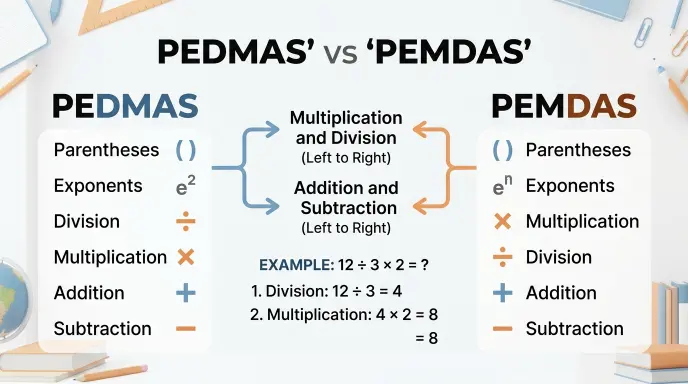
PEMDAS stands for Parentheses, Exponents, Multiplication, Division, Addition, and Subtraction. PEDMAS places division before multiplication in the acronym. However, this difference does not change the actual rules of calculation. Multiplication and division have equal priority, just as addition and subtraction do, so operations at the same level are generally evaluated from left to right.
In this guide, you will learn the meanings of PEDMAS and PEMDAS, understand their differences, and explore simple examples with step-by-step solutions. You will also discover common mistakes, practical tips, and practice questions to strengthen your understanding. Whether you are a student, parent, or teacher, this explanation will help you approach order-of-operations problems with greater accuracy and confidence.
What Does PEDMAS or PEMDAS Mean?
PEDMAS and PEMDAS are memory aids that help students solve mathematical expressions in the correct order. Although their letters arrange multiplication and division differently, neither operation automatically takes priority over the other. Instead, both are evaluated from left to right after parentheses and exponents have been handled.
For example, when solving 18 ÷ 3 × 2, you must divide first because division appears before multiplication from left to right. Therefore, the result is 12, not 3.
Likewise, addition and subtraction share the same priority level. Consequently, understanding these rules matters more than memorizing the letters alone.
PEDMAS vs PEMDAS: What’s the Difference?
PEDMAS and PEMDAS are mathematical acronyms rather than grammatical terms. They help learners remember the sequence used to evaluate mathematical expressions accurately.
PEDMAS stands for:
- Parentheses
- Exponents
- Division
- Multiplication
- Addition
- Subtraction
PEMDAS stands for:
- Parentheses
- Exponents
- Multiplication
- Division
- Addition
- Subtraction
Although the middle letters appear in a different order, both abbreviations communicate the same calculation principles.
Comparison Table
| Feature | PEDMAS | PEMDAS |
|---|---|---|
| Full form | Parentheses, Exponents, Division, Multiplication, Addition, Subtraction | Parentheses, Exponents, Multiplication, Division, Addition, Subtraction |
| Category | Mathematical mnemonic | Mathematical mnemonic |
| Primary purpose | Remembering calculation order | Remembering calculation order |
| Multiplication and division | Equal priority | Equal priority |
| Addition and subtraction | Equal priority | Equal priority |
| Mathematical validity | Correct when interpreted properly | Correct when interpreted properly |
| Common usage | Some educational settings | Common in American education |
Mini recap: Both mnemonics teach the same rules. Neither division nor multiplication automatically comes first. Similarly, addition and subtraction have equal precedence. Therefore, the correct result depends on applying the shared priority levels and evaluating operations from left to right.
Is PEDMAS vs PEMDAS a Grammar, Vocabulary, or Usage Issue?
The PEDMAS versus PEMDAS distinction is primarily a mathematical notation and educational usage issue. It isn’t a grammar problem because neither expression functions as a conventional English word.
Nevertheless, students may encounter different versions depending on their school, textbook, teacher, or country. As a result, recognizing both abbreviations can make mathematics lessons easier to follow.
Are PEDMAS and PEMDAS Interchangeable?
Yes. Both are interchangeable as memory aids when students apply the standard rules correctly.
For example, consider this expression:
8 + 4 × 3
First, calculate the multiplication:
8 + 12 = 20
Therefore, the answer is 20 under either mnemonic.
Formal Versus Informal Usage
In formal mathematics, the actual order of operations matters more than the mnemonic. Consequently, teachers and textbooks may explain precedence directly rather than relying exclusively on an acronym.
In informal learning, however, PEDMAS and PEMDAS provide convenient reminders. Even so, students shouldn’t treat the letters as a strict instruction to perform division before multiplication or multiplication before division.
Academic Versus Casual Usage
In academic settings, students should demonstrate their working steps and follow the notation rules taught in class. Meanwhile, casual discussions may use either abbreviation without changing the mathematical meaning.
Ultimately, both approaches are acceptable when the learner understands the underlying principles.
How to Use PEDMAS Correctly
PEDMAS can help students solve expressions involving parentheses, powers, division, multiplication, addition, and subtraction. However, the acronym works only when each operation is interpreted according to its actual priority.
Workplace Example
Suppose an employee calculates a production expense using this expression:
50 + 6 × 4
First, calculate the multiplication:
6 × 4 = 24
Next, add the remaining value:
50 + 24 = 74
Therefore, the total is 74.
If the employee adds 50 and 6 first, the result becomes incorrect because the expression contains no parentheses requiring that sequence.
Academic Example
Consider this classroom problem:
24 ÷ 6 × 3
First, evaluate the division from left to right:
24 ÷ 6 = 4
Next, multiply the result by 3:
4 × 3 = 12
Thus, the correct answer is 12.
Although PEDMAS lists division before multiplication, the result follows from their equal precedence and left to right evaluation.
Technology Example
A calculator or spreadsheet evaluates mathematical expressions according to its implemented expression rules. For example, a correctly parsed expression such as 5 + 2 × 6 produces 17 because multiplication precedes addition.
However, when using a programming language, users should check its documented syntax and operator precedence, especially when expressions contain unfamiliar operators.
Usage recap: Use PEDMAS as a memory aid, not as a rigid sequence for every individual operation. First handle parentheses and exponents, then process multiplication and division from left to right, followed by addition and subtraction from left to right.
How to Use PEMDAS Correctly
PEMDAS is another effective way to remember the order of operations. It is especially familiar to students who learn mathematics in the United States.
However, the M appearing before D doesn’t mean multiplication must always happen before division. Instead, both operations belong to the same precedence level.
Workplace Example
Imagine a shop calculates the cost of four products priced at 12 each, then adds a delivery charge of 8.
The expression is:
4 × 12 + 8
First, multiply:
4 × 12 = 48
Next, add the delivery charge:
48 + 8 = 56
Therefore, the total cost is 56.
Academic Example
Consider this expression:
20 − 8 ÷ 4
First, divide:
8 ÷ 4 = 2
Then subtract:
20 − 2 = 18
Consequently, the answer is 18 rather than 3.
Technology Example
A spreadsheet formula might look like this:
=10+5*2
In a spreadsheet that follows standard arithmetic precedence, multiplication occurs before addition. Therefore, the formula returns 20.
If the user wants to add 10 and 5 before multiplying by 2, parentheses are necessary:
=(10+5)*2
The result is 30.
Usage recap: PEMDAS provides the same guidance as PEDMAS. Although multiplication appears before division in the acronym, both operations have equal precedence. Therefore, apply parentheses and exponents first, followed by multiplication or division from left to right.
When You Should NOT Use PEDMAS or PEMDAS
Although these mnemonics are helpful, several situations require extra care. Understanding their limitations prevents incorrect calculations and unnecessary confusion.
1. When You Treat Multiplication as Always First
Don’t assume multiplication automatically precedes division simply because M comes before D in PEMDAS.
For example, 16 ÷ 4 × 2 equals 8 when evaluated from left to right.
2. When You Treat Division as Always First
Similarly, PEDMAS doesn’t mean every division operation must be completed before every multiplication operation.
Instead, follow the expression from left to right within that priority level.
3. When Parentheses Change the Calculation
Consider:
(5 + 3) × 2
First, calculate the parentheses:
8 × 2 = 16
Without parentheses, 5 + 3 × 2 equals 11. Therefore, grouping symbols can change the result.
4. When You Ignore Exponents
Exponents must be evaluated before multiplication, division, addition, and subtraction.
For example:
3 + 2² × 4
First, calculate 22=4. Next, multiply 4 by 4, then add 3. The result is 19.
5. When You Assume Addition Always Comes First
Addition doesn’t automatically precede subtraction. Both operations share the same precedence level.
For example:
15 − 6 + 2
Evaluate from left to right:
15 − 6 = 9
Then:
9 + 2 = 11
6. When an Expression Contains Fractions
A fraction bar groups its numerator and denominator. Therefore, evaluate each part carefully before completing the remaining calculation.
For instance, (6+2)/4 equals 2, whereas 6+2/4 equals 6.5.
7. When You Work With Programming Languages
Programming languages can have rules that differ from ordinary school arithmetic in specific areas. For instance, exponentiation symbols, integer division, and unary operators may behave differently.
Therefore, consult the relevant language’s operator rules when necessary.
8. When You Ignore Negative Signs
Negative numbers can create additional confusion, especially when exponents are involved.
For example:
−3² = −9
However:
(−3)² = 9
The parentheses determine whether the negative sign is included in the base.
Common PEDMAS and PEMDAS Mistakes
Students frequently make mistakes because they memorize the letters without understanding how mathematical precedence works. Fortunately, a few simple habits can prevent most of these errors.
| Correct sentence or expression | Incorrect sentence or expression | Explanation |
|---|---|---|
12 ÷ 3 × 2 = 8 | 12 ÷ 3 × 2 = 2 | Division and multiplication are evaluated from left to right. |
6 + 2 × 5 = 16 | 6 + 2 × 5 = 40 | Multiplication comes before addition. |
(6 + 2) × 5 = 40 | (6 + 2) × 5 = 16 | Parentheses require addition first. |
18 − 5 + 2 = 15 | 18 − 5 + 2 = 11 | Addition and subtraction share priority. |
2 + 3² = 11 | 2 + 3² = 25 | The exponent is evaluated before addition. |
−4² = −16 | −4² = 16 | The exponent applies to 4, not the preceding negative sign. |
The Decision Rule
Remember: Parentheses first, then exponents, followed by multiplication and division from left to right. Finally, perform addition and subtraction from left to right.
If you need to choose between PEDMAS and PEMDAS, either mnemonic works. The key is to understand the mathematical rules instead of treating the letters as an inflexible instruction list.
PEDMAS and PEMDAS in Modern Technology
Mathematical expressions appear in spreadsheets, calculators, coding environments, scientific software, and automated problem solving tools. Consequently, understanding precedence remains important even when software performs the calculations.
For example, a spreadsheet formula such as =8+2*5 normally returns 18. However, =(8+2)*5 returns 50 because parentheses change the evaluation order.
Likewise, computer programs use defined operator precedence rules. Although these rules often resemble school arithmetic, programming languages may introduce additional operators and special cases.
Therefore, students should understand the expression before relying on a calculator or other computational tool. This approach makes it easier to detect unexpected results and explain each calculation confidently.
The Origin of PEDMAS and PEMDAS
PEDMAS and PEMDAS developed as educational memory aids designed to help students recall mathematical precedence rules.
PEMDAS is widely associated with American mathematics education, while PEDMAS is used in some other educational settings. Other related mnemonics include BODMAS, BIDMAS, and BEDMAS, which use terms such as brackets, orders, indices, or division.
Although these abbreviations differ, their purpose is similar. They help learners remember which operations to evaluate first.
However, the acronyms themselves don’t replace formal mathematical conventions. Instead, they provide an accessible starting point for understanding how expressions are evaluated.
An Expert Perspective on Learning Order of Operations
“Understand the priority of operations, and the mnemonic becomes a reminder rather than a rule to memorize blindly.”
This educational principle highlights why conceptual understanding matters. Although memorizing PEDMAS or PEMDAS can help beginners, the strongest learners also understand how grouping symbols, exponents, and equal priority levels influence the final answer.
For that reason, practicing several different expression types is more useful than memorizing the acronym alone.
Two Practical Case Studies
The following examples illustrate how understanding order of operations can prevent mistakes in everyday calculations. These are hypothetical teaching scenarios rather than reports of measured research outcomes.
Case Study 1: A Student Solving a Homework Problem
A student receives this expression:
30 ÷ 5 × 2 + 4
Initially, the student multiplies 5 by 2 first because multiplication appears before division in PEMDAS.
That approach produces an incorrect answer.
Instead, the student evaluates the expression properly:
30 ÷ 5 = 6
Next:
6 × 2 = 12
Finally:
12 + 4 = 16
Result: The student obtains 16 by following the actual precedence rules rather than treating the mnemonic as a strict letter by letter sequence.
Case Study 2: An Employee Checking a Spreadsheet
An employee needs to calculate the total charge for three items costing 15 each, plus a fixed fee of 10.
The intended expression is:
3 × 15 + 10
First, calculate the product:
3 × 15 = 45
Next, add the fee:
45 + 10 = 55
However, if the employee intends to apply the fixed fee to each item’s combined price, the formula may need different grouping, depending on the business rule.
Result: Writing the formula clearly and using parentheses where necessary helps prevent misunderstandings about the intended calculation.
PEDMAS and PEMDAS Error Prevention Checklist
Before submitting a mathematical answer, review these points.
Always Use These Rules
- Check whether parentheses or other grouping symbols appear.
- Evaluate exponents before multiplication and division.
- Perform multiplication and division from left to right.
- Complete addition and subtraction from left to right.
- Include parentheses when a particular grouping is intended.
- Verify complicated expressions with a calculator after showing the working.
Never Make These Assumptions
- Never assume multiplication always comes before division.
- Never assume division always comes before multiplication.
- Never evaluate addition before multiplication without a reason.
- Never ignore a fraction bar or grouping symbol.
- Never assume a negative sign automatically belongs to an exponent’s base.
- Never rely on the acronym alone when a programming language uses additional operators.
Following this checklist helps students build accuracy and confidence. Moreover, it encourages them to explain their reasoning rather than merely report an answer.
Related Grammar Confusions You Should Master
Although PEDMAS and PEMDAS concern mathematics rather than grammar, learning how to distinguish similar terms is a useful academic skill. Likewise, these related mathematical topics strengthen understanding of calculation rules.
- BODMAS vs PEMDAS: Different mnemonics for remembering order of operations.
- BIDMAS vs BODMAS: Understanding the terms indices and orders.
- BEDMAS vs PEMDAS: Comparing brackets and parentheses.
- Multiplication vs Division: Understanding equal precedence.
- Addition vs Subtraction: Applying left to right evaluation.
- Parentheses vs Brackets: Recognizing grouping notation.
- Exponents vs Powers: Understanding repeated multiplication and exponent notation.
- Expression vs Equation: Distinguishing a mathematical expression from a statement of equality.
- Negative Exponents vs Negative Numbers: Recognizing different meanings in mathematical notation.
- Order of Operations vs Left to Right Calculation: Knowing when precedence takes priority and when operations share the same level.
By mastering these distinctions, learners can interpret mathematical notation more accurately and avoid common errors.
Frequently Asked Questions
1. What is the difference between PEDMAS and PEMDAS?
PEDMAS places division before multiplication in its acronym, whereas PEMDAS places multiplication before division. Nevertheless, both represent the same order of operations because multiplication and division share equal precedence.
2. Which is correct, PEDMAS or PEMDAS?
Both are correct as mathematical memory aids. The choice depends on the educational convention being used. Regardless of the abbreviation, multiplication and division must be evaluated from left to right, as must addition and subtraction.
3. Does multiplication come before division in PEMDAS?
No. Although multiplication appears before division in PEMDAS, both operations have equal priority. Therefore, evaluate whichever appears first when reading the expression from left to right.
4. Does division come before multiplication in PEDMAS?
Not automatically. PEDMAS lists division before multiplication, but the acronym doesn’t establish separate priority levels for those operations. Instead, evaluate multiplication and division from left to right.
5. What does PEDMAS stand for in mathematics?
PEDMAS stands for Parentheses, Exponents, Division, Multiplication, Addition, and Subtraction. It is a mnemonic that helps learners remember the standard sequence for evaluating mathematical expressions.
6. What does PEMDAS stand for in mathematics?
PEMDAS stands for Parentheses, Exponents, Multiplication, Division, Addition, and Subtraction. It helps students remember the same mathematical precedence rules used by PEDMAS.
7. What is the correct order of operations?
First, evaluate parentheses or other grouping symbols. Next, evaluate exponents. Then perform multiplication and division from left to right, followed by addition and subtraction from left to right.
8. Why do PEDMAS and PEMDAS give the same answers?
Both mnemonics represent the same priority levels. Although their letters arrange multiplication and division differently, neither operation takes precedence over the other. Consequently, correct application produces the same result.
9. Is BODMAS the same as PEMDAS?
BODMAS and PEMDAS are broadly equivalent memory aids. BODMAS commonly stands for Brackets, Orders, Division, Multiplication, Addition, and Subtraction. Their terminology differs, but the standard arithmetic precedence rules remain the same.
Conclusion:
PEDMAS and PEMDAS are two different abbreviations for remembering the same mathematical order of operations. Although their letters place division and multiplication in different positions, both follow the same standard precedence rules.
First, solve parentheses and evaluate exponents. Next, perform multiplication and division from left to right. Finally, complete addition and subtraction from left to right.
Ultimately, understanding these rules is more important than memorizing the letters. Once you recognize which operations share equal priority, you can solve expressions more accurately in schoolwork, workplace calculations, and everyday situations.









