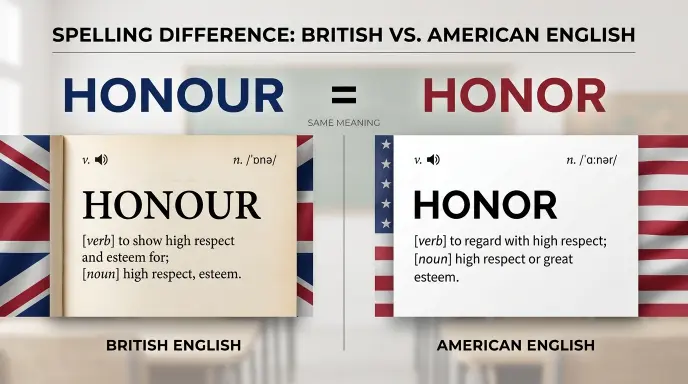
Have you ever wondered whether to write honour or honor? You may have seen both spellings in books, websites, school assignments, and professional documents. Although they look slightly different, both are correct English words. The real difference comes down to regional spelling conventions, which can confuse students, bloggers, and even experienced writers. Choosing the right version helps make your writing clearer and more consistent.
The main difference is that honour is the standard British English spelling, commonly used in the United Kingdom and many other countries that follow British spelling conventions. In contrast, honor is the standard American English spelling, preferred in the United States. Both words express respect, integrity, recognition, or high regard for someone or something. Their meanings and pronunciation are essentially the same, so the extra letter “u” does not change the word’s meaning.
In this guide, you will discover the difference between honour and honor, explore simple definitions, and learn how to use each spelling correctly in everyday conversations, academic assignments, and professional writing. You will also find practical sentence examples, common spelling mistakes, and easy tips for remembering which version to choose. Whether you are writing for a British or American audience, understanding these regional conventions will help you produce more accurate, polished, and consistent English.
X vs Y: What’s the Difference?
The words honour and honor express the same idea, although their spellings differ across English varieties. Consequently, neither spelling is inherently more correct than the other.
Honour is commonly used in British English, Canadian English, Australian English, and other varieties that follow British spelling conventions. Meanwhile, honor is preferred in American English.
Both words can function as nouns or verbs. As nouns, they describe respect, integrity, distinction, or a privilege. As verbs, they describe showing respect, recognizing an achievement, or fulfilling an agreement.
| Feature | Honour | Honor |
|---|---|---|
| Part of speech | Noun and verb | Noun and verb |
| Primary spelling convention | British English | American English |
| Meaning | Respect, dignity, recognition, or fulfilment | Respect, dignity, recognition, or fulfillment |
| Workplace usage | Common in British style | Common in American style |
| Academic writing | Preferred in British English publications | Preferred in American English publications |
| Pronunciation | Generally the same | Generally the same |
| Example | She received an honour for her service. | She received an honor for her service. |
Mini recap
Both spellings communicate the same meaning.
However, British English generally uses honour, whereas American English uses honor.
Therefore, choose the spelling that matches your intended audience.
Most importantly, remain consistent throughout the same document.
Is Honour vs Honor a Grammar, Vocabulary, or Usage Issue?
The difference between these spellings is primarily a spelling and regional usage issue, not a grammatical distinction. Both forms follow the same grammatical rules and carry the same meanings.
Are Honour and Honor Interchangeable?
Yes. In most contexts, the two spellings are interchangeable because they represent the same word. For example, a student may receive an honour in London or an honor in New York.
Nevertheless, regional conventions matter. A British newspaper would normally print honour, whereas an American newspaper would generally print honor. Using the alternative spelling may not make a sentence grammatically incorrect, but it can make the writing inconsistent with its intended style.
Formal vs Informal Usage
Both spellings are appropriate for formal and informal communication. For instance, a business letter, university essay, wedding speech, or everyday conversation can use either form when it follows the relevant regional convention.
However, professional documents require greater consistency. If an organization follows American English, use honor, honorable, and honorary. Conversely, British English typically uses honour, honourable, and honorary is an exception to the usual pattern because that particular word retains its American style of spelling in both varieties.
Academic vs Casual Usage
In academic writing, follow the spelling guidelines of your institution, publisher, or required style guide. For example, a British university assignment will generally use honour, while an American college paper will normally use honor.
In casual messages, either spelling is understandable. Still, choosing one convention consistently makes your writing appear more polished.
Practical rule: Grammar determines how the word functions in a sentence, while regional spelling conventions determine whether you write honour or honor.
How to Use Honour Correctly
The spelling honour is appropriate when writing in British English or following a publication that uses British spelling conventions. It can describe a privilege, a person’s integrity, or the act of respecting someone.
Workplace Example
A company based in the United Kingdom might write:
“Our organization is proud to honour employees who demonstrate outstanding leadership.”
Here, honour is a verb because it describes the action of recognizing employees for their achievements.
Similarly, a formal announcement could say, “It is an honour to work with such a dedicated team.” In this example, the word is a noun that expresses privilege and appreciation.
Academic Example
A British university might announce:
“The department will honour the researcher for her contribution to environmental studies.”
In this sentence, the verb describes public recognition of academic achievement. Likewise, a student might write, “Academic honour requires honesty, effort, and respect for others.”
Technology Example
A British banking application could display the message:
“Your bank may honour a payment when the required conditions are satisfied.”
Here, honour means to accept or fulfil a financial obligation. Similarly, a digital booking platform might state that it will honour a confirmed reservation according to its terms.
Quick Usage Recap
Use honour when your writing follows British spelling conventions. Furthermore, remember that the word can be either a noun or a verb, depending on its role in the sentence.
How to Use Honor Correctly
The spelling honor is standard in American English. It appears in professional documents, academic publications, public announcements, and ordinary conversation throughout the United States.
Workplace Example
An American company might write:
“We are proud to honor our employees for their dedication and service.”
In this sentence, honor is a verb because it describes recognizing employees’ contributions.
Likewise, a manager could say, “It is an honor to lead this team.” Here, the noun expresses appreciation and privilege.
Academic Example
An American university might announce:
“The faculty will honor the graduating students for their research achievements.”
In addition, a student could write, “Academic honor depends on honesty, fairness, and responsible conduct.”
Both examples use the standard American spelling.
Technology Example
An American payment service might display:
“The bank may honor the transaction if sufficient funds are available.”
In this context, honor means to approve or fulfil a financial obligation. Similarly, a reservation platform might promise to honor a confirmed booking under its stated conditions.
Quick Usage Recap
Choose honor for American English publications, university assignments, business communication, and software designed for American users. Moreover, use related forms such as honorable and honorary when the context requires them.
When You Should NOT Use Honour or Honor
Although both spellings are correct, certain situations require you to choose one over the other. Consider these common mistakes before publishing a document.
1. Do not mix regional spellings unnecessarily. For example, writing “We honor the volunteers and honour their dedication” in one American English paragraph creates inconsistency.
2. Do not assume one spelling is universally correct. Although honor is standard in the United States, honour is expected in British English.
3. Do not change a direct quotation silently. If a source uses honour, preserve its original spelling when quoting it, unless your editorial policy permits an explicitly indicated adjustment.
4. Do not ignore an institution’s style guide. An academic journal may require a specific spelling convention, even when both forms are understandable.
5. Do not confuse spelling with meaning. Neither form automatically indicates greater respect, stronger integrity, or a different level of recognition.
6. Do not alter official names without checking them. Awards, institutions, organizations, and historical titles may preserve a particular spelling.
7. Do not apply the same spelling rule to every related word. For example, honorary generally keeps its spelling in both American and British English, despite the difference between honor and honour.
8. Do not rely exclusively on automatic spelling suggestions. A spelling checker configured for American English may flag honour, even when it is entirely appropriate in British writing.
Ultimately, the correct choice depends on context rather than on a universal rule that makes one spelling superior.
Common Mistakes With Honour and Honor
Spelling errors often occur when writers switch between English varieties without noticing the change. Fortunately, a few examples make the distinction easy to understand.
| Correct sentence | Incorrect sentence | Explanation |
|---|---|---|
| It is an honour to receive this award. | It is an honor to receive this award. | The second sentence is not grammatically wrong, but it does not follow the British spelling convention assumed here. |
| We honor our veterans every year. | We honour our veterans every year. | The second sentence is inconsistent with standard American spelling. |
| She received an honour for her service. | She received a honour for her service. | The article is incorrect because the word takes an, not a, in standard usage. |
| The organization will honour its agreement. | The organization will honours its agreement. | The verb must agree with the subject. After will, use the base form honour. |
| They showed honour during the competition. | They showed honours during the competition. | In this context, the singular noun expresses integrity or respect. |
| It was an honor to meet the professor. | It was a honor to meet the professor. | The correct article is an because the initial sound is a vowel sound. |
Notice that some apparent errors involve regional spelling, while others involve genuine grammatical mistakes. Therefore, identifying the type of error helps you correct it accurately.
A Simple Decision Rule
If you are writing for a British English audience, use honour. If you are writing for an American English audience, use honor.
The distinction concerns regional spelling, not the action, person, or tool described. In either variety, the word can function as a noun or a verb.
Honour and Honor in Modern Technology and Writing Tools
Digital communication has made regional spelling differences more visible. For example, word processors, email applications, online forms, and publishing platforms may use different default dictionaries.
Consequently, a British writer using an American English keyboard setting may receive a spelling warning for honour. Conversely, an American writer using British English settings may see a warning for honor.
Neither warning necessarily means the word is incorrect. Instead, it often reflects the selected language preference.
For accurate results, select the appropriate English variety in your writing application. Additionally, review the spelling of related terms throughout the document.
| Writing situation | Recommended spelling |
|---|---|
| British business report | Honour |
| American university essay | Honor |
| British website content | Honour |
| American customer support message | Honor |
| International publication | Follow its editorial policy |
| Official award title | Preserve the official spelling |
Although automated proofreaders can identify many spelling inconsistencies, the writer must still consider the intended audience and context.
Etymology: Where Do Honour and Honor Come From?
Both spellings trace back to the same historical word. Their development reflects the influence of French and Latin on English vocabulary.
The English word derives from Old French onor or honour, ultimately connected to Latin honor, meaning esteem, respect, or public distinction.
Over time, English spelling developed regional differences. British English generally retained the u in words such as honour, colour, and favour. American English increasingly favored simplified spellings, helping establish honor, color, and favor as standard forms in the United States.
These changes did not create different meanings. Instead, they produced alternative spellings that reflect the historical development of English in different regions.
Therefore, understanding the origin of the word helps explain why both forms remain correct today.
An Expert Perspective on Regional Spelling
A useful editorial principle is:
“Good spelling respects both the meaning of a word and the conventions of its intended audience.”
This principle emphasizes that effective writing requires more than selecting a dictionary entry. Writers must also consider consistency, context, and reader expectations.
For example, an American publication that consistently uses honor looks more professional when it follows the same convention in related words. Likewise, a British publication benefits from using honour throughout its material.
Importantly, regional differences should not be mistaken for differences in intelligence, education, or writing ability. Both forms are established standards of English.
Two Practical Case Studies
The following hypothetical examples demonstrate how a consistent spelling policy can improve editorial accuracy. Their figures are illustrative rather than independently measured research results.
Case Study 1: A British Educational Website
Suppose an educational website based in the United Kingdom publishes 120 articles. During an editorial review, its team discovers that 30 articles use a mixture of British and American spellings.
The editors establish a British English style guide and review the affected pages. They standardize honour, colour, and favour wherever those spellings are appropriate.
As a result, all 120 articles follow the same regional convention after the review.
Practical lesson: A shared style guide helps writers and editors maintain consistency across a large publication. It also reduces avoidable proofreading work.
Case Study 2: An American Business Newsletter
Consider an American business newsletter that publishes 40 issues each year. Its editors notice that several contributors use British spellings in otherwise American English articles.
The team adds a short spelling checklist to its editorial process. During a subsequent review of 10 sample issues, editors find that all 10 follow the selected American convention.
Practical lesson: A simple review process can make spelling more consistent without changing the message, tone, or substance of the writing.
Both examples illustrate a straightforward principle: choose the appropriate convention first, then apply it consistently.
Error Prevention Checklist
Use this checklist before submitting an assignment, publishing an article, or sending a professional document.
Always Use Honour When
- You are following standard British English spelling.
- Your British publication or institution requires the traditional spelling.
- You are writing a British English sentence that uses related forms such as honourable according to its established conventions.
- You need to maintain consistency with surrounding British English text.
Always Use Honor When
- You are following standard American English spelling.
- Your American publication or institution specifies American English.
- You are preparing American English business communication or educational material.
- You need to maintain consistency with surrounding American English text.
Never Make These Assumptions
- Do not assume that honour is more formal than honor.
- Do not assume that the two forms have different definitions.
- Do not replace an official spelling without verification.
- Do not accept every spelling checker warning as proof of an error.
Finally, read the document once more after correcting individual words. That final review helps catch inconsistencies that an isolated spelling check might miss.
Related Grammar Confusions You Should Master
Understanding regional spelling also helps clarify other common differences in English. The following comparisons are especially useful for students, professional writers, and English learners.
1. Colour vs Color: British and American spellings of the same word describing a visual characteristic.
2. Favour vs Favor: Regional spelling alternatives used when expressing preference or kindness.
3. Labour vs Labor: Different regional forms referring to work or effort.
4. Centre vs Center: British and American spellings for the middle of something.
5. Theatre vs Theater: Regional alternatives for a venue used for performances.
6. Organise vs Organize: Both forms occur across English varieties, although preferences vary by region and style guide.
7. Licence vs License: British English generally uses licence as a noun and license as a verb, while American English uses license for both.
8. Practice vs Practise: British English generally distinguishes the noun practice from the verb practise, while American English normally uses practice for both.
9. Defence vs Defense: Alternative British and American spellings for protection against an attack or accusation.
10. Travelling vs Traveling: British English usually doubles the l in this form, while American English generally uses one l.
Learning these patterns helps you identify whether a difference concerns spelling, grammar, or meaning. As a result, you can make better decisions when editing your own writing.
Frequently Asked Questions
1. Is honour or honor the correct spelling?
Both spellings are correct. However, honour is standard in British English, while honor is standard in American English. Therefore, choose the form that matches your audience or required writing style.
2. What is the difference between honour and honor in British and American English?
The difference is regional spelling rather than meaning. British English retains the u in honour, whereas American English omits it in honor. Both words refer to respect, dignity, recognition, or fulfilling an obligation.
3. Should I use honour or honor in a formal letter?
Use honour in a formal letter written according to British English conventions. Conversely, use honor when following American English conventions. Both forms are appropriate for professional correspondence.
4. Is honour or honor correct in academic writing?
Both are acceptable, depending on the institution or publication. British academic publications generally prefer honour, whereas American academic publications typically use honor. Always follow the relevant style guide.
5. Does honour mean something different from honor?
No. Both spellings share the same essential meanings and grammatical functions. They can describe personal integrity, respect, distinction, or the act of recognizing someone or fulfilling a commitment.
6. How do you spell honour in American English?
The standard American English spelling is honor. For example, an American university might say, “We honor students for their outstanding achievements.”
7. How do you spell honor in British English?
The standard British English spelling is honour. For instance, a British organization might write, “We honour those who serve their community.”
8. Is honour or honor more professional?
Neither spelling is inherently more professional. Professionalism depends on using the appropriate regional convention, maintaining consistency, and communicating clearly. Both forms are suitable for formal documents.
9. Which spelling should I use for an international audience?
For an international audience, first check whether your organization or publication follows a particular English convention. If no preference exists, choose one spelling system and use it consistently throughout the document.
Conclusion:
Ultimately, honour and honor are two correct spellings of the same English word. The main distinction is geographical: British English generally uses honour, whereas American English prefers honor.
Therefore, the best choice depends on your readers, publication requirements, and established writing conventions. Neither form is inherently better, more formal, or more meaningful than the other.
Before submitting an assignment, publishing an article, or sending a business letter, check the regional spelling conventions used throughout your document. Then apply them consistently.
Final verdict: Choose honour for British English and honor for American English. When you follow this simple rule, you can avoid unnecessary spelling confusion and write with greater confidence.









