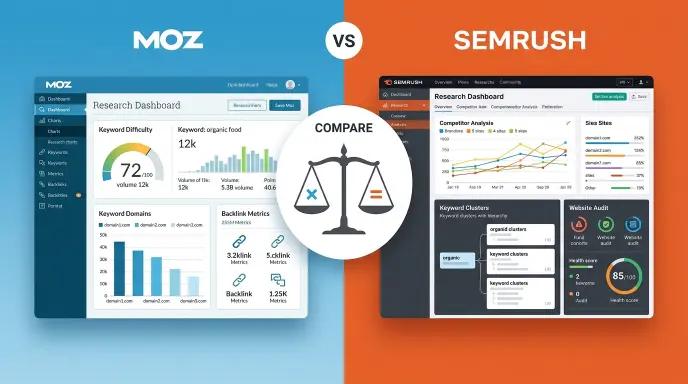
Choosing the right digital marketing tool can make a big difference in how you research keywords, analyze competitors, and grow your website. Moz or Semrush is a common question among bloggers, website owners, and digital marketers looking for reliable insights without wasting their budget. Although both platforms offer powerful features, they differ in pricing, functionality, and user experience. So, which one is the better choice in 2026?
Moz is widely known for its Domain Authority metric, keyword research capabilities, and backlink analysis tools. Semrush, on the other hand, provides a broader marketing toolkit that includes competitor research, content optimization, technical website analysis, and paid advertising insights. Each platform has its own strengths, so the best option depends on your goals, experience, and budget.
In this guide, we will compare Moz vs Semrush in terms of features, pricing, keyword research, backlink analysis, and ease of use. You will discover which platform may be more suitable for beginners, bloggers, small businesses, and marketing professionals, helping you make a confident, informed decision.
Moz vs Semrush: What’s the Difference?
Moz and Semrush are commercial software platforms designed to help website owners understand search performance and improve their online visibility. Although both serve similar purposes, they offer different approaches to keyword discovery, competitor research, backlink analysis, and website auditing.
What Is Moz?
Moz is a digital marketing software platform best known for its keyword research tools, backlink analysis, rank tracking, and domain authority metrics.
In particular, Moz Pro provides features that help users evaluate ranking opportunities, examine competing websites, and monitor changes in search visibility. Its Domain Authority metric estimates a website’s comparative ranking strength based on link related signals. However, Domain Authority is a proprietary metric rather than an official search engine ranking factor.
For beginners, Moz offers a relatively approachable way to understand important website performance indicators. Furthermore, its educational resources can help users develop a stronger understanding of keyword research and link analysis.
What Is Semrush?
Semrush is a digital marketing platform offering a broad collection of tools for keyword research, competitor intelligence, website auditing, backlink analysis, advertising research, content planning, and performance reporting.
For example, users can investigate which search terms competitors target, explore estimated organic traffic, discover keyword opportunities, and review technical website problems. Additionally, its broader toolset can support teams managing several websites or coordinating multiple marketing activities.
However, the number of available features may feel overwhelming to someone who only needs basic keyword research or occasional rank tracking.
Moz vs Semrush Comparison Table
| Feature | Moz | Semrush |
|---|---|---|
| Main purpose | Search visibility and website analysis | Broader digital marketing research |
| Keyword research | Yes | Yes |
| Competitor analysis | Available | Extensive research features |
| Backlink analysis | Yes | Yes |
| Website auditing | Yes | Yes |
| Domain Authority | Moz metric | Uses different authority metrics |
| Technical reporting | Available | Broad auditing capabilities |
| Advertising research | More limited | Major platform capability |
| Learning curve | Generally approachable | Can be steeper |
| Best suited for | Focused search optimization | Comprehensive marketing workflows |
Note: Available features, usage limits, and subscription terms vary by plan and can change over time.
Quick recap: Moz is a strong option for users who prioritize straightforward search analysis and link related metrics. Semrush is attractive for marketers who need several research capabilities within one platform. Nevertheless, neither tool guarantees higher rankings, because search performance depends on many factors beyond software selection.
Moz or Semrush: Which Platform Is Better for Keyword Research?
Keyword research helps you discover what people search for, how competitive a topic may be, and which subjects deserve attention. Both platforms provide useful data, although the experience and available research features differ.
Keyword Research With Moz
Moz Keyword Explorer helps users discover keyword suggestions, estimate monthly search volume, assess ranking difficulty, and understand search intent. Consequently, it can support bloggers who need to compare several topics before creating an article.
For example, a beginner writing about grammar might compare “affect vs effect” with “effect vs impact.” The available metrics can help prioritize research, although actual search results should also be reviewed before choosing a topic.
Moz is especially useful when you want a focused workflow that combines keyword discovery with ranking analysis.
Keyword Research With Semrush
Semrush offers keyword discovery, keyword grouping, competitive research, and tools for examining the search terms associated with other websites. Its Keyword Magic Tool can help expand an initial phrase into a larger collection of related queries.
For instance, a website owner researching “dream meanings” could explore specific dream scenarios, question based searches, and related subjects. This broader list can help organize a content calendar around different reader needs.
Moreover, Semrush supports competitor keyword research, making it easier to investigate subjects that similar websites already cover. Its official feature descriptions include keyword research and competitor analysis among its core capabilities.
Keyword research verdict: Choose Moz when you prefer a focused keyword discovery process. Consider Semrush when you want to explore wider keyword groups and competitor opportunities in one working environment.
Moz vs Semrush for Competitor Analysis
Competitor analysis involves examining other websites to understand their visibility, content strategy, ranking keywords, and potential strengths. Although both platforms support competitive research, the depth of your workflow matters.
How Moz Helps Analyze Competitors
Moz provides competitive research features that can help users compare websites, investigate ranking keywords, and identify content opportunities.
Suppose a competing blog consistently appears for several vocabulary comparison searches. You can investigate overlapping keywords, assess your own rankings, and identify related topics that deserve further research.
However, third party estimates should be treated as directional evidence rather than exact records of a competitor’s traffic or revenue.
How Semrush Helps Analyze Competitors
Semrush offers broader competitive intelligence, including organic keyword research, domain analysis, paid advertising research, and keyword gap comparisons. These capabilities can help businesses understand how competing websites attract visitors through different channels.
For example, an online store might compare three rival domains to discover overlapping search terms and subjects that competitors cover but its own website does not.
Furthermore, this information can inform content planning, product page improvements, and advertising research. Nevertheless, copying a competitor’s pages without adding original value is unlikely to create a strong long term advantage.
Competitor analysis verdict: Semrush is a compelling choice for users who need a broader competitive research workflow. Moz remains useful for focused comparisons and identifying search related opportunities.
Moz vs Semrush for Backlink Analysis
Backlinks are links from other websites that point to your pages. They can help search engines discover content and provide signals about its relevance and authority. However, not every backlink is valuable, and acquiring large numbers of low quality links is not a reliable growth strategy.
Backlink Research With Moz
Moz Link Explorer helps users investigate backlink profiles, referring domains, and link related metrics. Its Domain Authority score estimates a domain’s comparative ranking potential using Moz’s own methodology.
This metric can be helpful when comparing similar websites. Nevertheless, it is not a Google metric, and a higher score does not guarantee better rankings.
For example, a small educational blog may have fewer referring domains than a large publication but still perform well for a narrowly focused topic.
Backlink Research With Semrush
Semrush provides backlink analysis tools for reviewing referring domains, discovering link opportunities, and comparing competing websites. Depending on the subscription, users can also investigate additional link building workflows.
Consequently, agencies managing outreach campaigns may appreciate the ability to combine backlink research with broader competitor analysis.
Backlink verdict: Both platforms can support backlink evaluation. Compare the actual links, relevant referring websites, and available data before choosing a winner based on a proprietary score alone.
How to Use Moz Effectively
Moz works best when you have a clear research objective instead of opening reports without a specific question. Therefore, start by identifying the problem you want to solve.
Workplace Example
A marketing specialist preparing a monthly performance report can use Moz to review selected keyword rankings and investigate opportunities for improvement. As a result, the report can focus on meaningful changes rather than a collection of unrelated metrics.
Academic Example
A student researching digital marketing practices can use keyword exploration to examine how different search phrases relate to a topic. However, the resulting estimates should support the research process rather than replace credible academic evidence.
Technology Example
A website administrator can use available site auditing features to identify technical issues that deserve attention. For example, broken links, missing page elements, or other detected problems may indicate areas for further inspection.
Practical Usage Recap
Moz is useful when you want to concentrate on keyword discovery, ranking observations, and link related measurements. For the best results, choose a small group of meaningful metrics and review them consistently.
How to Use Semrush Effectively
Semrush can support a wider research process, especially when several marketing activities need to work together. Even so, using every available report is unnecessary for most websites.
Workplace Example
An agency account manager can examine competitor keywords, investigate changes in ranking visibility, and prepare reports for clients. Consequently, the team can use research findings to explain priorities and recommend specific improvements.
Academic Example
A researcher studying online competition can compare several websites, observe the topics they cover, and investigate differences in their visible search performance. Nevertheless, estimated traffic figures should not be presented as verified visitor counts.
Technology Example
A website manager can run a technical audit, review detected issues, and prioritize corrections according to their likely impact. Additionally, ranking reports can help the team monitor whether important search terms improve after relevant changes.
Practical Usage Recap
Semrush is suitable for users who want to combine keyword research, competitor investigation, technical checks, and reporting. Start with the features connected to your immediate goals, then expand your workflow as needed.
Moz or Semrush: Pricing, Value, and Ease of Use
Pricing is an important consideration, particularly for bloggers, freelancers, and small businesses working with limited budgets.
However, the cheapest subscription is not automatically the best value. Instead, compare what each plan provides with the tasks you perform regularly.
| Consideration | Moz | Semrush |
|---|---|---|
| Learning experience | Often approachable for focused research | May require more time to explore |
| Research scope | Core search and link analysis | Broad marketing research |
| Best value depends on | Relevant features and usage limits | Relevant features and usage limits |
| Team reporting | Depends on plan | Depends on plan |
| Budget decision | Review current subscription terms | Review current subscription terms |
Because subscription prices and usage allowances can change, verify the current terms directly with each provider before purchasing.
For a personal blog, a basic plan or free research options may be enough to begin. Conversely, an agency that needs competitor analysis, extensive reporting, and multiple research workflows may justify a larger investment.
Ultimately, calculate value by asking one question: Will this platform save enough time or improve enough decisions to justify its recurring cost?
When You Should NOT Use Moz or Semrush
Although these platforms provide useful research data, neither is necessary for every website task. In the following situations, another approach may be more appropriate.
1. When you only need a spelling correction. A dictionary or trusted language reference is more suitable than a large marketing platform.
2. When you need verified visitor counts. Third party traffic estimates are not equivalent to your own website analytics records.
3. When you expect guaranteed rankings. No subscription can promise a particular position because search results depend on many changing factors.
4. When you have no clear research objective. Collecting hundreds of keyword suggestions without deciding what to publish can waste time.
5. When you need academic proof. Marketing databases cannot replace peer reviewed studies or primary research.
6. When your budget cannot support a subscription. Begin with available free tools, manual research, and your own performance data.
7. When you want to copy competitors. Competitor reports should inspire original research, not duplicate another publisher’s work.
8. When one metric determines every decision. Keyword difficulty, authority scores, and estimated traffic each provide only part of the picture.
Therefore, select software according to your actual requirements rather than assuming that a more expensive platform will automatically produce better outcomes.
Is Moz vs Semrush a Grammar, Vocabulary, or Usage Issue?
The comparison between Moz and Semrush is a product selection question, not a grammar or vocabulary problem. Both names identify software brands, and neither is a substitute for the other.
They are also not fully interchangeable in practical use. Although their capabilities overlap, each platform offers its own features, metrics, reporting options, and subscription limits.
In formal business writing, use the correct brand name and describe the particular feature you mean. Similarly, in casual discussions, avoid calling every website research platform “Semrush” or “Moz” when you mean a different product.
For academic work, distinguish between measured results, estimated figures, and your own interpretation. As a result, your comparisons will be clearer and more credible.
Moz and Semrush in Modern Technology and Automated Research Tools
Website research platforms continue to develop alongside changes in search behavior and marketing technology. Consequently, both Moz and Semrush have introduced capabilities related to brand visibility beyond traditional keyword ranking reports. Their current product information describes features for monitoring brand presence in conversational search environments and other emerging discovery channels.
However, the presence of a new feature does not mean that every subscription includes it. Before committing to a platform, verify which tools are available in your selected plan.
Moreover, automated recommendations should be treated as starting points rather than unquestionable instructions. Review the underlying evidence, consider your audience’s needs, and confirm important findings before changing your publishing strategy.
Common Mistakes When Choosing Moz or Semrush
The most frequent errors arise when users compare headline metrics without considering their meaning.
| Correct sentence | Incorrect sentence | Explanation |
|---|---|---|
| Moz reports a Domain Authority score. | Google gives every website a Moz Authority score. | Domain Authority is Moz’s proprietary metric. |
| Semrush estimates competitor traffic. | Semrush knows every competitor’s exact traffic. | Third party traffic figures are estimates. |
| Both platforms support keyword research. | Both platforms provide identical data. | Features, databases, and measurements can differ. |
| A higher authority score may inform comparison. | A higher authority score guarantees first place. | No proprietary score guarantees a ranking. |
| I selected Semrush for its broader research features. | Semrush is automatically better for everyone. | The right choice depends on individual needs. |
Decision Rule
If you need focused keyword and link analysis, evaluate Moz first. If you need broader competitor intelligence and multiple marketing workflows, evaluate Semrush first.
Nevertheless, test both against the same research task whenever possible. That approach gives you a more useful comparison than relying exclusively on promotional claims or other people’s preferences.
Two Practical Case Studies: Moz vs Semrush
The following examples are illustrative scenarios, not independently verified customer results. Their purpose is to demonstrate how a website owner could evaluate these platforms using measurable outcomes.
Case Study 1: A Small Educational Blog
Imagine a new educational website publishing articles about commonly confused English words. The owner has limited funds and wants to identify topics with realistic ranking opportunities.
Initially, the owner compares 30 candidate keywords using a consistent research process. After reviewing search intent, competing pages, and the website’s existing content, the owner selects 10 topics for publication.
The owner then tracks impressions, clicks, ranking changes, and engagement over eight weeks. For this example, suppose six of the ten pages begin receiving organic clicks during the measurement period.
The owner can then compare the research time, usefulness of the keyword suggestions, and subscription cost associated with each platform.
Result: Six pages receiving clicks is the illustrative outcome, not a promised result from either tool. The better platform is the one that helps the owner make stronger decisions within the available budget.
Case Study 2: A Growing Digital Marketing Agency
Now consider an agency managing 12 client websites. Its team needs competitor research, technical audits, keyword tracking, and consistent client reporting.
The agency tests both platforms on three representative client projects. During a four week evaluation, it records the time required to prepare reports, the number of actionable issues identified, and the ease of sharing findings with clients.
For example, suppose the agency reduces its average reporting time from five hours to three hours per client after improving its workflow. Across 12 clients, that represents a potential saving of 24 hours per reporting cycle.
Result: The hypothetical saving comes from the improved workflow, not a guaranteed product feature. The agency should choose the platform that delivers comparable efficiency without sacrificing reporting quality or exceeding its budget.
Etymology and Brand Background
Unlike ordinary vocabulary pairs, Moz and Semrush are brand names rather than competing spellings of the same word.
Moz developed from the name SEOmoz, which originated as an online search marketing community and educational resource. Over time, the company developed commercial software for website research and performance monitoring.
Semrush developed as a competitive research platform and expanded into a broader digital marketing product suite. Today, its documented capabilities include keyword discovery, competitor analysis, backlink research, technical audits, and reporting.
Consequently, their names should be treated as proper nouns. Capitalize them consistently when writing reports, reviews, and product comparisons.
An Expert Perspective on Choosing the Right Platform
“Useful research is not about collecting the largest amount of data. It is about finding reliable signals, understanding their limitations, and turning them into decisions that serve your audience.”
This principle applies regardless of which platform you choose. First, define the problem. Next, gather relevant evidence. Finally, implement a practical change and measure its outcome.
For instance, a keyword report becomes valuable when it helps you publish a more relevant article, improve an existing page, or discover a genuine content gap.
Therefore, judge a tool by the quality of the decisions it supports rather than the number of reports it contains.
Error Prevention Checklist
Before choosing either platform, use this checklist to keep your evaluation focused.
Always Use Moz When
- You prefer its research interface and available keyword metrics.
- You want to investigate backlink profiles and comparative domain metrics.
- Its current subscription offers the features your project actually needs.
- Your research process benefits from a focused set of tools.
Choose Semrush When
- You need extensive competitor keyword research.
- You want to combine several marketing research activities.
- Its available reporting and auditing features match your workflow.
- The subscription cost is justified by your expected usage.
Never Assume That
- A higher authority score guarantees better rankings.
- Estimated competitor traffic is exact.
- Every advertised feature is included in every plan.
- Purchasing both platforms is necessary for a successful website.
- Software alone can replace original content and sound editorial judgment.
Finally, document your starting position before making major changes. Otherwise, you may struggle to determine whether later improvements came from your research, your content updates, or unrelated changes in search demand.
Related Grammar Confusions You Should Master
Although Moz and Semrush are brand names rather than grammar alternatives, the following comparisons can help you write more accurately when discussing digital marketing, technology, and website performance.
- Affect vs Effect: Understand the difference between an action and a result.
- Fewer vs Less: Learn when to use countable and uncountable quantities.
- Advice vs Advise: Distinguish a noun from a verb.
- Its vs It’s: Separate possession from a contraction.
- Then vs Than: Identify time relationships and comparisons.
- Your vs You’re: Avoid confusing possession with a contraction.
- Principal vs Principle: Separate a person or primary element from a fundamental rule.
- Complement vs Compliment: Understand completion and praise.
- Site vs Cite: Distinguish a website or location from referencing a source.
- Practice vs Practise: Learn the standard noun and verb distinction in American and British English.
Frequently Asked Questions
1. Is Moz or Semrush better for beginners?
Moz may suit beginners who prefer focused keyword and backlink research. Meanwhile, Semrush may appeal to learners who want to explore several marketing tools. Ultimately, the easier option depends on your goals, budget, and familiarity with research software.
2. What is the main difference between Moz and Semrush?
The main difference is their overall scope and workflow. Both provide keyword research, ranking analysis, and backlink insights. However, Semrush offers a broad collection of competitive and marketing research features, while Moz is well known for its focused search analysis and Domain Authority metric.
3. Is Semrush more accurate than Moz?
Neither platform is universally more accurate for every metric. Their databases, calculations, and reporting methods differ. Therefore, compare the same keywords, domains, and locations, and validate important findings against your own website data.
4. Is Moz Domain Authority the same as Semrush Authority Score?
No. Domain Authority is a Moz metric, whereas Semrush uses its own Authority Score. Although both help compare domains, their methodologies differ. Consequently, their numerical values should not be treated as directly interchangeable measurements.
5. Can I use Moz and Semrush together?
Yes. Using both can provide complementary perspectives on keywords, competitors, and backlinks. However, overlapping subscriptions may be unnecessary for a small website. First, identify the features you need, then determine whether the additional cost provides meaningful value.
6. Which platform is better for competitor keyword research?
Semrush is worth evaluating when competitor keyword discovery and keyword gap analysis are central to your work. Nevertheless, Moz also offers competitive research capabilities. Test both using the same competitor websites before making a final decision.
7. Is Moz cheaper than Semrush?
The answer depends on the current subscription plans, billing periods, and included usage limits. Compare the total recurring cost and relevant features rather than relying on an advertised starting price alone.
8. Do Moz and Semrush guarantee higher Google rankings?
No. Both platforms provide research and monitoring tools, but neither guarantees ranking improvements. Results depend on content relevance, website quality, competition, technical performance, and other factors outside either platform’s control.
9. Which platform should a small blog choose?
A small blog should begin with the platform that makes its essential tasks easier and fits its budget. If keyword research and backlink monitoring are the primary needs, evaluate Moz. If extensive competitor research is more important, evaluate Semrush.
Final Verdict
For a personal blog or a beginner seeking straightforward research, start by evaluating Moz. For an agency or business requiring broader competitor analysis, investigate Semrush first. If your budget permits, compare both using the same project before committing.
The right platform should save time, clarify opportunities, and support measurable improvements rather than simply generate more data.
Conclusion:
Ultimately, Moz or Semrush is a choice between two capable research platforms, not a contest with one universal winner. Moz is worth considering for focused keyword research, backlink evaluation, and domain comparisons. In contrast, Semrush can be a better fit for users who need extensive competitor intelligence and several marketing workflows.
Before purchasing either subscription, identify your main goals, compare available features, and test the quality of the information each platform provides. Most importantly, use the findings to make informed decisions, publish useful content, and measure real results. The best choice is the one that supports your website’s needs without creating unnecessary costs or complexity.









