Have you ever wondered whether to write “carrys” or “carries” in an English sentence? Although these spellings look similar, only one is correct in standard English when using the verb carry in the third person singular present tense. Choosing the wrong spelling can make your writing appear less professional, especially in school assignments, business emails, blog posts, and other important documents. The good news is that understanding the difference is simple once you learn the basic spelling rule.
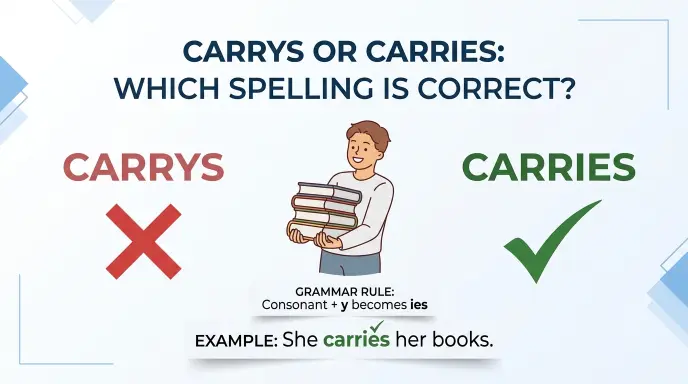
The correct spelling is “carries,” not “carrys.” When a verb ends in a consonant followed by y, the y usually changes to ies when forming the third person singular present tense. For example, we write “she carries the bag,” “he studies English,” and “it flies high.” However, the verb remains “carry” with subjects such as I, you, we, and they. Learning this pattern helps you avoid common grammar mistakes and apply the same rule to many other English verbs.
In this guide, we will explain the meaning of carries, why carrys is incorrect in standard English, and how to use the correct form in everyday sentences. You will also discover practical examples, common spelling mistakes, and easy tips for remembering the rule. Whether you are a student, an English learner, a blogger, or a professional writer, this straightforward explanation will help you write with greater confidence. By the end, you will know exactly when to use “carries” and how to recognize similar spelling patterns in English.
Carrys or Carries: The Essential Difference
The difference between carrys and carries concerns English spelling rules, verb conjugation, and grammatical accuracy. Although both forms may look reasonable to beginners, only one is accepted in standard written English.
For example, when someone describes a person transporting groceries, carrying responsibility, or holding an object, the correct verb form depends on the sentence’s subject. Consequently, learning this simple rule helps prevent mistakes in emails, school assignments, workplace documents, and everyday messages.
Moreover, understanding why carries is correct makes it easier to spell other verbs, including studies, tries, and worries. Instead of memorizing every word separately, you can apply the same spelling pattern to many common English verbs.
In this guide, you’ll learn the difference between both spellings, explore practical examples, understand common mistakes, and discover a simple decision rule for choosing the correct form every time.
Carrys vs Carries: What’s the Difference?
The central distinction is straightforward: carries is the correct third person singular form of carry, whereas carrys is a misspelling in standard English.
What Does Carries Mean?
Carries is a verb form used with a singular third person subject in the present simple tense. It describes transporting something, holding an object, supporting a weight, or bearing responsibility.
For instance, consider these sentences:
- She carries her laptop to work every morning.
- He carries responsibility for the final decision.
- The delivery truck carries fresh vegetables.
- This bridge carries heavy traffic throughout the day.
- My sister carries a small notebook in her purse.
In each example, the subject is she, he, or another singular noun. Therefore, the verb takes the ending ies rather than simply adding s.
What Does Carrys Mean?
Carrys is not the standard spelling of this verb form. Although people sometimes write it by applying an incorrect spelling pattern, dictionaries and conventional English grammar recognize carries as the correct form.
For example:
Incorrect: She carrys her books to school.
Correct: She carries her books to school.
The mistake occurs because writers may assume that adding s to the base verb is sufficient. However, verbs ending in a consonant followed by y generally require a spelling change before the third person singular ending is added.
Comparison Table
| Feature | Carries | Carrys |
|---|---|---|
| Standard spelling | Correct | Incorrect |
| Base verb | Carry | Carry |
| Part of speech | Verb | Intended verb form |
| Grammatical use | Present simple, third person singular | Not accepted in standard English |
| Example | He carries a briefcase. | He carrys a briefcase. |
| Suitable for formal writing | Yes | No |
Quick Recap
Carries is the only correct spelling for the intended verb form.
Carrys results from an incorrect application of English spelling rules.
Furthermore, the correct form works with singular subjects such as he, she, and it.
Therefore, whenever the sentence uses he carries or she carries, remember to change the final y to ies.
Is Carrys vs Carries a Grammar, Vocabulary, or Usage Issue?
The distinction between carrys and carries is primarily a spelling and grammar issue. Both forms are intended to represent the same verb, but only carries follows the standard English spelling convention.
Are Carrys and Carries Interchangeable?
No, these spellings aren’t interchangeable in standard English. Although readers can often understand the intended meaning of carrys, that doesn’t make it grammatically acceptable.
For example, the sentence My father carries the groceries follows standard spelling. However, My father carrys the groceries contains an error that should be corrected before publication or submission.
Formal Versus Informal Writing
In formal writing, including business reports, academic papers, and professional correspondence, always use carries. Informal conversations may contain spelling mistakes, particularly in hurried text messages, but casual communication doesn’t change the correct spelling.
Similarly, social media posts, comments, and personal notes should use carries when accuracy matters. Even when the audience understands the intended message, correct spelling improves readability and credibility.
Academic Versus Casual Usage
In academic writing, spelling accuracy demonstrates attention to detail. Consequently, students should write sentences such as The researcher carries out the experiment rather than using the incorrect alternative.
In casual communication, the consequences may be less serious. Nevertheless, repeated spelling mistakes can reinforce incorrect habits, so learning the rule remains useful.
How to Use Carries Correctly
The verb carries appears in numerous situations because carry has several meanings. Depending on context, it can describe physical movement, responsibility, transmission, or the ability to support weight.
Workplace Examples
In professional settings, carries frequently describes duties, obligations, or the movement of materials.
Examples:
- The manager carries responsibility for approving the budget.
- She carries important documents to every meeting.
- The warehouse conveyor carries packages to the loading area.
These sentences use carries because the subjects are singular. Furthermore, the examples show that the verb can refer to both physical objects and abstract responsibilities.
Academic Examples
In educational contexts, the word can describe research, scientific processes, or the movement of information.
Examples:
- The experiment carries significant implications for future research.
- The student carries her reference books to the library.
- This argument carries more weight when supported by evidence.
Notice that the third sentence uses carries figuratively. In other words, the argument has importance or influence rather than physical weight.
Technology Examples
Technology provides additional examples of the correct form.
- This cable carries electrical signals between devices.
- The application carries user preferences across compatible devices.
- The network carries data between connected computers.
In each sentence, a singular subject performs the action. Therefore, carries is the correct form.
Usage Recap
Use carries with singular third person subjects in the present simple tense.
Additionally, remember that the word can describe physical transportation, communication, influence, and responsibility. Its meaning changes according to context, but its spelling remains consistent.
How to Use Carry Without Adding Ies
Although carries is correct in certain sentences, the base form carry remains necessary in several other grammatical situations. Understanding these situations prevents writers from adding the wrong ending.
With I, You, We, and They
Use carry with the subjects I, you, we, and they in the present simple tense.
Examples:
- I carry my lunch to work.
- You carry the equipment carefully.
- We carry our supplies in separate bags.
- They carry heavy boxes upstairs.
In these cases, the verb doesn’t change to carries because the subject isn’t third person singular.
After Modal Verbs
After modal verbs such as can, could, will, would, and should, use the base form carry.
Examples:
- She can carry the suitcase.
- He will carry the documents tomorrow.
- The machine should carry the load safely.
Although the subjects are singular, the modal verbs require the base form. Consequently, writing she can carries is incorrect.
After Does and Doesn’t
Similarly, use carry after does and doesn’t when forming questions or negative statements.
Examples:
- Does she carry her identification?
- He doesn’t carry cash.
- Why does the vehicle carry extra fuel?
The auxiliary verb already expresses the relevant grammatical information. Therefore, the main verb stays in its base form.
Usage Recap
Use carries with singular third person subjects in ordinary present simple statements.
However, use carry with I, you, we, and they, as well as after modal verbs and the auxiliary verbs does and doesn’t.
When You Should NOT Use Carrys or Carries
Choosing between these spellings becomes easier when you recognize situations in which neither the incorrect form nor the third person singular form is appropriate.
1. When the Subject Is I
Incorrect: I carries my bag.
Correct: I carry my bag.
Because I takes the base form in the present simple tense, the ending ies isn’t appropriate.
2. When the Subject Is They
Incorrect: They carries their supplies.
Correct: They carry their supplies.
Although they can refer to one person in singular they usage, the verb still takes the base form carry.
3. After Can
Incorrect: She can carries the box.
Correct: She can carry the box.
A modal verb requires the base form of the following verb, regardless of whether the subject is singular.
4. After Doesn’t
Incorrect: He doesn’t carries a wallet.
Correct: He doesn’t carry a wallet.
The auxiliary doesn’t already marks the grammatical structure, so the main verb remains unchanged.
5. In a Present Simple Question
Incorrect: Does she carries the equipment?
Correct: Does she carry the equipment?
Questions formed with does require the base verb after the subject.
6. When Giving a Direct Command
Incorrect: Carries the bag carefully!
Correct: Carry the bag carefully!
Commands normally use the base form of the verb. Therefore, the ending ies shouldn’t appear in an ordinary imperative sentence.
7. When Using the Past Tense
Incorrect: Yesterday, she carries the groceries.
Correct: Yesterday, she carried the groceries.
The past tense of carry is carried. Consequently, neither carry nor carries is suitable for this past time reference.
8. When Forming the Continuous Tense
Incorrect: She carries the boxes right now.
Correct: She is carrying the boxes right now.
The first sentence can describe a regular activity, but the second more clearly describes an action happening at the moment of speaking. In continuous constructions, use a form of be followed by carrying.
Common Mistakes and Decision Rules
Many spelling errors happen because writers focus on the sound of a word rather than its grammatical structure. However, a few examples can make the distinction much easier to remember.
| Correct sentence | Incorrect sentence | Explanation |
|---|---|---|
| She carries a backpack. | She carrys a backpack. | Change consonant plus y to ies. |
| They carry the boxes. | They carries the boxes. | Plural subjects use the base form. |
| He doesn’t carry cash. | He doesn’t carries cash. | Use the base form after doesn’t. |
| Does she carry a notebook? | Does she carries a notebook? | Use the base form after does. |
| She carried the package yesterday. | She carries the package yesterday. | The past tense is carried. |
| He can carry the equipment. | He can carries the equipment. | Modal verbs take the base form. |
| The truck carries supplies. | The truck carry supplies. | A singular third person subject takes carries. |
The Simple Decision Rule
If the subject is he, she, it, or another singular noun in an ordinary present simple statement, use carries. If the sentence requires the base verb, use carry. Never use carrys as the standard spelling.
For example, The teacher carries the books is correct because teacher is singular. Conversely, The teachers carry the books is correct because teachers is plural.
Remember, the spelling depends on both the subject and the grammatical construction. Therefore, don’t automatically choose carries whenever the sentence mentions one person.
Carries and Carry in Modern Technology
Digital writing tools, spellcheckers, grammar applications, and predictive keyboards can help identify incorrect spellings. For example, a writing assistant may flag carrys and suggest carries.
However, automatic correction doesn’t always determine whether the surrounding sentence is grammatically appropriate. A tool might correct carrys to carries even when the sentence actually requires carry.
For example, They carries the equipment needs a subject verb agreement correction, not merely a spelling replacement. The proper sentence is They carry the equipment.
Therefore, use digital proofreading tools as a helpful second check rather than a replacement for grammatical understanding. Ultimately, the writer must consider the subject, tense, and sentence structure.
The Etymology Behind Carries
The word carry entered English through Anglo French and Old Northern French forms related to transporting or conveying something. Over time, it became a common English verb with both literal and figurative meanings.
The spelling pattern in carries reflects a broader English convention. When a verb ends in a consonant followed by y, the y usually changes to i before the third person singular ending es is added.
For example:
| Base verb | Correct third person singular |
|---|---|
| Carry | Carries |
| Study | Studies |
| Try | Tries |
| Worry | Worries |
| Hurry | Hurries |
However, when a verb ends in a vowel followed by y, the final y usually remains unchanged.
For example, play becomes plays, and enjoy becomes enjoys. This distinction explains why carries is correct while carrys isn’t.
An Expert Style Explanation
A useful way to understand this spelling rule is to connect it with subject verb agreement.
“In standard English, the correct present simple form depends on the subject and the verb’s spelling pattern. For verbs ending in a consonant followed by y, the third person singular form generally changes y to ies.”
This explanation summarizes the conventional spelling rule rather than presenting a quotation from a named linguist.
More importantly, it shows why spelling and grammar work together. A writer must identify the subject, determine the intended tense, and then select the correct verb form.
Two Practical Case Studies
The following examples demonstrate how the rule can improve real world writing. They are illustrative scenarios, not results from controlled research.
Case Study 1: A Student’s English Assignment
A student writes the sentence, “My brother carrys his books to school every day.”
At first glance, the intended meaning is clear. Nevertheless, the spelling error could affect the quality of the assignment and reduce the student’s confidence in written English.
The corrected sentence is:
“My brother carries his books to school every day.”
The improvement comes from applying the consonant plus y rule. Because brother is a singular third person subject, carry changes to carries.
Practical result: The sentence now follows standard spelling and subject verb agreement conventions.
Case Study 2: A Workplace Delivery Report
A warehouse employee drafts this report: “The delivery vehicle carrys fragile equipment to the storage area.”
Although the message is understandable, the spelling mistake makes the report less polished. Since workplace documents may be reviewed by managers, clients, or auditors, accurate writing is important.
The corrected version reads:
“The delivery vehicle carries fragile equipment to the storage area.”
Here, delivery vehicle is a singular noun phrase. Therefore, the verb must be carries.
Practical result: The corrected sentence communicates the same information while meeting standard written English expectations.
Error Prevention Checklist
Before submitting a message, report, assignment, or article, review the following checklist.
Always Use Carries When
- The subject is he, she, or it in a present simple statement.
- A singular person performs the action regularly.
- A singular object or organization transports or supports something.
- You are using a verb ending in a consonant followed by y in the third person singular form.
Never Use Carrys When
- You mean the standard present simple form of carry.
- You’re writing a formal document or academic assignment.
- A spelling checker flags the word as incorrect.
- You are tempted to add only s to a verb ending in consonant plus y.
Check the Sentence Structure Too
- Use carry after can, will, should, and similar modal verbs.
- Use carry after does and doesn’t.
- Use carried for the simple past tense.
- Use carrying in continuous verb constructions.
- Use carry with I, you, we, and they in the present simple tense.
By following these steps, you can correct the spelling and ensure that the complete sentence is grammatically appropriate.
Related Grammar Confusions You Should Master
Learning the carry spelling pattern also helps with other common English questions. Likewise, understanding these related distinctions can improve sentence construction and everyday communication.
- Study or Studies: Learn when to change the final y to ies.
- Try or Tries: Understand third person singular verb forms.
- Play or Plays: Recognize why a vowel before y changes the rule.
- Worry or Worries: Apply the consonant plus y convention.
- Fly or Flies: Distinguish base forms from singular present forms.
- Do or Does: Identify the correct auxiliary for different subjects.
- Have or Has: Learn how subject agreement affects irregular forms.
- Go or Goes: Understand third person singular spelling.
- Was or Were: Choose the appropriate past tense form of be.
- Its or It’s: Distinguish possession from a contraction.
Together, these topics demonstrate that English spelling and grammar become easier when you recognize recurring patterns rather than memorize isolated examples.
Frequently Asked Questions
1. Is carrys or carries the correct spelling?
Carries is the correct spelling in standard English. The verb carry changes its final y to i before adding es when used with a singular third person subject in the present simple tense.
2. Why is carries spelled with ies instead of ys?
The spelling follows a standard English rule. When a verb ends in a consonant followed by y, the final y usually changes to i before the ending es is added. Therefore, carry becomes carries.
3. Is carrys ever grammatically correct?
No, carrys isn’t accepted as the standard spelling of this verb form. Although someone might use it as a typing error or an invented name, it shouldn’t replace carries in conventional English writing.
4. When should I use carries in a sentence?
Use carries when a singular third person subject performs an action in the present simple tense. For example, She carries her laptop to work and The truck carries fresh produce are both correct.
5. Should I write he carry or he carries?
In an ordinary present simple statement, write he carries. The subject he is third person singular, so the verb requires the appropriate ending. However, after a modal verb, write he can carry.
6. Is it correct to say she carrys a bag?
No, the correct sentence is She carries a bag. Because carry ends in a consonant followed by y, the final letter changes to i before es is added.
7. What is the difference between carry, carries, and carried?
Carry is the base form, used with subjects such as I and they in the present simple tense. Carries is the third person singular present form, while carried is the simple past and past participle form.
8. Do you use carries with plural subjects?
No, plural subjects generally use carry in the present simple tense. For example, The workers carry the equipment is correct, whereas The workers carries the equipment is incorrect.
9. Is carries correct in professional and academic writing?
Yes, carries is the standard spelling and is appropriate for professional, academic, and casual writing whenever the grammatical construction requires it. By contrast, carrys should be corrected.
Conclusion:
When choosing between carrys or carries, remember that carries is the correct spelling for the third person singular present simple form of carry. The alternative carrys is a common spelling error and shouldn’t appear in standard English writing.
The most reliable method is to identify the subject and check the verb construction. For example, write she carries the bag, but use they carry the bags. Similarly, after doesn’t or can, use the base form carry rather than carries.
Ultimately, mastering this small spelling rule will help you write more accurately in school assignments, workplace reports, emails, and everyday messages. Once you understand the consonant plus y pattern, you’ll also find it easier to spell verbs such as studies, tries, and worries correctly.









