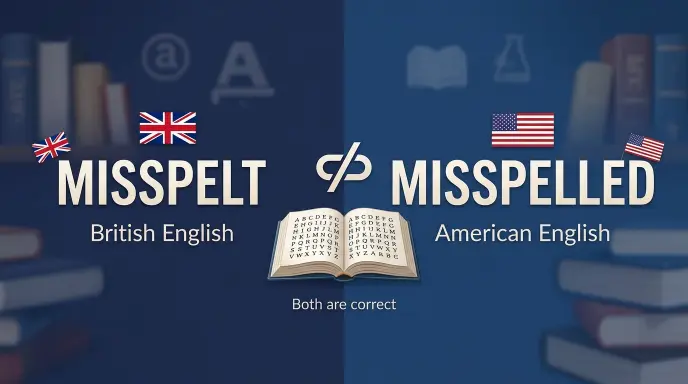
Have you ever wondered whether to write misspelt or misspelled? You are not alone. These two spellings often confuse English learners, students, bloggers, and even experienced writers. At first glance, they may look like different words, but both are correct forms of the verb misspell, which means to spell a word incorrectly. The main difference comes down to regional spelling preferences and verb forms. Understanding when to use each version can help you write more confidently, avoid common spelling mistakes, and communicate clearly in academic, professional, and everyday situations.
In British English, misspelt is a widely accepted past-tense and past-participle form, while misspelled is also correct. In American English, misspelled is generally the more common choice. For example, you can write, “I misspelled your name in the email,” or “I misspelt your name in the email.” Both sentences are grammatically acceptable, although the preferred spelling may depend on your audience. Recognizing this regional difference is especially useful when preparing school assignments, business emails, website content, or articles for an international readership.
In this guide, we will explore the meaning of misspelt and misspelled, explain their grammatical differences, and provide simple examples that show how to use them correctly. You will also learn which spelling is more suitable for British and American audiences, discover common mistakes to avoid, and find practical tips for choosing the right form. With clear explanations and everyday examples, this guide will help you make an informed choice and improve your English writing without unnecessary confusion.
Misspelt or Misspelled: Quick Answer and Meaning
When comparing misspelt or misspelled, the main difference is regional preference rather than meaning. Both words describe a spelling mistake, and neither is inherently incorrect. Nevertheless, American publications usually favor misspelled, whereas British publications commonly accept misspelt alongside misspelled. For professional, academic, and international writing, consistency is the most important rule.
For example:
- British English: She misspelt the student’s surname.
- American English: She misspelled the student’s surname.
Although the spellings differ, both sentences communicate exactly the same idea. Consequently, writers should select the form that matches their intended variety of English.
Misspelt vs Misspelled: What’s the Difference?
The words misspelt and misspelled are alternative forms of the same verb. Specifically, misspell means to write a word with incorrect letters or an incorrect letter sequence.
What Does Misspelt Mean?
Misspelt is the past tense and past participle of misspell. It is particularly common in British English, although its use is not restricted exclusively to the United Kingdom.
For instance, consider this sentence:
“The receptionist misspelt my surname on the appointment form.”
Here, misspelt explains that the receptionist wrote the surname incorrectly. Similarly, British writers may use it in schoolwork, correspondence, newspapers, and everyday conversations.
What Does Misspelled Mean?
Misspelled is another past tense and past participle form of misspell. It is the standard preferred form in American English and is also widely accepted in British English.
For example:
“The receptionist misspelled my surname on the appointment form.”
The meaning remains unchanged. However, American readers will generally find this spelling more familiar in formal documents, educational materials, and workplace communication.
Comparison Table
| Feature | Misspelt | Misspelled |
|---|---|---|
| Part of speech | Verb form | Verb form |
| Base verb | Misspell | Misspell |
| Grammatical role | Past tense or past participle | Past tense or past participle |
| Common regional preference | British English | American English |
| Accepted in British English | Yes | Yes |
| Accepted in American English | Less common | Yes |
| Meaning | Spelled incorrectly | Spelled incorrectly |
| Example | He misspelt my name. | He misspelled my name. |
Quick Recap
Both spellings are grammatically correct.
However, misspelt is more characteristic of British English.
Meanwhile, misspelled is the usual choice in American English.
Ultimately, your audience and your chosen style guide should determine which form you use.
Is Misspelt vs Misspelled a Grammar, Vocabulary, or Usage Issue?
The distinction between these spellings is primarily a matter of regional spelling and usage, rather than a fundamental grammar difference.
Although both words have the same meaning, their preferred forms vary across English speaking communities.
Are Misspelt and Misspelled Interchangeable?
Yes. In most contexts, the two forms are interchangeable because they describe the same action. For example, “I misspelt the address” and “I misspelled the address” are both correct.
Nevertheless, writers should avoid switching between them without a reason. Otherwise, a document may appear inconsistent, particularly when it follows a specific national spelling standard.
Formal vs Informal Usage
Both forms are suitable for formal and informal communication. For example, either spelling can appear in an email, a text message, a report, or an examination response.
However, regional expectations still matter. A British institution may prefer misspelt, while an American employer may expect misspelled. Therefore, matching the reader’s conventions helps maintain a polished presentation.
Academic vs Casual Writing
In academic writing, consistency is more important than choosing one form over the other. For instance, a British university assignment may use misspelt, whereas an American research paper will generally use misspelled.
Similarly, casual messages allow either spelling. Even so, choosing the familiar local form can make your writing feel more natural.
How to Use Misspelt Correctly
The word misspelt works when describing a word, name, phrase, or other written expression that contains a spelling error. Because it is a verb form, it normally appears with a subject or as part of a larger verb phrase.
Workplace Example
“Unfortunately, the client’s surname was misspelt on the invoice.”
In this sentence, misspelt functions as a past participle in a passive construction. It identifies the error without specifying who made it.
Academic Example
“The student misspelt three technical terms in the examination.”
Here, misspelt is the simple past tense. It describes a completed action in the past.
Technology Example
“The search engine did not recognize the misspelt product name.”
In this example, misspelt modifies the noun product name. It describes the name as containing an incorrect spelling.
Usage Recap
Use misspelt confidently when writing in British English or when following a style guide that accepts this form. Furthermore, remember that it can function as a past tense verb, a past participle, or a participial adjective, depending on the sentence.
How to Use Misspelled Correctly
The word misspelled follows the same grammatical patterns as misspelt. Therefore, American writers can use it to describe an incorrect spelling in professional documents, academic work, digital content, and ordinary conversation.
Workplace Example
“The manager noticed that the supplier’s name was misspelled in the contract.”
Here, misspelled appears in a passive construction. The sentence emphasizes the error rather than the person responsible for it.
Academic Example
“The researcher misspelled an author’s name in the bibliography.”
In this case, the verb describes an action completed in the past. Consequently, it is appropriate when reporting a mistake that occurred during the preparation of an academic paper.
Technology Example
“The application highlighted the misspelled word in red.”
Here, misspelled describes a word that a digital spelling checker has identified as potentially incorrect.
Usage Recap
Choose misspelled when writing for an American audience or following American English conventions. Additionally, use it consistently throughout a document unless you are discussing differences between regional spelling systems.
When You Should NOT Use Misspelt or Misspelled
Although both forms are correct, certain situations require extra care. In particular, writers should distinguish a genuine spelling mistake from a grammatical error, a typographical slip, or an accepted regional variant.
1. When describing an incorrect grammatical structure: Use grammatically incorrect if the problem concerns sentence structure rather than spelling. For example, “She go to school” has a grammatical error, not necessarily a misspelling.
2. When the spelling is correct in another regional variety: Do not automatically label colour incorrect because an American document uses color. Instead, identify the regional convention being followed.
3. When writing for a United States audience: Prefer misspelled in standard American English publications, especially when consistency is expected.
4. When writing for a British audience: Consider misspelt if it matches the publication’s preferred spelling style. Nevertheless, misspelled is also acceptable in British English.
5. When quoting an original document: Preserve the original spelling when accuracy matters. If necessary, explain the error separately instead of silently changing the quotation.
6. When using a noun instead of a verb: Do not confuse misspelled with misspelling. For example, “There is a misspelling in the report” uses the noun form.
7. When the problem involves punctuation: A missing comma or apostrophe is not automatically a misspelling. Describe the specific punctuation error instead.
8. When editing a document with established conventions: Do not change every occurrence simply because you prefer another form. First, check the document’s spelling standard and apply it consistently.
Common Mistakes With Misspelt and Misspelled
Even experienced writers sometimes confuse spelling, grammar, and regional preference. Fortunately, a few practical examples make the distinction easier to understand.
| Correct sentence | Incorrect sentence | Explanation |
|---|---|---|
| She misspelled my name. | She missspelled my name. | The incorrect version contains an extra letter s. |
| He misspelt the word yesterday. | He misspelted the word yesterday. | The past tense is already expressed by misspelt. |
| The word was misspelled. | The word was misspelling. | The passive construction requires the past participle misspelled. |
| I made a spelling mistake. | I made a misspelled. | Misspelled is a verb form or participial adjective, not a noun. |
| The word is misspelled. | The word is misspell. | The sentence needs a participial adjective or an appropriate verb construction. |
| She misspelled the address. | She misspelleded the address. | Adding another past tense ending is unnecessary and incorrect. |
| The word was misspelt. | The word was misspelted. | The accepted British form does not take an additional ed. |
Why These Mistakes Happen
First, English contains many verbs that form their past tense by adding ed. However, misspell has two accepted past forms, so learners sometimes apply the ending incorrectly.
Moreover, writers may confuse a verb with a noun or adjective. Therefore, identifying the grammatical role of the word before choosing its form can prevent many errors.
Decision Rule Box
If you are writing in American English, choose misspelled.
If you are writing in British English, misspelt is a common choice, although misspelled is also correct.
If you are following a publication’s style guide, follow its preferred spelling.
If you are describing the mistake itself as a noun, use misspelling.
The most useful rule is to match your audience first, then maintain the same spelling convention throughout the document.
Misspelt and Misspelled in Modern Technology
Digital writing tools have made spelling checks easier. For example, word processors, email applications, online forms, and mobile keyboards can highlight words that appear incorrect.
However, spelling checkers do not always understand context. A person’s surname may be unfamiliar, a technical term may be legitimate, or a regional spelling may differ from the application’s selected language.
Consequently, a tool might flag misspelt when its language setting expects American English. Conversely, a British English setting may accept the word without any warning.
Likewise, predictive text and automated proofreading systems may suggest changes that are unnecessary for the intended audience. Therefore, writers should check the language setting and review suggestions before accepting them.
Most importantly, remember that a spelling suggestion is not always proof of an error. Human judgment remains essential when names, specialist vocabulary, quotations, and regional conventions are involved.
Etymology: Where Do Misspelt and Misspelled Come From?
Both forms originate from the verb misspell, which combines the prefix mis, meaning wrongly or incorrectly, with spell, meaning to write or name letters in the correct order.
The verb developed two accepted past tense forms through differences in English verb formation. The form misspelled follows the familiar pattern of adding ed, while misspelt follows a pattern associated with verbs such as spelt.
Over time, regional preferences became more established. British English retained common use of spelt and misspelt, whereas American English generally favored spelled and misspelled.
Nevertheless, both forms remain understandable across English speaking regions. Their difference reflects spelling conventions rather than a difference in meaning.
An Expert Style Principle for Better Spelling
“Accurate writing depends not only on choosing the correct word, but also on using it consistently for the readers you intend to reach.”
This principle highlights an important distinction. A word can be correct in one regional variety while being less familiar in another.
Therefore, effective proofreading involves more than checking individual letters. It also requires attention to audience expectations, grammatical context, and the conventions of the document.
Two Practical Case Studies: Choosing the Right Form
The following illustrative case studies demonstrate how regional spelling preferences can influence editing decisions. The outcomes are examples of editorial improvements rather than claims about measured research results.
Case Study One: An American Business Report
A marketing team prepares a customer report for a United States audience. During proofreading, an editor notices that the report uses misspelt in three places and misspelled in two others.
Although both forms are understandable, the mixture creates an inconsistent presentation.
The editor changes the three British preferred forms to misspelled. The report now follows one regional convention throughout, making the document easier to review and maintaining consistency across all five occurrences.
Practical result: All five instances follow the same American English preference, reducing editorial inconsistency without changing the intended meaning.
Case Study Two: A British School Assignment
A student writes an English assignment using misspelled throughout. The teacher’s preferred British English style commonly uses misspelt, so the student reviews the assignment before submission.
After checking the relevant style requirements, the student changes the wording where appropriate and retains the same form consistently.
The student also learns to distinguish a spelling mistake from a grammatical error. As a result, the assignment communicates the intended explanation more precisely.
Practical result: The revised assignment follows the selected regional style and demonstrates a clearer understanding of spelling terminology.
These examples show that choosing the right form is less about declaring one word universally correct and more about applying a clear editorial standard.
Error Prevention Checklist for Misspelt or Misspelled
Before submitting an assignment, email, article, or professional document, review the following checklist.
Always Use Misspelt When
- You are writing in British English and prefer the traditional British form.
- Your publication or institution specifically recommends misspelt.
- You want to describe a spelling error using the past tense or past participle.
- You have checked that the surrounding sentence uses the correct grammatical structure.
Always Use Misspelled When
- You are following standard American English conventions.
- Your American publication or workplace style guide prefers this spelling.
- You need a familiar form for a United States audience.
- You want to maintain consistency with other American spellings in the same document.
Never Use Either Form When
- You actually mean misspelling as a noun.
- The problem concerns grammar rather than spelling.
- The word is correctly spelled but unfamiliar to your spell checker.
- You are discussing punctuation rather than incorrect letters.
Ultimately, proofreading should consider meaning, grammar, and regional spelling together. That approach prevents unnecessary corrections while keeping your writing clear and professional.
Related Grammar Confusions You Should Master
Once you understand regional spelling differences, you can improve your writing further by learning these related distinctions.
1. Spelled vs Spelt: Understand why both past tense forms of spell are accepted and how regional preferences differ.
2. Canceled vs Cancelled: Learn which spelling is generally preferred in American and British English.
3. Traveled vs Travelled: Compare the regional conventions for doubling the final consonant.
4. Color vs Colour: Recognize accepted American and British spelling variations.
5. Organize vs Organise: Understand differences in spelling conventions and the preferences of individual style guides.
6. Misspelling vs Typographical Error: Learn why an incorrect spelling and a typing slip are not always the same thing.
7. Grammar vs Spelling: Distinguish incorrect sentence structure from incorrectly written words.
8. Practice vs Practise: Understand the traditional distinction between the noun and verb forms in British English and the usual American convention.
9. Advice vs Advise: Learn how pronunciation, spelling, and grammatical function distinguish these commonly confused words.
10. Its vs It’s: Identify the difference between a possessive determiner and a contraction.
These comparisons are useful because correct writing involves more than memorizing individual spellings. Instead, understanding patterns helps you apply the rules to unfamiliar words and situations.
Frequently Asked Questions
1. Is misspelt or misspelled the correct spelling?
Both are correct. However, misspelt is more common in British English, while misspelled is generally preferred in American English. The two forms have the same meaning, so your choice should depend on your audience and the style you follow.
2. Is misspelt British English or American English?
Misspelt is particularly associated with British English. It is a recognized past tense and past participle form of misspell. Although American readers can understand it, misspelled is the more usual choice in American writing.
3. Is misspelled correct in British English?
Yes. British English accepts both misspelt and misspelled. Nevertheless, some British publications prefer misspelt because it matches their established spelling conventions. Always check the relevant style guide when consistency matters.
4. Why do Americans write misspelled instead of misspelt?
American English generally favors regular past tense forms ending in ed. Consequently, misspelled is the more familiar spelling in the United States. However, this preference does not make misspelt inherently incorrect.
5. Is misspelted a correct word?
No. Misspelted is not a standard form of the verb misspell. The accepted alternatives are misspelt and misspelled. Adding another past tense ending creates an unnecessary and incorrect form.
6. What is the difference between misspelt and misspelled in a sentence?
There is no difference in meaning. For example, “She misspelt the address” and “She misspelled the address” both describe an incorrectly written address. The difference is primarily a matter of regional spelling preference.
7. Is misspelled a verb or an adjective?
Misspelled is a past tense and past participle form of the verb misspell. It can also function as a participial adjective when it describes a noun, as in “a misspelled name.” Its grammatical role depends on how it is used in the sentence.
8. Should I use misspelt or misspelled in academic writing?
Choose the form that matches your institution’s spelling conventions. For American academic writing, misspelled is generally the preferred choice. For British academic writing, either form may be acceptable, although your institution may specify a preference.
9. What is the noun form of misspelt or misspelled?
The noun is misspelling. For example, “The teacher identified a misspelling in the essay.” Unlike misspelt and misspelled, which function as verb forms or participial adjectives, misspelling names the error itself.
Conclusion:
The difference between misspelt and misspelled is straightforward once you understand regional English conventions. Both forms are correct, and both describe the act of writing a word incorrectly.
However, misspelt is more common in British English, whereas misspelled is the usual preference in American English. Therefore, neither form should automatically be treated as a spelling mistake.
For everyday communication, either option works. For academic assignments, workplace documents, and published articles, consistency is more important than personal preference.
Final verdict: Choose misspelled for standard American English and misspelt when it better matches your preferred British English style. Above all, follow your audience’s expectations and maintain that choice throughout your writing.









