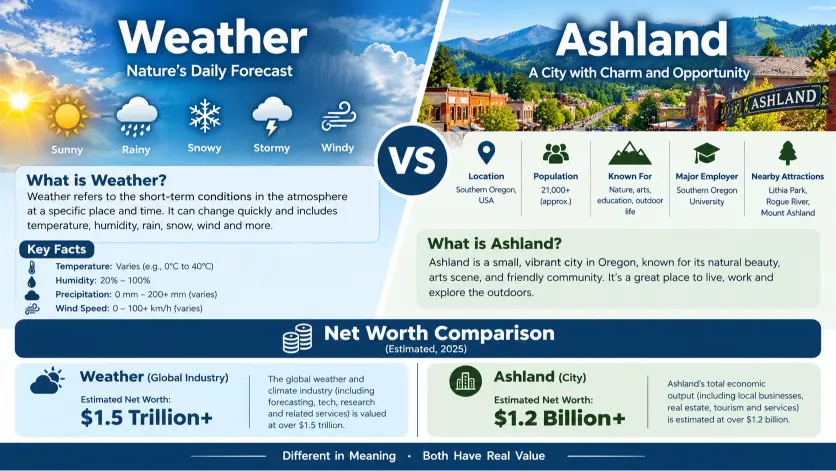
Planning your day in Ashland? Checking the local weather forecast can help you decide what to wear, when to travel, and which outdoor activities are worth planning. Whether you are a local resident, a tourist, or someone preparing for a weekend getaway, understanding Ashland’s weather makes it easier to plan with confidence. From sunny afternoons to unexpected rain and colder winter mornings, weather conditions can influence everything from daily commutes to sightseeing. But what should you expect today, and how might the forecast change over the coming days?
This guide to weather in Ashland helps you understand current conditions, daily temperatures, hourly forecasts, precipitation chances, and seasonal climate patterns. You can also learn what to expect during spring, summer, fall, and winter, making it easier to prepare for changing conditions. Since Ashland can refer to multiple places, confirming the correct location is essential for finding an accurate forecast.
For the most reliable planning, compare updated forecasts from trusted weather services and check official alerts when severe conditions are possible. Remember that forecasts can change, especially several days ahead. By combining current weather updates with seasonal information, you can make better decisions about travel, clothing, and outdoor plans in Ashland.
Weather or Ashland: What Is the Difference?
Although weather and Ashland can appear together in a search query, they are not synonyms, spelling alternatives, or interchangeable vocabulary words. Instead, each serves a different grammatical and practical function.
What Does Weather Mean?
Weather is a common noun that refers to the condition of the atmosphere at a particular time and place. For example, it describes temperature, rainfall, sunshine, humidity, cloud cover, wind, and storms.
Furthermore, weather can change within minutes or hours. A sunny morning may become cloudy by afternoon, while a calm evening may bring heavy rain overnight.
Examples:
- The weather is pleasant this morning.
- We canceled the picnic because of bad weather.
- Tomorrow’s weather forecast predicts heavy rain.
- Cold weather can make outdoor activities uncomfortable.
In everyday conversation, weather also appears in expressions such as weather conditions, weather forecast, and weather report. Therefore, the word is useful in personal conversations, scientific discussions, travel planning, and professional communication.
What Does Ashland Mean?
Ashland is a proper noun, most commonly used as a place name. Several communities in the United States and elsewhere use this name. Depending on the context, it may refer to a city, town, neighborhood, or another geographical location.
For instance, Ashland, Oregon, is a city in the southwestern part of Oregon. Ashland, Kentucky, is another American city. Therefore, the name alone does not always identify one specific destination.
Examples:
- Ashland, Oregon, attracts visitors interested in theater and outdoor recreation.
- My relatives live in Ashland, Kentucky.
- We are planning a weekend trip to Ashland.
- The local forecast says rain is possible in Ashland tomorrow.
Notice that Ashland begins with a capital letter because it is a proper noun. However, weather normally begins with a lowercase letter unless it appears at the start of a sentence or within a title.
Schema Friendly Comparison
Weather
Part of speech
Common noun
Meaning
Atmospheric conditions
Example
The weather is cloudy.
Ashland
Part of speech
Proper noun
Meaning
A geographical name
Example
Ashland is our destination.
Mini recap
Weather describes atmospheric conditions, while Ashland identifies a place.
Weather is generally written in lowercase, whereas Ashland is capitalized.
The two words can appear in one sentence when discussing conditions in a specific location.
For example, What is the weather in Ashland today? is grammatically correct.
Is Weather or Ashland a Grammar, Vocabulary, or Usage Issue?
The difference between weather and Ashland is primarily a matter of vocabulary, capitalization, and context. Nevertheless, understanding their grammatical roles makes it easier to use both expressions accurately.
Are Weather and Ashland Interchangeable?
No. Weather describes atmospheric conditions, whereas Ashland usually names a geographical location. Replacing one with the other changes the meaning of a sentence.
For example, consider these statements:
- The weather is beautiful today.
- Ashland is beautiful in spring.
The first sentence describes atmospheric conditions. In contrast, the second describes a place and its appearance.
Therefore, the words cannot substitute for each other without changing the message.
Formal Versus Informal Usage
In formal writing, use weather when discussing climate conditions, forecasts, outdoor safety, or environmental observations. Meanwhile, use Ashland when identifying a destination, institution, or location associated with that name.
In casual conversation, people often combine the terms naturally.
For example, someone might ask, “What’s the weather like in Ashland?” This question is informal, clear, and grammatically correct.
Similarly, a travel report might state, “Weather conditions in Ashland remained dry throughout the afternoon.” Both words have distinct roles in the sentence.
Academic Versus Casual Writing
In academic writing, the distinction becomes especially important when discussing geographical observations.
For example, a researcher might compare rainfall measurements in Ashland with those in another city. In that case, Ashland identifies the research location, while weather describes the conditions being measured.
By contrast, a casual message might simply say, “The weather in Ashland looks great today.”
Both versions are acceptable because the vocabulary matches the intended meaning.
How to Use Weather Correctly
Weather appears in everyday conversation, workplace communication, academic writing, and digital services. Therefore, understanding its practical applications helps prevent ambiguity.
Workplace Example
Suppose a construction manager is organizing outdoor work. Before scheduling workers, the manager checks the forecast.
Correct example: “The weather forecast indicates strong winds tomorrow, so we should postpone the rooftop installation.”
Here, weather describes the atmospheric conditions that could affect workplace safety. Moreover, the sentence explains why the information matters.
Academic Example
A geography student might write:
“Researchers recorded rainfall, temperature, and wind speed to evaluate weather patterns across the study area.”
In this example, weather refers to measurable atmospheric conditions. Consequently, the word is suitable for scientific and educational writing.
Technology Example
Weather applications display current conditions, hourly forecasts, severe weather warnings, and expected temperatures.
For example, a user might enter a location into a weather application to discover whether rain is likely. The application then provides information associated with that location.
Importantly, weather describes the information being requested, not the geographical destination itself.
Usage Recap
Use weather when discussing rain, sunshine, temperature, wind, storms, forecasts, or atmospheric conditions. Furthermore, use specific terms such as rainfall, humidity, and temperature when greater precision is necessary.
How to Use Ashland Correctly
Ashland is a geographical name, so its correct usage depends on identifying the intended place. Because multiple locations share this name, adding a state, region, or country often improves clarity.
Workplace Example
A business might prepare a delivery schedule for several destinations.
Correct example: “The delivery team will arrive in Ashland, Oregon, before noon.”
The name identifies the destination, while the state clarifies which Ashland the sentence refers to.
Similarly, a company might discuss its Ashland office, regional branch, or local customers.
Academic Example
A geography report could state:
“The research team collected observations in Ashland, Oregon, during the summer.”
Here, Ashland identifies the study location. Meanwhile, additional information explains when the research took place.
If the report discusses atmospheric conditions, the writer can use both words:
“The team recorded weather observations in Ashland throughout July.”
This sentence distinguishes the location from the environmental information collected there.
Technology Example
Mapping applications, travel websites, and location based services may use Ashland as a destination or search term.
For example, entering “Ashland, Oregon” into a map helps identify the intended city. Adding “weather” to the search then requests atmospheric information for that destination.
Consequently, a query such as “Ashland weather today” combines a location name with the information being requested.
Usage Recap
Capitalize Ashland because it is a proper noun. Additionally, specify the state or region when several places could match the name.
Weather or Ashland in Search Queries
The phrase weather or Ashland may appear to compare two alternatives. However, in practical search behavior, the more likely useful interpretation is a request involving the weather in a place called Ashland.
For instance, users might search for:
- Weather in Ashland today
- Ashland weather forecast this week
- Current temperature in Ashland, Oregon
- Rain forecast for Ashland, Kentucky
- Weather conditions near Ashland
- Best time to visit Ashland based on the weather
These searches have different levels of specificity. Nevertheless, each combines atmospheric information with a location.
Why Location Matters
Weather is location dependent. Conditions in Ashland, Oregon, may differ considerably from conditions in Ashland, Kentucky, even on the same day.
Therefore, a search that includes only Ashland may return information for a location selected by the search service. To reduce confusion, include the state or region whenever possible.
Choosing the Right Search Phrase
If you want current atmospheric information, write “weather in Ashland” followed by the relevant state or country.
On the other hand, if you want geographical information, search for “Ashland city” or specify the state.
Likewise, if you want travel recommendations, use a phrase such as “things to do in Ashland, Oregon.”
The best wording depends on the information you need rather than on choosing one word over the other.
When You Should NOT Use Weather or Ashland
Although both terms are useful, several situations call for extra care.
1. Do not use weather to identify a destination. Instead of writing, “We traveled to weather,” identify the actual place you visited.
2. Do not use Ashland to describe atmospheric conditions. Rather than saying, “The Ashland is rainy,” write, “The weather in Ashland is rainy.”
3. Do not capitalize weather unnecessarily. In the middle of an ordinary sentence, write “The weather is changing” rather than “The Weather is changing.”
4. Do not write ashland as a place name when standard capitalization is required. Use Ashland in ordinary geographical references.
5. Do not assume every Ashland refers to the same city. Add a state or region when the intended location is important.
6. Do not confuse weather with climate. Weather refers to atmospheric conditions over shorter periods, while climate describes longer term patterns.
7. Do not omit the location from a forecast request when precision matters. A forecast for Ashland, Oregon, may not apply to Ashland, Kentucky.
8. Do not treat weather or Ashland as a spelling comparison. The words have different meanings and are not competing spellings of one expression.
Common Mistakes and Decision Rules
The following examples demonstrate how context determines the correct wording.
Correct sentence
The weather in Ashland is sunny.
Incorrect sentence
The Ashland in weather is sunny.
Explanation: Weather describes the conditions, while Ashland identifies the location. Their grammatical roles must remain clear.
Correct sentence
We are visiting Ashland next weekend.
Incorrect sentence
We are visiting weather next weekend.
Explanation: Visiting requires a destination in this context. Weather is not a place name.
Correct sentence
The weather forecast predicts rain in Ashland.
Incorrect sentence
The Ashland forecast predicts rain in weather.
Explanation: The first sentence clearly identifies the forecast, the expected condition, and the location.
Correct sentence
I checked the weather before traveling to Ashland, Oregon.
Incorrect sentence
I checked the Ashland before traveling to weather.
Explanation: The correct version uses weather for atmospheric information and Ashland for the destination.
The Decision Rule
If you mean atmospheric conditions, use weather.
If you mean the geographical location, use Ashland.
If you mean atmospheric conditions at that location, use both.
Example: “The weather in Ashland is cold today.”
This rule works in most everyday situations. However, if Ashland refers to a business, organization, or another named entity rather than a geographical destination, use the surrounding context to determine its precise meaning.
Weather and Ashland in Modern Technology and Digital Tools
Modern digital services frequently combine location information with weather data. Consequently, these words may appear together in search engines, mobile applications, navigation tools, and online travel platforms.
For example, a weather application may request a city name before displaying a local forecast. When a user enters Ashland, the application attempts to identify the appropriate location.
Likewise, a navigation application uses Ashland as a destination rather than as a description of atmospheric conditions. A separate weather service can then provide information about rain, temperature, or wind in that area.
Search queries also depend on wording. “Ashland temperature today” requests a specific measurement, while “Ashland attractions” requests destination information.
Therefore, the more precisely a user describes the intended task, the easier it becomes to retrieve relevant results. Still, the reliability of a forecast depends on the data source, location accuracy, and forecast period.
Etymology: Where Do Weather and Ashland Come From?
Understanding the history of each term provides additional vocabulary context.
The Origin of Weather
The English word weather developed from older Germanic forms associated with wind, atmosphere, and changing environmental conditions. Over time, it became the familiar noun used for rain, sunshine, temperature, and related phenomena.
Today, weather is central to meteorology, environmental studies, agriculture, aviation, and daily communication.
The Origin of Ashland
Ashland is a place name formed from the English word ash, referring to an ash tree, and land, referring to an area of ground or territory.
Nevertheless, the historical origin of an individual place named Ashland can vary. The name’s general word components do not establish the specific history of every town or community bearing it.
As a result, geographical history should be checked against the particular Ashland being discussed.
An Expert Perspective on Correct Usage
A useful principle in clear writing is that words should identify the intended subject without forcing readers to guess.
As a practical editorial rule:
“Choose the word that names exactly what you mean, then use context to make the relationship clear.”
This is an editorial principle rather than a quotation attributed to a specific linguist.
Applied here, weather names atmospheric conditions, while Ashland names a place. When both concepts matter, a sentence such as “The weather in Ashland is improving” communicates the relationship directly.
Furthermore, correct capitalization helps readers distinguish a proper noun from an ordinary vocabulary word.
Two Practical Case Studies
The following hypothetical examples illustrate how this distinction can improve communication.
Case Study One: Planning an Outdoor Event
Imagine that a school is arranging an outdoor sports day in Ashland. The organizers need to decide whether the event should proceed.
Initially, a notice states, “Ashland may be unsuitable tomorrow.” Unfortunately, this wording does not explain whether the concern involves the location, access, or atmospheric conditions.
The organizers revise the notice:
“The weather forecast for Ashland predicts heavy rain tomorrow, so the outdoor event may be postponed.”
Now the message identifies the location, the relevant conditions, and the possible consequence.
Result: The revised notice reduces ambiguity and gives families a clearer reason for the scheduling decision. No numerical improvement is assumed because this example is illustrative.
Case Study Two: Searching for Local Conditions
Consider a traveler preparing to visit Ashland, Oregon. The traveler enters “weather” into a search service but does not provide a location.
The results may concern a different city or the traveler’s current location. Consequently, the information might not help with packing or itinerary planning.
The traveler changes the query to “weather in Ashland, Oregon, this weekend.”
The more specific wording identifies both the information requested and the intended destination.
Result: The revised query reduces location ambiguity and is more likely to return relevant forecast information, although the actual result depends on the search service and available data.
Error Prevention Checklist
Before publishing a sentence or entering a location based query, review these points.
Always Use Weather When
- You are describing rain, sunshine, snow, wind, or temperature.
- You are discussing a forecast or atmospheric conditions.
- You are explaining how environmental conditions affect travel or work.
- You are referring to short term atmospheric changes.
Always Use Ashland When
- You are identifying a place named Ashland.
- You are referring to a destination, local community, or regional location.
- You are describing a visit, journey, or local activity associated with that place.
- You need to specify where a weather observation was recorded.
Never Use These Terms Incorrectly
- Never substitute Ashland for weather when describing rain or temperature.
- Never substitute weather for Ashland when identifying a destination.
- Never assume an unspecified Ashland identifies one particular city.
- Never overlook capitalization when using Ashland as a proper noun.
Finally, if your sentence refers to atmospheric conditions in a specific place, combining both words is often the clearest solution.
Related Grammar Confusions You Should Master
Although weather and Ashland are not alternative spellings, other English word pairs are genuinely easy to confuse. Learning these distinctions can improve everyday writing.
1. Weather vs whether: Weather describes atmospheric conditions, while whether introduces alternatives or uncertainty.
2. There vs their: There refers to a place or introduces a statement, whereas their indicates possession.
3. Its vs it’s: Its expresses possession, while it’s is a contraction of it is or it has.
4. Affect vs effect: Affect is commonly a verb meaning to influence, while effect is commonly a noun meaning a result.
5. Then vs than: Then relates to time or sequence, while than is used in comparisons.
6. Your vs you’re: Your indicates possession, while you’re means you are.
7. Climate vs weather: Climate describes long term patterns, while weather describes atmospheric conditions over shorter periods.
8. City vs county: A city is a settlement or municipality, while a county is an administrative division in certain jurisdictions.
9. Capitalization vs lowercase: Proper nouns such as Ashland generally require an initial capital letter, while common nouns such as weather usually do not.
10. Forecast vs climate prediction: A weather forecast estimates future atmospheric conditions, while climate projections examine possible long term patterns.
Understanding these differences helps writers choose precise language and avoid confusion in both formal and casual communication.
Frequently Asked Questions
1. What is the difference between weather and Ashland?
Weather describes atmospheric conditions, such as rain, wind, and temperature. Ashland is a proper noun commonly used as a geographical name. Therefore, weather describes conditions, while Ashland identifies a place.
2. Is weather or Ashland the correct word?
Both words are correct, but they serve different purposes. Use weather when discussing atmospheric conditions and Ashland when identifying the intended place. When describing local conditions, use both in a phrase such as “the weather in Ashland.”
3. What does weather in Ashland mean?
Weather in Ashland refers to atmospheric conditions at a particular location named Ashland. Depending on the intended city, the phrase may refer to temperature, rain, wind, sunshine, or a local forecast.
4. Should Ashland always be capitalized?
Yes, when Ashland is used as a proper name, it should begin with a capital letter. For example, write “Ashland is a popular destination.” However, capitalization may differ if the word appears as part of a specialized name or stylized brand.
5. Is Ashland a city or a weather term?
Ashland is most commonly recognized as a place name, including the names of several American cities. It is not a standard term for atmospheric conditions. The precise geographical reference depends on the context.
6. How do I search for the weather in Ashland today?
Enter “weather in Ashland” along with the relevant state or region. This extra information helps distinguish between places sharing the same name. For current conditions, consult a weather service that provides recent observations and forecasts.
7. Can weather and Ashland appear in the same sentence?
Yes. For example, “The weather in Ashland is expected to improve tomorrow.” In this sentence, weather describes atmospheric conditions, while Ashland identifies the location.
8. What is the difference between weather and climate in Ashland?
Weather describes short term conditions, such as today’s temperature or tomorrow’s rain. Climate refers to longer term patterns observed over many years. Therefore, a forecast for Ashland concerns weather, while a study of its typical seasonal conditions concerns climate.
9. Why is the phrase weather or Ashland confusing?
The phrase places two unrelated concepts together without explaining their relationship. Since weather describes atmospheric conditions and Ashland usually names a location, the intended meaning becomes clearer when the words are used in a complete question, such as “What is the weather in Ashland?”
Conclusion:
The difference between weather and Ashland is straightforward once you understand their meanings. Weather is a common noun for atmospheric conditions, while Ashland is a proper noun commonly used for a geographical location.
Therefore, neither word replaces the other. Instead, select the term that matches your intended meaning. If you are discussing rain, sunshine, wind, or temperature, use weather. If you are identifying a destination, use Ashland.
For the clearest wording, combine them when appropriate. For example, “The weather in Ashland is pleasant today” communicates both the location and its atmospheric conditions. Ultimately, accurate word choice, correct capitalization, and sufficient location details make your writing easier to understand and your searches more precise.









