Have you ever wondered whether “themselves” or “themself” is the correct word to use in a sentence? You are not alone. Many English learners, students, writers, and even experienced professionals find these two forms confusing. Both words are used as reflexive pronouns, but they are not always interchangeable. Choosing the right one depends on the meaning of your sentence, the pronoun you are referring to, and the writing style you want to follow. Understanding this small grammatical difference can help you write more clearly, avoid common mistakes, and communicate with greater confidence.
Traditionally, “themselves” is the standard reflexive form of the plural pronoun “they.” For example, “The students prepared themselves for the exam.” However, “themself” is also an established form in modern English, particularly when “they” refers to one person whose gender is unknown, irrelevant, or nonbinary. For instance, “Someone should remind themself to take a break.” Although some traditional grammar guides prefer “themselves” in every context, modern dictionaries and style guides increasingly recognize the singular use of “themself.”
In this guide, we will explain the difference between themselves and themself with simple definitions, practical sentence examples, and easy-to-follow grammar rules. We will also explore when each word is appropriate, what common mistakes to avoid, and how formal writing conventions may influence your choice. By looking at traditional grammar alongside contemporary English usage, this article aims to provide a balanced, evidence-informed explanation that readers can apply in school assignments, professional communication, and everyday conversations. By the end, you will know how to choose the form that best fits your sentence and its context.
Themselves or Themself: What Is the Difference?
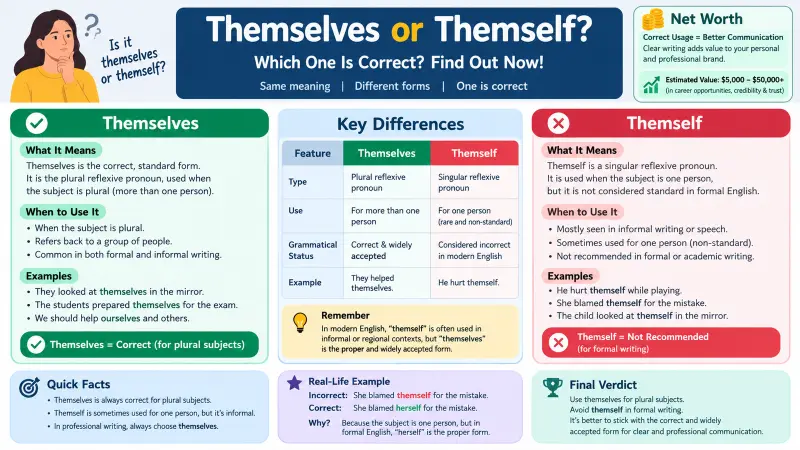
When deciding between themselves or themself, the main consideration is whether you are referring to multiple people or one person who uses singular they. Although both forms appear in modern English, their conventional usage differs.
For example, if several employees complete a project independently, you would normally write, “The employees prepared the presentation themselves.” However, if one employee uses singular they, the sentence may read, “Alex prepared the presentation themself.”
Nevertheless, some writers use themselves with singular they, particularly in formal publications and academic writing. Therefore, the correct choice depends on the intended meaning, the person’s pronouns, and the style guide being followed.
Themselves vs Themself: What Is the Difference?
To understand the distinction, it helps to examine each word separately, including its grammatical role and typical applications.
What Does Themselves Mean?
Themselves is a reflexive pronoun and an intensive pronoun. It usually refers to more than one person, animal, or entity previously mentioned in a sentence.
As a reflexive pronoun, it indicates that the subject performs an action that affects the same subject.
Examples include:
- The students introduced themselves before the lesson.
- The managers congratulated themselves on completing the project.
- The children dressed themselves without assistance.
Additionally, themselves can emphasize a subject rather than describe an action directed back toward it.
For instance, “The authors themselves approved the final manuscript” emphasizes that the authors personally approved the document.
Importantly, themselves is also commonly used with singular they. Consequently, it can refer to one person when that person uses they and them pronouns.
Example: “Jordan described themselves as an experienced designer.”
What Does Themself Mean?
Themself is a singular reflexive pronoun generally used when referring to one person, particularly someone who uses singular they pronouns.
For example:
- Alex prepared themself for the interview.
- Jordan reminded themself to submit the application.
- My colleague introduced themself to the new team.
In each example, the subject refers to one individual rather than several people.
Furthermore, themself can communicate the relationship between a person and their own actions without requiring gendered pronouns such as himself or herself.
However, not every publication accepts themself in every context. Some editors prefer themselves with singular they, while others recognize both forms. Therefore, writers should consider their audience and the applicable editorial guidelines.
Comparison Table
| Feature | Themselves | Themself |
|---|---|---|
| Part of speech | Reflexive or intensive pronoun | Reflexive pronoun, sometimes intensive |
| Typical reference | Multiple people | One person |
| Plural subjects | Standard choice | Generally unsuitable |
| Singular they | Widely accepted | Increasingly accepted |
| Formal writing | Commonly accepted | Acceptance varies |
| Casual communication | Natural | Natural for many speakers |
| Gender neutral | Yes | Yes |
| Main consideration | Number and established convention | Singular reference and personal usage |
Quick recap: Use themselves when referring to multiple people. For one person who uses singular they, either themself or themselves may be appropriate. Because editorial preferences differ, consistency matters most when both forms are acceptable.
Is Themselves vs Themself a Grammar, Vocabulary, or Usage Issue?
The distinction involves grammar, vocabulary, and usage. However, the central question concerns how a reflexive pronoun agrees with its antecedent and how English speakers use singular they.
Are They Interchangeable?
Not in every sentence.
When a plural subject refers back to itself, themselves is the conventional choice.
Correct: “The players prepared themselves for the final match.”
Incorrect in standard usage: “The players prepared themself for the final match.”
Conversely, when a single person uses singular they, both forms may be acceptable.
For example:
“Taylor taught themselves to play the guitar.”
“Taylor taught themself to play the guitar.”
Both sentences can be correct. Nevertheless, some readers and editors prefer the first, while others favor the second because it more explicitly reflects a singular reference.
Formal Versus Informal Usage
In formal writing, themselves remains a familiar choice, especially when referring to singular they. Meanwhile, themself is increasingly recognized in contemporary English, although acceptance varies by publication and institution.
In casual conversations, either form can sound natural, depending on the speaker’s preferences.
Academic Versus Everyday Writing
Academic writers should follow their institution’s style guide. For instance, a university may permit singular they while recommending themselves as its reflexive form.
By contrast, a publication that recognizes themself may prefer that form when the antecedent is singular.
Therefore, the best practice is to identify the intended reference, check the applicable guidelines, and maintain consistency throughout the document.
How to Use Themselves Correctly
The word themselves serves several purposes in everyday, professional, and academic English. Most importantly, it commonly refers to plural subjects and is also used with singular they.
Workplace Example
Suppose a team completes a demanding project without outside assistance.
Correct: “The employees organized themselves into smaller groups.”
Here, the plural noun employees establishes the reference, so themselves is appropriate.
Similarly, a manager might write, “The department heads themselves reviewed the proposed changes.” In this sentence, the pronoun adds emphasis.
Academic Example
In an academic paper, a researcher might write:
“Participants described themselves as confident problem solvers.”
Because participants refers to multiple individuals, the reflexive pronoun agrees with the subject.
Additionally, an academic author may write, “Each student should ask themselves whether the evidence supports the conclusion.” This singular construction is widely used in contemporary English, although certain style guides prefer different formulations.
Technology Example
Consider a software application that allows multiple users to manage their profiles.
Correct: “Users can identify themselves through a secure verification process.”
Here, themselves refers to the plural noun users.
Likewise, documentation might state, “Developers should familiarize themselves with the available settings.”
Usage recap: Choose themselves for plural subjects. Also, recognize that it is widely used with singular they, especially in established formal conventions and contemporary general writing.
How to Use Themself Correctly
Although themself is less traditional than themselves, it has an established role in contemporary English, especially when the subject is one person referred to with singular they.
Workplace Example
Imagine that a colleague named Morgan uses they and them pronouns.
You could write:
“Morgan prepared themself for the leadership interview.”
The pronoun refers to Morgan, a single individual. Consequently, themself is a reasonable choice when it aligns with Morgan’s usage and the organization’s writing guidelines.
Academic Example
A student might write:
“Every researcher should allow themself sufficient time to evaluate the findings.”
Here, themself refers to one researcher considered individually.
However, because academic conventions vary, the writer should check whether the relevant institution accepts this construction.
Technology Example
A digital platform may allow a person to manage personal settings.
For example:
“Each account holder can customize the interface to suit themself.”
The sentence treats the account holder as an individual. Nevertheless, an editor may prefer “to suit their needs” because that alternative avoids the disputed reflexive form.
Usage recap: Use themself when referring to one person, especially someone who uses singular they. However, consider the audience, personal pronouns, and editorial requirements before choosing it.
When You Should NOT Use Themselves or Themself
Although both words are useful, certain constructions create grammatical or stylistic problems. Therefore, recognizing these situations can prevent confusion.
1. Do Not Use Themself for an Ordinary Plural Subject
Incorrect: “The teachers prepared themself for the meeting.”
Correct: “The teachers prepared themselves for the meeting.”
Because teachers refers to several people, the plural reflexive form is appropriate.
2. Do Not Assume Themselves Always Refers to Multiple People
Incorrect assumption: “Themselves can never refer to one person.”
Correct understanding: “Themselves is also widely used with singular they.”
Although the word traditionally has a plural role, modern English also accepts it in many singular contexts.
3. Do Not Ignore a Person’s Pronouns
If someone uses they and them pronouns, avoid automatically replacing those pronouns with gendered alternatives.
For example, “Alex prepared themself” may be appropriate when it reflects Alex’s preferences and the publication’s conventions.
4. Do Not Mix Forms Without a Reason
Awkward: “Jordan introduced themself, then reminded themselves to speak clearly.”
Better: “Jordan introduced themself, then reminded themself to speak clearly.”
Alternatively, a writer whose preferred convention uses themselves can maintain that form throughout.
5. Do Not Use Reflexive Pronouns Without a Clear Reference
Awkward: “The supervisor told the assistant that themselves were responsible.”
Better: “The supervisor told the assistant that they were responsible.”
The first sentence has an unclear grammatical relationship. A simpler construction makes the intended meaning easier to understand.
6. Do Not Confuse Reflexive and Intensive Usage
Incorrect: “Themselves completed the assignment yesterday.”
Better: “They completed the assignment themselves.”
A reflexive or intensive pronoun generally needs an appropriate grammatical position and a clear antecedent.
7. Do Not Disregard Your Style Guide
A university, newspaper, or employer may specify a preferred form.
Therefore, even when both forms are defensible, follow the relevant standard in formal documents.
8. Do Not Force Either Form When a Clearer Sentence Works
Instead of writing, “Every applicant should prepare themself for the assessment,” you could write, “All applicants should prepare for the assessment.”
This revision is useful when the reflexive pronoun adds no necessary meaning.
Common Mistakes With Themselves and Themself
The following examples show how small wording changes can improve grammatical accuracy and readability.
| Correct sentence | Incorrect sentence | Explanation |
|---|---|---|
| The children entertained themselves. | The children entertained themself. | The subject is plural, so themselves is standard. |
| Jordan reminded themself about the appointment. | Jordan reminded himself about the appointment. | If Jordan uses singular they, the gendered pronoun may not reflect their pronouns. |
| Taylor described themselves as creative. | Taylor described themself as creative. | The second sentence is not universally incorrect. It may simply conflict with a particular editor’s preference. |
| The players congratulated themselves. | The players congratulated themself. | Several players are being discussed. |
| Alex introduced themself to the group. | Alex introduced themselves to the group. | Both forms may be acceptable when Alex uses singular they. |
| The managers themselves approved the plan. | The managers themself approved the plan. | The plural subject conventionally takes themselves. |
Decision Rule Box
If you are referring to multiple people, use themselves.
If you are referring to one person who uses singular they, themself or themselves may work.
If a style guide specifies one form, follow that guidance.
This rule resolves most everyday questions without requiring an extensive grammar analysis.
Themselves and Themself in Modern Technology and Digital Communication
Contemporary digital communication frequently uses singular they because it offers a gender neutral way to refer to an individual whose gender is unknown, irrelevant, or expressed through those pronouns.
For example, a help desk might write, “A customer can reset their password themselves.” Here, themselves refers to the individual customer.
Meanwhile, a personalized account message could say, “The user can update their profile themself.” This construction may suit a publication that accepts singular themself.
However, software interfaces should prioritize clarity and consistency. For instance, “Users can update their own profiles” avoids the issue entirely.
Similarly, writing assistants and grammar checking tools may recommend different forms because their recommendations depend on language models, dictionaries, regional conventions, and editorial settings.
Therefore, writers should not assume that one automated suggestion represents the only correct choice. Instead, consider the sentence’s meaning, the person’s pronouns, and the publication’s requirements.
The Etymology of Themselves and Themself
The history of these words reflects the development of English reflexive pronouns.
The word them developed from Old Norse influence on English and gradually became the standard object form associated with they. Over time, English speakers combined object pronouns with forms related to self to create reflexive expressions.
The word themselves became established as the conventional reflexive form for plural references. Meanwhile, themself developed as a singular alternative, especially in contexts involving singular they.
Although themself has sometimes been treated as nonstandard, its use is not simply a recent invention. Its recognition has grown as English speakers and editors have increasingly discussed gender neutral language and singular pronouns.
Consequently, the difference between these forms reflects both grammatical convention and ongoing changes in English usage.
An Expert Perspective on Choosing the Correct Form
A useful principle for writers is that pronoun selection should reflect the intended reference rather than rely on appearance alone.
“Choose the reflexive pronoun that clearly refers back to its subject, respects the person’s pronouns, and follows the conventions of your audience.”
This is a practical editorial principle, not a quotation attributed to a named linguist.
In other words, grammatical number matters, but so do clarity, identity, and consistency. Therefore, writers should avoid treating every singular use of themselves as an error or every instance of themself as automatically correct.
Two Practical Case Studies: Themselves vs Themself
The following examples illustrate how these choices work in realistic editing situations.
Case Study 1: Editing a Workplace Report
A company prepares a report about a group of employees completing a training program.
Original sentence: “The employees evaluated themself after the training session.”
The editor changes it to: “The employees evaluated themselves after the training session.”
Result: The revised sentence follows conventional agreement between a plural subject and its reflexive pronoun. It also removes an avoidable grammatical inconsistency.
The lesson is straightforward: when the subject clearly refers to several people, themselves is the normal choice.
Case Study 2: Revising a University Profile
A university publishes a profile of a student named Riley, who uses they and them pronouns.
Original sentence: “Riley prepared themselves for the research presentation.”
An editor working for a publication that prefers singular themself revises it to: “Riley prepared themself for the research presentation.”
Result: The revised wording aligns with the publication’s selected convention while retaining Riley’s pronouns.
Importantly, the original sentence was also acceptable in many contemporary contexts. The change reflects editorial preference rather than a universal correction.
Together, these examples show why context matters. A plural agreement error requires correction, whereas the choice between two accepted singular forms may be a matter of style.
Error Prevention Checklist: Themselves or Themself
Before publishing a sentence, check the following points.
Always Use Themselves When
- The subject clearly refers to multiple people.
- Several employees, students, customers, or participants perform an action affecting themselves.
- A style guide specifically recommends themselves with singular they.
- Consistency with the rest of the document requires that form.
Never Use Themself When
- The subject is an ordinary plural noun and conventional plural agreement is intended.
- The sentence conflicts with a binding editorial requirement.
- The wording creates confusion that a simpler construction could prevent.
Before Making Your Final Choice
First, identify the subject. Next, determine whether it refers to one person or multiple people. Then, consider the individual’s pronouns and the intended grammatical relationship. Finally, check the publication’s preferred style.
By following these steps, you can make a reliable choice without overcomplicating an ordinary sentence.
Related Grammar Confusions You Should Master
Understanding reflexive pronouns also helps clarify other common English usage questions. In addition, learning these distinctions can improve sentence structure and editing accuracy.
- They vs Them: Learn the difference between subject and object pronouns.
- Their vs Theirs: Understand possessive determiners and possessive pronouns.
- Yourself vs Yourselves: Match the reflexive form to the intended reference.
- Himself vs Herself: Choose the appropriate reflexive pronoun for the person being discussed.
- Who vs Whom: Distinguish subject and object roles.
- Its vs It’s: Separate possession from the contraction meaning “it is” or “it has.”
- Everyone Is vs Everyone Are: Understand agreement with indefinite pronouns.
- Each Other vs Themselves: Distinguish reciprocal actions from reflexive ones.
- Whoever vs Whomever: Identify the grammatical role within a clause.
- Less vs Fewer: Understand traditional countability rules and modern usage.
These topics share an important principle: effective grammar depends on meaning, sentence structure, and context rather than memorizing isolated rules.
Frequently Asked Questions
1. Is Themself Grammatically Correct?
Yes. Themself is an established singular reflexive pronoun, especially for people who use singular they. Nevertheless, acceptance varies by publication and style guide, so check the requirements of your intended audience.
2. Is Themselves Singular or Plural?
Themselves is traditionally plural, as in “The children dressed themselves.” However, it is also widely used with singular they, as in “Jordan introduced themselves.”
3. Should I Use Themself or Themselves for One Person?
Either can be appropriate when referring to one person who uses singular they. However, themself emphasizes the singular reference, while themselves remains common in formal and general writing.
4. Is Themself Accepted in Academic Writing?
It depends on the institution and publication. Some academic editors accept themself for a singular person, whereas others prefer themselves. Therefore, consult the relevant style guide before submitting your work.
5. Why Do People Use Themself Instead of Themselves?
Some writers prefer themself because it corresponds more directly to one individual. Additionally, it can make the singular reference explicit while preserving gender neutral language.
6. Can Themselves Refer to a Nonbinary Person?
Yes. If a nonbinary person uses they and them pronouns, themselves can be appropriate. However, themself may also be suitable, depending on the person’s preferences and the writing convention.
7. What Is the Difference Between Themselves and Themself in a Sentence?
Themselves is the conventional plural reflexive pronoun and is also common with singular they. In contrast, themself is a singular reflexive form often chosen for one person who uses those pronouns.
8. Is Themself More Correct Than Themselves for Singular They?
Not universally. Both forms are accepted in many contexts, and neither is always more correct. The best choice depends on the intended meaning, personal pronouns, and applicable editorial standards.
9. What Is the Plural Form of Themself?
The conventional plural form is themselves. For example, “The volunteers organized themselves before the event.”
10. How Can I Avoid Mistakes When Using Themselves or Themself?
Start by identifying the subject and determining whether it refers to one person or multiple people. Then, consider pronouns and style requirements. Finally, read the sentence aloud to check whether the reference is clear.
Conclusion:
Choosing between themselves and themself becomes easier once you understand how each form works. Themselves is the standard reflexive pronoun for plural subjects, while themself is a recognized singular option, particularly for someone who uses singular they.
However, the distinction is not always absolute. Because themselves is also widely accepted with singular they, writers should consider context rather than automatically labeling one form incorrect.
For everyday communication, prioritize clear meaning and respect for personal pronouns. Meanwhile, in academic and professional documents, follow the relevant style guide and maintain consistency.
Ultimately, the best choice is the one that communicates your meaning accurately, fits the intended audience, and follows the conventions of the document you are writing.