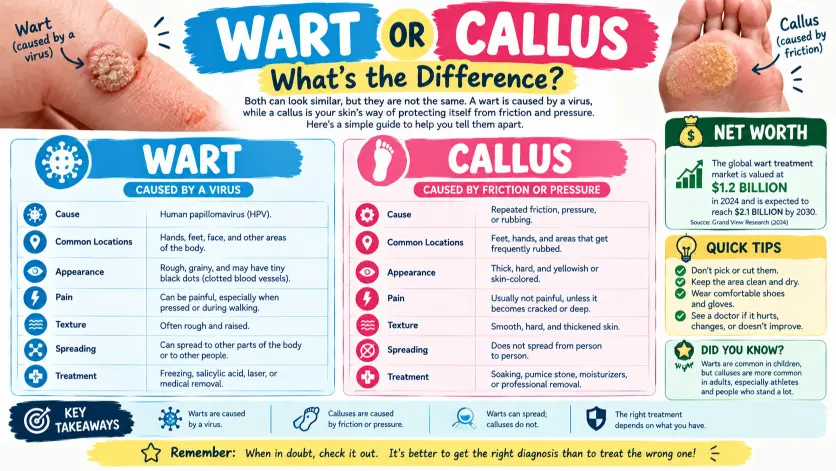
Have you noticed a hard, rough, or unusual spot on your foot and wondered whether it is a wart or callus? You are not alone. These two skin conditions can look surprisingly similar, especially when they appear on the toes, soles, or other areas exposed to pressure and friction. However, they develop for different reasons and may have different signs that can help you tell them apart.
Knowing the difference between a wart and a callus matters because choosing the wrong treatment may not solve the problem and could irritate your skin. In this guide, we will explain the most noticeable differences in appearance, texture, causes, location, and symptoms using simple, evidence-informed information.
You will also learn what commonly causes each condition, how they are usually managed, and when it is sensible to seek advice from a qualified healthcare professional. By the end, identifying a wart or callus should feel much less confusing.
Wart or Callus: What Is the Difference?
Although warts and calluses can look surprisingly similar, they are not the same skin condition. The most important difference is why they develop.
A wart is a small growth caused by infection with certain types of human papillomavirus, commonly known as HPV. Warts can occur on many parts of the body, including the fingers, hands, soles of the feet, and around the nails.
A callus is an area of thickened skin that forms because the skin repeatedly experiences pressure, rubbing, or friction. It is the body’s natural protective response. Calluses are especially common on the feet, palms, and areas exposed to repeated mechanical stress.
The two can sometimes be confused because both may feel hard and look rough. However, their surface, location, tenderness, and skin markings can provide useful clues.
Mini recap: A wart is associated with a viral infection, while a callus is associated with repeated mechanical stress. Warts can interrupt the normal pattern of skin lines and may contain tiny dark dots. Calluses generally have a more uniform thickened appearance and develop where pressure repeatedly occurs.
How Can You Tell If It Is a Wart or Callus?
Looking at the area carefully can provide clues, although appearance alone cannot always provide a definite diagnosis.
One useful observation is the pattern of the skin. Normal skin has tiny lines and ridges. With a callus, these lines often continue across the thickened skin. With a wart, the normal skin pattern may be disrupted because the wart grows within the skin.
Another clue is the location. A thick patch on the ball of the foot that corresponds with a shoe pressure point is more consistent with a callus. A rough growth on a finger, particularly one that appears without an obvious source of friction, may be more suggestive of a wart.
Tiny dark dots can sometimes appear in warts. These are commonly associated with small blood vessels within the lesion. They aren’t necessarily dirt or embedded material.
Pain can also offer a clue. A plantar wart on the sole may feel particularly uncomfortable when pressure is applied from the sides. A callus is more likely to hurt directly where pressure is being applied.
These clues aren’t perfect. Some warts become heavily covered with thick skin, especially on the feet, making them look very similar to calluses.
Is Wart or Callus a Grammar, Vocabulary, or Usage Issue?
The phrase wart or callus is not primarily a grammar issue. It is a vocabulary and usage distinction involving two different medical and dermatological terms.
The words are not interchangeable. Using one in place of the other can change the meaning of a sentence.
For example, saying that a person developed a callus after repeated shoe friction describes a pressure related skin change. Saying that the same person developed a wart suggests an infectious cause.
In casual conversation, people sometimes use broad expressions such as “a bump,” “hard skin,” or “a spot.” These descriptions can be understandable, but they don’t necessarily identify the actual condition.
In academic, workplace, educational, or medical writing, greater precision is useful. If the cause is unknown, it is better to describe what can actually be observed rather than confidently labeling the lesion.
For example:
Less precise: “There is a hard bump on my foot.”
More precise: “There is a rough, thickened area on the sole that may need evaluation to determine whether it is a wart or callus.”
This distinction is especially important when treatment depends on the diagnosis.
What Is a Wart?
A wart is a noncancerous skin growth associated with certain types of HPV. Different wart types can appear in different locations and have different appearances.
Common warts often develop on the hands and fingers. They may have a rough, uneven surface and can gradually become more noticeable.
Plantar warts occur on the soles of the feet. Because walking creates pressure and friction, the surface of a plantar wart can become covered by thickened skin. This is one reason people sometimes mistake a plantar wart for a callus.
Warts may occur individually or in groups. Some can persist for a long time, while others eventually disappear as the immune system responds to the infection.
Workplace example
A person who frequently handles equipment might notice a rough growth on a finger. If there is no consistent pressure point explaining the thickened skin, a wart could be one possibility.
Academic example
In a biology or health education assignment, the correct term is important because a wart and a callus have different underlying causes.
Technology example
A symptom tracking application might allow a user to record a “skin growth” before a healthcare professional determines whether it resembles a wart, callus, blister, or another condition.
Usage recap: Use wart when referring to a growth associated with certain HPV infections. Don’t use the word simply to describe any hard or rough area of skin.
What Is a Callus?
A callus is a thickened area of skin caused by repeated pressure or friction. It is essentially a protective response in which the outer layer of skin becomes thicker.
Calluses commonly appear on the feet because shoes, walking patterns, sports, and body weight can repeatedly place pressure on particular areas. They can also develop on the hands of people who perform repetitive manual activities.
A callus isn’t contagious. If the underlying friction continues, the thickened area may remain or become more pronounced.
For example, a musician who repeatedly presses a string instrument against the fingers may develop thickened skin. Someone whose shoes repeatedly rub against the same part of the foot may also develop a callus.
Workplace example
A construction worker who regularly grips tools may develop callused areas on the palms because of repeated pressure.
Academic example
In a health education context, a callus can be explained as a protective thickening of the outer skin caused by mechanical stress.
Technology example
Fitness and activity tracking platforms can help users identify repeated activities associated with friction, although an app cannot reliably diagnose a skin condition from activity data alone.
Usage recap: Use callus when the thickened skin is associated with repeated friction or pressure. Removing the source of pressure is often an important part of preventing further irritation.
When You Should NOT Use Wart or Callus
There are several situations where casually choosing one term can create confusion.
- Don’t call every rough patch a wart. Rough skin has many possible causes.
- Don’t call every thickened area a callus. A wart can become covered by thick skin and resemble a callus.
- Don’t assume a dark dot means dirt. Some warts can contain tiny blood vessels that appear as dark points.
- Don’t diagnose from color alone. Color can vary depending on skin tone, location, irritation, and other factors.
- Don’t assume foot location automatically means callus. Plantar warts commonly occur on the feet.
- Don’t assume pain automatically means wart. Both conditions can become uncomfortable.
- Don’t use the terms interchangeably in medical writing. Their causes and management can differ.
- Don’t aggressively remove an uncertain lesion. Cutting, scraping, or irritating the skin can cause injury and may make the problem harder to evaluate.
Common Mistakes and Decision Rules
People often make the mistake of relying on only one feature. A better approach is to consider several clues together.
Decision Rule Box
If the thickened skin appears where repeated pressure or friction occurs, a callus is more likely.
If the area looks like a rough growth that disrupts normal skin markings or contains tiny dark dots, a wart may be more likely.
These are practical clues rather than a substitute for professional diagnosis.
Wart or Callus in Modern Technology
Modern health applications can help people record symptoms, track changes, and organize information before speaking with a healthcare professional. Some modern powered image tools can also analyze photographs and suggest possible categories of skin conditions.
However, image recognition should not be treated as a definitive diagnosis.
A photograph may have limitations caused by lighting, camera quality, skin tone, focus, angle, or the similarity between different skin conditions. A plantar wart hidden beneath thickened skin is a good example of why visual classification can be difficult.
The safest use of technology is often documentation and preparation, rather than self diagnosis. A person can record when the lesion appeared, whether it has changed, where it occurs, whether it hurts, and whether there is repeated pressure in that area.
Wart and Callus Etymology
The word wart comes from an old Germanic word family associated with a wart or skin growth. Its use in English dates back many centuries.
The word callus comes from Latin callum, referring to hard skin. Its meaning fits the modern concept because a callus is essentially an area where the skin becomes hardened or thickened.
Understanding the origins of these words can make their meanings easier to remember. Wart describes a particular type of growth, while callus emphasizes hardened skin.
Expert style quotation
“The most useful distinction is not simply how rough the skin looks, but why the area developed and how the surrounding skin pattern has changed.”
This principle is valuable because appearance alone can be misleading.
Two Practical Case Studies
Case Study One: Repeated Shoe Pressure
Imagine a recreational runner who notices a thickened area beneath the front part of the foot. The spot appears exactly where pressure occurs during walking and running. The person also notices that the same area becomes more pronounced after wearing tightly fitted shoes.
The practical result is that reducing friction, improving footwear fit, and addressing the pressure point may help prevent further thickening.
This pattern is more consistent with a callus than with an unexplained infectious growth, although a healthcare professional would be needed for confirmation if the appearance is unusual.
Case Study Two: A Rough Growth on the Finger
Consider a student who develops a rough growth on a finger without an obvious repetitive pressure point. Over time, the surface becomes uneven and normal skin markings appear interrupted.
The practical result is that the person should avoid assuming it is merely hardened skin. A healthcare professional can determine whether the growth resembles a wart or another type of lesion and recommend appropriate management.
These examples demonstrate an important lesson: the context surrounding a skin change can be as informative as its appearance.
Author expertise
Written from a language and health education perspective, with emphasis on precise terminology, practical usage, and clear consumer friendly explanations.
Error Prevention Checklist
Always use wart when
• You are specifically referring to a growth associated with certain HPV infections.
• The context involves a diagnosed or suspected wart.
• You are discussing common, plantar, flat, or other recognized wart types.
• You are explaining that the growth may be contagious.
Never use callus when
• You have no evidence that repeated pressure or friction caused the thickened area.
• You are simply guessing that a rough growth is a callus.
• The lesion has unusual features that require professional evaluation.
Always use callus when
• The skin is thickened at a repeated pressure point.
• Friction from footwear or equipment clearly corresponds with the area.
• You are describing protective skin thickening rather than an infectious growth.
Related Grammar Confusions You Should Master
Learning the distinction between wart and callus also highlights a broader language lesson: similar looking things don’t always have identical meanings.
Other useful terminology distinctions include:
- Affect vs effect: one commonly functions as a verb, while the other is commonly used as a noun.
- Advice vs advise: one is a noun and the other is a verb.
- Practice vs practise: usage depends partly on regional English conventions.
- Everyday vs every day: one is an adjective while the other is an adverbial expression.
- Compliment vs complement: praise and completion have different meanings.
- Discreet vs discrete: privacy and separateness are not the same concept.
- Principal vs principle: a person or main item differs from a rule or belief.
- Stationary vs stationery: staying still differs from writing materials.
- Fewer vs less: countable items and uncountable quantities usually require different choices.
- Altar vs alter: a religious structure and the act of changing something are unrelated meanings.
The common lesson is simple: choosing the right word requires attention to meaning, context, and function rather than appearance alone.
Advanced FAQs
What is the main difference between a wart and a callus?
A wart is associated with certain HPV infections, while a callus develops because of repeated pressure or friction. They can look similar, particularly on the feet, but their causes are different.
How can you tell if a foot lesion is a wart or callus?
Look at several clues rather than one feature. A pressure point with uniform thickened skin may suggest a callus, while disrupted skin lines and tiny dark points may suggest a wart. Professional evaluation is appropriate when the diagnosis isn’t clear.
Can a wart look like a callus?
Yes. Plantar warts can become covered by thickened skin because the sole of the foot experiences constant pressure. This can make them difficult to distinguish from ordinary calluses.
Are calluses contagious?
No. Calluses result from repeated friction or pressure and aren’t contagious.
Are warts contagious?
Warts can spread because they are associated with a viral infection. Transmission can occur through direct contact or contact with contaminated surfaces, although the likelihood of transmission varies.
Do warts hurt more than calluses?
Neither condition is guaranteed to hurt. Plantar warts and calluses can both become painful depending on their location and the amount of pressure placed on them.
Can you remove a wart like a callus?
You shouldn’t assume that the same approach is appropriate. A wart and a callus have different causes, so treatment should be based on an accurate identification of the lesion.
Should you cut off a callus yourself?
Aggressively cutting thickened skin can cause injury and infection. If a callus is painful, persistent, recurrent, or associated with an underlying health concern, professional advice is safer.
When should you see a healthcare professional about a wart or callus?
Seek professional evaluation if the lesion bleeds, changes significantly, becomes very painful, repeatedly returns, looks unusual, or doesn’t improve. People with conditions that affect circulation, sensation, or healing should be particularly cautious about treating foot lesions themselves.
Final Verdict: Wart or Callus
The clearest way to remember wart or callus is to focus on the cause rather than appearance alone. A wart is a growth associated with certain HPV infections, whereas a callus is thickened skin caused by repeated pressure or friction.
A rough patch on the foot isn’t automatically a callus, and a hard growth isn’t automatically a wart. Location, skin markings, pressure patterns, surface characteristics, and changes over time can all provide useful clues.
When you’re uncertain, avoid aggressive self treatment and consider professional evaluation. Correct terminology matters because identifying the underlying condition is the first step toward choosing an appropriate response.









