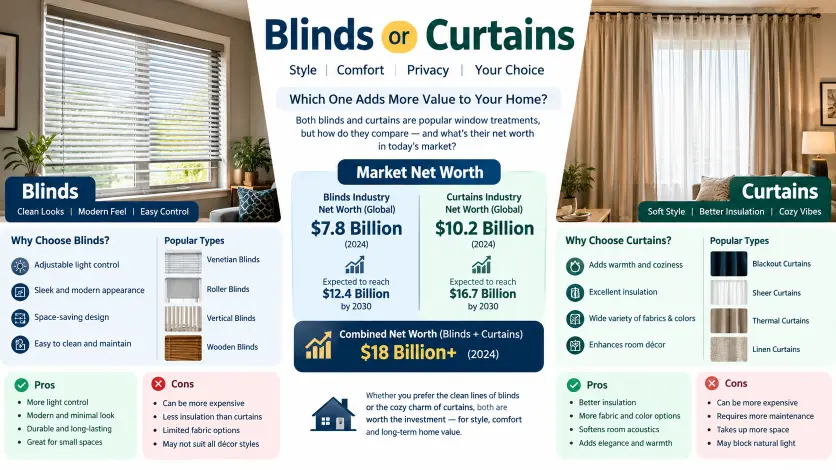
Choosing between blinds or curtains may seem like a simple decorating decision, but the right option can change how a room looks, feels, and functions. Are you looking for better privacy, easier light control, improved insulation, or simply a more stylish finish for your windows? The answer depends on your room, lifestyle, budget, and personal taste.
Both blinds and curtains have clear advantages, but they are not ideal for every situation. Blinds can offer precise light control and a clean, modern appearance, while curtains can add warmth, softness, color, and visual character to a space. Factors such as window size, maintenance, privacy, sunlight, and interior design should also influence your choice.
In this guide, we’ll compare blinds or curtains in a simple and practical way. You’ll learn their major differences, benefits, drawbacks, costs, maintenance needs, and the best choices for different rooms. By the end, you’ll have a clearer idea of which window covering fits your home and everyday needs.
Blinds or Curtains: What Is the Difference?
Blinds and curtains both cover windows, but they are not exactly the same thing.
Blinds are window coverings that usually have a structured design. Depending on the style, they may contain horizontal slats, vertical slats, a continuous sheet of material, or fabric sections that fold or roll. Many types can be adjusted to control sunlight and privacy.
Curtains are generally made from fabric and hang vertically from a curtain rod, track, or similar support. They can be opened completely, partially, or closed across the window.
The difference becomes especially important when you’re shopping for window treatments. A person looking for precise light control may prefer blinds, while someone focused on softness, decoration, or fabric choices may prefer curtains.
| Feature | Blinds | Curtains |
|---|---|---|
| Basic design | Structured covering, slats, panels, or fabric | Hanging fabric panels |
| Light control | Often highly adjustable | Depends on fabric and lining |
| Privacy | Usually easy to adjust | Strong when fully closed |
| Appearance | Clean and structured | Soft and decorative |
| Material | Wood, metal, vinyl, polyester, fabric, and more | Cotton, linen, polyester, velvet, silk, and more |
| Maintenance | Often easy to dust or wipe | May require washing or professional cleaning |
| Space requirements | Usually compact | Can extend beyond the window |
| Common styles | Roller, Venetian, Roman, vertical, cellular | Sheer, blackout, thermal, lined, pleated |
| Best known advantage | Precise control | Style and fabric versatility |
Quick Recap
Blinds generally offer more precise control over light and privacy.
Curtains provide greater flexibility in fabric, texture, color, and decorative appearance.
Both can improve privacy, reduce sunlight, and contribute to the overall comfort of a room.
The better choice depends on your specific needs rather than a universal rule.
Are Blinds or Curtains a Grammar, Vocabulary, or Usage Issue?
The difference between blinds and curtains is primarily a vocabulary and usage issue, not a grammar problem.
Both words function as nouns. They identify different types of physical window coverings.
You could correctly say:
The blinds are closed.
Or:
The curtains are closed.
The grammar of both sentences is correct. The important question is whether the word accurately describes the object.
Are Blinds and Curtains Interchangeable?
They can sometimes be used broadly in casual conversation, but they aren’t exact synonyms.
For example, someone might say, “I need new curtains,” when they simply mean new window coverings. The listener may understand the general idea.
However, in a furniture store or interior design discussion, precision matters. A customer asking for blinds may expect a roller blind, Venetian blind, or Roman blind rather than fabric panels hanging from a rod.
Formal Usage
In professional writing, product descriptions, architectural documents, and interior design content, the distinction should be clear.
For example:
The office uses adjustable blinds to control afternoon glare.
This gives the reader useful information about the type of window treatment.
Casual Usage
In everyday conversation, people often use broad vocabulary. Someone might refer to all window treatments as curtains or shades without intending to make a technical distinction.
That doesn’t necessarily make the speaker grammatically wrong. It simply makes the description less precise.
What Are Blinds?
Blinds are window coverings designed with a structured system that allows the covering to be positioned or adjusted.
Some blinds use horizontal slats. Others use vertical slats, while roller blinds use a continuous piece of material that moves up and down. Roman blinds use fabric that folds into sections when raised.
Common types include:
Venetian blinds: These contain horizontal slats that can be tilted to control light.
Vertical blinds: These use vertical panels and are often suitable for wide windows or glass doors.
Roller blinds: These use a continuous sheet of material that rolls around a tube.
Roman blinds: These are fabric coverings that fold into neat sections when raised.
Wooden blinds: These provide a natural appearance and structured light control.
Blinds in the Workplace
Blinds are common in offices because employees often need to control glare without completely blocking daylight.
For example:
Please lower the blinds because the sunlight is reflecting on my monitor.
The sentence sounds natural because blinds are frequently associated with adjustable light control.
Blinds in Academic Writing
In academic or educational writing, the word can describe a specific type of window treatment.
For example:
Adjustable blinds can help control the amount of direct sunlight entering a classroom.
This is clear and technically appropriate.
Blinds and Technology
Modern blinds can also be motorized. Some systems can respond to timers, light sensors, temperature conditions, or smart home commands.
For example:
The smart blinds automatically close when the afternoon sunlight becomes intense.
Blinds Usage Recap
Use blinds when you are referring to a structured window covering that is designed to be adjusted, raised, lowered, rolled, or tilted.
What Are Curtains?
Curtains are fabric panels designed to hang over or around windows.
They can be simple and lightweight or thick and highly insulating. Their appearance can dramatically change the character of a room.
Common types include sheer curtains, blackout curtains, thermal curtains, lined curtains, eyelet curtains, and pleated curtains.
Curtains in the Workplace
Curtains can be used in offices, conference rooms, hotels, restaurants, and other professional spaces.
For example:
The conference room has heavy curtains that can be closed during presentations.
The sentence clearly identifies fabric panels being used to control light and privacy.
Curtains in Academic Writing
Curtains may also appear in academic discussions of architecture, interior design, energy efficiency, and household environments.
For example:
Heavy curtains can reduce the amount of cold air entering a room through poorly insulated windows.
Curtains and Technology
Modern homes can use motorized curtains connected to smart home systems.
For example:
The smart curtains open automatically every morning at seven.
The technology changes how the curtains operate, but the object is still correctly called a curtain.
Curtains Usage Recap
Use curtains when you’re describing hanging fabric panels that cover windows or doors.
Blinds or Curtains: Which Is Better for Privacy?
Both options can provide excellent privacy, but they work differently.
Blinds can offer very precise control. Depending on the design, you can adjust the angle of the slats so that daylight enters while direct views into the room are limited.
Curtains provide privacy when they are fully closed. Blackout or lined curtains can create a particularly private environment.
For bedrooms and bathrooms, privacy may be the most important consideration. In these spaces, either option can work well when the material and design are chosen appropriately.
If you want adjustable privacy throughout the day, blinds may have an advantage. If you prefer complete coverage with a softer appearance, curtains can be a strong choice.
Blinds or Curtains: Which Is Better for Light Control?
Light control is one of the biggest differences between the two.
Blinds often allow you to make small adjustments. Venetian blinds, for example, can be tilted to redirect sunlight without completely darkening a room.
Curtains usually provide broader control. Opening them allows natural light into the room, while closing them blocks or reduces light according to the fabric.
Blackout curtains can be particularly useful in bedrooms, nurseries, home theaters, and rooms where strong sunlight is undesirable.
Roller blinds can also provide excellent light control, especially when made with blackout or light filtering materials.
The best option therefore depends on whether you want precise adjustment or broad coverage.
Blinds or Curtains: Which Is Easier to Clean?
Cleaning requirements vary according to the material and design.
Many blinds can be cleaned using a microfiber cloth, duster, or suitable vacuum attachment. Waterproof materials may also be wiped with a damp cloth.
Curtains are different because fabric can collect dust and odors. Some curtains can be machine washed, while others may require specialist cleaning.
The easiest option depends on the exact product.
A simple roller blind may require very little maintenance, while delicate fabric curtains may require more care.
However, high quality curtains with washable materials can also be surprisingly easy to maintain.
Blinds or Curtains: Which Is Better for Interior Design?
This decision is largely subjective.
Blinds usually create a cleaner, more structured appearance. They can work especially well with contemporary, minimalist, Scandinavian, and modern interiors.
Curtains create softness. They can add color, texture, height, warmth, and visual interest.
Long curtains installed close to the ceiling can make windows appear taller. Patterned curtains can become a major decorative feature.
Blinds are often less visually dominant, which makes them useful when the homeowner wants furniture, artwork, or architectural features to remain the focus.
For this reason, many designers combine both.
A roller blind can provide everyday privacy and light control, while curtains add softness and decoration.
When You Should Not Use Blinds or Curtains
Choosing the wrong term can create confusion, especially in professional or commercial contexts.
1. Don’t Call Every Window Covering a Blind
A fabric panel hanging from a rod is generally a curtain, even if it performs the same basic function as a blind.
2. Don’t Call Every Fabric Covering a Curtain
Some blinds are made from fabric. Roman blinds and roller blinds are examples.
3. Don’t Use the Terms Randomly in Product Descriptions
Online shoppers need accurate information. Calling a roller blind a curtain can lead customers to expect a completely different product.
4. Don’t Ignore the Structure
The physical design helps determine the correct terminology.
5. Don’t Assume a Similar Function Means Identical Vocabulary
Two objects can both block sunlight without having the same name.
6. Don’t Use Casual Terminology in Technical Writing
Interior design specifications, construction documents, and product catalogs require greater precision.
7. Don’t Assume One Option Works Everywhere
The best window treatment depends on the window size, room function, lighting, maintenance needs, and design preferences.
Common Mistakes With Blinds and Curtains
| Correct sentence | Incorrect or confusing sentence | Explanation |
|---|---|---|
| Please close the blinds. | Please close the curtains. | The second sentence changes the object being described. |
| She bought linen curtains. | She bought linen blinds. | Linen fabric panels are commonly described as curtains. |
| We installed Venetian blinds. | We installed Venetian curtains. | Venetian blinds use horizontal slats. |
| The bedroom has blackout curtains. | The bedroom has blackout blinds. | Both products exist, so context determines which is correct. |
| The curtains hang from a rod. | The blinds hang from a rod. | The statement normally describes fabric curtains. |
| Tilt the blinds to reduce glare. | Tilt the curtains to reduce glare. | Tilting is associated with adjustable blind slats. |
Decision Rule
Use blinds for structured or adjustable window coverings such as Venetian, roller, vertical, and Roman blinds.
Use curtains for fabric panels that hang from rods, tracks, or similar supports.
When you’re unsure, the neutral expression window covering is useful until you can identify the specific product.
Blinds or Curtains in Modern Technology
Technology has transformed both traditional window coverings.
Motorized blinds can now be controlled using remote controls, smartphone applications, timers, sensors, and smart home systems.
Curtains can also be motorized. Automated tracks allow fabric panels to open and close without manual movement.
AI based home automation can add another layer of convenience. Smart systems can learn household routines, monitor environmental conditions, and coordinate window coverings with lighting and temperature controls.
For example, a smart home could automatically lower blinds when intense sunlight reaches a particular room. Another system could open curtains in the morning and close them at night.
The terminology doesn’t change simply because technology is involved.
A motorized roller blind is still a blind.
A motorized fabric panel is still a curtain.
The Etymology of Blinds and Curtains
The words have different historical backgrounds.
The word blind has a long history connected with the idea of covering or preventing sight. Over time, the term became associated with window coverings designed to block or control visibility and light.
The word curtain comes through Middle English and Old French, with historical connections to words describing a hanging covering or enclosure.
Their modern meanings developed gradually, which helps explain why both words now describe objects used to cover windows while referring to different designs.
Expert Perspective
Precise vocabulary describes not only what an object does, but also how that object is designed and used.
That principle is particularly useful when distinguishing everyday terms that have similar functions.
Two Practical Case Studies
Case Study 1: Home Office Glare
Consider a person working from home in a room with a large south facing window.
During the afternoon, sunlight creates reflections on the computer screen. The homeowner needs to reduce glare while keeping some natural light.
Adjustable blinds are a practical choice because the angle can be changed without completely blocking daylight.
The result is more precise control over the working environment.
Case Study 2: Bedroom Comfort
Now consider a bedroom where the primary concerns are privacy, darkness, and visual warmth.
A pair of lined blackout curtains may be more suitable. They can cover the entire window, reduce incoming light, and contribute to the room’s decorative appearance.
The result is a darker, softer, and more visually comfortable sleeping environment.
These examples show why there isn’t a universal answer to the question of which option is better.
Error Prevention Checklist
Always Use Blinds When:
You are describing adjustable slats or structured coverings.
You are referring to Venetian blinds.
You are talking about roller blinds.
You are describing vertical blinds.
You are discussing a blind that rolls, folds, tilts, or moves within a structured mechanism.
Never Use Curtains When:
You are specifically describing horizontal or vertical blind slats.
You are naming a particular blind style.
You are writing a technical product description for a blind.
You need to explain a mechanism that is unique to blinds.
Always Use Curtains When:
You are describing hanging fabric panels.
You are discussing fabric, drapes, pleats, rods, or curtain tracks.
You are referring to sheer or blackout fabric panels.
Avoid Using Either Word When:
You don’t know which type of window treatment is installed.
The exact product doesn’t matter to the discussion.
You need a broad term that includes several types.
In those cases, window covering is a safe and accurate expression.
Related Grammar Confusions You Should Master
Understanding blinds and curtains can also improve your awareness of other everyday vocabulary distinctions.
Here are several related language pairs worth learning:
- Shade vs shadow: A shade can block light, while a shadow is generally created when an object blocks light.
- House vs home: A house is a physical structure, while home often emphasizes the place where someone lives.
- Furniture vs furnishing: Furniture usually refers to movable items such as chairs and tables, while furnishings can have a broader meaning.
- Lend vs borrow: Lend means giving something temporarily, while borrow means receiving something temporarily.
- Lay vs lie: These verbs differ in meaning and grammatical behavior.
- Affect vs effect: Affect is commonly a verb, while effect is commonly a noun, although both can have additional grammatical uses.
- Fewer vs less: Fewer generally works with countable items, while less is commonly used with uncountable amounts.
- Everyday vs every day: Everyday is an adjective, while every day refers to each day.
- Advice vs advise: Advice is a noun, while advise is a verb.
- Practice vs practise: The distinction depends partly on the variety of English being used.
Learning these distinctions helps develop more precise everyday English.
Frequently Asked Questions
Are blinds and curtains the same thing?
No. Blinds and curtains are both window coverings, but they have different structures. Blinds are usually more structured or adjustable, while curtains are generally fabric panels that hang from rods or tracks.
Which is better, blinds or curtains?
Neither is automatically better. Blinds can be ideal for precise light control and a structured appearance, while curtains can provide softness, decoration, insulation, and broad window coverage.
Are blinds more modern than curtains?
Blinds are often associated with modern and minimalist interiors, but curtains can also look highly contemporary. The overall appearance depends on material, color, installation, and room design.
Do blinds provide more privacy than curtains?
Blinds can provide highly adjustable privacy because some designs allow you to control the angle of the slats. Curtains can provide excellent privacy when completely closed, especially when made from opaque or blackout fabric.
Are curtains better for bedrooms?
Curtains can be excellent for bedrooms because blackout and lined fabrics can reduce incoming light while adding softness to the room. However, blackout blinds can also be highly effective.
Are blinds easier to clean than curtains?
Many blinds are easy to dust or wipe, while curtains may need washing or specialist cleaning. However, maintenance depends on the material and specific design.
Can you use blinds and curtains together?
Yes. Combining blinds and curtains is common. The blinds can provide precise privacy and light control, while curtains add decoration, softness, and additional insulation.
Is a roller blind a curtain?
No. A roller blind is generally classified as a type of blind. It uses a continuous sheet of material that rolls around a tube rather than hanging as a conventional curtain panel.
What is the correct general term for blinds and curtains?
The broad term window covering is useful when you want to refer to both blinds and curtains without identifying a particular type.
Which lasts longer, blinds or curtains?
There is no universal answer. Lifespan depends on material quality, installation, cleaning, sunlight exposure, humidity, and frequency of use. High quality products from either category can remain functional for many years.
Final Verdict: Blinds or Curtains?
The choice between blinds or curtains comes down to what you want your window covering to accomplish.
Choose blinds when precise light adjustment, compact design, and structured appearance are your priorities. They can be especially useful in offices, kitchens, bathrooms, and modern interiors.
Choose curtains when you want fabric, softness, decorative flexibility, and broad coverage. They work particularly well in bedrooms, living rooms, dining rooms, and spaces where interior style is important.
If you want the advantages of both, there’s no reason to choose only one. Combining blinds with curtains can provide excellent privacy, flexible light control, insulation, and visual appeal.
The most important language rule is simple: blinds and curtains are related window coverings, but they aren’t identical terms. Use the word that accurately describes the physical product you’re discussing. When the exact type doesn’t matter, window covering is the clearest general expression.









