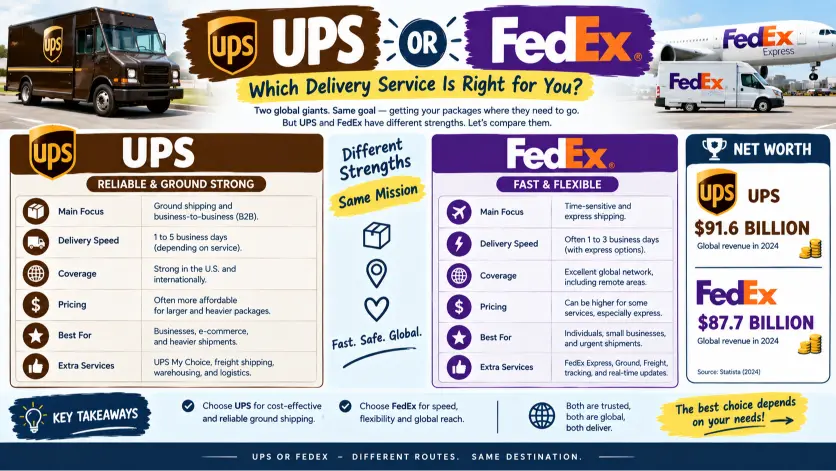
Choosing between UPS or FedEx can seem simple until you compare the actual shipping cost, delivery speed, package size, destination, tracking options, and additional fees. One carrier may be cheaper for a particular package, while the other may offer better value for express, residential, business, or international delivery. That is why there is no single winner for every shipment.
Recent 2026 comparisons show that UPS is often strong for domestic ground and heavier packages, while FedEx can be highly competitive for express and residential delivery services. In this guide, we will compare UPS vs FedEx from the factors that actually matter when choosing a shipping carrier.
You will learn how their prices, delivery speeds, tracking, ground services, express options, international shipping, and surcharges differ. The goal is not simply to declare one company better, but to help you understand which carrier makes the most sense for your specific shipment. For international shipments from Pakistan, FedEx also provides services such as International Priority and International Economy, with transit times depending on the destination.
UPS vs FedEx: What’s the Difference?
UPS and FedEx are proper nouns used as company names. UPS refers to United Parcel Service, while FedEx refers to FedEx Corporation. Both companies provide transportation and delivery services, but they operate different networks and offer different combinations of ground, express, freight, international, and specialized shipping services.
The simplest distinction is this: UPS and FedEx are competing shipping companies, not two spellings of the same word. The better choice depends on factors such as package size, destination, delivery speed, pickup options, price, and the type of service required.
| Feature | UPS | FedEx |
|---|---|---|
| Full name | United Parcel Service | Federal Express, now FedEx |
| Part of speech | Proper noun | Proper noun |
| Main function | Package transportation and delivery | Package transportation and delivery |
| Common services | Ground, air, freight, international | Ground, air, freight, international |
| Tracking | Available | Available |
| Residential delivery | Available | Available |
| Business shipping | Strong option | Strong option |
| Express shipping | Available | Available |
| Freight services | Available | Available |
| Best choice | Depends on shipment requirements | Depends on shipment requirements |
Mini Recap
UPS and FedEx are both legitimate shipping carriers.
Neither company is automatically better for every shipment.
Delivery location, package characteristics, speed, and price can change the best choice.
For important shipments, compare the actual service and delivery estimate rather than relying only on brand reputation.
Is UPS vs FedEx a Grammar, Vocabulary, or Usage Issue?
The confusion surrounding UPS and FedEx is primarily a vocabulary and usage issue, rather than a traditional grammar problem.
Both names function as proper nouns because they identify specific companies. You wouldn’t normally replace one with the other simply because the sentence structure remains grammatically correct.
For example, these sentences are grammatically sound:
“I shipped the package with UPS.”
“I shipped the package with FedEx.”
However, changing the carrier changes the meaning of the sentence. If a customer specifically requested FedEx, saying UPS isn’t a grammatical error. It’s a factual or usage error.
The names can appear in formal and casual communication. In workplace writing, academic research involving logistics, invoices, shipping instructions, and everyday conversations, the correct company name should be used.
In casual speech, someone might say, “I sent it by UPS,” or “FedEx is delivering it tomorrow.” In professional communication, it’s better to identify the actual carrier accurately.
UPS: Meaning, Usage, and Practical Examples
UPS stands for United Parcel Service. It is a global package delivery and logistics company that serves individuals, businesses, retailers, and other organizations.
The abbreviation UPS is normally written in capital letters because it is an initialism and a company name.
A workplace example might be:
“Our office sent the signed documents through UPS yesterday.”
Here, UPS identifies the carrier responsible for transportation.
An academic example could be:
“The researcher compared delivery performance among major carriers, including UPS.”
In technology, UPS can appear in shipping software, ecommerce platforms, tracking systems, warehouse management tools, and automated order processing. A website might allow a customer to select UPS as the shipping method during checkout.
One important point is that UPS can also mean an uninterruptible power supply in technology. Context therefore matters. In a computer related sentence, “The server is connected to a UPS” may refer to a battery backup device rather than the shipping company.
UPS Usage Recap
Use UPS when you specifically mean United Parcel Service.
Capitalize the company name as UPS.
Don’t assume UPS means the shipping company when the context is computers or electricity.
Always check the actual carrier before describing a shipment.
FedEx: Meaning, Usage, and Practical Examples
FedEx is the name of a major transportation and logistics company. The brand name is associated with package delivery, express transportation, freight, and other logistics services.
In workplace communication, you might write:
“FedEx picked up the customer order this afternoon.”
The name identifies the company providing the transportation service.
In an academic context, a logistics report could state:
“The study examined how FedEx and other carriers manage time sensitive shipments.”
Technology also plays an important role in FedEx shipping. Ecommerce systems, business software, warehouse platforms, and tracking applications can integrate shipping information and delivery status.
For example:
“The ecommerce platform automatically generated a FedEx shipping label.”
Here, FedEx identifies the selected carrier rather than a generic shipping method.
FedEx Usage Recap
Use FedEx when you mean the FedEx company or its shipping services.
Write the brand name as FedEx.
Don’t replace FedEx with UPS unless the shipment was actually handled by UPS.
In professional writing, identify the carrier accurately because the name can affect tracking, billing, and delivery instructions.
When You Should NOT Use UPS or FedEx
Choosing between UPS and FedEx isn’t simply a matter of picking whichever name sounds more familiar. There are several situations where using the wrong name can create practical problems.
1. When the Tracking Number Belongs to Another Carrier
If the tracking information identifies another carrier, don’t describe the shipment as UPS or FedEx merely because either company is commonly associated with package delivery.
2. When a Customer Specifies the Carrier
If a customer requests FedEx, changing the shipment to UPS without permission can cause confusion or violate the agreed shipping arrangement.
3. When a Shipping Label Has Already Been Created
The carrier printed on the shipping label should normally match the actual carrier handling the package.
4. When Comparing Delivery Prices
Don’t say that UPS is cheaper than FedEx as a universal rule. Pricing depends on destination, service level, package dimensions, weight, account arrangements, and other factors.
5. When Discussing Delivery Guarantees
A carrier’s service terms can vary by service and circumstance. Don’t treat one company’s delivery commitment as if it automatically applies to the other.
6. When Writing Business Records
Invoices, purchase records, customer messages, and shipping documentation should use the correct company name.
7. When Discussing Technology
UPS may mean an uninterruptible power supply in a technology context. Don’t automatically interpret every use of UPS as United Parcel Service.
8. When the Carrier Has Not Yet Been Selected
If you’re discussing a general shipping option, use “shipping carrier” or “delivery service” rather than incorrectly naming UPS or FedEx.
Common Mistakes: UPS or FedEx
| Correct sentence | Incorrect sentence | Explanation |
|---|---|---|
| I shipped the package with UPS. | I shipped the package with FedEx. | The carrier must match the actual shipment. |
| FedEx picked up the order. | UPS picked up the order. | Company names identify different carriers. |
| We compared UPS and FedEx rates. | We compared UPS rates from FedEx. | The companies should not be treated as the same service. |
| The customer requested FedEx. | The customer requested UPS. | The customer’s specified carrier matters. |
| UPS delivered the parcel. | FedEx delivered the parcel. | Delivery records should identify the actual carrier. |
| The software generated a FedEx label. | The software generated a UPS label. | Shipping labels are carrier specific. |
Decision Rule Box
If the shipment is being handled by United Parcel Service, use UPS.
If the shipment is being handled by FedEx, use FedEx.
If you don’t know the carrier, use a neutral term such as shipping carrier until the carrier is confirmed.
Unlike ordinary spelling comparisons, there is no universal rule saying that one is correct and the other is incorrect. The correct choice depends on which company you actually mean.
UPS and FedEx in Modern Technology and Tools
Modern shipping increasingly depends on software. Ecommerce platforms can calculate shipping options, generate labels, provide tracking information, and communicate delivery updates without requiring a customer to contact a carrier manually.
UPS and FedEx can both appear within shipping management systems, online stores, warehouse platforms, customer service software, and logistics dashboards.
Modern technology also changing how shipping information is processed. AI based systems can help businesses forecast demand, organize inventory, analyze delivery patterns, estimate shipping requirements, and identify potential operational problems.
However, technology doesn’t eliminate the importance of using the correct carrier name. An automated system may distinguish UPS and FedEx because each carrier can have different services, rates, tracking information, and delivery requirements.
For writers and businesses, this means accuracy matters even more. A wrong carrier name can create confusion between an order record, a shipping label, a tracking number, and a customer’s expectations.
UPS or FedEx: Which Is Better?
There isn’t one universal winner.
UPS may be the more suitable option for one shipment, while FedEx may be more suitable for another. Businesses often compare carriers based on their shipping volume, destinations, package types, negotiated rates, pickup arrangements, and required delivery speeds.
For an individual sending a single package, the practical approach is straightforward. Compare the available services for the specific package and destination.
For a business, the decision can be more complex. A company shipping hundreds or thousands of packages may evaluate historical delivery performance, claims, pricing, pickup reliability, customer support, integration options, and international capabilities.
The important lesson is that “UPS or FedEx” is a comparison question, not a grammar correction question.
Etymology and Name Origins
UPS traces its corporate history to the company founded in 1907 as the American Messenger Company. It later developed into United Parcel Service, with the UPS name becoming strongly associated with package transportation and logistics.
FedEx originated from Federal Express, which began operations in 1971. The company later adopted the shorter FedEx name as its corporate identity.
The two names therefore have completely different histories. They’re not alternative forms of the same word and shouldn’t be treated as spelling variants.
From a language perspective, both are brand names that have become deeply familiar in everyday American English.
An Expert View on UPS and FedEx Usage
A useful language principle applies here:
“Accuracy begins with using the specific name that matches the thing you actually mean.”
That principle is especially important with brand names. UPS and FedEx may occupy the same general category, but they identify different organizations.
Using one when you mean the other can make a sentence grammatically correct while still making the information inaccurate.
Two Practical Case Studies
Case Study 1: Small Ecommerce Business
Imagine an online retailer that sends 200 packages each month. The owner has traditionally selected UPS because it was the familiar option.
The business then compares its actual shipment profile across both carriers. After reviewing package dimensions, destinations, delivery requirements, and quoted rates, the owner discovers that certain routes perform better with FedEx while others remain more suitable for UPS.
The concrete result is a more informed carrier selection process. Instead of asking, “Which company is better?” the business asks, “Which service is better for this shipment?”
The lesson is simple: carrier performance should be evaluated against the shipment, not against brand familiarity.
Case Study 2: Customer Service Communication
Consider a retailer whose customer receives an automated message saying the order was shipped through FedEx. A support employee later tells the customer that UPS has the package.
The grammar in the employee’s message isn’t necessarily wrong. The problem is factual accuracy.
The concrete result can be customer confusion, unnecessary tracking searches, and additional support work.
A better workflow is to pull the carrier directly from the shipping record before communicating with the customer. This small accuracy check can prevent an avoidable service problem.
Error Prevention Checklist
Always Use UPS When
You mean United Parcel Service.
The shipping record identifies UPS as the carrier.
The customer specifically selected UPS.
A UPS label or tracking record is being discussed.
You are referring to the company rather than another meaning of the abbreviation.
Never Use FedEx When
The shipment was actually sent through UPS.
A customer specifically requested UPS and no carrier change occurred.
A shipping document clearly identifies another carrier.
You are describing a UPS tracking event.
You are using the company name only because “FedEx” sounds like a general word for shipping.
Always Use FedEx When
The shipment record identifies FedEx.
The customer selected a FedEx service.
A FedEx label or tracking record is being discussed.
You are specifically referring to FedEx as a company.
Related Grammar Confusions You Should Master
UPS and FedEx aren’t traditional grammar alternatives, but learning other commonly confused terms can improve overall writing accuracy.
Some useful comparisons include:
- Affect vs effect
- Fewer vs less
- Then vs than
- Its vs it’s
- Your vs you’re
- Their vs there vs they’re
- Accept vs except
- Advice vs advise
- Lay vs lie
- Further vs farther
These pairs demonstrate an important principle: words can look or sound similar while performing completely different roles.
UPS and FedEx demonstrate a related idea from vocabulary and usage. Two names can belong to the same category without referring to the same thing.
Frequently Asked Questions About UPS or FedEx
Is UPS or FedEx cheaper?
Neither carrier is always cheaper. Shipping cost depends on factors such as package weight, dimensions, destination, delivery speed, service type, account pricing, and additional charges. The best approach is to compare the actual rates for the shipment you need to send.
Is UPS faster than FedEx?
Not universally. Delivery speed depends on the specific service, origin, destination, shipping time, and delivery commitment. A particular UPS service may be faster for one shipment while a FedEx service may be faster for another.
What is the difference between UPS and FedEx?
UPS and FedEx are separate shipping and logistics companies. Both provide package delivery and related transportation services, but they have different networks, service offerings, pricing arrangements, and operational characteristics.
Should I say UPS or FedEx when talking about shipping?
Use the name of the actual carrier. If UPS is transporting the package, say UPS. If FedEx is transporting it, say FedEx. If the carrier hasn’t been selected, use a neutral expression such as “shipping carrier.”
Are UPS and FedEx the same company?
No. UPS and FedEx are separate companies. They compete in the package delivery and logistics industry.
Which is better for business shipping, UPS or FedEx?
There is no universal answer. Businesses should compare carrier pricing, service availability, delivery requirements, destinations, package characteristics, pickup arrangements, technology integration, and historical performance.
Does UPS mean something other than United Parcel Service?
Yes. In technology and electrical contexts, UPS commonly means an uninterruptible power supply. Context determines which meaning is intended.
Why do people confuse UPS and FedEx?
They are frequently confused because both are major delivery companies and provide similar categories of services. Their names can therefore become interchangeable in casual conversation, even though they represent different companies.
Can I use UPS and FedEx interchangeably in a sentence?
No, not when you are identifying the actual carrier. Replacing one with the other changes the factual meaning of the sentence.
Final Verdict: UPS or FedEx?
The correct choice between UPS or FedEx depends on what you actually mean. Both are major shipping and logistics companies, but they are separate organizations with their own services, networks, pricing, and delivery processes.
If you’re writing about a shipment, check the carrier record before naming it. If the package is handled by UPS, write UPS. If FedEx is handling it, write FedEx. If you’re comparing the two, mention both names clearly.
The biggest takeaway is that this isn’t really a spelling problem. UPS and FedEx are different proper nouns, so accuracy depends on choosing the company that matches the real shipping situation.









