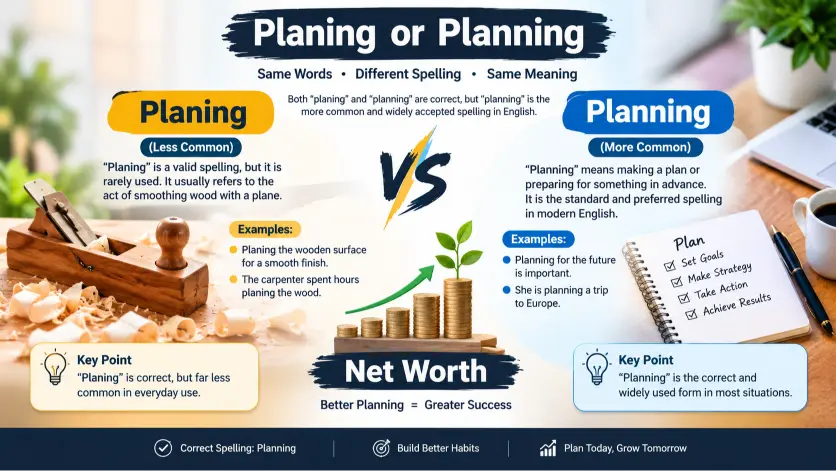
Have you ever typed “planing” or “planning” and suddenly wondered whether you have chosen the correct spelling? You are not alone. These two words look almost identical, but they can have different meanings and grammatical uses. A single extra letter can completely change what you are trying to say.
Understanding the difference is especially important when writing emails, school assignments, business content, social posts, or professional documents.
In this guide, we will clearly explain planing or planning, including their meanings, correct spelling, pronunciation, grammatical forms, and practical examples. You will also learn why planning is normally the correct choice when you mean making arrangements or deciding what to do in the future, while planing has a more specific meaning related to smoothing or shaping a surface. The explanation is based on standard English usage and common dictionary definitions, so you can confidently choose the right word in everyday and professional writing.
X vs Y: What’s the Difference?
The easiest way to understand these two words is to focus on the base words they come from.
Planning is the present participle and gerund form of the verb plan. It means thinking ahead, organizing activities, preparing for an event, or deciding how something should be done.
For example:
We are planning a family vacation for December.
Here, planning describes the action of preparing or organizing something.
Planing, on the other hand, comes from the verb plane. In woodworking, to plane something means to smooth or shape its surface using a tool called a plane. The word can also describe a particular motion across water, especially when a boat moves rapidly enough to skim across the surface.
For example:
The carpenter is planing the wooden board.
In this sentence, planing has nothing to do with making future arrangements.
| Word | Part of speech | Base word | Main meaning | Example |
|---|---|---|---|---|
| Planning | Verb form and gerund | Plan | Organizing or preparing for something | She is planning a meeting. |
| Planing | Verb form and gerund | Plane | Smoothing wood or gliding across water | He is planing the board. |
Quick recap
Planning relates to preparation, organization, and future decisions.
Planing relates mainly to woodworking or movement across water.
They aren’t interchangeable in ordinary writing.
Using one instead of the other can create a completely different meaning.
Planing or Planning: Is This a Grammar, Vocabulary, or Usage Issue?
This confusion is primarily a spelling and vocabulary issue connected to grammar.
Both words are legitimate English words. The problem isn’t that one is universally wrong. The problem is that they come from different verbs and describe different actions.
The verb plan becomes planning because the final consonant is doubled before adding the ending ing. This follows a common spelling pattern in English.
The verb plane becomes planing because the final silent e is removed before the ending ing is added.
Compare these forms:
plan → planning
plane → planing
The difference is only one letter, but the meanings are very different.
In everyday, workplace, school, and online communication, planning is overwhelmingly more common because people frequently discuss plans, schedules, projects, trips, events, and goals.
Planing is much more specialized. You’ll mainly encounter it in woodworking, boat descriptions, marine terminology, and technical discussions.
Are they interchangeable?
No.
You cannot normally replace planning with planing.
We are planning the project.
This means the people are organizing or preparing the project.
We are planing the project.
This would suggest that they are smoothing or shaping the project with a plane, which makes little practical sense unless the sentence is being used humorously or metaphorically.
Formal versus casual usage
There isn’t a meaningful formal versus informal distinction between these two spellings.
Instead, the distinction is meaning based.
In professional emails, academic writing, business documents, and everyday conversations, use planning when you mean preparation or organization.
Use planing when the subject genuinely involves its specialized meanings.
Planning: Meaning, Grammar, and Everyday Usage
Planning is one of the most useful forms of the verb plan.
The verb plan means to think about something before it happens and decide how to approach it. When you add ing, you get planning.
It can function as part of a progressive verb phrase:
They are planning a new campaign.
It can also function as a gerund:
Planning ahead can save time.
The word appears in almost every area of modern life.
People plan vacations, meetings, meals, lessons, budgets, careers, projects, weddings, business strategies, and personal goals.
Workplace example
Our team is planning the next product launch.
The sentence describes an ongoing process of organizing and preparing.
Another example is:
The manager is planning a meeting with the sales department.
Again, the meaning involves preparation.
Academic example
Students should spend more time planning their essays before writing.
Here, planning means organizing ideas and deciding how the essay will develop.
Technology example
The development team is planning the next software update.
This means the team is deciding what the update should include and how it should be prepared.
Usage recap
Use planning when someone is organizing, preparing, scheduling, designing, or deciding what to do.
If your sentence involves a future activity, strategy, arrangement, or goal, planning will usually be the correct choice.
Planing: Meaning, Grammar, and Specialized Usage
Planing is a legitimate English word, but it has a much narrower range of everyday uses.
Its primary meaning comes from plane, a woodworking verb. A plane is a tool designed to remove thin layers from wood and create a smooth, even surface.
For example:
The carpenter is planing the door.
Here, planing means removing small amounts of wood to improve the surface or shape.
There is another specialized meaning associated with boats and watercraft.
A boat can be described as planing when it moves quickly across the surface of the water rather than traveling primarily through it.
For example:
The speedboat was planing across the lake.
This is a technical use and is much less common than planning.
Workplace example
The carpenter spent the morning planing the wooden panels.
This is appropriate if the workplace involves woodworking.
Academic example
The study examines how planing affects the surface quality of different types of wood.
This could appear in a technical or engineering context.
Technology example
The automated machine is planing each wooden component to a precise thickness.
Here, the word describes a manufacturing process rather than future preparation.
Usage recap
Use planing when the context involves a plane, woodworking, surface shaping, or a boat moving rapidly over water.
If you’re talking about schedules, preparation, goals, or decisions, don’t use this spelling.
When You Should NOT Use Planing or Planning
Knowing when not to use a word is often more useful than memorizing a definition.
Here are common situations where choosing the wrong spelling can change the meaning or make your sentence incorrect.
1. Talking about future arrangements
Incorrect:
I am planing my weekend.
Correct:
I am planning my weekend.
You’re organizing your weekend, not smoothing a piece of wood.
2. Discussing a business strategy
Incorrect:
The company is planing its expansion.
Correct:
The company is planning its expansion.
Business strategy requires planning.
3. Preparing for an examination
Incorrect:
She is planing her study schedule.
Correct:
She is planning her study schedule.
The student is organizing the schedule.
4. Organizing an event
Incorrect:
They are planing a wedding.
Correct:
They are planning a wedding.
A wedding requires preparation and organization.
5. Describing woodworking
Incorrect:
The carpenter is planning the rough board.
Correct:
The carpenter is planing the rough board.
Here, planing is appropriate because the carpenter is using a plane.
6. Describing a fast boat
Incorrect:
The boat was planning across the water.
Correct:
The boat was planing across the water.
The specialized marine meaning requires planing.
7. Talking about personal goals
Incorrect:
He is planing his career.
Correct:
He is planning his career.
Career decisions involve preparation and organization.
8. Describing a woodworking machine
Incorrect:
The machine is planning the wooden surface.
Correct:
The machine is planing the wooden surface.
The machine is shaping the material.
Common Mistakes and Decision Rules
The most common mistake occurs when writers know the word plan but accidentally remove or add a letter when forming the ing form.
The spelling rules are actually straightforward.
When plan becomes its ing form, the final consonant is doubled:
plan → planning
When plane becomes its ing form, the silent e is removed:
plane → planing
| Correct sentence | Incorrect sentence | Explanation |
|---|---|---|
| We are planning the trip. | We are planing the trip. | The meaning is preparation. |
| She is planning a presentation. | She is planing a presentation. | A presentation is organized, not smoothed with a tool. |
| He is planing the board. | He is planning the board. | The carpenter is shaping wood. |
| The boat is planing across the lake. | The boat is planning across the lake. | This is the marine meaning of planing. |
| They are planning a new strategy. | They are planing a new strategy. | Strategy development involves planning. |
| The worker is planing the surface. | The worker is planning the surface. | The surface is being smoothed. |
Decision Rule Box
If you mean the action of organizing or preparing, use planning.
If you mean smoothing wood with a plane or gliding across water, use planing.
This simple distinction will solve almost every spelling question involving these two words.
Planing or Planning in Modern Technology and Tools
Modern technology has made planning an especially common word.
Software applications can help users plan projects, schedules, trips, budgets, marketing campaigns, study sessions, and many other activities.
People also use digital assistants and tools for planning tasks. For example, someone might ask a tool to help with planning a weekly schedule or planning a content strategy.
The word planing remains specialized even in modern technology.
Computer controlled woodworking equipment can perform planing automatically. Manufacturing systems may use machines that plane wooden components to a specified thickness.
The important point is that technology doesn’t change the underlying distinction.
If software helps you organize future actions, you’re planning.
If a machine physically smooths a wooden surface, it may be planing.
Why the Spelling Difference Matters
At first glance, this may seem like a minor spelling issue. In practice, it demonstrates an important principle of English: a single letter can change both meaning and grammatical identity.
Consider:
We are planning the table.
This normally means you’re organizing something involving a table.
Now consider:
We are planing the table.
This suggests that you’re smoothing or shaping a wooden table with a plane.
The difference is tiny in writing but significant in meaning.
This matters especially in professional communication. A spelling error in a casual message may be overlooked, but repeated errors in business documents, technical writing, or academic work can affect clarity and credibility.
Etymology: Where Do Plan and Plane Come From?
The words have different historical paths.
Plan entered English through French and ultimately traces back to Latin planus, associated with something flat or level. Over time, its meaning developed toward an organized scheme or proposed course of action.
Plane, in the woodworking sense, is connected to the idea of making a surface level or smooth. The tool and the action developed around shaping material to create an even surface.
Although the words look related, modern English treats them as separate words with separate meanings.
That distinction is important because spelling alone doesn’t always tell you how closely related two English words are.
An Expert Perspective on Choosing the Correct Word
A useful principle in professional editing is that meaning should guide spelling rather than spelling guide meaning.
When you encounter a confusing pair, don’t simply ask, “Which spelling looks right?”
Instead, ask:
“What action am I actually describing?”
If the action involves organizing, preparing, or deciding, choose planning.
If the action involves smoothing wood or describing a boat’s movement across water, choose planing.
This approach is more reliable because it connects spelling with meaning.
Two Practical Case Studies
Case Study 1: Workplace Communication
Imagine a project coordinator writing this sentence in a company update:
We are planing the next phase of the project.
The intended meaning is clearly that the team is preparing the next phase. The correct form is:
We are planning the next phase of the project.
The correction changes only one letter, but it removes an unnecessary moment of confusion for the reader.
Result: The sentence immediately communicates project preparation rather than a specialized woodworking action.
Case Study 2: Technical Woodworking Content
Now consider a woodworking tutorial that says:
The machine is planning the wooden surface.
If the machine is removing material from the wood to create a smoother surface, the appropriate form is:
The machine is planing the wooden surface.
Result: The corrected sentence accurately identifies a physical manufacturing process and avoids confusing the reader with the much more common word planning.
These examples show why context matters more than frequency alone.
Error Prevention Checklist
Always use planning when:
You mean preparing for something.
You mean organizing an activity.
You mean deciding what to do.
You mean developing a strategy.
You mean arranging a schedule.
You mean preparing a project.
You mean thinking ahead about an event or goal.
Never use planing when:
You are discussing a vacation schedule.
You are describing business preparation.
You are talking about career goals.
You are discussing an examination strategy.
You are organizing a meeting.
You are preparing a wedding.
You are describing project management.
Use planing when:
A person is smoothing or shaping wood with a plane.
A machine is performing the woodworking process.
A boat is moving across water in the specialized marine sense.
Related Grammar Confusions You Should Master
Understanding confusing word pairs can improve your overall English accuracy. Here are several useful distinctions worth learning:
Affect vs effect: Learn the difference between influence and result.
Advice vs advise: One is a noun and the other is a verb.
Practice vs practise: The distinction depends partly on the variety of English being used.
Their vs there: Possession and location require different words.
Your vs you’re: Possessive meaning and the phrase “you are” must be distinguished.
Its vs it’s: Possession and contraction have different functions.
Then vs than: Time and comparison require different forms.
Lose vs loose: Losing something is different from something not being tight.
Principal vs principle: A person or main item differs from a rule or belief.
Stationary vs stationery: Being still differs from writing materials.
Mastering these pairs helps you become more precise because you learn to connect spelling with meaning.
Advanced FAQs
What is the correct spelling, planning or planing?
Both spellings are correct, but they have different meanings. Planning means organizing or preparing for something. Planing usually means smoothing or shaping wood with a plane, or moving across water in a specialized marine sense.
Is planning spelled with one n or two?
The correct spelling is planning with two n letters. It comes from the verb plan, and the final consonant is doubled before the ing ending is added.
Is planing a real word in English?
Yes. Planing is a real English word. It is the ing form of plane and is commonly associated with woodworking. It can also describe a boat moving rapidly across the surface of water.
Why is planning spelled with two n letters?
The spelling follows an English word formation rule. The short vowel and consonant pattern in plan causes the final consonant to be doubled before adding ing, producing planning.
Why does plane become planing instead of planeing?
The final silent e in plane is removed before the ing ending is added. Therefore, the result is planing, not planeing.
Should I write planning a project or planing a project?
You should write planning a project. The phrase means organizing or preparing the project. Planing a project would suggest the specialized physical process associated with using a plane.
Is planing the same as planning?
No. They are different words with different meanings. Planning concerns preparation and organization, while planing generally concerns smoothing wood or a specialized type of movement across water.
What is the difference between plan and plane?
Plan can mean to organize or prepare for something. Plane can refer to a woodworking tool or the act of smoothing a surface. The ing forms are therefore planning and planing.
How can I remember the difference between planning and planing?
Think about the base word. Plan becomes planning when you are preparing something. Plane becomes planing when you are working with a plane or describing the specialized movement of a boat.
Which word is more common in everyday English, planning or planing?
Planning is far more common in everyday English because people regularly discuss schedules, goals, projects, travel, work, education, and future decisions. Planing appears mainly in specialized woodworking and marine contexts.
Final Verdict: Planing or Planning
The correct choice depends entirely on what you mean.
Planning is the word you need when you’re talking about organizing, preparing, scheduling, strategizing, or thinking ahead. It is the form you’ll encounter in ordinary conversations, workplace writing, academic work, and most digital communication.
Planing is a specialized word connected primarily with smoothing or shaping wood using a plane. It can also describe a boat moving rapidly across the surface of water.
So, if you’re asking whether you should write planing or planning when discussing a project, vacation, meeting, goal, or strategy, the answer is planning. Remember the simple rule: plan means prepare, while plane means smooth or shape.









