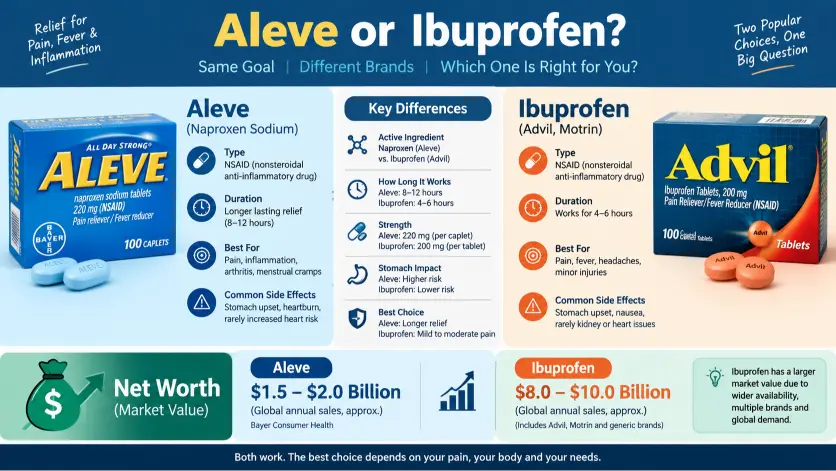
When pain, inflammation, a headache, or a fever suddenly appears, many people wonder whether Aleve or ibuprofen is the better choice. Both are common over-the-counter pain relievers, but they are not exactly the same. Their active ingredients, how long they work, dosing schedules, and potential risks can differ.
Choosing between them should depend on more than simply asking which medicine is “stronger.” Factors such as the type of pain, how long relief is needed, other medicines you take, and your personal health history can all matter.
In this guide, we’ll compare Aleve and ibuprofen in clear, easy-to-understand language. You’ll learn their key differences, common uses, duration of action, potential side effects, and important safety considerations. The information is based on established medication knowledge and is intended to help readers make more informed questions and decisions, while recognizing that a healthcare professional is the right source for personalized medical advice.
Aleve vs Ibuprofen: What’s the Difference?
Aleve is a brand name for a medicine containing naproxen sodium. In standard over the counter Aleve tablets, each tablet contains 220 mg of naproxen sodium, equivalent to 200 mg of naproxen. It belongs to the NSAID class and is used for temporary relief of minor aches, arthritis pain, muscular aches, backache, menstrual cramps, headache, toothache, and fever.
Ibuprofen is the generic name of an NSAID used to reduce pain, fever, and inflammation. Common over the counter products contain ibuprofen as their active ingredient. It is available in several forms and is commonly used for headaches, muscle aches, toothaches, backaches, menstrual pain, arthritis symptoms, and fever.
| Feature | Aleve | Ibuprofen |
|---|---|---|
| Active ingredient | Naproxen sodium | Ibuprofen |
| Drug class | NSAID | NSAID |
| Main effects | Pain, fever, inflammation | Pain, fever, inflammation |
| Typical OTC adult interval | Every 8 to 12 hours according to label | Usually every 4 to 6 hours according to label |
| Duration | Generally longer acting | Generally shorter acting |
| Common uses | Muscle pain, arthritis, menstrual cramps, headache | Headache, muscle pain, fever, menstrual cramps, dental pain |
| Brand or generic status | Brand containing naproxen sodium | Generic drug name |
| Major safety concerns | Stomach bleeding, cardiovascular and kidney risks | Stomach bleeding, cardiovascular and kidney risks |
The most important practical distinction is duration. Naproxen has a substantially longer half life than ibuprofen. Research describes naproxen’s half life as roughly 12 to 17 hours, while ibuprofen’s is around 2 hours. This helps explain why naproxen products are generally taken less frequently.
Quick Recap
Aleve and ibuprofen are not the same medicine.
Both belong to the NSAID family and can treat pain, fever, and inflammation.
Aleve contains naproxen sodium and generally lasts longer.
Ibuprofen leaves the body more quickly and is commonly taken at shorter intervals.
The best option depends on the type of pain, medical history, other medicines, and individual risk factors.
Is Aleve vs Ibuprofen a Medication, Vocabulary, or Usage Issue?
Unlike spelling comparisons such as two commonly confused English words, Aleve vs ibuprofen is a medication comparison.
There is also an important terminology distinction.
Aleve is a brand name. Its active ingredient is naproxen sodium.
Ibuprofen is the generic name of a different NSAID.
Therefore, the terms aren’t interchangeable even though they can be used for many of the same symptoms.
For example, saying that Aleve “is ibuprofen” is incorrect. Both are NSAIDs, but they are chemically different medicines.
In casual conversation, people may use either name when asking for “pain medicine.” In a medical, workplace, academic, or pharmacy setting, however, accuracy matters. The active ingredient should be identified because the two medicines have different dosing schedules, pharmacokinetic properties, interactions, and individual risks.
This distinction becomes especially important when someone is already taking one NSAID. Taking another NSAID without professional guidance can increase the risk of adverse effects rather than providing a simple boost in pain relief. MedlinePlus specifically warns against combining naproxen with other NSAIDs such as ibuprofen unless directed by a healthcare professional.
Aleve: What It Is and How It Is Used
Aleve contains naproxen sodium, an NSAID that works by reducing the body’s production of substances involved in pain, fever, and inflammation.
The standard OTC Aleve label states that adults and children 12 years and older may take one 220 mg tablet every 8 to 12 hours while symptoms last, with specific limits on the number of tablets in a 24 hour period. The product label also emphasizes using the smallest effective amount and following the package directions.
Workplace Example
Imagine someone develops back soreness after physically demanding work. They may ask a pharmacist whether naproxen could help control the pain and inflammation.
The relevant question isn’t simply whether Aleve is “stronger.” A healthcare professional would consider the person’s age, health conditions, current medicines, duration of symptoms, and risk factors before recommending an NSAID.
Academic Example
A health sciences student might write:
“Naproxen is an NSAID with a relatively long half life.”
That is more precise than writing:
“Aleve is a long lasting painkiller.”
The first sentence identifies the pharmacological class and characteristic being discussed.
Technology Example
Medication reminder applications often distinguish medicines by active ingredient, dose, and schedule, rather than treating all pain relievers as identical. A medication database could therefore list Aleve under naproxen sodium while listing ibuprofen separately.
Usage Recap
Use Aleve when referring specifically to the brand product.
Use naproxen or naproxen sodium when discussing the active medicine.
Don’t assume that a longer duration automatically means better pain relief or greater safety.
Ibuprofen: What It Is and How It Is Used
Ibuprofen is an NSAID that reduces substances involved in pain, fever, and inflammation. Prescription and nonprescription forms are used for several types of pain, including menstrual pain, headaches, muscle aches, arthritis symptoms, toothaches, and backaches.
Nonprescription ibuprofen is commonly taken at shorter intervals than naproxen. MedlinePlus notes that adults and children older than 12 years may usually take nonprescription ibuprofen every 4 to 6 hours as needed, while the package directions determine the appropriate maximum.
Workplace Example
Suppose an employee has a mild headache during a workday and is considering an OTC pain reliever. Ibuprofen may be one option, but the person should first check the label and consider whether they have any medical conditions or take medicines that could interact with it.
Academic Example
A scientific explanation might state:
“Ibuprofen has a shorter elimination half life than naproxen.”
This explains an important pharmacological difference without implying that one medicine is universally superior.
Technology Example
A health application might display ibuprofen as the active ingredient while showing different strengths and formulations. Users should not assume that every product containing ibuprofen has the same concentration or dosing instructions.
Usage Recap
Use ibuprofen when referring to the active drug.
Check the exact product label before taking it.
Don’t automatically combine ibuprofen with another NSAID.
Aleve or Ibuprofen: Which Lasts Longer?
This is one of the clearest differences between the two.
Naproxen generally has a much longer half life than ibuprofen. Research reports naproxen’s half life at approximately 12 to 17 hours, while ibuprofen’s is around 2 hours.
This does not mean naproxen provides exactly six or eight times more pain relief. Half life describes how quickly the medicine is eliminated from the body. Clinical pain relief depends on dose, condition, individual response, formulation, and other factors.
For someone seeking longer intervals between doses, naproxen’s pharmacological profile can be useful. For someone who prefers a shorter acting medicine, ibuprofen may be considered.
Neither characteristic automatically makes one medicine safer for every person.
Aleve or Ibuprofen: Which Is Better for Inflammation?
Both medicines reduce inflammation because both belong to the NSAID class.
NSAIDs work primarily by inhibiting cyclooxygenase enzymes involved in the production of prostaglandins. These substances participate in pain, fever, and inflammation.
Naproxen’s longer half life means its effects can be maintained for longer periods with less frequent dosing. Ibuprofen has a shorter half life and therefore generally requires more frequent administration when continued pain control is needed.
However, “better” depends on the situation. A medicine that works well for one person may be unsuitable for another because of kidney disease, ulcer history, cardiovascular disease, pregnancy, other medicines, or previous reactions to NSAIDs.
When You Should NOT Use Aleve or Ibuprofen
There are several situations where choosing between these medicines without professional advice can be risky.
- You already take another NSAID. Taking naproxen and ibuprofen together can increase NSAID related risks.
- You have a history of stomach ulcers or gastrointestinal bleeding. NSAIDs can cause ulcers and serious bleeding.
- You take blood thinning medicines. Certain anticoagulants and other medicines can increase bleeding risk when combined with NSAIDs.
- You have kidney disease. NSAIDs can affect kidney function, particularly in people who already have kidney problems.
- You have cardiovascular disease or significant cardiovascular risk factors. Non aspirin NSAIDs can increase the risk of heart attack and stroke.
- You are pregnant. NSAID use around 20 weeks of pregnancy or later requires medical guidance because of potential fetal and pregnancy related risks.
- You are preparing for certain surgery. Both medicines have important surgical warnings, including around coronary artery bypass surgery.
- Your pain is persistent or unexplained. Repeatedly treating pain without identifying its cause can delay appropriate medical care.
Common Mistakes: Aleve or Ibuprofen
| Correct sentence | Incorrect sentence | Explanation |
|---|---|---|
| Aleve contains naproxen sodium. | Aleve contains ibuprofen. | Aleve’s active ingredient is naproxen sodium. |
| Ibuprofen is an NSAID. | Ibuprofen is the same as naproxen. | They are different NSAIDs. |
| Naproxen generally lasts longer than ibuprofen. | Naproxen is always stronger. | Duration and strength are not identical concepts. |
| Check the label before taking another pain medicine. | More NSAIDs mean more pain relief. | Combining NSAIDs can increase risk. |
| Ibuprofen may be used for fever. | All ibuprofen products have identical directions. | Products and formulations can differ. |
| Aleve is a brand name. | Aleve is the generic name for all NSAIDs. | Aleve specifically refers to a naproxen product. |
Decision Rule Box
If you mean the brand containing naproxen sodium, use Aleve.
If you mean the active medicine called ibuprofen, use ibuprofen.
If you mean the drug class that includes both medicines, use NSAID.
The distinction isn’t grammatical. It’s pharmacological and terminology based.
Aleve and Ibuprofen in Modern Technology
Modern medication databases, electronic health records, pharmacy systems, and health tools generally need to distinguish between brand names and active ingredients.
For example, an AI assistant asked whether Aleve and ibuprofen are the same should identify that Aleve contains naproxen sodium and that ibuprofen is a different NSAID.
Technology can make medication information easier to access, but it doesn’t eliminate the need to verify product labels. Different countries may sell medicines under different brand names, and combination products can contain additional active ingredients.
An especially important issue is duplicate medication exposure. A person may take a prescription product containing an NSAID and unknowingly add an OTC product containing another NSAID. Checking active ingredients is therefore more reliable than checking brand names alone.
Aleve vs Ibuprofen: Etymology and Naming
The name ibuprofen comes from chemical naming elements associated with its molecular structure.
Naproxen, the active medicine in Aleve, is a separate chemical compound with its own name and pharmacological profile.
Aleve, meanwhile, is a brand name, not the name of the active drug itself.
This explains why comparing “Aleve” and “ibuprofen” can initially feel confusing. One term identifies a commercial product, while the other identifies a generic medication.
For precise medical writing, distinguishing brand names from generic names is good practice.
Expert style takeaway: When comparing medicines, identify the active ingredient first, then compare duration, intended use, dosing instructions, interactions, and safety considerations.
Two Practical Evidence Cases
Case Study 1: Duration of Action
Pharmacological evidence provides a clear explanation for the different dosing intervals. Naproxen has a substantially longer half life than ibuprofen. Reviews report approximately 12 to 17 hours for naproxen compared with approximately 2 hours for ibuprofen.
The practical result is that naproxen can maintain drug exposure for longer, while ibuprofen is eliminated more quickly.
This is one reason OTC labels commonly specify different dosing intervals for the two medicines.
Case Study 2: Acute Pain Research
A Cochrane review examined 15 randomized, double blind, placebo controlled trials involving 1,509 adults with moderate to severe acute postoperative pain. At studied doses equivalent to 500 mg naproxen or 400 mg naproxen sodium, about half of participants achieved at least half pain relief over four to six hours, with effects lasting on average up to nine hours.
This evidence demonstrates that naproxen can provide meaningful acute pain relief, but it does not establish that naproxen is universally better than ibuprofen for every type of pain.
Author Expertise
This article is written from an evidence focused health education perspective, emphasizing accurate medication terminology, pharmacology, safe OTC use, and clear consumer communication.
Important Safety Considerations
Both medicines carry important NSAID warnings.
Non aspirin NSAIDs can increase the risk of heart attack and stroke, and the risk may increase with higher doses or longer use. They can also cause ulcers, gastrointestinal bleeding, and other serious digestive complications.
Risk can be greater for certain people, including older adults and those with previous ulcers, cardiovascular disease, kidney problems, or specific medication combinations.
Neither medicine should be treated as harmless simply because it is available without a prescription.
If pain is severe, unusual, persistent, or repeatedly returns, the more useful question may not be which NSAID to take. It may be why the pain is happening in the first place.
Error Prevention Checklist
Always Use Aleve When
You are specifically referring to the brand product containing naproxen sodium.
You have confirmed the product’s active ingredient and directions.
You are discussing Aleve as a commercial brand rather than ibuprofen as a generic medicine.
Never Use Ibuprofen When
You actually mean naproxen or an Aleve product.
You are assuming that two NSAIDs can safely be taken together without professional advice.
You are relying on a general internet dosage rather than checking the specific product label.
You are ignoring medical conditions or medicines that could increase NSAID related risks.
Related Medication Confusions You Should Master
Understanding Aleve and ibuprofen is easier when you also understand these related distinctions:
- Naproxen vs naproxen sodium
- Brand name vs generic name
- NSAID vs acetaminophen
- Ibuprofen vs aspirin
- Pain relief vs inflammation reduction
- Dose vs dosing interval
- Active ingredient vs brand name
- Over the counter medicine vs prescription medicine
- Short term use vs long term NSAID use
- Pain symptom treatment vs treatment of the underlying cause
These distinctions help prevent one of the most common medication mistakes: assuming that medicines with similar purposes are automatically interchangeable.
Frequently Asked Questions
Is Aleve the same as ibuprofen?
No. Aleve contains naproxen sodium, while ibuprofen is a different NSAID. They can be used for some of the same types of pain and inflammation, but they are not the same medicine.
Is Aleve stronger than ibuprofen?
It isn’t accurate to describe one as universally stronger. Naproxen has a longer half life, so its effects and dosing interval differ from ibuprofen. Individual response also varies.
Can you take Aleve and ibuprofen together?
Generally, you should not combine these NSAIDs unless a healthcare professional specifically tells you to do so. Combining them can increase the risk of adverse effects, including gastrointestinal bleeding.
Which lasts longer, Aleve or ibuprofen?
Naproxen, the active medicine in Aleve, generally has a much longer half life than ibuprofen. This is why Aleve is typically taken less frequently than standard OTC ibuprofen.
Is ibuprofen better for fever?
Ibuprofen is an established OTC medicine for reducing fever, but whether it is the best choice depends on the individual and their health circumstances. The product label should be followed carefully.
Is Aleve better for inflammation?
Both naproxen and ibuprofen are NSAIDs and can reduce inflammation. Aleve’s longer duration may be useful in some circumstances, but it doesn’t mean that naproxen is automatically the best choice for every person or condition.
Which is safer for the stomach, Aleve or ibuprofen?
Neither should be considered risk free for the stomach. Both are NSAIDs and can cause ulcers and gastrointestinal bleeding. Individual risk depends on factors such as age, medical history, dose, duration, alcohol use, and other medicines.
Can I take ibuprofen if I already took Aleve?
Don’t assume that you can safely add ibuprofen after taking Aleve. Because both are NSAIDs, combining them can increase risks. Ask a pharmacist or healthcare professional about your specific situation.
When should I ask a doctor about pain instead of taking an OTC NSAID?
Seek professional advice when pain is severe, persistent, unexplained, repeatedly returning, associated with concerning symptoms, or occurring in someone with significant medical conditions or potentially interacting medicines.
Final Verdict: Aleve or Ibuprofen?
Aleve and ibuprofen are different NSAIDs, not interchangeable names for the same medicine. Aleve contains naproxen sodium and generally lasts longer because naproxen remains in the body considerably longer than ibuprofen. Ibuprofen has a shorter half life and is commonly taken at shorter intervals.
For simple pain relief, either may be appropriate for some adults when used exactly according to the product label. However, the “better” choice depends on the type of pain, desired dosing interval, medical history, other medications, and individual risk.
Most importantly, don’t combine Aleve and ibuprofen simply because one doesn’t seem to be working quickly enough. Both are NSAIDs, and using them together can increase the chance of serious adverse effects.
If you have kidney disease, a history of ulcers or gastrointestinal bleeding, cardiovascular disease, take blood thinners, are pregnant, or use other regular medicines, check with a healthcare professional before choosing an NSAID.









