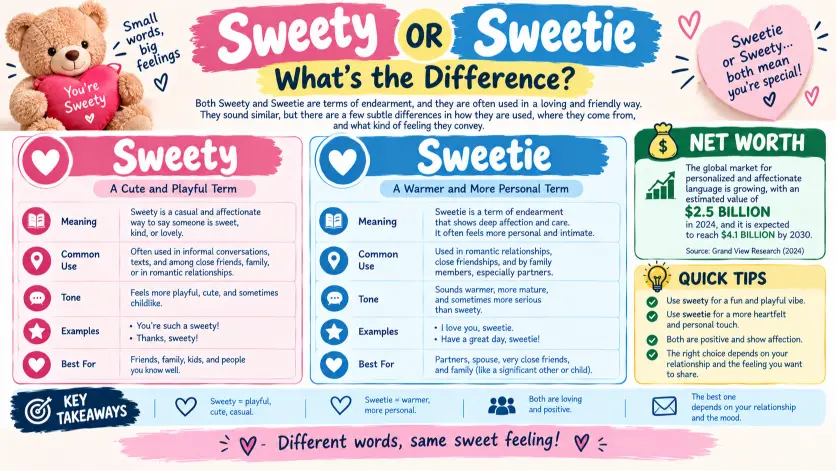
Have you ever typed “sweety” or “sweetie” and suddenly wondered whether you chose the correct spelling? You’re not alone. These two words look and sound very similar, so it’s easy to confuse them, especially in texts, social media messages, and casual conversations. But does one spelling have a different meaning, or is one simply a common mistake?
In this guide, we’ll clearly explain sweety or sweetie, including which spelling is generally considered standard English, what each form means, and how people actually use these words in everyday communication. You’ll also see simple examples that make the difference easy to remember.
The goal is to give you a reliable, practical explanation based on standard English usage rather than confusing grammar rules. Whether you’re writing a friendly message, addressing someone affectionately, or improving your English vocabulary, this guide will help you confidently choose the right word for the situation.
Sweety vs Sweetie: What’s the Difference?
Sweetie is a noun commonly used as an affectionate name for someone. It can describe a romantic partner, child, close friend, family member, or another person toward whom the speaker feels affection.
For example:
“Thanks for helping me, sweetie.”
Sweety is sometimes used informally as an alternative spelling of sweetie, particularly in casual online communication. However, it is not the preferred standard spelling when you are directly addressing someone affectionately.
The word sweetie is therefore the better choice in most ordinary situations.
| Word | Part of speech | Main use | Standard usage | Example |
|---|---|---|---|---|
| Sweetie | Noun | Affectionate term for a person | Common and established | “Good morning, sweetie.” |
| Sweety | Noun or informal variant | Casual spelling or reference to sweetness | Less common | “She called him sweety.” |
Quick recap
Sweetie is the normal spelling when speaking affectionately to someone.
Sweety can appear in informal communication, but it is considerably less common.
For professional, academic, edited, or polished writing, sweetie is generally the safer choice.
If you’re writing a message to someone you care about, “sweetie” will almost always look natural.
Is Sweety vs Sweetie a Grammar, Vocabulary, or Usage Issue?
The difference between sweetie and sweety is primarily a spelling and usage issue, rather than a complicated grammar problem.
Both forms may be encountered in real communication, but they don’t have equal status in standard everyday English.
Sweetie in standard English
Sweetie is an established noun. It is commonly used as a term of affection.
You might hear:
“Are you okay, sweetie?”
“Sweetie, could you come here for a moment?”
“She’s such a sweetie.”
The word can function both as a direct form of address and as a noun referring to a person.
Sweety in casual communication
Sweety appears much less frequently as an affectionate spelling. It may occur because writers naturally connect the word with sweet, adding the familiar ending “y.”
It is especially possible to encounter it in informal messages, comments, usernames, captions, or personal writing.
That doesn’t necessarily make every occurrence grammatically wrong. Language users often create informal spellings. However, if your goal is conventional English, sweetie is the stronger choice.
Formal versus informal usage
Neither word is particularly formal. Sweetie is affectionate and conversational, so you wouldn’t normally use it in a formal business report or academic essay.
For casual communication, however, sweetie is perfectly natural when the relationship and context make the affectionate tone appropriate.
How to Use Sweetie Correctly
Sweetie is most useful when you’re talking directly to someone affectionately or describing someone in a fond way.
It can express warmth, tenderness, familiarity, or reassurance.
Workplace example
Because sweetie is informal and personal, be careful with it at work.
For example:
Thanks for taking care of that, sweetie.”
This might sound warm between close colleagues, but it could also sound overly familiar or inappropriate in a professional setting.
A more neutral workplace alternative would be:
“Thanks for taking care of that.”
The important point is that correct spelling doesn’t automatically make a word appropriate for every situation.
Academic example
Sweetie generally has little place in formal academic writing.
Instead of:
“The researcher calls the child sweetie.”
An academic writer might simply say:
“The researcher uses an affectionate term when addressing the child.”
If the actual word is important to the analysis, however, sweetie can be discussed as part of a quotation or linguistic example.
Technology example
Technology has made affectionate language extremely common in digital communication.
A text message might say:
“Good night, sweetie. Talk to you tomorrow.”
Social media comments, messaging apps, and online conversations often use sweetie because digital communication tends to resemble spoken conversation.
Usage recap
Use sweetie when you want the established affectionate noun.
Use it mainly in personal or conversational contexts.
Avoid assuming that affectionate language belongs in every professional situation.
How to Use Sweety Correctly
Sweety is less straightforward because its use varies considerably between speakers and informal writing communities.
You may see it in messages such as:
“Good morning, sweety!”
The intended meaning is usually obvious. The writer means the same thing they would normally express with sweetie.
However, if you are choosing the spelling yourself, sweetie is generally preferable.
Workplace example
Writing “Thank you, sweety” to a colleague can create two issues. First, the spelling may look nonstandard. Second, the affectionate tone may be inappropriate for the professional relationship.
A neutral alternative is usually better.
Academic example
Sweety should generally be avoided in formal academic prose unless you are discussing the word itself, quoting someone, or analyzing informal language.
For example:
“The message uses the informal spelling sweety to create a friendly tone.”
Here, the word is being analyzed rather than casually used.
Technology example
Sweety can appear in online communication because people frequently type according to sound, habit, or personal preference. Autocorrect and predictive text may also influence what people choose.
Social media language is particularly flexible. A spelling that is unusual in edited prose may still be understandable in a casual message.
Usage recap
Sweety is understandable in many informal contexts.
It can function as a casual spelling variant of sweetie.
For standard English, polished writing, and situations where you want the safest spelling, choose sweetie.
When You Should NOT Use Sweety or Sweetie
Choosing the correct spelling is only half the issue. You also need to consider whether an affectionate term is appropriate.
Here are several situations where caution is useful.
1. Formal business correspondence
Avoid affectionate terms in formal emails unless the relationship clearly supports that tone.
2. Academic assignments
Do not casually address readers, teachers, researchers, or subjects as sweetie in formal academic prose.
3. Professional complaints
Using sweetie during a disagreement can sound sarcastic or patronizing.
For example:
“Listen, sweetie, that’s not what happened.”
Even though the spelling is correct, the tone may be offensive.
4. Conversations with strangers
Calling someone sweetie can be perceived as overly familiar when you don’t know them.
5. Customer service situations
Employees should generally choose neutral language unless their workplace culture specifically encourages affectionate expressions.
6. Serious discussions
During sensitive conversations, an affectionate nickname can unintentionally minimize someone’s feelings.
7. Formal publications
If you’re writing an article, report, or professional document, use sweetie only when the context genuinely requires it.
8. When you want neutral language
Sometimes the best solution isn’t choosing between sweetie and sweety. It is simply using the person’s name or a neutral expression.
Common Mistakes With Sweety and Sweetie
| Correct sentence | Incorrect or less preferred sentence | Explanation |
|---|---|---|
| “Good morning, sweetie.” | “Good morning, sweety.” | Sweetie is the established spelling for affectionate address. |
| “She called her daughter sweetie.” | “She called her daughter sweety.” | Sweetie is the conventional noun. |
| “Thanks, sweetie.” | “Thanks, sweety.” | The first form is more standard. |
| “The character says sweetie.” | “The character says sweety.” | Use sweetie when reproducing conventional English. |
| “Sweetie can be an affectionate term.” | “Sweety can be an affectionate term.” | Sweety is less established for this meaning. |
Decision Rule
If you are affectionately addressing a person, use sweetie.
If you encounter sweety in informal communication, understand that it may be an informal spelling, but don’t automatically treat it as the preferred standard form.
This rule works in the overwhelming majority of everyday situations.
Sweety and Sweetie in Modern Technology
Digital communication has made spelling variation much more visible.
People now communicate through text messages, social networks, chat applications, voice transcription modern technology writing tools. These environments often preserve informal language rather than correcting every variation into formal English.
Predictive keyboards may suggest one spelling based on language settings, personal typing history, or common usage patterns. Meanwhile, users may intentionally choose unconventional spellings to make a message sound more personal.
AI writing tools can also encounter both forms because they process large amounts of natural language. However, seeing a spelling online doesn’t automatically mean that it is the preferred standard form.
For language learners, this is an important lesson: frequency on the internet and standard English usage are not always identical.
If you want your writing to look polished, sweetie remains the safer choice.
The Etymology Behind Sweetie
Sweetie is derived from sweet, a word with a long history in English.
Sweet originally described taste, particularly the opposite of bitterness or sourness. Over time, the word developed broader meanings connected with pleasantness, kindness, beauty, gentleness, and affection.
The ending “ie” can create a diminutive or affectionate form in English. Similar formations appear in words used to express familiarity or fondness.
That development helps explain why sweetie became an established affectionate term.
Sweety, by contrast, is often understood as a spelling influenced by the base word sweet and the common “y” ending. Its informal appearance doesn’t give it the same conventional status as sweetie.
An expert perspective
“In standard English, sweetie is the established affectionate form, while sweety is best understood as a less conventional informal spelling.”
The practical lesson is more important than the historical detail: when in doubt, write sweetie.
Two Practical Case Studies
Case Study 1: A personal text message
Imagine someone wants to send a morning message to a partner:
“Good morning, sweetie. I hope you slept well.”
The word immediately communicates affection and familiarity. Replacing it with “sweety” would probably still be understood, but the spelling would look less conventional to many readers.
The result is a simple decision: sweetie provides the intended meaning while following the established spelling.
Case Study 2: A professional message
Now imagine a manager writing to an employee:
“Thanks for finishing the report, sweetie.”
Although sweetie is spelled correctly, the message may not be appropriate. The issue is no longer spelling. It is professional tone.
A better version might be:
“Thanks for finishing the report.”
This demonstrates an important writing principle: correct vocabulary still needs the right context.
Error Prevention Checklist
Always use sweetie when:
You are addressing someone affectionately.
You are writing polished conversational English.
You want the conventional spelling.
You are explaining the standard term to an English learner.
You are writing edited content where spelling consistency matters.
Be careful with sweety when:
You are writing formal content.
You are preparing an academic assignment.
You are creating professional communication.
You want to follow conventional dictionary style.
You are unsure whether an informal spelling is appropriate.
Related Grammar Confusions You Should Master
Understanding sweetie and sweety is useful, but English contains many other pairs that create similar confusion.
Here are several worth learning:
- Everyday vs every day
One describes something ordinary, while the other refers to each day. - Advice vs advise
Advice is a noun, while advise is a verb. - Affect vs effect
These words have different grammatical functions and meanings. - Your vs you’re
One shows possession, while the other means you are. - Its vs it’s
One indicates possession, while the other is a contraction. - Then vs than
Then usually relates to time, while than introduces comparison. - Compliment vs complement
One expresses praise, while the other refers to something that completes or enhances another thing. - Loose vs lose
Loose describes something not tight, while lose refers to no longer having something. - Fewer vs less
These are traditionally distinguished according to countable and uncountable nouns. - Principal vs principle
Principal commonly refers to a person or something most important, while principle refers to a rule or belief.
Learning these distinctions improves both accuracy and confidence in everyday writing.
Frequently Asked Questions
Is sweetie or sweety correct?
Sweetie is the standard and more widely accepted spelling when you are using the word as an affectionate term for a person. Sweety may appear as an informal spelling, but sweetie is generally the safer choice in standard English.
Is sweetie a real English word?
Yes. Sweetie is an established English noun used as an affectionate term for someone. It can be used when directly addressing a person or when referring to someone affectionately.
Is sweety grammatically correct?
Sweety can occur in informal English, especially online or in personal messages. However, it is much less conventional than sweetie when the intended meaning is an affectionate name for a person.
Why do people spell sweetie as sweety?
People may spell sweetie as sweety because the pronunciation can make the spelling seem logical. The spelling may also be influenced by the word sweet and the common ending “y.” Informal digital communication encourages many such variations.
Can I call my boyfriend sweetie?
Yes. Sweetie can be used affectionately for a romantic partner. The exact level of intimacy depends on the relationship and the communication style between the two people.
Can you call a girl sweetie?
Yes. Sweetie can be used for people of different genders. It can refer to a romantic partner, child, family member, friend, or another person when the context makes the affectionate meaning appropriate.
Is sweetie formal or informal?
Sweetie is primarily informal and conversational. It is appropriate in many personal situations but generally isn’t suitable for formal academic or professional writing unless the context specifically requires the word.
Is sweetie a term of endearment?
Yes. Sweetie is a common term of endearment. It communicates affection, warmth, friendliness, familiarity, or tenderness depending on the relationship and context.
Is sweety a misspelling of sweetie?
In many contexts, sweety can be considered a nonstandard or informal spelling of sweetie. Because sweetie is the established form for affectionate address, it is usually the better spelling when you want conventional English.
Which one should I use in a text message?
If you’re affectionately addressing someone, use sweetie. It is natural, familiar, and widely recognized. Sweety may be understood, but sweetie is the more conventional choice.
Final Verdict
When you’re choosing between sweety or sweetie, the answer is straightforward: sweetie is the preferred standard spelling when you mean an affectionate term for a person. Sweety may appear in informal messages, social media posts, and casual online communication, and readers will often understand what the writer means. However, its use is less conventional.
The safest decision is to choose sweetie whenever you want your writing to look natural, polished, and consistent with standard English. Remember the simple rule: sweetie is the standard affectionate form; sweety is an informal variation you may encounter.
Whether you’re writing a text, caption, personal note, or language article, choosing the conventional spelling helps your message communicate exactly what you intend.









