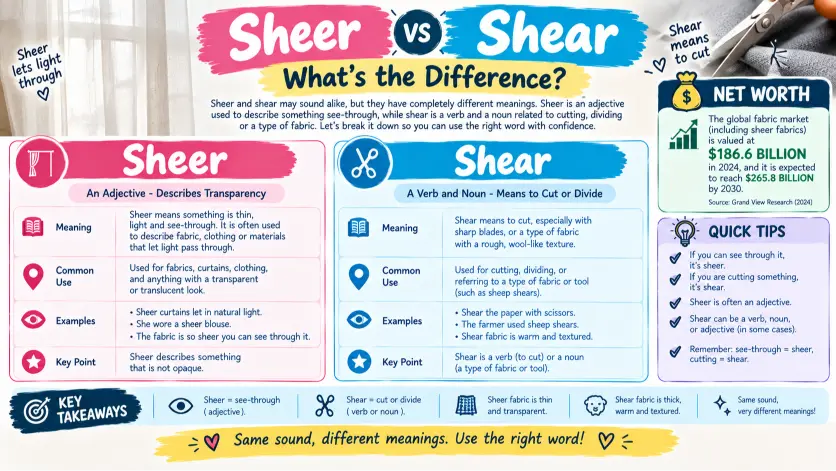
Have you ever wondered whether the correct word is “sheer” or “shear”? These two words look and sound similar, but they have very different meanings and uses. A small spelling mistake can completely change the meaning of your sentence, especially when writing emails, school assignments, articles, or professional content.
Understanding the difference becomes much easier when you connect each word with its common meaning and real world usage. Sheer can describe something extremely steep, complete, or very thin and transparent, while shear is commonly used as a verb related to cutting, especially cutting hair, wool, or another material.
This guide explains both words in clear, everyday English with practical examples and simple memory tips. Based on standard English usage and established dictionary meanings, you’ll learn when to use sheer, when to use shear, and how to avoid common mistakes. By the end, choosing the right word should feel quick and natural.
Sheer vs Shear: What’s the Difference?
Sheer is primarily an adjective, although it can also function as an adverb in certain constructions. As an adjective, it can describe something extremely steep, very thin, almost transparent, complete, or impressive because of its intensity. For example, “The mountain has a sheer cliff” describes a nearly vertical surface.
Shear, by contrast, is commonly used as a verb. It means to cut or trim something, particularly hair, wool, grass, or another material. It can also function as a noun when referring to a cutting instrument or the process involving cutting.
The easiest distinction is therefore based on meaning rather than pronunciation.
In short, sheer describes a quality, condition, degree, or appearance.
Meanwhile, shear normally describes an action involving cutting or trimming.
Therefore, if your sentence involves something being steep, transparent, extreme, or complete, sheer may be appropriate.
If the sentence involves cutting or trimming, shear is usually the correct choice.
Is Sheer vs Shear a Grammar, Vocabulary, or Usage Issue?
This confusion is mainly a vocabulary and usage issue rather than a basic grammar problem. Both words are legitimate English terms, but they belong in different semantic situations.
They aren’t interchangeable. Although their pronunciation is identical in many varieties of English, their meanings are unrelated in ordinary usage.
In formal writing, choosing the correct spelling matters because context alone may not completely repair the mistake. For example, “the shear size of the building” is incorrect when the intended meaning is extreme size. The proper expression is “the sheer size of the building.”
Similarly, “workers sheer the sheep” is incorrect when the intended action is cutting wool. The correct verb is “workers shear the sheep.”
In academic writing, precision is particularly important because a single spelling difference can change the meaning of a statement. In casual conversation, listeners may understand the intended word from context. However, written communication does not provide the same protection.
Consequently, learning the distinction is useful for students, professionals, editors, researchers, and everyday writers.
How to Use Sheer Correctly
Sheer has several meanings, so its usage deserves careful attention. First, it can describe something almost vertical or extremely steep. Consider the sentence, “The hikers stopped beside a sheer drop.” Here, sheer emphasizes the steepness of the drop.
Second, sheer can describe fabric that is very thin or transparent. For instance, “She wore a sheer curtain over the window.” In this sense, the word concerns visibility through a material.
Third, sheer can emphasize an extreme amount or degree. “The project succeeded through sheer determination” means that determination alone played a powerful role.
Finally, sheer can express complete or absolute quality. “The sheer beauty of the landscape surprised everyone” emphasizes the overwhelming degree of beauty.
Workplace example
“The sheer volume of customer requests required another employee.”
Here, sheer emphasizes how unusually large the volume was.
Academic example
“The researchers were surprised by the sheer scale of the environmental change.”
The word highlights the remarkable degree of the change.
Technology example
“The sheer amount of stored data affected system performance.”
In this context, sheer emphasizes an exceptionally large quantity.
Usage recap
Use sheer when describing intensity, magnitude, steepness, transparency, or completeness.
If you can replace the word with “complete,” “extreme,” “very steep,” or “thin and transparent,” sheer may be the appropriate choice.
How to Use Shear Correctly
Shear generally refers to cutting, trimming, or removing material. Its most familiar use concerns sheep. Farmers shear sheep by cutting away their wool.
However, the word has a much wider range of applications. A gardener may shear a hedge. A stylist may shear hair. A manufacturer may use shearing equipment to cut metal sheets.
The noun form also appears frequently. “Shears” can refer to a cutting instrument consisting of two blades. In engineering, shear can describe a force or deformation involving parallel forces acting in opposite directions.
Workplace example
“The technician will shear the excess material before assembly.”
Here, shear describes the planned cutting process.
Academic example
“The experiment measured the shear force applied to the sample.”
In this sentence, shear belongs to technical scientific vocabulary.
Technology example
“The machine uses a shear mechanism to cut the material precisely.”
The term identifies a mechanical cutting process.
Usage recap
Use shear when the sentence involves cutting, trimming, removing material, or describing a technical force.
If an action physically changes the size or shape of material through cutting, shear is usually the word you need.
When You Should NOT Use Sheer or Shear
Knowing when not to use these terms can prevent many common errors. Although context sometimes helps readers understand the intended meaning, incorrect spelling still weakens written communication.
1. Do not use sheer for ordinary cutting
Incorrect: “The farmer will sheer the sheep.”
Correct: “The farmer will shear the sheep.”
The action is cutting wool, so shear is required.
2. Do not use shear for extreme size
Incorrect: “The shear number of visitors surprised us.”
Correct: “The sheer number of visitors surprised us.”
The intended meaning concerns an unusually large quantity.
3. Do not use sheer when describing a cutting tool
Incorrect: “The tailor picked up a sheer.”
Correct: “The tailor picked up a pair of shears.”
The noun refers to a cutting instrument.
4. Do not use shear for transparent fabric
Incorrect: “The designer selected a shear material.”
Correct: “The designer selected a sheer material.”
The fabric is thin enough to allow light or visibility through it.
5. Do not use sheer for technical cutting force incorrectly
Incorrect: “The engineer measured the sheer force.”
Correct: “The engineer measured the shear force.”
Engineering uses shear for a specific type of force or deformation.
6. Do not rely only on pronunciation
Because the two words can sound identical, listening carefully isn’t enough. You must identify the meaning intended by the sentence.
7. Do not assume spell checking will solve the problem
Both words are correctly spelled English terms. Therefore, a standard spell checker may not identify a contextual mistake.
Common Mistakes and Decision Rules
Contextual spelling mistakes are especially common with words that share pronunciation. The following examples make the distinction clearer.
Decision Rule Box
If you mean extreme, complete, steep, thin, or transparent, use SHEER.
If you mean cutting, trimming, removing material, or a technical cutting force, use SHEAR.
This simple distinction handles most everyday situations.
Sheer and Shear in Modern Technology and Smart Tools
Modern technology has created additional situations in which these terms appear. For example, engineering software may calculate shear stress, shear force, and shear deformation during structural analysis.
Meanwhile, sheer frequently appears in descriptions of scale or magnitude. A technical report might discuss the sheer volume of information processed by a system.
Digital writing tools can identify spelling patterns, but contextual accuracy still depends on meaning. Since both words are legitimate dictionary entries, a tool may accept either spelling even when one doesn’t fit the sentence.
Therefore, writers should first determine what they intend to communicate. After that, they can use automated checking as an additional review step rather than relying on it as the final authority.
Sheer and Shear: Etymology and Word History
Understanding word history can make vocabulary distinctions easier to remember.
Sheer developed from older English forms associated with meanings such as bright, clear, pure, or steep. Over time, its meanings expanded into descriptions involving transparency, steepness, and extreme degree.
Shear has a different historical path. It is connected with old Germanic words associated with cutting. Related forms appear across several Germanic languages.
Therefore, despite their identical pronunciation in common English speech, the words have separate histories and meanings.
That difference explains why their spellings remain distinct today.
An Expert Perspective on the Difference
A useful language principle is this: “When two words sound alike, meaning should determine spelling.”
This principle applies well beyond these two terms. English contains many homophones whose pronunciation offers no reliable clue about written form.
Therefore, the safest approach is to identify the idea first and select the spelling second.
Two Practical Case Studies
Case Study 1: Workplace Communication
Consider an employee preparing a report about manufacturing production. The writer wants to explain that an unusually large amount of material was processed.
The first draft says, “The shear volume of material increased production time.”
The intended meaning is magnitude, not cutting. After correction, the sentence becomes, “The sheer volume of material increased production time.”
The correction changes only one letter, yet it restores the intended meaning and makes the report more professional.
Case Study 2: Academic Writing
Imagine a student writing about sheep farming. The original sentence states, “Farmers sheer sheep during the warmer months.”
Because the sentence describes removing wool, the correct verb is shear.
The revised sentence reads, “Farmers shear sheep during the warmer months.”
Again, the correction is small, but it demonstrates precise vocabulary control. Such accuracy is particularly valuable in academic assignments because contextual spelling errors can distract readers from the main argument.
Error Prevention Checklist
Always use SHEER when
You mean something extremely steep.
You mean something thin or transparent.
You mean an unusually large amount.
You mean complete or absolute quality.
You want to emphasize intensity or magnitude.
Never use SHEAR when
You are describing extreme size.
You are describing transparent fabric.
You mean complete effort or determination.
You are emphasizing the remarkable degree of something.
Always use SHEAR when
You mean cutting wool or hair.
You mean trimming vegetation.
You mean cutting material.
You are describing a technical force involving deformation.
You are referring to shears as a cutting instrument.
Never use SHEER when
You are describing the act of cutting.
You are discussing wool removal.
You are naming a cutting mechanism.
You are referring to technical shear stress or shear force.
Related Grammar Confusions You Should Master
Once you understand these words, several other commonly confused pairs become easier to recognize.
Affect vs Effect
Affect commonly functions as a verb, while effect frequently functions as a noun. Their exact roles can vary, so context remains important.
Principal vs Principle
Principal can refer to a person or something primary. Principle refers to a fundamental rule, belief, or standard.
Stationary vs Stationery
Stationary describes something that isn’t moving. Stationery refers to writing materials.
Compliment vs Complement
A compliment expresses praise. A complement completes or enhances something.
Its vs It’s
Its indicates possession. It’s is a contraction meaning “it is” or “it has.”
Their vs There vs They’re
Their indicates possession. There refers to a place or existence. They’re means “they are.”
Advice vs Advise
Advice is a noun. Advise is generally a verb.
Practice vs Practise
In American English, practice is used for both noun and verb functions. British usage commonly distinguishes practice as a noun and practise as a verb.
Loose vs Lose
Loose describes something not firmly fixed. Lose refers to failing to keep or find something.
Than vs Then
Than is mainly used for comparisons. Then generally refers to time, sequence, or consequence.
Advanced FAQs
What is the difference between sheer and shear?
Sheer describes qualities such as extreme degree, steepness, transparency, or completeness. Shear generally refers to cutting, trimming, removing material, or a technical force.
Is sheer a synonym for extreme?
In many contexts, yes. Sheer can emphasize an unusually high degree or intensity. For example, “sheer determination” highlights the exceptional strength of someone’s determination.
Is shear a verb or a noun?
Shear can be both. As a verb, it means to cut or trim. As a noun, it can refer to the cutting process, a cutting instrument in some contexts, or a technical force.
How do you remember sheer vs shear?
A useful memory trick is to associate shear with scissors and cutting. Sheer, meanwhile, can describe something steep, transparent, complete, or extreme.
Is it sheer size or shear size?
The correct expression is “sheer size” when you mean exceptionally large size.
Is it shear sheep or sheer sheep?
The correct expression is “shear sheep” because the verb refers to cutting their wool.
What does sheer mean in clothing?
When describing clothing or fabric, sheer means thin or transparent enough for light or visibility to pass through.
What does shear mean in engineering?
In engineering, shear can describe a force, stress, or deformation associated with forces acting in opposite directions across a material.
Are sheer and shear homophones?
Yes, in many varieties of English they are pronounced alike. However, they have different meanings, spellings, and grammatical uses.
Can spell checking distinguish sheer from shear?
Not reliably. Since both are correctly spelled words, basic spelling software may accept either one. Meaning and sentence context are therefore essential.
Final Verdict: Sheer or Shear?
The difference between sheer and shear becomes simple once you focus on meaning instead of pronunciation. Use sheer for extreme degree, steepness, transparency, completeness, or intensity. Use shear for cutting, trimming, removing material, or describing a related technical force.
Remember the practical rule: sheer describes a quality, while shear usually describes an action or technical process.
So, write “the sheer size of the building” when you mean exceptional magnitude. However, write “the farmer will shear the sheep” when you mean cutting wool.
Because these words sound alike, the spelling can be easy to overlook. Nevertheless, choosing the correct form improves clarity, professionalism, and accuracy in everything from classroom assignments to workplace documents.









