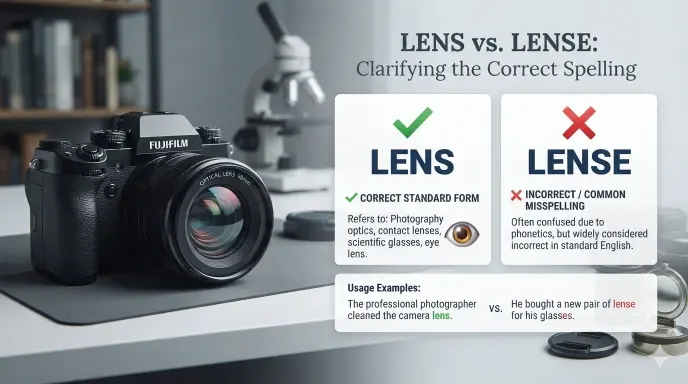
The words lense or lens can easily cause confusion, especially when you see the incorrect spelling “lense” used online. If you are writing an email, school assignment, blog post, product description, or social media caption, choosing the right spelling matters. So, is lense a correct English word, or should you always write lens?
The correct spelling in standard modern English is lens. It can refer to an optical object that focuses light, such as the lens in a camera, eyeglasses, or the human eye. It can also be used figuratively to describe a way of viewing or understanding something.
This guide explains lense vs lens with clear definitions, pronunciation, examples, common mistakes, and practical usage tips. By the end, you will know exactly which spelling to use and why lens is the accepted choice in standard English.
Lense or Lens: What’s the Difference?
The main difference is simple: lens is the accepted standard spelling, while lense is generally an incorrect spelling in modern English.
The word lens is a noun. It refers to a curved piece of transparent material that changes the direction of light. Depending on context, it can describe an optical component, a camera part, or a contact lens placed directly on the eye.
The spelling lense is not normally accepted as the standard noun in contemporary English. People sometimes write it because they pronounce “lens” in a way that makes an extra vowel sound seem possible. However, pronunciation should not be used as a guide for adding an extra letter.
| Point of comparison | Lens | Lense |
|---|---|---|
| Standard spelling | Yes | No |
| Part of speech | Noun | Usually a misspelling |
| Meaning | Optical device or viewing component | No standard modern meaning in ordinary English |
| Photography | Correct | Incorrect |
| Science | Correct | Incorrect |
| Academic writing | Correct | Incorrect |
| Everyday writing | Correct | Incorrect |
In short, lens is the form you should choose.
Meanwhile, lense should normally be avoided in standard writing.
Consequently, if you are describing a camera component, optical device, or contact lens, write lens.
Is Lense or Lens a Grammar, Vocabulary, or Usage Issue?
The confusion between lense or lens is primarily a spelling and vocabulary usage issue, rather than a complicated grammar problem.
Both forms may appear similar because English contains many words ending in “se.” Nevertheless, “lens” has its own established spelling, and adding an extra “e” changes the word into a nonstandard form.
Importantly, lens is not merely a formal alternative to “lense.” It is the standard word in both casual and professional communication.
For example, you would write:
I bought a new camera lens.
You would also write:
The microscope uses a powerful lens.
Similarly, academic researchers, photographers, optometrists, engineers, and technology writers use lens.
Therefore, this is not a situation where one spelling belongs to formal English and another belongs to casual conversation. Instead, lens is the normal spelling across contexts.
In academic work, using “lense” can make an otherwise polished sentence appear careless. Likewise, in workplace communication, the incorrect spelling can reduce clarity and professionalism.
How to Use Lens Correctly
The noun lens has several practical applications. Consequently, understanding its meaning in different settings makes the correct spelling easier to remember.
Workplace Example
Consider a photography business discussing equipment:
The photographer replaced the damaged lens before the event.
Here, lens refers to the optical component attached to a camera.
Another workplace example could be:
Please clean the camera lens before the product shoot.
In both sentences, the word identifies a physical object.
Academic Example
In science or education, the word can describe an optical element:
The convex lens focuses light onto the surface.
Likewise:
Students examined the specimen through a microscope lens.
In these examples, lens has a technical meaning related to optics.
Technology Example
Modern devices frequently contain lenses:
The smartphone uses multiple camera lenses for different shooting modes.
Likewise:
A wide angle lens can capture a broader scene.
Therefore, the same spelling remains correct even when technology changes the context.
Usage Recap
Use lens when you mean an optical component, camera component, contact lens, or figurative viewpoint.
Because the spelling remains unchanged across these situations, there is no reason to switch to “lense.”
Why Do People Write Lense?
The incorrect form lense usually results from spelling intuition rather than a different meaning.
First, English spelling contains many words where a final “e” appears before another letter pattern. Consequently, writers may assume that “lens” needs a similar ending.
Second, pronunciation can contribute to the mistake. Depending on accent and speaking speed, the final sound in “lens” may not feel completely obvious to someone learning English.
Third, typing habits can reinforce the error. When people write quickly, they sometimes add letters that feel visually familiar.
However, these factors do not create a legitimate alternative spelling.
Therefore, the safest approach is simple: memorize lens as the standard noun.
When You Should NOT Use Lense or Lens
Although lens is correct, you should still avoid using it when you actually mean another concept.
Here are several common situations where careful word selection matters.
1. When You Mean a Viewpoint
You can use lens metaphorically to describe a perspective:
We should examine the issue through a historical lens.
However, if you mean someone’s personal opinion, words such as “viewpoint,” “opinion,” or “perspective” may be more precise.
2. When You Mean Glasses
A complete pair of glasses is not simply called a lens.
For example:
She bought new glasses.
However, the individual optical pieces inside the glasses can be called lenses.
3. When You Mean a Camera
A camera and a lens are different objects.
For instance:
I bought a new camera.
is different from:
I bought a new lens for my camera.
4. When You Mean an Eye
The human eye and its natural lens are not identical.
Therefore, writing “the eye” when you mean its internal lens can create an inaccurate statement.
5. When You Are Writing a Technical Definition
In scientific writing, precision is especially important. Use lens specifically when referring to an optical component that refracts or focuses light.
6. When You Are Describing Contact Lenses
The singular form is lens, while the plural is lenses.
For example:
I need a new contact lens.
For two or more:
She ordered new contact lenses.
7. When You Are Writing for Publication
Published material should consistently use the recognized spelling. Therefore, “lense” should generally be corrected before publication.
8. When You Are Checking Someone Else’s Work
Do not automatically assume that “lense” is an intentional variant. In ordinary modern English, it is most likely a spelling mistake.
Common Mistakes: Lense or Lens
Because the two forms look almost identical, writers can overlook the error during proofreading.
| Correct sentence | Incorrect sentence | Explanation |
|---|---|---|
| I cleaned the camera lens. | I cleaned the camera lense. | The standard spelling is lens. |
| This lens produces sharp images. | This lense produces sharp images. | “Lense” is not the standard form. |
| The microscope lens is dirty. | The microscope lense is dirty. | Scientific usage requires lens. |
| She replaced her contact lens. | She replaced her contact lense. | The singular noun is lens. |
| The photographer bought a new lens. | The photographer bought a new lense. | Photography uses the spelling lens. |
| This convex lens bends light. | This convex lense bends light. | Optical terminology uses lens. |
| The lens is cracked. | The lense is cracked. | Lens is the accepted spelling. |
Decision Rule Box
If you mean the optical object, use “lens.”
If you mean a camera component, use “lens.”
If you mean a contact lens, use “lens.”
If you mean a figurative perspective, use “lens.”
There is no ordinary modern context in which “lense” should replace the standard spelling “lens.”
Lens and Lense in Modern Technology
Modern technology has made the word lens even more common.
For example, smartphones now contain sophisticated camera systems that may include several lenses. Each lens can serve a different purpose, such as capturing wide scenes, distant subjects, or detailed closeups.
Similarly, webcams, security cameras, medical imaging devices, microscopes, telescopes, and virtual reality equipment can involve optical lenses.
Consequently, technology has not created a new spelling.
Instead, it has expanded the number of situations where lens appears in technical and everyday language.
Digital photography has also introduced terms such as wide angle lens, zoom lens, telephoto lens, macro lens, camera lens, and portrait lens.
In every case, the singular spelling remains lens.
The plural is lenses.
That distinction is useful because learners sometimes mistakenly assume that the plural should be “lenses” only because “lense” exists. In reality, lenses is simply the plural form of lens.
Lens in Science and Medicine
The word lens has a long history in scientific terminology.
In optics, a lens changes the path of light. Depending on its shape and purpose, it may converge or diverge light rays.
For example, a convex lens can bring incoming light rays toward a focal point. Conversely, a concave lens spreads light rays outward.
Medicine also uses the word frequently.
The human eye contains a natural lens that helps focus incoming light onto the retina. Contact lenses are designed to sit on the surface of the eye and correct certain vision problems.
Therefore, scientific and medical contexts strongly reinforce the standard spelling.
Using “lense” in these settings would be especially noticeable because technical vocabulary depends on consistent terminology.
A Short History of the Word Lens
The English word lens comes from Latin lens, meaning “lentil.” The connection comes from the shape of an early optical lens, which resembled a lentil seed.
Over time, the term became associated with transparent optical objects that bend or focus light.
The word eventually became firmly established in scientific and technical English.
Interestingly, its spelling remained relatively compact compared with many other English words.
Therefore, the modern form lens is not an abbreviation or casual shortening. It is the established English noun.
This history also explains why adding an extra “e” is unnecessary.
An Expert Style Rule for Remembering Lens
A useful editorial principle is:
“When a technical term already has an established spelling, familiarity should guide correction rather than pronunciation.”
That principle applies especially well to lens.
Instead of asking whether “lense” looks natural, ask whether it is the recognized spelling used in standard English.
Once you associate lens with cameras, eyes, microscopes, and viewpoints, remembering the correct form becomes much easier.
Two Practical Case Studies
Case Study One: Photography Description
Imagine a photographer preparing a product description for a camera accessory.
The original sentence reads:
This lense captures sharp images in low light.
After proofreading, the sentence becomes:
This lens captures sharp images in low light.
The correction removes the spelling error without changing the meaning.
The practical result is greater consistency across the product description, equipment specifications, and customer instructions.
Case Study Two: Educational Science Material
Consider a school worksheet containing this sentence:
A convex lense focuses light.
The corrected version reads:
A convex lens focuses light.
The scientific statement remains unchanged, but the terminology now follows standard English usage.
The practical result is a cleaner educational resource and a spelling model that students can safely reproduce in assignments and examinations.
These examples demonstrate why a tiny spelling difference can matter in professional and educational communication.
Error Prevention Checklist
Before publishing or submitting your writing, use this quick review.
Always Use Lens When
- You mean a camera component.
- You mean an optical device.
- You mean a contact lens.
- You mean the natural lens inside the eye.
- You mean a microscope component.
- You mean a telescope component.
- You mean a figurative perspective.
- You mean one optical object.
Never Use Lense When
- You are writing standard English.
- You are describing camera equipment.
- You are discussing vision correction.
- You are writing a scientific assignment.
- You are preparing technical documentation.
- You are editing professional content.
- You are describing photography equipment.
- You are referring to an optical component.
Related Grammar Confusions You Should Master
Learning lens correctly can also encourage you to examine other commonly confused English terms.
- Advice vs advise
- Affect vs effect
- Practice vs practise
- Breath vs breathe
- Loose vs lose
- Principal vs principle
- Stationary vs stationery
- Compliment vs complement
- Then vs than
- Its vs it’s
These pairs demonstrate an important lesson: words that look or sound similar do not necessarily perform the same function.
Therefore, developing careful vocabulary habits can prevent repeated spelling and usage problems.
Advanced FAQs
Is lense a correct English word?
Generally, no. In standard modern English, lens is the accepted spelling for the optical noun. “Lense” is normally treated as a misspelling.
Is it lens or lense for a camera?
The correct spelling is lens. A camera lens is the optical component that helps form an image.
Why do people spell lens as lense?
People may add the final “e” because of pronunciation, spelling patterns, or typing habits. Nevertheless, those reasons do not make “lense” the standard spelling.
What is the plural of lens?
The plural of lens is lenses. For example, “The photographer owns several camera lenses.”
Is lens a noun or a verb?
In ordinary English, lens is primarily a noun. It can identify an optical component or, in figurative language, a perspective through which something is examined.
Can lens be used metaphorically?
Yes. For example, you might say, “We examined the problem through a cultural lens.” In this case, lens means a particular perspective or framework.
Is lense accepted in formal writing?
It should generally be avoided. Formal writing should use the established spelling lens.
Is lens used in medical English?
Yes. Medical language frequently uses terms such as eye lens, intraocular lens, and contact lens.
What is the difference between lens and lenses?
Lens is singular, while lenses is plural. For example, “The camera has one lens” becomes “The camera has three lenses.”
How can I remember the correct spelling of lens?
Associate lens with cameras, eyes, microscopes, and telescopes. Remember that the standard singular form ends immediately after “lens,” without an additional “e.”
Final Verdict: Lense or Lens?
When choosing between lense or lens, use lens.
It is the standard spelling for an optical component, camera component, contact lens, and figurative perspective. Meanwhile, lense is generally considered a spelling mistake in contemporary standard English.
Therefore, whether you are writing a school assignment, photography guide, product description, scientific explanation, medical document, or everyday message, lens is the reliable choice. The easiest rule is also the most useful one: one optical object is a lens, while multiple optical objects are lenses.
Once this distinction becomes familiar, the confusion disappears. You don’t need to treat “lense” as a formal alternative or a different vocabulary choice. In standard usage, simply choose lens.









