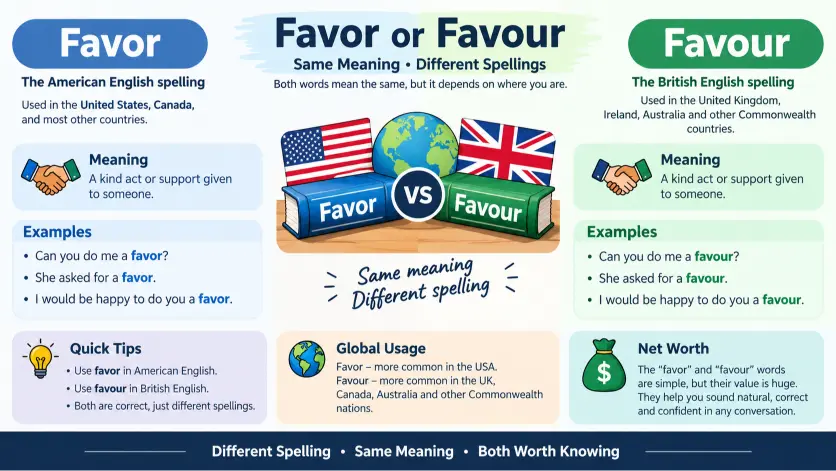
Have you ever wondered whether favor or favour is the correct spelling? You may see both versions in books, websites, emails, and everyday conversations, which can make this simple word surprisingly confusing. The good news is that both spellings are correct, but they belong mainly to different varieties of English. Favor is the standard spelling in American English, while favour is commonly used in British English and other varieties influenced by British usage. Knowing this small distinction can help you write more confidently and avoid unnecessary spelling mistakes.
The difference between favor and favour is not about meaning or grammar. Both words can refer to an act of kindness, approval, support, or a preference, depending on the context. The main difference is regional spelling.
In this guide, we’ll explain where each form is used, how the words work in real sentences, and which spelling you should choose for American, British, academic, workplace, and international writing. With clear examples and practical usage rules, you’ll quickly know when to write favor and when favour.
Favor or Favour: What’s the Difference?
“Favor” and “favour” are nouns and verbs with the same basic meanings. The difference is primarily regional spelling. American English generally uses “favor,” whereas British English generally uses “favour.”
As a noun, the word can refer to approval, support, kindness, or a helpful action. For example, someone might ask a colleague for a favor. Similarly, a person can say that a particular decision is in their favor.
As a verb, the term means to prefer, support, approve of, or treat someone positively. For instance, a manager might favor one proposal because it offers greater value. Likewise, a teacher might favor a particular approach because it produces clearer results.
| Feature | Favor | Favour |
|---|---|---|
| Part of speech | Noun and verb | Noun and verb |
| Primary spelling | American English | British English |
| Meaning | Support, kindness, preference, approval | Support, kindness, preference, approval |
| Common audience | United States | United Kingdom and many British English regions |
| Example | Could you do me a favor? | Could you do me a favour? |
| Related form | Favorable | Favourable |
| Formal correctness | Correct in American English | Correct in British English |
Quick Recap
“Favor” is the usual American spelling.
“Favour” is the usual British spelling.
Both forms have the same pronunciation and meaning.
Therefore, your audience and chosen English variety should determine your spelling.
Is Favor or Favour a Grammar, Vocabulary, or Usage Issue?
The difference between these forms is mainly a spelling and usage issue, rather than a difference in grammar or vocabulary. Both versions function in the same grammatical ways.
For example, both can operate as nouns:
“Can you do me a favor?”
“Can you do me a favour?”
Likewise, both can operate as verbs:
“She favors practical solutions.”
“She favours practical solutions.”
Consequently, changing the spelling does not change the grammatical structure. Instead, it signals which regional convention the writer is following.
In formal writing, consistency matters more than choosing one version universally. Therefore, an American university assignment would normally use “favor,” while a British academic paper would generally use “favour.”
In casual communication, readers usually understand both forms. Nevertheless, consistent spelling creates a stronger impression of editorial control.
How to Use Favor Correctly
“Favor” is the preferred spelling in American English. Therefore, writers targeting readers in the United States should generally choose this form.
Workplace Example
A professional might write:
“Could you do me a favor and review this report?”
Here, “favor” means a helpful action requested from another person. Similarly, a manager could write:
“The evidence favors the second proposal.”
In that sentence, the verb means that the evidence supports one option more strongly.
Academic Example
An American student might write:
“The available evidence favors this interpretation.”
Here, the word functions as a verb. However, another sentence could use it as a noun:
“The researcher asked a colleague for a favor.”
Thus, the spelling remains unchanged regardless of its grammatical role.
Technology Example
A software interface designed primarily for American users might contain wording such as:
“Add to favorites.”
Similarly, a technical guide could say:
“Users can save a page as a favorite.”
Therefore, American spelling can appear throughout digital products, documentation, menus, and user instructions.
Usage Recap
Use “favor” when following American English conventions. Furthermore, keep related forms consistent, such as “favorite” and “favorable,” when your chosen style follows American spelling.
How to Use Favour Correctly
“Favour” is the preferred spelling in British English. It is also common in several countries and institutions that traditionally follow British spelling conventions.
Workplace Example
A British professional might write:
“Could you do me a favour and check these figures?”
Similarly, a business report could state:
“The latest figures favour the proposed strategy.”
Therefore, the same grammatical functions remain available while the spelling follows British convention.
Academic Example
A university paper using British English might state:
“The findings favour a broader interpretation.”
Alternatively, a student could write:
“The researcher requested a favour from a colleague.”
Consequently, “favour” works naturally in both scholarly and everyday contexts.
Technology Example
A digital application using British English might label a saved item as a “favourite.” Likewise, a website might describe a feature that lets readers add articles to their favourites.
Thus, the spelling can influence interface wording, documentation, settings, and help materials.
Usage Recap
Use “favour” when your publication, institution, employer, or audience follows British English. Above all, maintain the same regional spelling throughout your document.
When You Should NOT Use Favor or Favour
Although both spellings are legitimate, there are situations where choosing the wrong regional form can create unnecessary inconsistency.
1. Do Not Mix Regional Styles Without a Reason
Avoid writing “favor” in one section and “favour” in another when the same document follows one English convention. Consistency makes professional writing easier to evaluate.
2. Do Not Assume One Form Is Universally Correct
It is inaccurate to claim that only “favor” or only “favour” is correct. Both belong to established varieties of English.
3. Do Not Change the Spelling Randomly
If a document is written for an American audience, changing between forms can look like an editing oversight. Therefore, choose one convention before completing the document.
4. Do Not Use British Spelling in an American Style Guide
If an organization specifically requires American English, “favour” may conflict with its editorial standards.
5. Do Not Use American Spelling Against a Required British Standard
Likewise, an institution requiring British English may expect “favour.”
6. Do Not Change Only One Related Word
Regional spelling often affects related vocabulary. Therefore, writers should consider forms such as “favorite” and “favourite” when establishing a consistent style.
7. Do Not Treat Regional Preference as a Meaning Difference
The two forms do not normally represent separate meanings. Instead, they represent different spelling conventions.
8. Do Not Overcorrect Someone Without Considering Their English Variety
A British writer using “favour” has not necessarily made a spelling mistake. Likewise, an American writer using “favor” is following a legitimate standard.
Common Mistakes: Favor or Favour
Understanding the difference becomes easier when you compare correct and incorrect usage patterns.
| Correct sentence | Incorrect sentence | Explanation |
|---|---|---|
| Could you do me a favor? | Could you do me a favour? | The second form may conflict with an American style requirement. |
| Could you do me a favour? | Could you do me a favor? | The second form may conflict with a British style requirement. |
| She favors the first option. | She favours the first option. | “Favors” follows American spelling. |
| She favours the first option. | She favors the first option. | “Favours” follows British spelling. |
| My favorite book is here. | My favourite book is here. | American spelling uses “favorite.” |
| My favourite book is here. | My favorite book is here. | British spelling uses “favourite.” |
However, remember that some examples above are not universally grammatically wrong. Instead, they can be inappropriate when they conflict with the required regional style.
Favor and Favour in Modern Technology and Digital Tools
Modern digital products frequently expose regional spelling differences because software can be designed for specific markets. Consequently, users may encounter “favorite” in one application and “favourite” in another.
For example, an American interface may allow users to save an item as a “favorite.” Meanwhile, a British interface may call the same feature a “favourite.”
This distinction can also appear in dictionaries, writing applications, browser settings, document editors, and language preferences. Therefore, seeing either spelling inside a digital product does not automatically indicate an error.
Furthermore, writing assistants and language checking systems may identify a spelling as inconsistent when the selected regional dictionary differs from the writer’s intended variety. As a result, checking the document’s language setting can prevent unnecessary corrections.
Ultimately, technology follows language conventions established for its intended users. Thus, context remains the most reliable guide.
Where Did Favor and Favour Come From?
The word has a long history connected to Latin and French influence on English. The English form developed from Old French usage and ultimately traces back to Latin favor, associated with goodwill, support, or approval.
Over time, English developed regional spelling conventions. British spelling retained the “u” in several words influenced by French patterns, while American English increasingly preferred shorter spellings in many cases.
The distinction became especially noticeable through American dictionary and editorial traditions. Consequently, modern American English commonly uses “favor,” while British English retains “favour.”
This historical development explains why both spellings can coexist without representing separate vocabulary items.
“Good language is not merely about correctness; it is also about choosing conventions that serve the reader.”
This principle is particularly useful here because the intended audience determines which regional form is most appropriate.
Two Practical Case Studies
Case Study One: American Business Communication
Imagine a company based in New York preparing customer support templates for users across the United States. The editorial team initially used both “favor” and “favour” because different employees followed different spelling habits.
After adopting American English as the company standard, the team changed all customer facing templates to “favor,” “favorite,” and related American forms.
As a result, the company created a more consistent written identity across emails, support pages, and product messages. The concrete improvement was not a change in meaning but a reduction in editorial inconsistency.
Case Study Two: British Academic Writing
Consider a university department in the United Kingdom preparing course materials. Several documents used American spellings alongside British conventions.
The department adopted British English for its materials and standardized forms such as “favour,” “favourite,” and “favourable.”
Consequently, students encountered a consistent spelling system across handbooks, assignments, and teaching resources. The practical result was clearer editorial alignment with the institution’s chosen English variety.
These examples demonstrate an important point: consistency is often more valuable than arguing that one spelling is universally superior.
Error Prevention Checklist
Before submitting your writing, use this quick review.
Always Use Favor When
You are writing primarily for an American audience.
Your employer requires American English.
Your publication style guide specifies American spelling.
Your document already uses American forms such as “favorite.”
You are maintaining an American language setting across a digital project.
Never Use Favour When
Your assigned style specifically requires American English.
Your publication has a strict American editorial standard.
You are editing an American document where regional consistency matters.
You have intentionally selected American English for the entire project.
Always Use Favour When
Your audience primarily follows British English.
Your university or employer specifies British spelling.
Your publication follows British editorial conventions.
Your document already uses forms such as “favourite.”
Never Use Favor When
Your assigned style specifically requires British English.
Your institution expects British spelling throughout formal work.
You are editing a document that must follow an established British style guide.
Related Grammar Confusions You Should Master
Once you understand “favor” and “favour,” several other regional spelling differences become easier to recognize. These pairs often create similar questions among learners and professional writers.
- Color vs colour: American and British spelling conventions differ.
- Honor vs honour: The same regional pattern appears here.
- Labor vs labour: American English generally removes the “u.”
- Favorite vs favourite: This is the closely related adjective form.
- Center vs centre: The spelling difference involves letter order.
- Theater vs theatre: Both forms remain established in different varieties.
- Realize vs realise: Regional conventions can differ in the final letters.
- Organize vs organise: Both spellings appear in recognized standards.
- License vs licence: British usage can distinguish noun and verb forms differently.
- Practice vs practise: British English may distinguish the noun and verb, while American English generally uses “practice” for both.
Therefore, learning spelling as a system rather than memorizing isolated words can make regional differences much easier to manage.
Frequently Asked Questions
Is favor or favour correct?
Both are correct. “Favor” is the standard American spelling, whereas “favour” is the standard British spelling and is also common in other English varieties influenced by British usage.
Is favor American or British spelling?
“Favor” is primarily American spelling. Therefore, it is normally preferred when writing for readers in the United States or following an American editorial standard.
Is favour British English?
Yes. “Favour” is the traditional British English spelling. It is also widely used in other regions where British English conventions have influenced education, publishing, or government communication.
Do favor and favour mean the same thing?
Yes. In ordinary usage, they have the same meanings and grammatical functions. The principal difference is spelling based on regional English conventions.
Should I use favor or favour in academic writing?
Use whichever spelling matches your university, journal, instructor, or required style guide. Consequently, American academic writing generally prefers “favor,” while British academic writing generally prefers “favour.”
Why does American English remove the u from favour?
American English developed several spelling conventions that favor shorter forms. Over time, dictionaries and publishers helped establish forms such as “favor,” “color,” and “honor” as standard American spellings.
Which spelling is more common online?
The answer depends on the audience and geographic distribution of the content. American English is widespread online, while British spelling remains common across many international communities. Therefore, frequency alone should not determine your choice.
Is favor formal or informal?
“Favor” can be completely formal. Its level of formality depends on the sentence and context, not simply on the spelling. For example, professional writing can naturally use “favor” when following American English.
Is favour outdated?
No. “Favour” is not an outdated spelling. It remains standard and widely accepted in British English and other varieties that follow British conventions.
How can I remember the difference between favor and favour?
A simple memory rule is to connect “favor” with American English and “favour” with British English. Then check the related forms used throughout your document to maintain consistency.
Final Verdict
The correct choice between favor or favour depends on the English variety you are using. American English generally prefers “favor,” while British English generally prefers “favour.” Neither spelling should automatically be labeled wrong because both belong to established language standards.
Therefore, think about your audience before making the final choice. If you are writing for Americans, “favor” is usually the safest option. If you are writing for British readers or an institution using British English, “favour” is normally appropriate.
Most importantly, avoid switching between regional conventions without a clear reason. Consistent spelling improves readability, strengthens professional presentation, and helps readers recognize the language standard behind your writing.
Ultimately, the best rule is simple: choose the spelling that matches your audience, then use that convention consistently from beginning to end.









