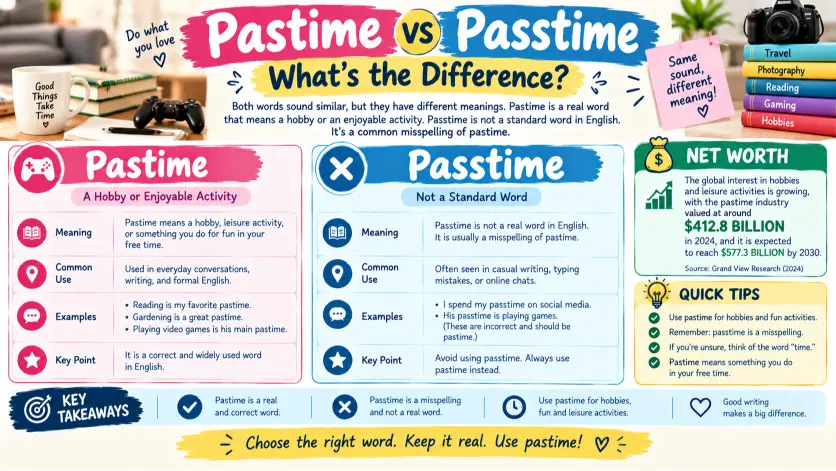
Have you ever stopped while writing and wondered whether the correct word is pastime or passtime? You are not alone. This spelling confusion is common because the word sounds as though it could contain the word “pass.” However, only one spelling is accepted in standard English, and knowing the difference can help you avoid an embarrassing mistake in emails, essays, articles, and everyday writing.
The correct spelling is pastime, meaning an activity you enjoy doing during your free time. Reading, gardening, painting, playing sports, or listening to music can all be described as pastimes. The spelling passtime is a common misspelling and should generally be avoided in formal and professional English.
In this guide, we will explain the meaning, origin, pronunciation, grammar, and correct usage of pastime, with clear examples to make the distinction easy to remember. Whether you are a student, writer, professional, or simply improving your English, this explanation will give you a reliable answer you can use confidently.
Pastime or Passtime: What’s the Difference?
First, pastime is the standard English noun for an enjoyable activity pursued during leisure. For example, reading, gardening, painting, fishing, or playing chess can all be described as pastimes.
By contrast, passtime is generally considered a misspelling rather than an accepted alternative. Although its appearance seems understandable because people often say they are “passing time,” the noun has a different established spelling.
Furthermore, pastime has been used in English for centuries. Therefore, dictionaries and established writing conventions recognize it as the correct form. Meanwhile, passtime can appear in informal online writing, but that visibility doesn’t make it standard.
Quick Recap
Therefore, pastime is the correct spelling.
Meanwhile, passtime is normally a spelling mistake.
Although both forms may be understood, only one belongs in standard English.
Consequently, choose pastime whenever you mean a leisure activity.
Is Pastime or Passtime a Grammar, Vocabulary, or Usage Issue?
Primarily, this is a spelling and vocabulary issue, although usage also matters. The confusion doesn’t usually involve sentence structure because the problem occurs before grammar enters the picture.
For example, someone might write, “Cooking is my favorite passtime.” The sentence structure is perfectly understandable. However, the noun itself has been spelled incorrectly. Therefore, correcting the word to “pastime” fixes the problem.
Moreover, pastime isn’t interchangeable with passtime in standard English. Since the latter isn’t the accepted spelling, treating both forms as equal creates unnecessary uncertainty.
In casual communication, readers may understand “passtime” immediately. Nevertheless, formal contexts require greater precision. Therefore, school assignments, applications, reports, professional profiles, published articles, and business documents should use pastime.
Likewise, academic writing may discuss leisure behavior, recreational interests, cultural activities, or hobbies. In each situation, pastime remains the established noun.
However, everyday speech doesn’t normally reveal the spelling difference because the two forms can sound similar. Consequently, the confusion often appears when someone moves from conversation to writing.
What Does Pastime Mean?
Generally, pastime is a noun describing an activity that a person enjoys doing during free time. It can be something relaxing, creative, physical, social, intellectual, or simply entertaining.
For instance, a person might spend Saturday afternoon gardening. Therefore, gardening could be that person’s favorite pastime.
Similarly, another individual might enjoy crossword puzzles after work. In that case, solving puzzles is a leisure pursuit and can accurately be called a pastime.
Importantly, a pastime doesn’t have to be productive. Reading a serious book can qualify, but watching a comedy series can also qualify. Likewise, collecting stamps, walking, cooking, drawing, playing music, and fishing can all function as pastimes.
Furthermore, the word often carries a positive or neutral sense. It describes something people choose to do for enjoyment rather than something they must complete as part of their responsibilities.
Workplace Example
For example, an employee might write, “My favorite pastime is hiking because it helps me relax after a busy week.”
Consequently, the sentence works naturally in a professional introduction, employee profile, or personal statement.
Academic Example
Similarly, a researcher might write, “Reading remains a popular pastime among university students.”
As a result, the term can comfortably appear in educational discussions about leisure, culture, or behavior.
Technology Example
Likewise, technology has created new forms of leisure. Someone might say, “Playing strategy games online has become a popular pastime.”
Therefore, digital gaming, photography, streaming entertainment, and creative software projects may all be discussed as modern pastimes, depending on context.
Usage Recap
Overall, pastime refers to an enjoyable activity pursued during leisure.
Therefore, use it when describing hobbies or recreational interests.
Meanwhile, don’t replace it with the visually tempting spelling “passtime.”
What Does Passtime Mean?
Strictly speaking, passtime isn’t the standard noun used in contemporary English for a leisure activity. Instead, it is usually a mistaken spelling of pastime.
However, the error is understandable. People frequently use the verb phrase “pass time,” meaning to occupy a period while waiting or while having nothing specific to do. Consequently, the visual similarity between “pass time” and “pastime” can lead writers toward the incorrect form “passtime.”
For example, a person might say, “I read magazines to pass time at the airport.” Here, pass time consists of two words and functions as a verb phrase.
By comparison, “Reading is my favorite pastime” contains one noun. Therefore, the spelling and grammatical function are different.
Workplace Example
For instance, “I listen to podcasts to pass time during my commute” uses the verb phrase correctly.
However, “Podcasts are my favorite pastime” uses the noun correctly.
Academic Example
Similarly, an academic writer might explain that travelers use entertainment to pass time during long journeys. Yet the writer could also describe listening to music as a common pastime.
Consequently, both expressions can appear in one discussion, but they perform different grammatical jobs.
Technology Example
Likewise, someone can use a mobile game to pass time while waiting for an appointment. Alternatively, mobile gaming may become a regular pastime.
Therefore, the context determines whether you need a verb phrase or a noun.
Usage Recap
In short, passtime should normally be corrected to pastime.
Meanwhile, pass time is a legitimate two word verb phrase.
Therefore, don’t confuse the established noun with the separate expression.
When You Should NOT Use Pastime or Passtime
Although pastime is correct, it isn’t suitable for every situation. Therefore, choosing the right expression requires attention to meaning.
- Don’t use pastime when describing a required duty.
For example, completing a mandatory workplace report isn’t normally a pastime because it isn’t performed for leisure. - Don’t use pastime when you mean pass time.
For instance, “I watched television to pass time” describes occupying a period rather than naming a hobby. - Don’t use passtime in formal writing.
Since it isn’t the standard spelling, it can make otherwise polished content appear careless. - Don’t use pastime as a synonym for every activity.
A job, responsibility, appointment, or obligation isn’t automatically a pastime. - Don’t write pass time as one word when using the verb phrase.
For example, “We played cards to pass time” requires two words. - Don’t choose passtime merely because it resembles pass time.
English spelling doesn’t always follow modern visual logic. - Don’t assume pronunciation determines spelling.
Similar pronunciation doesn’t mean two written forms are equally acceptable. - Don’t substitute pastime for hobby in every sentence.
The words overlap, but “pastime” often emphasizes leisure activity rather than personal identity or long term interest.
Common Mistakes: Pastime or Passtime
The following examples show how the confusion usually appears in real writing.
Decision Rule Box
If you mean an enjoyable leisure activity, use “pastime.”
If you mean occupying time while waiting or doing something else, use “pass time.”
If you see “passtime” being used for a leisure activity, replace it with “pastime.”
Pastime and Pass Time: The Important Distinction
At this point, the easiest way to understand the issue is to compare pastime with pass time, rather than treating “passtime” as a genuine competing word.
A pastime is a thing or activity. Therefore, it functions as a noun.
To pass time means to occupy time. Consequently, it functions as a verb phrase.
For example, “Painting is a relaxing pastime” identifies the activity itself. Conversely, “I paint to pass time” explains why someone performs an activity at a particular moment.
Furthermore, one person can use both expressions naturally. A traveler may have reading as a regular pastime while reading a magazine to pass time during a delayed flight.
Therefore, understanding the grammatical distinction makes the spelling choice much easier.
Pastime or Passtime in Modern Technology and AI Tools
Modern technology has changed the kinds of activities people enjoy during leisure. Nevertheless, the spelling of pastime hasn’t changed.
For example, digital photography, online gaming, video editing, music production, virtual communities, and creative writing can all become pastimes.
Meanwhile, people may use digital tools to pass time while commuting, waiting in a queue, or sitting in a reception area. Thus, the two concepts remain useful even though modern leisure looks different from traditional hobbies.
Importantly, new technology doesn’t make “passtime” a newly accepted spelling. Instead, contemporary communication still follows the established form pastime.
Therefore, whether someone enjoys reading printed books or creating digital artwork, the noun remains unchanged.
Why Is Pastime Spelled Without a Double S?
Historically, pastime developed as a compound involving the idea of passing time pleasantly. Over time, English spelling conventions settled on the single word pastime.
Consequently, modern writers shouldn’t reconstruct the spelling based only on the phrase “pass time.”
This distinction is important because English contains many words whose modern spelling cannot always be predicted from their component meanings. Therefore, recognizing established vocabulary is often more reliable than creating a spelling that seems logically obvious.
Expert Style Note
“When a familiar phrase and an established noun look similar, check the grammatical role before choosing the spelling.”
This principle is particularly useful here because pass time and pastime are related in meaning, yet they operate differently within a sentence.
Two Practical Case Studies
Case Study One: Student Assignment
Consider a university student writing about weekend activities. The first draft says, “My favorite passtime is reading historical novels.”
Because the student is identifying a leisure activity, the correct form is “pastime.” After correction, the sentence becomes clearer and conforms to standard written English.
Suppose the student reviews 20 similar vocabulary choices before submission. If even five involve commonly confused forms, a short proofreading routine can prevent multiple avoidable errors.
Therefore, this example demonstrates how a small spelling distinction can affect the overall polish of academic work.
Case Study Two: Professional Profile
Now consider a professional biography stating, “Photography is my favorite passtime.”
Although readers will understand the intended meaning, the unusual spelling can distract from the person’s expertise. After changing it to “pastime,” the sentence becomes conventional and immediately recognizable.
Suppose the profile receives 1,000 monthly views. Even without changing its substance, correcting obvious language errors can make the presentation appear more carefully edited.
Therefore, accurate word choice contributes to credibility, especially when a short profile represents someone’s professional identity.
Error Prevention Checklist
Use the following checklist whenever you’re uncertain about this spelling.
Always Use Pastime When
You mean a hobby or leisure activity.
You are naming something someone enjoys during free time.
You are writing an academic assignment.
You are preparing a professional profile.
You are creating published content.
You are describing recreational behavior.
You need the noun for an enjoyable activity.
Never Use Passtime When
You mean a leisure activity.
You are writing formally.
You are submitting school or university work.
You are preparing business communication.
You are editing professional content.
You are describing someone’s hobby.
You want the standard English spelling.
Instead, use pastime.
Use Pass Time When
You mean to occupy a period.
You are describing something done while waiting.
You are using the expression as a verb phrase.
For example, “I listened to music to pass time.”
Related Grammar Confusions You Should Master
Once you understand pastime or passtime, several other commonly confused expressions become easier to recognize.
- Everyday or every day: one describes something ordinary, while the other refers to each day.
- Alot or a lot: “a lot” is the standard form.
- Advice or advise: one is a noun, while the other is a verb.
- Affect or effect: these words usually perform different grammatical roles.
- Fewer or less: usage depends on whether the noun is countable.
- Then or than: one commonly relates to time or sequence, while the other marks comparison.
- Your or you’re: possession and contraction require different forms.
- Its or it’s: one shows possession, while the other is a contraction.
- Compliment or complement: their meanings differ despite similar pronunciation.
- Principal or principle: one commonly identifies a person or main element, while the other describes a rule or belief.
Therefore, mastering these distinctions can significantly improve everyday written communication.
Frequently Asked Questions
Is pastime or passtime correct?
Pastime is correct. It is the standard noun for an activity someone enjoys during free time. Conversely, “passtime” is generally a misspelling and shouldn’t be used in formal or carefully edited writing.
Is pastime one word or two words?
Pastime is one word. Therefore, write “Reading is my favorite pastime,” rather than separating the word into two parts.
Why do people spell pastime as passtime?
People often make this mistake because pastime is associated with the phrase “pass time.” Consequently, writers may incorrectly combine the verb phrase and add a second s.
Is passtime a real English word?
In standard contemporary English, passtime isn’t the accepted spelling for the noun meaning a leisure activity. Therefore, writers should use pastime instead.
What is the difference between pastime and pass time?
A pastime is an enjoyable activity, while pass time is a verb phrase meaning to occupy a period. Therefore, “Chess is my pastime” and “I play chess to pass time” have different grammatical functions.
Can a hobby be called a pastime?
Yes. A hobby can be described as a pastime when it is an activity enjoyed during leisure. However, the words aren’t identical in every context because “hobby” can suggest a more regular or developed personal interest.
Is pastime formal or informal?
Pastime is a standard neutral noun. Therefore, it can appear in casual conversation, professional writing, educational material, journalism, and other formal contexts.
How do you remember the spelling of pastime?
A useful method is to remember that the noun is pastime, while the verb phrase is pass time. Consequently, avoid creating “passtime” as a hybrid spelling.
What is another word for pastime?
Depending on context, alternatives include hobby, recreation, leisure activity, diversion, amusement, and recreational pursuit. However, each alternative has slightly different shades of meaning.
Is pastime still commonly used?
Yes. Pastime remains a familiar standard English noun, especially when discussing hobbies, recreation, leisure, cultural activities, and personal interests.
Final Verdict
Ultimately, pastime is the correct spelling when you mean an enjoyable activity pursued during free time. Therefore, “Reading is my favorite pastime” is correct, while “Reading is my favorite passtime” should be corrected.
Meanwhile, pass time is a separate two word expression. It means to occupy a period, particularly while waiting or looking for something to do.
Consequently, the easiest rule is simple: pastime is the noun, while pass time is the verb phrase. Although “passtime” may look logical, standard English doesn’t treat it as the preferred spelling. Therefore, whenever you’re writing an assignment, profile, article, email, application, or professional document, choose pastime confidently.









