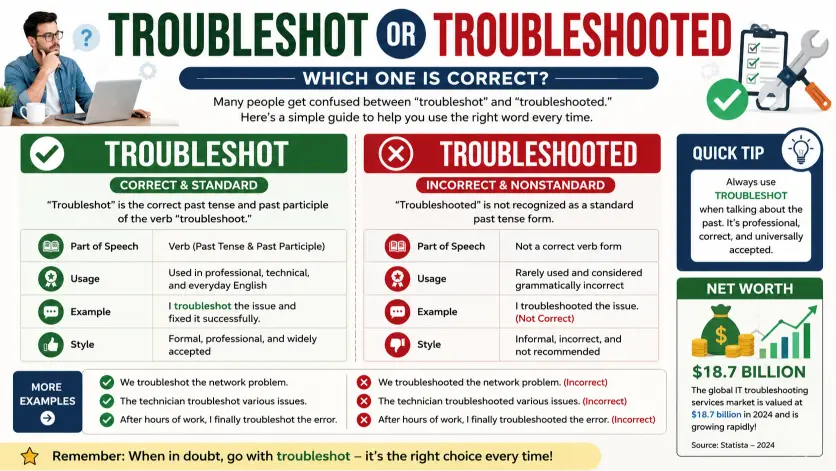
Have you ever written “troubleshooted” and then stopped to wonder whether it actually sounds correct? You are not alone. The past tense of troubleshoot can be confusing because, unlike many regular English verbs, it does not simply take -ed. The correct past-tense form is generally “troubleshot,” while troubleshoot means to identify, investigate, and solve a problem, especially with technology, equipment, or a system. For example, you might say, “The technician troubleshot the network issue yesterday.” Understanding this small but important distinction can help you write more naturally and avoid an awkward or incorrect verb form.
In this guide, we’ll clearly explain troubleshot vs. troubleshooted, including their meanings, grammar rules, pronunciation, and practical examples. We’ll also look at how the word is used in professional, technical, and everyday English so you can confidently choose the right form. Whether you are writing an email, report, technical document, or casual message, this guide will help you use troubleshot correctly and communicate with greater accuracy.
Ttroubleshot or Troubleshooted: What’s the Difference?
The difference is primarily a matter of verb formation and standard English usage. The verb troubleshoot means to investigate a problem systematically and identify its cause or solution.
Its accepted past tense is troubleshot.
The form troubleshooted sometimes appears in informal writing, workplace conversations, online forums, and technical discussions. However, it isn’t the standard past form recommended for polished English.
| Form | Part of Speech | Standard Usage | Example |
| Troubleshoot | Verb | Correct base form | I troubleshoot network problems. |
| Troubleshot | Verb | Correct past tense | I troubleshot the server yesterday. |
| Troubleshot | Verb | Correct past participle | We have troubleshot similar issues before. |
| Troubleshooted | Verb | Generally nonstandard | I troubleshooted the computer yesterday. |
The easiest point to remember is that troubleshoot behaves like an irregular verb.
You don’t normally say “I shooted the ball yesterday.” You say “I shot the ball.”
Likewise, you don’t normally say “I troubleshooted the system.” You say “I troubleshot the system.”
Quick Recap
Troubleshoot is the present form.
Troubleshot is the standard past tense.
Troubleshot is also the standard past participle.
Troubleshooted is generally considered nonstandard in careful English.
Is Ttroubleshot vs Troubleshooted a Grammar, Vocabulary, or Usage Issue?
The confusion is mainly a grammar and usage issue, rather than a vocabulary problem.
Both forms are understandable because English speakers naturally recognize “troubleshoot” as a verb. The confusion occurs because many verbs form their past tense by adding “ed.” For example, “worked” comes from “work,” and “fixed” comes from “fix.”
That pattern doesn’t apply to every English verb.
Troubleshoot follows the irregular pattern associated with shoot. The historical structure of the word matters because “troubleshoot” is essentially a combination of “trouble” and “shoot.” Its past form follows “shoot,” giving us troubleshot.
In formal writing, academic assignments, technical documentation, resumes, business reports, and professional emails, troubleshot is the safer and standard choice.
In casual conversation, you may occasionally hear “troubleshooted.” People usually understand what the speaker means, but familiarity doesn’t automatically make a form standard.
Formal vs Informal Usage
In formal English:
The engineer troubleshot the network failure.
In casual workplace speech, someone might say:
I troubleshooted that issue earlier.
The second sentence may be understood, but the first is preferable when accuracy and professional credibility matter.
Academic vs Casual Usage
Academic writing generally favors established grammatical forms. If you’re describing a researcher’s technical work, “troubleshot” is appropriate.
Casual digital communication is more flexible. People often create regular forms for irregular verbs because they sound logical. That doesn’t mean those forms belong in polished writing.
How to Use Troubleshot Correctly
Troubleshot is the past tense and past participle form you should use when describing completed troubleshooting work.
It works naturally in technical, professional, academic, and everyday contexts.
Workplace Example
Correct:
The IT specialist troubleshot the connection problem before the meeting.
Here, the troubleshooting happened in the past, so troubleshot is correct.
Another example is:
Our technician troubleshot the printer and restored normal operation.
This sentence clearly describes a completed action.
Academic Example
Correct:
The students troubleshot several equipment failures during the experiment.
Academic writing benefits from precise verb forms. Since the troubleshooting happened during a completed experiment, “troubleshot” correctly expresses the past action.
Technology Example
Correct:
I troubleshot the software installation problem and identified a compatibility issue.
This is particularly common in technical writing because troubleshooting is frequently discussed as a completed task.
Usage Recap
Use troubleshot for a troubleshooting action that happened in the past.
Use it in resumes, reports, assignments, emails, documentation, and professional communication.
If you are describing a completed technical task, troubleshot is almost always the form you want.
How to Use Troubleshooted Correctly
The important point is that troubleshooted is generally not the preferred standard form.
You may encounter it because English speakers sometimes apply the regular past tense pattern to unfamiliar or compound verbs. Since “troubleshoot” looks like an ordinary modern compound verb, adding “ed” can feel natural.
For example, someone may instinctively write:
I troubleshooted the database problem.
The intended meaning is clear, but standard edited English would normally change this to:
I troubleshot the database problem.
Workplace Example
Instead of:
I troubleshooted five customer issues this morning.
Use:
I troubleshot five customer issues this morning.
Academic Example
Instead of:
The researchers troubleshooted the equipment failure.
Use:
The researchers troubleshot the equipment failure.
Technology Example
Instead of:
The developer troubleshooted the application error.
Use:
The developer troubleshot the application error.
Usage Recap
“Troubleshooted” can be understood, but it is not the standard choice.
Avoid it in polished professional and academic writing.
When you need the past form of “troubleshoot,” choose troubleshot.
When You Should NOT Use Troubleshot or Troubleshooted
Knowing when a word should not be used is just as useful as knowing its correct form.
1. Don’t use troubleshot for a present action
Incorrect:
She troubleshot the system every morning.
If the action is a regular present activity, use “troubleshoot”:
She troubleshoots the system every morning.
2. Don’t use troubleshot when the sentence requires the base verb
After modal verbs such as “can,” “will,” “should,” and “must,” use the base form.
Correct:
We can troubleshoot the problem tomorrow.
Not:
We can troubleshot the problem tomorrow.
3. Don’t use troubleshooted as a polished past form
Avoid:
The technician troubleshooted the server.
Prefer:
The technician troubleshot the server.
4. Don’t confuse troubleshoot with repair
Troubleshooting means investigating a problem to determine its cause or solution. It doesn’t necessarily mean that the problem was completely repaired.
Someone can troubleshoot an issue without successfully fixing it.
5. Don’t use the past form after “to”
Correct:
The team needs to troubleshoot the issue.
Not:
The team needs to troubleshot the issue.
6. Don’t use troubleshot for a person
A person is a troubleshooter, not a troubleshot.
Correct:
She is an experienced troubleshooter.
7. Don’t treat every verb as a regular “ed” verb
English contains many irregular verbs. Their past forms need to be learned individually.
8. Don’t choose a form simply because it sounds logical
“Troubleshooted” may seem logical because “fixed” and “tested” are regular forms. Standard English doesn’t always follow the simplest pattern.
Common Mistakes and Decision Rules
The most common error is treating “troubleshoot” as though it were a regular verb.
| Correct sentence | Incorrect sentence | Explanation |
| I troubleshot the computer. | I troubleshooted the computer. | The standard past form is troubleshot. |
| She troubleshoots network problems. | She troubleshot network problems every day. | Present habitual action needs troubleshoots. |
| We will troubleshoot the error. | We will troubleshot the error. | A modal or future construction takes the base form. |
| They have troubleshot the system. | They have troubleshooted the system. | The standard past participle is troubleshot. |
| He needs to troubleshoot the issue. | He needs to troubleshot the issue. | The infinitive requires troubleshoot. |
| She is a troubleshooter. | She is a troubleshot. | Troubleshooter refers to a person who solves problems. |
Decision Rule Box
If you mean the completed troubleshooting action, use “troubleshot.”
If you mean the person who investigates problems, use “troubleshooter.”
If you mean the present action, use “troubleshoot” or “troubleshoots,” depending on the subject.
If you mean an action that will happen later, use “will troubleshoot.”
Ttroubleshot or Troubleshooted in Modern Technology and Tools
The word “troubleshoot” is especially common in modern technology because software, networks, devices, applications, and artificial intelligence systems can all experience technical problems.
Technology documentation frequently describes troubleshooting as a systematic process. A support engineer might troubleshoot an authentication failure, while a developer might troubleshoot a software bug.
Modern tools also use troubleshooting language when helping users diagnose problems. For example, an AI assistant may explain how to troubleshoot a connection issue, identify likely causes, or suggest diagnostic steps.
The grammatical rule hasn’t changed because technology has changed.
Whether you’re discussing a laptop from years ago, a cloud application, or an AI powered system, the standard past form remains troubleshot.
Examples include:
The engineer troubleshot the API failure.
The support team troubleshot the login issue.
The developer has troubleshot similar bugs before.
This makes correct verb usage especially valuable for technical professionals whose resumes and documentation are read by other specialists.
Why Is Troubleshot the Correct Past Form?
The reason becomes clearer when you look at the structure of the word.
“Troubleshoot” contains “shoot,” which is an irregular verb.
The verb “shoot” has the forms:
shoot
shot
shot
Because “troubleshoot” follows this irregular pattern, its standard forms are:
troubleshoot
troubleshot
troubleshot
This is similar to other compound verbs that retain the irregular behavior of their original verbs.
The presence of “trouble” before “shoot” doesn’t turn the entire verb into a regular verb.
This is why “troubleshooted” sounds plausible but isn’t the preferred standard form.
A Useful Memory Trick
Think of the word as:
trouble + shoot
Then remember:
shoot → shot
Therefore:
troubleshoot → troubleshot
That simple connection makes the correct form much easier to remember.
Expert View on the Correct Form
A useful grammar principle is that compound verbs can retain the irregular forms of their underlying verbs.
In practical terms, writers shouldn’t assume that every newly encountered verb forms its past tense with “ed.”
The established standard form matters more than what seems mechanically logical.
As a practical editorial rule:
When a compound verb contains an irregular verb, check whether the compound retains that irregular pattern before creating a regular past form.
This principle helps explain why troubleshot is preferable to “troubleshooted.”
Two Practical Case Studies
Case Study 1: Technical Resume
Imagine a software support specialist writing a resume.
Original:
Troubleshooted recurring database connection errors for enterprise clients.
The meaning is understandable, but the verb choice can make the sentence look less polished.
Improved:
Troubleshot recurring database connection errors for enterprise clients.
The correction changes only one word, but it makes the accomplishment align with standard professional English.
Case Study 2: Technical Documentation
Consider an internal support report:
The technician troubleshooted the authentication failure and restarted the service.
A polished version would be:
The technician troubleshot the authentication failure and restarted the service.
The result is clearer and grammatically standard, while the technical meaning remains unchanged.
These examples demonstrate an important writing lesson: small grammatical choices can influence how professional technical communication appears to readers.
Error Prevention Checklist
Always Use Troubleshot When
☐ You are describing a completed troubleshooting action.
☐ You are writing a professional report.
☐ You are describing technical work on a resume.
☐ You are writing an academic assignment.
☐ You are using the present perfect construction with “have,” “has,” or “had.”
☐ You want the standard past form of troubleshoot.
Never Use Troubleshooted When
☐ You are writing formal professional English.
☐ You are preparing technical documentation.
☐ You are writing an academic paper.
☐ You are describing completed troubleshooting work on a resume.
☐ You want to use the accepted standard past tense.
☐ You are editing content for grammatical accuracy.
Related Grammar Confusions You Should Master
Learning “troubleshot” is useful, but English contains many similar verb form questions. Understanding these patterns can make your writing considerably more accurate.
Here are several related confusions worth mastering:
- Passed vs past
- Lay vs lie
- Rise vs raise
- Led vs lead
- Advice vs advise
- Affect vs effect
- Who vs whom
- Learned vs learnt
- Dreamed vs dreamt
- Proved vs proven
These examples show why English grammar cannot always be mastered by applying one simple rule to every verb.
Advanced FAQs
Is troubleshot the correct past tense of troubleshoot?
Yes. Troubleshot is the standard past tense of “troubleshoot.” For example, “The technician troubleshot the network problem yesterday.”
Is troubleshooted grammatically correct?
“Troubleshooted” is generally considered nonstandard in careful English. Although readers can understand it, troubleshot is the established form and is recommended for formal, academic, technical, and professional writing.
What is the past participle of troubleshoot?
The standard past participle is troubleshot. For example, “The team has troubleshot several similar issues.”
Can I say I troubleshot the computer?
Yes. “I troubleshot the computer” is grammatically correct when you mean that you investigated a computer problem in the past.
Should I use troubleshoot or troubleshot after will?
Use troubleshoot after “will.”
Correct:
I will troubleshoot the problem tomorrow.
Not:
I will troubleshot the problem tomorrow.
Should I say troubleshot or troubleshooted on a resume?
Use troubleshot on a resume. It is the standard past form and gives the sentence a more polished professional appearance.
For example:
Troubleshot network connectivity issues for remote employees.
Is troubleshoot an irregular verb?
Yes. Its past form follows the irregular pattern associated with “shoot.”
The basic forms are:
troubleshoot, troubleshot, troubleshot
What is the noun for a person who troubleshoots?
The standard noun is troubleshooter.
For example:
She is an experienced technical troubleshooter.
Why do people say troubleshooted?
People often create “troubleshooted” by applying the regular English past tense rule of adding “ed.” Because “troubleshoot” is a modern compound verb, the regular form may sound natural to some speakers. However, standard usage favors troubleshot.
Is troubleshot used in both American and British English?
Yes. Troubleshot is recognized in both major varieties of standard English. Regional preferences can affect some vocabulary and grammatical forms, but “troubleshot” is the established form for the past tense and past participle of “troubleshoot.”
Final Answer
When deciding between troubleshot or troubleshooted, remember that the underlying verb is troubleshoot, and its standard past form is troubleshot. The form “troubleshooted” may appear in informal communication, but it isn’t the preferred choice in standard edited English.
Use troubleshoot for the base form, troubleshoots for third person singular present tense, and troubleshot for both the standard past tense and past participle.
The easiest memory trick is simple:
shoot → shot
Therefore:
troubleshoot → troubleshot
If you’re writing a resume, report, academic assignment, technical document, or professional email, choose troubleshot.









