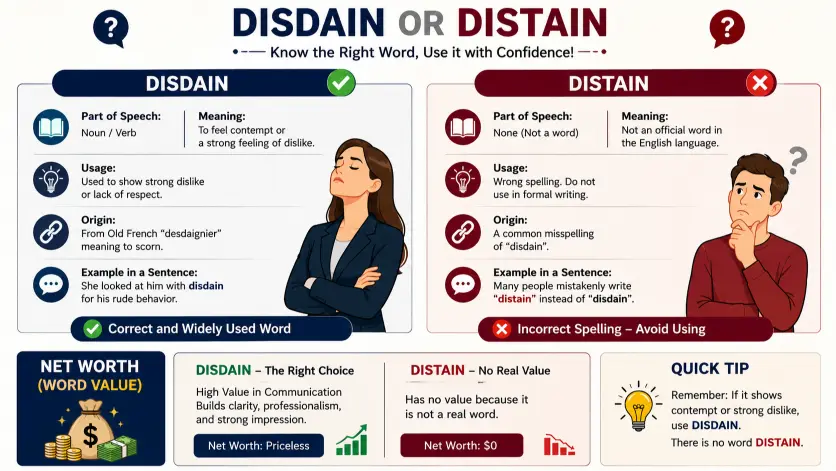
Have you ever typed “disdain or disdain” into Google because you were unsure which spelling was correct? You are not alone. These two words look almost identical, but only one is the standard English word used to describe a strong feeling of dislike, disrespect, or contempt. The confusion often comes from pronunciation, where the spelling can be difficult to remember.
If you are writing an email, school assignment, article, or professional document, choosing the correct form matters because even a small spelling mistake can affect clarity and credibility. In this guide, we’ll clearly explain whether “disdain” or “distain” is correct, what each word means, how they differ, and how to use them naturally in sentences. You’ll also see practical examples, related words, pronunciation tips, and an easy memory trick to help you remember the correct spelling.
Whether you are a student, writer, English learner, or simply trying to improve your vocabulary, this straightforward explanation will help you use the word with confidence.
Disdain or Distain: What’s the Difference?
Disdain is primarily used as both a noun and a verb.
As a noun, disdain means a strong feeling that someone or something is unworthy of respect or consideration.
Example:
She looked at the dishonest proposal with disdain.
Here, disdain describes her feeling of contempt toward the proposal.
As a verb, disdain means to consider something unworthy, beneath one’s dignity, or not worth doing.
Example:
He disdained to respond to the insulting comment.
Disdain is a much rarer word. Historically, it has been associated with staining, discoloring, tarnishing, or disgracing something. In modern standard English, however, it is seldom used outside historical, literary, or specialized discussions.
| Feature | Disdain | Distain |
| Part of speech | Noun and verb | Rare verb |
| Modern frequency | Common | Very rare |
| Main meaning | Contempt, disrespect, or treating something as unworthy | To stain, tarnish, discolor, or disgrace |
| Everyday usage | Yes | Generally no |
| Formal writing | Yes | Usually avoided unless historically relevant |
| Example | She showed disdain for the unfair decision. | The archaic text uses the word to mean tarnish. |
Mini Recap
Disdain is the standard modern word for contempt or strong disrespect.
Disdain is rare and historically connected with staining or tarnishing.
If you’re talking about attitude, disrespect, or contempt, choose disdain.
For almost every ordinary modern English sentence, disdain is not the word you want.
Is Disdain or Distain a Grammar, Vocabulary, or Usage Issue?
The confusion is primarily a vocabulary and spelling issue, rather than a grammar rule.
Grammar determines how words function within sentences. Vocabulary determines which word carries the intended meaning. Usage determines whether that word is appropriate in a particular context.
Disdain is fully established in modern English and appears in everyday, professional, academic, and literary writing. It can be used as a noun or verb.
Disdain is different. Although dictionaries and historical sources may record the word, its modern usage is extremely limited. It may appear in older literature or discussions of historical language, but using it as an alternative spelling of disdain is normally incorrect.
The two words are therefore not interchangeable.
In academic writing, professional correspondence, essays, reports, and general digital communication, disdain should almost always be selected when the intended meaning involves contempt or disrespect.
A useful practical rule is simple: if you’re describing an attitude of looking down on someone or something, write disdain.
How to Use Disdain Correctly
Disdain is the word you’ll encounter most often in contemporary English. It can express an emotional attitude, a judgment, or an intentional refusal to treat something as worthy.
Workplace Example
The manager showed disdain for employees who questioned the new policy.
Here, disdain describes an attitude of contempt or disrespect.
Another example is:
She spoke about the outdated process with obvious disdain.
The word works naturally in workplace communication when describing a dismissive attitude.
Academic Example
The author expresses disdain for social traditions that discourage independent thought.
This usage is suitable for an essay because it identifies an attitude of contempt or strong disapproval.
Technology Example
Some users express disdain for software that collects excessive personal data.
Again, the word describes a negative attitude toward something perceived as undesirable.
Usage Recap
Use disdain when you mean contempt, disrespect, or a feeling that someone or something is beneath consideration.
It works as both a noun and a verb and is appropriate in modern formal and informal English.
How to Use Disdain Correctly
Disdain requires considerably more caution.
In historical English, the word has been used in connection with staining, discoloring, tarnishing, or disgracing. Because modern readers rarely encounter it, using it in ordinary communication can create confusion.
Workplace Example
In contemporary workplace writing, you would almost never need disdain. If you mean that someone’s reputation was damaged, words such as tarnish, damage, or disgrace are usually clearer.
Academic Example
A literature student may encounter disdain while studying older English texts. In that situation, retaining the original spelling may be appropriate when discussing the historical language.
Technology Example
Modern technology writing generally has no reason to use disdain. If you’re describing damaged data, corrupted information, or a stained image, choose a more precise contemporary term such as corrupt, distort, stain, or tarnish, depending on the meaning.
Usage Recap
Distain is not the normal spelling of disdain.
Use it only when the historical or specialized meaning genuinely requires it. In ordinary modern writing, replacing it with a clearer contemporary word is usually better.
When You Should NOT Use Disdain or Distain
Knowing when not to use a word can be just as valuable as knowing its definition.
1. Don’t use disdain when you mean contempt
Incorrect:
She looked at him with disdain.
Correct:
She looked at him with disdain.
2. Don’t use disdain when you mean physical staining
If you’re talking about paint, fabric, ink, or discoloration, disdain is completely inappropriate.
Instead, use stain, discolor, or another precise term.
3. Don’t treat disdain as a spelling variant in ordinary writing
Although historical forms can explain why the spelling exists, that doesn’t make distain an acceptable everyday substitute for disdain.
4. Don’t use disdain simply to mean dislike
Disdain usually carries a stronger sense of contempt or perceived superiority.
Someone can dislike a movie without feeling disdain for it.
5. Don’t use disdain when you mean disagreement
Disagreeing with an opinion doesn’t automatically involve contempt.
6. Don’t use archaic vocabulary merely to sound sophisticated
Rare words can make writing less clear rather than more impressive.
7. Don’t use disdain when the intended meaning is embarrassment
Disdain concerns contempt or unworthiness, not simply feeling embarrassed.
8. Don’t assume similar spelling means identical meaning
English contains many pairs that look alike but behave differently. Context should determine word choice.
Common Mistakes With Disdain or Distain
| Correct sentence | Incorrect sentence | Explanation |
| She spoke with disdain. | She spoke with disdain. | Contempt requires disdain. |
| He has disdain for dishonesty. | He has disdain for dishonesty. | Disdain is not the normal word for contempt. |
| The critic treated the idea with disdain. | The critic treated the idea with disdain. | The sentence describes contempt. |
| The fabric was stained with ink. | The fabric was disdained with ink. | Physical marking requires stain, not disdain. |
| She disdained the suggestion. | She disdained the suggestion. | Disdained means to regard it as unworthy. |
| His disdain was obvious. | His disdain was obvious. | The noun meaning contempt is disdain. |
Decision Rule Box
If you mean contempt, disrespect, or treating something as beneath consideration, use DISDAIN.
If you mean staining, tarnishing, or an archaic historical sense, DISTAIN may appear, but modern writing usually favors a clearer contemporary word.
For everyday English, disdain is the safe and correct choice.
Disdain or Disdain in Modern Technology
Modern technology has introduced an enormous amount of informal and professional writing, from software documentation to text, online discussions, workplace messages, and search queries.
That environment makes spelling distinctions especially important.
An automated writing system, spell checker, or predictive keyboard may recognize a rare word without understanding whether it fits the intended context. A technically valid dictionary entry doesn’t necessarily mean a word is appropriate for modern communication.
For example:
Users expressed disdain for the confusing interface.
This is natural modern English.
Replacing disdain with disdain would create an unusual sentence and potentially suggest that the writer intended the historical sense associated with staining or tarnishing.
When editing content, writers should therefore evaluate meaning and context, not simply accept a suggested spelling. A dictionary can tell you whether a word exists. Context determines whether it belongs in your sentence.
Etymology of Disdain or Distain
The history of these words helps explain why the spelling confusion exists.
Disdain entered English through Anglo French and Old French forms related to rejecting something as unworthy. Its deeper linguistic history connects with ideas of judging something as beneath one’s dignity or respect.
The word has retained this central concept for centuries. Modern meanings involving contempt, disrespect, and strong disapproval developed from that underlying idea of considering something unworthy.
Disdain has a different historical association. It has been connected with words relating to staining, marking, discoloring, or tarnishing. Historical vocabulary often contains spellings that resemble other words even though their meanings and origins differ.
This is one reason modern readers should be careful when encountering unusual spellings in older texts. A word that looks like a familiar modern term may have carried a different meaning in an earlier period.
An Editorial Principle
“The best word is the one that communicates the intended meaning clearly.”
That principle is especially useful with rare vocabulary. A historically valid word isn’t automatically the best modern word.
Two Practical Case Studies
Case Study 1: The Student Essay
Imagine a student writing:
The narrator views the corrupt officials with disdain.
The intended meaning is clearly contempt. Changing disdain to disdain immediately resolves the vocabulary error.
The practical result is greater precision, better academic credibility, and no ambiguity about the narrator’s attitude.
Case Study 2: Professional Content Editing
Consider a workplace article containing:
Customers have disdain for complicated payment systems.
The intended meaning is negative contempt or strong disapproval. Replacing disdain with disdain makes the sentence conform to standard contemporary usage.
In both cases, the correction doesn’t require rewriting the entire sentence. The key improvement comes from identifying the intended meaning before selecting the spelling.
These examples demonstrate a broader editing lesson: meaning should drive spelling, not visual similarity between words.
Error Prevention Checklist
Always use disdain when
☑ You mean contempt.
☑ You mean strong disrespect.
☑ You describe an attitude of looking down on someone.
☑ You mean that something is regarded as unworthy.
☑ You’re writing an essay, report, email, article, or general communication.
☑ You need the standard modern English word.
Never use disdain when
☒ You simply mean contempt.
☒ You mean disrespect.
☒ You are describing someone looking down on another person.
☒ You’re using it only because it looks similar to disdain.
☒ You want a modern synonym for contempt.
☒ You’re writing ordinary professional or academic English and have no historical reason for the unusual word.
Related Grammar Confusions You Should Master
Understanding disdain or disdain can lead to a wider study of commonly confused English words. These distinctions are particularly useful for students, professionals, editors, bloggers, and anyone trying to improve precise vocabulary.
Here are several related topics worth mastering:
- Affect or effect: Understand the difference between influence and result.
- Compliment or complement: Learn when praise differs from something that completes another thing.
- Discreet or discrete: Distinguish careful behavior from separate or distinct elements.
- Principal or principle: Separate a person or primary element from a fundamental rule.
- Stationary or stationery: Identify the difference between remaining still and writing materials.
- Advice or advise: Recognize the noun and verb forms.
- Accept or except: Distinguish receiving something from excluding something.
- Then or then: Use the correct word for comparison and sequence.
- Its or it’s: Separate possession from the contraction of it is.
- Your or you’re: Distinguish possession from the contraction of you are.
These pairs demonstrate an important truth about English: spelling alone isn’t enough. Meaning, grammatical role, pronunciation, history, and context all influence correct word choice.
Frequently Asked Questions
1. Is it disdain or distain?
Disdain is the correct standard English word when you mean strong dislike, disrespect, or contempt. Distain is generally considered a misspelling when used with this meaning.
2. What does disdain mean?
Disdain means a strong feeling that someone or something is unworthy of respect or consideration. It can also describe treating something with contempt.
3. Is distain a real word?
Yes, distain can appear as a rare or archaic word, particularly with meanings related to staining or discoloring. However, it is not the word you normally want when expressing contempt or disrespect.
4. How do you pronounce disdain?
Disdain is commonly pronounced “dis-DAYN.” The pronunciation can make the spelling confusing, especially for English learners.
5. What is an example of disdain?
An example is: “She looked at the dishonest behavior with disdain.” Here, disdain expresses strong disapproval or contempt.
6. What is the difference between disdain and distain?
The main difference is meaning and standard usage. Disdain is the common word meaning contempt or lack of respect, while distain is uncommon and has a different or historical sense.
7. Is disdain a noun or a verb?
Disdain can be both a noun and a verb. As a noun, it describes a feeling of contempt. As a verb, it means to consider someone or something unworthy or beneath your respect.
8. What are synonyms for disdain?
Common synonyms include contempt, scorn, disrespect, dislike, aversion, and derision, depending on the context.
9. How can I remember the spelling of disdain?
A simple trick is to remember “dis + dain” and associate disdain with disrespect or disapproval. If you mean contempt, choose disdain.
10. Which spelling should I use in formal writing?
For modern formal English, use disdain when you mean contempt, disrespect, or strong disapproval. It is the familiar and widely accepted spelling.
Conclusion
When you are choosing between disdain or distain, the answer is usually straightforward: use “disdain” when you mean contempt, disrespect, or strong disapproval. Although distain can be found in rare or historical usage, it is not the standard spelling for the meaning most people intend. Remembering this distinction can help you avoid an easy spelling mistake in emails, essays, articles, assignments, and everyday writing.
Disdain can work as both a noun and a verb, making it a useful word when you want to express a strong sense of contempt or lack of respect. If you are ever unsure, think of disdain as being connected with disapproval and contempt. With this simple memory trick and the examples above, you can confidently choose disdain the next time you wonder whether it is “disdain or distain.”









