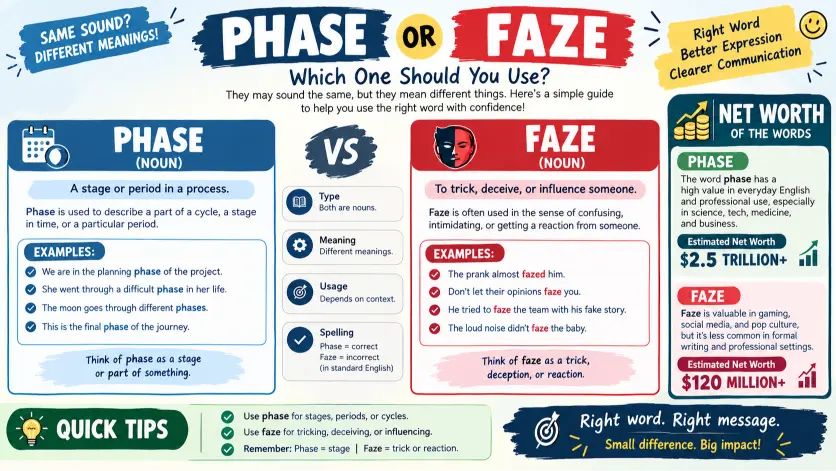
Confused about phase or faze? You are not alone. These two words look and sound similar, but they have completely different meanings and grammatical uses. Choosing the wrong one can easily change the meaning of your sentence.
Phase is generally used as a noun or verb when talking about a stage, period, or process, while faze is a verb meaning to disturb, worry, or unsettle someone. Understanding this simple distinction can make your writing clearer and help you avoid one of the most common English word-choice mistakes.
In this guide, we’ll break down phase vs. faze using clear definitions, practical examples, pronunciation tips, and easy memory tricks. Whether you’re a student, content writer, professional, or simply trying to improve your everyday English, you’ll learn exactly when to use each word. We’ll also explore common phrases such as “phase out” and “not fazed” so you can recognize these words confidently in real-world writing and conversation.
Phase or Faze: What Do These Words Mean?
The words phase and faze are commonly pronounced alike in English, but they have different spellings, meanings, and grammatical functions. Because they sound almost identical, writers often select the wrong word when writing quickly.
Phase is primarily used as a noun. It refers to a stage, period, or particular part of a process. A project can have a planning phase, development phase, testing phase, and final phase.
The word phase can also function as a verb. In expressions such as “phase in” and “phase out,” it describes introducing or removing something gradually.
Faze, on the other hand, is a verb. It means to disturb, unsettle, intimidate, embarrass, or bother someone. When you say that something “didn’t faze” a person, you mean that the situation did not make that person nervous or uncomfortable.
Consider these examples:
The company has entered a new phase of growth.
Here, phase means a stage.
The criticism didn’t faze her.
Here, faze means to disturb or discourage.
The pronunciation may cause confusion, but the meaning provides the best way to choose the correct spelling.
Phase vs Faze: What’s the Difference?
The simplest way to distinguish these words is to consider what the sentence is describing.
| Word | Part of Speech | Meaning | Common Context | Example |
|---|---|---|---|---|
| Phase | Noun | A stage, period, or part of a process | Projects, development, science, life | The project entered its final phase. |
| Phase | Verb | To introduce or remove something gradually | Business, technology, policy | The company will phase out the old system. |
| Faze | Verb | To disturb, unsettle, intimidate, or bother | Emotions and reactions | The criticism didn’t faze him. |
Quick Recap
• Phase means a stage, period, or part of a process.
• Faze means to disturb, unsettle, intimidate, or bother someone.
• Use phase when discussing development or stages.
• Use faze when discussing someone’s emotional reaction.
A helpful memory trick is simple: if you mean stage, choose phase. If you mean bother or unsettle, choose faze.
Is Phase vs Faze a Grammar, Vocabulary, or Usage Issue?
The confusion between phase or faze is mainly a vocabulary and usage issue. Grammar also plays a role because the words are used differently in sentences.
Phase is commonly a noun when it identifies a stage or period.
The project is entering a new phase.
It can also function as a verb.
The company will phase out the outdated equipment.
Faze is a verb describing a person’s reaction to something.
The difficult question didn’t faze the student.
The words aren’t interchangeable. Their similar pronunciation doesn’t make them synonyms.
In formal writing, academic assignments, business documents, articles, and professional communication, using the correct spelling is especially important. A spelling mistake involving phase and faze can make an otherwise polished sentence look careless.
In casual conversation, people may understand the intended meaning from context. However, written English requires greater precision.
How to Use Phase Correctly
Use phase when you’re talking about a stage, period, or part of a larger process.
The word appears frequently in business, education, science, technology, medicine, project management, and everyday descriptions of life.
Workplace Example
The company has entered a new phase of expansion.
The sentence describes a stage in the company’s growth.
Another natural example is:
The planning phase will continue until Friday.
The planning period is one stage of the larger project.
Academic Example
The research entered its experimental phase after the initial review.
Academic writing frequently uses phase because research and experiments are often divided into distinct stages.
Technology Example
The software is currently in the testing phase.
Technology products often move through several stages before becoming fully available to users.
Common Expressions With Phase
• A phase of development
• A testing phase
• A planning phase
• A final phase
• A transitional phase
• A phase of life
• Phase in
• Phase out
Usage Recap
Use phase when the sentence refers to a stage, period, or step in a process.
You can also use it as a verb when something is introduced or removed gradually.
The company will phase in the new policy.
The manufacturer plans to phase out the older model.
How to Use Faze Correctly
Faze is used when something affects a person’s confidence, emotional state, or sense of calm.
It can mean to disturb, unsettle, intimidate, embarrass, or bother someone.
One of the most familiar expressions is:
It didn’t faze me.
This means:
It didn’t bother or intimidate me.
Workplace Example
The unexpected question didn’t faze the manager.
The manager remained calm even though the question was difficult.
Academic Example
The complicated examination didn’t faze the experienced student.
The student wasn’t intimidated by the challenging examination.
Technology Example
The developer wasn’t fazed by the sudden system error.
The developer stayed calm despite encountering a technical problem.
Common Expressions With Faze
• It didn’t faze me.
• Nothing seems to faze her.
• The criticism didn’t faze him.
• She wasn’t fazed by the pressure.
• The difficult situation failed to faze them.
Usage Recap
Use faze when something disturbs, unsettles, intimidates, or bothers someone.
If you can replace the word with bother, unsettle, or intimidate, faze is probably the correct choice.
When You Should NOT Use Phase or Faze
Understanding incorrect contexts can make the distinction much easier to remember.
Don’t Use Faze for a Stage
Incorrect:
The project has entered a new faze.
Correct:
The project has entered a new phase.
A project has stages, so phase is the appropriate word.
Don’t Use Phase for Emotional Disturbance
Incorrect:
The criticism didn’t phase him.
Correct:
The criticism didn’t faze him.
The sentence describes the person’s reaction, so faze is correct.
Don’t Use Faze When Discussing Research
Incorrect:
The study is in its final faze.
Correct:
The study is in its final phase.
A study can move through different stages.
Don’t Use Phase When Someone Remains Calm
Incorrect:
The difficult interview didn’t phase her.
Correct:
The difficult interview didn’t faze her.
The sentence is about emotional resilience.
Don’t Confuse Phased With Fazed
These forms look similar but have completely different meanings.
The company phased out the old equipment.
The employee wasn’t fazed by the change.
The first sentence describes a gradual process. The second describes a person’s reaction.
Don’t Choose the Spelling Based Only on Sound
Since the words sound alike, pronunciation cannot tell you which spelling to use.
Instead, identify the meaning first.
Don’t Assume Common Online Usage Is Always Correct
A spelling mistake can appear repeatedly on websites, social media, forums, and informal messages. Frequency doesn’t automatically make an incorrect spelling standard English.
Don’t Treat the Words as Interchangeable
Although phase and faze sound alike, their meanings are fundamentally different.
Common Mistakes and Decision Rules
| Correct Sentence | Incorrect Sentence | Explanation |
|---|---|---|
| The project is in its final phase. | The project is in its final faze. | A project has stages, so use phase. |
| Nothing seems to faze her. | Nothing seems to phase her. | The sentence describes emotional disturbance. |
| The company will phase out the service. | The company will faze out the service. | Phasing out means removing something gradually. |
| The criticism didn’t faze him. | The criticism didn’t phase him. | Faze means disturb or unsettle. |
| We are entering the next phase. | We are entering the next faze. | The sentence describes a new stage. |
| The difficult task didn’t faze the team. | The difficult task didn’t phase the team. | The team remained calm despite difficulty. |
Easy Decision Rule
If you mean a stage, period, or step, use PHASE.
If you mean to disturb, unsettle, intimidate, or bother someone, use FAZE.
This simple distinction will solve most phase or faze questions.
Phase and Faze in Modern Technology
Modern technology provides plenty of examples where both words can appear naturally.
A software product can move through different phases of development. Developers may discuss planning, coding, testing, deployment, maintenance, and future improvements as separate stages.
For example:
The artificial intelligence platform has entered its testing phase.
Here, phase describes a development stage.
Now compare it with:
The unexpected software failure didn’t faze the engineer.
Here, faze describes the engineer’s reaction.
Artificial intelligence, software development, and digital products frequently combine technical processes with human decision making. Understanding the distinction between these words helps writers produce clearer technical documentation, reports, articles, and educational material.
Etymology of Phase and Faze
Although phase and faze sound alike, they have different linguistic histories.
Phase ultimately traces back to Greek and became associated with appearance, condition, and stages of development. Its scientific use became especially important when describing different stages or appearances of astronomical objects.
Faze has a different history and developed from an older English word associated with disturbing or frightening someone.
Their separate origins help explain why the two words have no meaningful connection despite their similar pronunciation.
This is a useful reminder that English contains many words that sound alike while having completely different meanings.
Expert Explanation: Why the Confusion Persists
“When two words sound alike but carry different meanings, context is often more reliable than pronunciation.”
That principle applies perfectly to phase and faze.
Instead of asking how the word sounds, ask what the sentence is communicating.
If you’re describing where something is within a process, use phase.
If you’re describing how someone reacts to pressure, difficulty, or criticism, use faze.
Author Expertise
This guide applies established English usage principles, contextual analysis, and practical editing techniques to explain commonly confused vocabulary in clear, reader focused language.
Practical Case Studies
Workplace Case Study
Consider this sentence:
The company has entered a new faze of expansion.
The intended meaning is understandable, but the spelling is incorrect.
The corrected version is:
The company has entered a new phase of expansion.
The company is moving into a new stage of development, so phase is required.
Result: Correcting one word makes the sentence appropriate for professional business writing.
Performance Review Case Study
Now consider:
The negative feedback didn’t phase the employee.
The writer means that the employee remained calm and wasn’t bothered by the feedback.
The correct sentence is:
The negative feedback didn’t faze the employee.
Here, the sentence describes the employee’s emotional response, so faze is the correct choice.
Result: Replacing phase with faze restores the intended meaning and makes the sentence grammatically and semantically accurate.
Error Prevention Checklist
Always Use PHASE When
• You mean a stage of development.
• You mean a period within a process.
• You are describing project stages.
• You are discussing scientific stages.
• You are describing technical development.
• You mean something is introduced gradually.
• You mean something is removed gradually.
• You are describing a particular period of life.
Always Use FAZE When
• Someone is disturbed by something.
• Someone is intimidated.
• Someone is unsettled.
• Someone is bothered.
• Someone remains calm despite pressure.
• Something doesn’t affect someone’s confidence.
• You could replace the word with bother.
• You could replace the word with unsettle.
Related Grammar Confusions You Should Master
English contains many pairs that create confusion because they sound alike, look similar, or are frequently misused.
Affect or Effect
Affect commonly functions as a verb meaning to influence, while effect commonly functions as a noun meaning a result.
Advice or Advise
Advice is a noun referring to a recommendation, while advise is a verb meaning to recommend or give guidance.
Compliment or Complement
A compliment is praise, while a complement is something that completes or works well with something else.
Principal or Principle
A principal can refer to a person in charge or something important, while a principle is a fundamental rule or belief.
Stationary or Stationery
Stationary means staying still, while stationery refers to writing materials.
Accept or Except
Accept means to receive or agree to something, while except means excluding something.
Then or Than
Then commonly relates to time or sequence, while than is generally used for comparisons.
Your or You’re
Your shows possession, while you’re is a contraction of “you are.”
Its or It’s
Its indicates possession, while it’s is a contraction of “it is” or “it has.”
Lose or Loose
Lose means to misplace something or fail to win, while loose means not tight or securely attached.
Advanced FAQs About Phase or Faze
What is the difference between phase and faze?
Phase refers to a stage, period, or part of a process, while faze means to disturb, unsettle, intimidate, or bother someone. They sound alike but have different meanings.
Is it correct to say “it didn’t phase me”?
If you mean that something didn’t bother, intimidate, or unsettle you, the standard spelling is “it didn’t faze me.”
Is it “a phase of life” or “a faze of life”?
The correct expression is “a phase of life.” A phase is a particular period or stage.
Is it “nothing phases me” or “nothing fazes me”?
The correct spelling is “nothing fazes me” when you mean that nothing bothers or intimidates you.
What does faze mean in simple English?
Faze means to make someone feel worried, nervous, embarrassed, intimidated, or unsettled. If something doesn’t faze you, you remain calm despite it.
What does phase mean in simple English?
Phase means a stage, period, or part of a larger process. A project, for example, can have a planning phase and a testing phase.
Can phase be used as a verb?
Yes. Phase can be used as a verb when something is introduced, removed, or organized gradually. The expressions phase in and phase out are common examples.
Is fazed a real word?
Yes. Fazed is the past tense and past participle of faze.
For example:
She wasn’t fazed by the criticism.
Why do phase and faze sound the same?
They are commonly pronounced alike, which makes them homophones. Their spellings and meanings are different because they developed from separate linguistic sources.
How can I easily remember phase versus faze?
Think of phase as a stage and faze as something that can bother you.
If you’re talking about a process, choose phase.
If you’re talking about someone’s reaction, choose faze.
Conclusion:
Choosing between JPEG and JPG is much simpler once you understand that they generally refer to the same image format. The main difference is the filename extension: .jpeg uses the longer form, while .jpg is the shorter version that became common because of older computer naming restrictions.
Neither extension automatically gives you better image quality, smaller file sizes, or faster loading. Those factors depend on things such as compression settings, image dimensions, encoding, and how the file is saved.
For everyday photos, websites, documents, and digital sharing, you can usually use either one as long as the platform supports it. If you’re discussing the image standard, JPEG is the more precise term. If you’re referring to a file ending in .jpg, JPG is perfectly correct.
So, when someone asks jpeg or jpg, the simple answer is: they are usually the same image format, just written with different file extensions. Focus on the image’s quality and file size rather than the extension itself.









