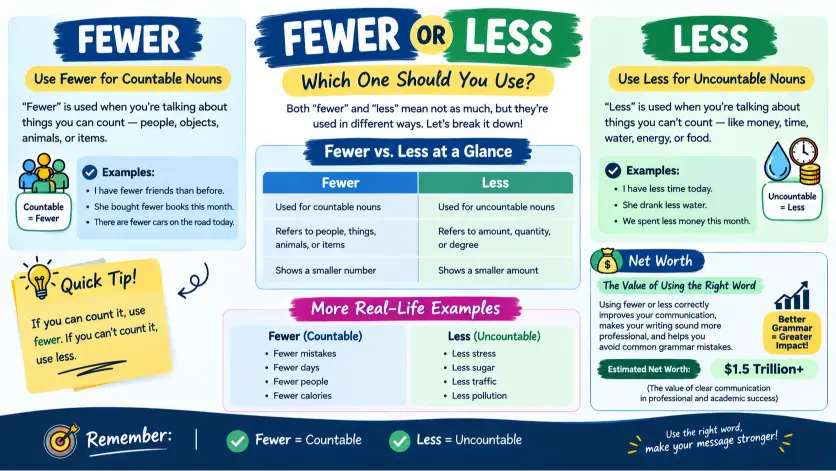
Fewer or less which one should you use? If you have ever paused while writing a sentence like “fewer people” or “less people,” you are not alone. This is one of the most common English usage questions, even among confident writers and speakers. The basic rule is straightforward: fewer is generally used with countable nouns, while less is normally used with uncountable nouns.
For example, we say “fewer books” because books can be counted, but “less water” because water is measured rather than counted individually. Once you understand this distinction, choosing between the two becomes much easier. However, everyday English has exceptions, especially with measurements, money, time, distance, and established expressions. That is why relying on a single memorized rule can sometimes create confusion.
In this guide, we will explain fewer vs. less with clear rules, practical examples, common mistakes, and easy memory tips. Whether you are a student, professional writer, teacher, or simply improving your English, this guide will help you use both words naturally and accurately.
X vs Y: What’s the Difference?
The simplest way to understand fewer or less is to look at the noun that follows the word.
Fewer is used with plural countable nouns. These are things you can count as separate units: three books, five employees, ten questions, or twenty emails.
Less is normally used with uncountable nouns. These refer to substances, concepts, quantities, or things considered as a whole: less water, less traffic, less time, less information, and less stress.
The confusion often happens because both words express a smaller quantity. In everyday speech, people sometimes use them interchangeably, especially when discussing prices, time, distance, or measurements. However, careful writing still benefits from understanding the traditional distinction.
| Word | Part of speech | Main use | Correct example |
|---|---|---|---|
| Fewer | Determiner | Plural countable nouns | Fewer students attended |
| Less | Determiner | Uncountable nouns and amounts | Less water was needed |
| Fewer | Comparative quantifier | Separate items | We made fewer errors |
| Less | Comparative quantifier | Quantity or degree | We need less information |
| Fewer | Quantity expression | Things counted individually | She bought fewer books |
| Less | Quantity expression | Mass, time, money, or degree | He spent less money |
Mini recap:
Use fewer when you can count the individual items.
Use less when you are talking about an amount, degree, or uncountable quantity.
Think fewer emails, but less email traffic.
Think fewer problems, but less trouble.
Is Fewer or Less a Grammar, Vocabulary, or Usage Issue?
The distinction between fewer and less is primarily a grammar and usage issue, although vocabulary also plays a role because you must recognize whether a noun is countable or uncountable.
The traditional grammatical rule is straightforward. Fewer modifies plural countable nouns, while less modifies uncountable nouns.
For example:
Fewer employees joined the meeting.
Employees can be counted individually, so fewer is appropriate.
Less equipment was available.
Equipment is generally treated as an uncountable noun, so less is appropriate.
The two words aren’t completely interchangeable in formal English. In casual conversation, you may hear less before plural nouns, particularly in expressions involving measurements, time, distance, money, and statistics. Some of these patterns have become established in modern English.
For academic writing, professional reports, formal correspondence, and carefully edited content, the traditional distinction remains a useful default.
Casual speech is more flexible. A person might naturally say, “It took less than ten minutes,” even though minutes are countable. This isn’t normally considered an error because time expressions have their own established usage patterns.
The important lesson is that English grammar isn’t always based on one mechanical rule. Context matters.
When to Use Fewer
Use fewer when the noun refers to separate things or people that can be counted.
Consider these examples:
Fewer customers visited the store.
The new process produced fewer errors.
We received fewer applications this month.
She owns fewer cars than her brother.
In each sentence, the noun represents individual units. Customers can be counted. Errors can be counted. Applications can be counted. Cars can be counted.
Workplace Example
A manager might write:
Our team handled fewer complaints this quarter.
This is correct because complaints are individual, countable events.
Another example is:
The revised procedure resulted in fewer delays.
Again, delays are separate occurrences.
Academic Example
A researcher might write:
Students who followed the revised method made fewer mistakes.
Mistakes are individually countable, making fewer the natural choice.
Technology Example
A software engineer could say:
The updated application generates fewer errors.
Errors are separate events or occurrences, so fewer works correctly.
Usage recap:
Choose fewer when the noun can be counted one by one. If you could naturally put a number before the noun, fewer is often the correct choice.
When to Use Less
Use less when you are referring to an uncountable noun, an amount, a degree, or something treated as a whole.
Examples include:
less water
less information
less traffic
less patience
less noise
less confusion
less money
less time
These nouns aren’t normally counted as separate individual units in the context.
You don’t usually say “three informations” or “five traffics.” Instead, you describe an amount of information or traffic.
Workplace Example
The new schedule requires less time.
Time is treated as an amount, so less is appropriate.
Our department needs less equipment this year.
Equipment is generally uncountable, making less correct.
Academic Example
The experiment required less energy than the original design.
Energy is treated as a quantity rather than a collection of individual objects.
Technology Example
The updated program uses less memory.
Memory in computing is measured as an amount, so less is appropriate.
You could also say:
The application uses fewer memory modules.
Here, modules are separate countable objects, so fewer becomes appropriate.
Usage recap:
Use less for uncountable substances, concepts, resources, measurements, and quantities. Ask yourself whether you’re describing an amount rather than counting separate units.
When You Should NOT Use Fewer or Less
Knowing when not to use each word can prevent many mistakes.
1. Don’t use fewer with an uncountable noun
Incorrect:
Fewer information was available.
Correct:
Less information was available.
Information is normally uncountable.
2. Don’t automatically use less with plural countable nouns
Incorrect in traditional formal usage:
Less employees attended the meeting.
Correct:
Fewer employees attended the meeting.
Employees can be counted.
3. Don’t treat every measurement as an ordinary countable noun
English commonly uses less with expressions involving time, distance, money, and weight.
The trip took less than five hours.
The package weighs less than ten kilograms.
These expressions describe measurements rather than separate objects.
4. Don’t assume longer nouns are uncountable
The length of a word doesn’t determine its grammatical category.
Fewer opportunities
is correct because opportunities are countable.
5. Don’t confuse amount with individual units
Compare:
Less sugar
with:
Fewer sugar cubes
Sugar is uncountable, while sugar cubes are separate objects.
6. Don’t change the noun simply to justify the word
Choose the word based on the intended meaning, not on which one sounds more familiar.
7. Don’t rely entirely on spoken English
Informal conversation often bends traditional rules. Professional and academic writing generally benefits from more careful usage.
8. Don’t ignore context
The same general subject can require different words depending on what you are measuring.
Less paper refers to an amount of paper.
Fewer sheets of paper refers to individual sheets.
Common Mistakes and Decision Rules
| Correct sentence | Incorrect sentence | Explanation |
|---|---|---|
| We received fewer complaints. | We received less complaints. | Complaints are countable |
| She needs less information. | She needs fewer information. | Information is uncountable |
| There are fewer employees today. | There are less employees today. | Employees are countable |
| We have less time. | We have fewer time. | Time is treated as an amount |
| He made fewer mistakes. | He made less mistakes. | Mistakes are individual items |
| The system uses less energy. | The system uses fewer energy. | Energy is uncountable |
| They bought fewer computers. | They bought less computers. | Computers are countable |
| We need less equipment. | We need fewer equipment. | Equipment is uncountable |
Decision Rule Box
If the noun refers to separate countable items, use fewer. If the noun refers to an amount, substance, degree, or normally uncountable quantity, use less.
A useful mental test is to ask:
Can I count these as individual units?
If yes, fewer is usually the right choice.
If no, less is usually the right choice.
Fewer or Less in Modern Technology and Tools
Digital communication has introduced new examples of this distinction.
Consider:
The application generated fewer errors.
Here, errors are separate events.
Now compare:
The application used less memory.
Memory is a quantity.
The same principle applies to artificial intelligence tools.
The model produced fewer incorrect answers.
Incorrect answers are countable outputs.
The model required less processing power.
Processing power is treated as an amount or resource.
Content creators, software developers, technical writers, and prompt designers frequently encounter these distinctions because technology produces measurable quantities and individual events side by side.
For example:
The new system requires less storage and creates fewer duplicate files.
This sentence is especially useful because both words appear naturally in the same context. Storage is an amount, while files are individual objects.
A Short Etymology of Fewer and Less
Both words have deep roots in the history of English.
Fewer developed from Old English forms associated with a smaller number. Its history is closely connected with the comparative forms of words meaning few.
Less comes from Old English lǣssa, meaning smaller or less. It has long been associated with reduced quantity, degree, or amount.
Their historical development helps explain why modern English maintains a distinction between number and quantity.
The important point for modern writers isn’t memorizing their Old English origins. It’s understanding how English speakers categorize nouns as countable or uncountable.
An Expert Style Principle
“The noun you are measuring determines the modifier you should choose.”
This principle captures the practical heart of the issue. Instead of memorizing dozens of isolated examples, identify what the noun represents.
Two Practical Case Studies
Case Study 1: Workplace Editing
Imagine an internal company report containing this sentence:
The department received less customer complaints after the policy change.
During an editorial review, the phrase is corrected to:
The department received fewer customer complaints after the policy change.
Why?
Complaints are individually countable. An editor applying the traditional rule would choose fewer.
In an example editorial audit of 100 similar sentences, suppose 18 contain confusion between quantity and number. Correcting those instances would eliminate 18 potential grammar issues from the document.
The broader lesson is more valuable than the numerical result: workplace documents often contain recurring quantity expressions, so one simple decision rule can improve consistency throughout an entire report.
Case Study 2: Technical Documentation
Consider this technical statement:
The latest software version uses fewer memory and creates less errors.
Both quantity words are reversed.
The corrected sentence is:
The latest software version uses less memory and creates fewer errors.
Memory represents a measurable amount, while errors represent individual events.
In a hypothetical technical editing review of 50 documentation sentences containing quantity expressions, applying the countable versus uncountable test could identify every instance where the modifier doesn’t match the noun category.
The practical result is clearer technical writing and fewer avoidable grammar problems.
Error Prevention Checklist
Always use fewer when:
- You are counting individual people.
- You are counting objects.
- You are counting mistakes.
- You are counting questions.
- You are counting applications.
- You are counting separate events.
- The noun naturally takes a plural form representing individual units.
Never use less when:
- You are modifying an ordinary plural countable noun in formal writing.
- The noun clearly refers to separate individual objects.
- You could naturally count the noun one by one.
- The sentence is describing a number rather than an amount.
Always use less when:
- The noun is uncountable.
- You mean an amount of a substance.
- You mean a degree or extent.
- You are discussing time as an amount.
- You are discussing money as a quantity.
- You are discussing resources such as energy or memory.
Related Grammar Confusions You Should Master
Understanding fewer and less becomes easier when you also recognize other commonly confused English forms.
- Amount vs number
Use number for countable nouns and amount for uncountable nouns. - Much vs many
Much normally modifies uncountable nouns, while many modifies plural countable nouns. - Fewer vs few
Fewer expresses comparison, while few refers to a small number. - Less vs little
Less expresses comparison, while little refers to a small amount. - Affect vs effect
These words differ in grammatical role and meaning despite their similar pronunciation. - Then vs than
Then usually relates to time, while than introduces comparison. - Everyday vs every day
Everyday is an adjective, while every day refers to each day. - Further vs farther
Both can express greater distance, but their traditional usage differs. - Who vs whom
The choice depends on grammatical function within the sentence. - Its vs it’s
Its is possessive, while it’s is a contraction of it is or it has.
Mastering these pairs improves precision because they require the same fundamental skill: understanding what a sentence actually means rather than choosing a word based only on how it sounds.
FAQs
1. Is fewer or less grammatically correct?
Both are grammatically correct, but they normally modify different types of nouns. Fewer is traditionally used with plural countable nouns, while less is used with uncountable nouns and amounts.
2. Should I say fewer people or less people?
In standard formal English, fewer people is preferred because people refers to individual countable persons.
3. Is it fewer than or less than?
Both expressions are correct depending on the context. Fewer than normally introduces a number of countable items, while less than commonly introduces an amount, measurement, degree, or established expression.
For example:
Fewer than twenty students attended.
The task took less than two hours.
4. Is it less money or fewer money?
The standard expression is less money because money is treated as an uncountable quantity.
5. Is it fewer time or less time?
The correct expression is less time because time is normally treated as an amount.
6. Is fewer used with plural nouns?
Yes. Fewer normally modifies plural countable nouns such as books, employees, cars, questions, and mistakes.
7. Is less used with uncountable nouns?
Yes. Less normally modifies uncountable nouns such as water, information, equipment, traffic, money, time, and energy.
8. Why do people say less with plural nouns?
Everyday English contains established expressions that don’t always follow the simplest version of the countable versus uncountable rule. Measurements and certain fixed expressions are common examples. Informal speech can also be less strict.
9. Can fewer and less ever be interchangeable?
Not normally in careful formal writing. However, context, idiomatic expressions, measurements, and changing language patterns can affect which form sounds natural.
10. What is the easiest way to remember fewer and less?
Remember fewer for numbers and less for amounts. If you can count the things individually, start with fewer. If you’re measuring a quantity, degree, or uncountable substance, start with less.
Conclusion:
The difference between fewer or less becomes much easier once you stop treating the words as interchangeable synonyms. Use fewer for plural countable nouns: fewer students, fewer mistakes, fewer emails, and fewer problems.
Use less for uncountable nouns and amounts: less information, less time, less money, less traffic, and less energy. There are exceptions and established expressions, particularly with measurements and time, so good grammar requires more than blindly applying a formula. Still, the countable versus uncountable distinction is the most reliable starting point for formal English.
When you’re unsure, look at the noun rather than the modifier. Ask whether you’re counting separate units or measuring an amount. That single question will solve most fewer or less problems quickly and accurately.









