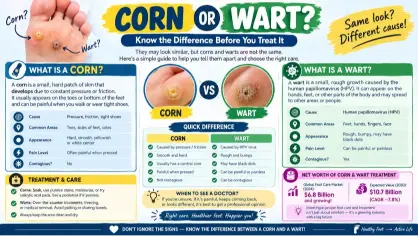
A small, hard bump on your foot can be surprisingly difficult to identify. Is it a corn or wart? Although these two skin problems can look similar, they have different causes and may require different approaches to treatment. Corns usually develop when repeated pressure or friction causes the skin to thicken, while warts are caused by an infection with certain types of human papillomavirus (HPV).
Knowing the difference matters because treating the wrong condition may not solve the problem. A corn often has a concentrated, hardened core and tends to hurt with direct pressure. A plantar wart may interrupt the natural lines of the skin and can sometimes show tiny dark dots caused by blood vessels.
In this guide, we’ll explain corn or wart differences, common symptoms, causes, appearance, pain patterns, treatment options, and when it’s best to have a dermatologist or healthcare professional examine the area.
Corn or Wart: What Is the Difference?
Although corns and warts can look remarkably similar, they aren’t the same skin condition. Understanding the difference matters because a treatment that helps a corn may not address a wart, and repeatedly irritating the area can make either problem more uncomfortable.
A corn is a localized area of thickened skin that forms when the skin experiences repeated pressure or friction. It commonly develops on the toes, sides of the feet, soles, or other areas exposed to rubbing. Tight footwear, unusual pressure while walking, and foot structure can all contribute.
A wart, by contrast, is a noncancerous skin growth caused by certain types of human papillomavirus, commonly known as HPV. Warts can develop on the hands, fingers, feet, and other parts of the body. Plantar warts occur on the soles of the feet and are particularly easy to mistake for corns.
From a language perspective, both corn and wart are common countable nouns. In everyday English, you might say, “I have a corn on my toe” or “There is a wart on my finger.”
| Feature | Corn | Wart |
|---|---|---|
| Basic cause | Repeated pressure or friction | Viral infection |
| Medical category | Thickened skin | Viral skin growth |
| Common location | Toes, feet, pressure points | Hands, fingers, feet and other areas |
| Surface | Usually smooth and hard | Often rough or uneven |
| Skin lines | Often continue across the area | May be interrupted |
| Tiny dark dots | Usually absent | May be visible |
| Pain | Often painful with direct pressure | Plantar warts may hurt when walking |
| Contagious | No | Yes |
| Typical trigger | Friction, pressure or footwear | HPV infection |
Mini recap:
A corn is mainly a response to repeated mechanical pressure.
A wart results from a viral infection of the skin.
Corns are not contagious, whereas warts can spread.
Plantar warts are the main reason the two conditions are frequently confused.
Is Corn or Wart a Grammar, Vocabulary, or Usage Issue?
The expression corn or wart isn’t primarily a grammar problem. It’s a vocabulary and usage distinction because the two nouns identify different things.
Neither word is interchangeable with the other in standard English. If you’re describing thickened skin caused by pressure, corn is the appropriate noun. If you’re describing a viral skin growth, wart is the appropriate term.
This distinction remains important in formal writing, medical communication, school assignments, workplace conversations, and casual speech. A doctor, teacher, editor, or reader may understand what you mean from context, but choosing the accurate word makes the communication clearer.
In academic or health related writing, precision matters even more. Saying that a wart developed because of friction can create an inaccurate explanation of its cause. Likewise, calling a pressure related corn a viral infection would be medically misleading.
In casual conversation, people sometimes use general expressions such as “a bump,” “a spot,” or “hard skin” when they’re uncertain. That’s perfectly understandable, especially before a professional examination. However, once the condition has been identified, the specific term is preferable.
Understanding a Corn: Meaning, Causes, and Usage
A corn is a compact area of hardened or thickened skin that usually develops because a particular part of the body is repeatedly exposed to pressure or friction.
Corns frequently appear on the toes and feet. A poorly fitting shoe can press against one area of the toe every time you walk. Over time, the skin responds by becoming thicker. This is the body’s protective response, although the resulting area can become uncomfortable or painful.
There are several common types of corns. A hard corn generally appears as a small, concentrated area of firm skin. A soft corn tends to develop between toes where moisture can keep the skin softer. A seed corn is usually smaller and may occur in groups.
Workplace example
Imagine someone who spends long hours standing in formal shoes. They might say:
“I developed a corn on my little toe because my shoes kept pressing against it.”
Here, corn is appropriate because the sentence describes pressure related thickening.
Academic example
A health education paper might explain:
“Repeated friction and pressure can contribute to the development of corns on the feet.”
The word works because the sentence is describing a physical condition rather than an infection.
Technology example
Technology doesn’t normally cause a corn directly, but technology related work can contribute indirectly. For example, someone who spends most of the day working at a standing desk may change their footwear or walking habits. If those changes increase pressure on one area of the foot, a corn may eventually develop.
A useful technology related sentence would be:
“Extended standing while working at a computer may expose the feet to pressure, particularly when footwear provides poor support.”
Usage recap: Use corn when the context involves localized thickened skin associated with pressure or friction. It isn’t the right word for a viral skin growth.
Understanding a Wart: Meaning, Causes, and Usage
A wart is a small skin growth associated with infection by certain types of HPV. Warts can occur in different forms and on different parts of the body.
Common warts often appear on the hands and fingers. Plantar warts develop on the soles of the feet and can sometimes grow inward because of pressure from walking. This makes plantar warts especially easy to mistake for corns.
A wart may have a rough or grainy surface. Normal skin lines can appear disrupted around or across it. Tiny dark dots may sometimes be visible because small blood vessels have become involved in the growth.
Workplace example
A person who notices a rough growth on a finger might say:
“I think I have a wart on my finger.”
That wording is appropriate when the growth has been identified as a wart.
Academic example
A biology or health textbook could state:
“Warts are skin growths associated with infection by certain types of human papillomavirus.”
This is more precise than simply calling every raised skin bump a wart.
Technology example
Digital health tools can help users compare descriptions or organize information about visible skin concerns, but an app or artificial intelligence tool shouldn’t be treated as a definitive diagnosis based only on a photograph. Lighting, image quality, skin tone, location, and texture can affect interpretation.
Usage recap: Use wart when referring to a viral skin growth. A plantar wart deserves particular attention because it can resemble a corn.
When You Should NOT Use Corn or Wart
Knowing what corn or wart means is useful, but knowing when not to use each term can prevent even more confusion.
1. Don’t call every hard bump a corn
A hard bump isn’t automatically a corn. Call it a corn only when the characteristics and cause fit the condition.
2. Don’t call every rough growth a wart
Several skin conditions can produce rough or raised areas. Appearance alone isn’t always enough to establish a diagnosis.
3. Don’t use wart for ordinary callused skin
A callus is usually a broader area of thickened skin caused by repeated friction or pressure. It isn’t simply another name for a wart.
4. Don’t use corn for a contagious growth
Corns aren’t contagious. If a growth appears to be spreading from one person to another, wart becomes a more relevant possibility.
5. Don’t assume every painful sole lesion is a corn
Pain beneath the foot can have several causes. A plantar wart is one possibility, but it isn’t the only one.
6. Don’t use the words interchangeably in medical writing
Medical and educational content requires accurate terminology. Substituting one term for the other can change the meaning.
7. Don’t diagnose from one visual feature
A central spot, rough surface, hardness, or pain can provide clues, but no single feature should automatically determine the diagnosis.
8. Don’t ignore a changing or persistent lesion
If a skin growth changes noticeably, bleeds, becomes severely painful, repeatedly returns, or doesn’t improve, professional evaluation is sensible.
Common Mistakes and Decision Rules
Many mistakes happen because people focus on appearance rather than cause and location.
| Correct sentence | Incorrect sentence | Explanation |
|---|---|---|
| “The pressure from my shoes caused a corn.” | “The pressure from my shoes caused a wart.” | Pressure is associated with corn formation, not the viral cause of a wart. |
| “The doctor identified a plantar wart.” | “The doctor identified a plantar corn caused by HPV.” | HPV is associated with warts, not corns. |
| “My wart may spread to another person.” | “My corn may spread to another person.” | Warts can be contagious, while corns aren’t. |
| “This thickened area developed where my shoe rubs.” | “This wart developed where my shoe rubs.” | Friction points toward a corn or callus, although examination may be needed. |
| “The rough growth may be a wart.” | “Every rough growth is a wart.” | Other skin conditions can look rough or raised. |
Decision Rule Box
If you mean thickened skin caused by repeated pressure or friction, use “corn.”
If you mean a viral skin growth associated with HPV, use “wart.”
If you’re uncertain about the actual skin condition, describe what you observe rather than guessing the diagnosis.
This rule is more reliable than judging the condition by hardness alone.
Corn or Wart in Modern Technology and Tools
Modern technology has made it easier to research unfamiliar skin conditions. Search engines, health websites, symptom checkers, and modern tools can help explain terminology and identify questions worth asking a healthcare professional.
However, technology has limits. A photograph cannot always distinguish between a corn, plantar wart, callus, cyst, or another skin condition. Two lesions may look similar while having completely different causes.
Modern tools are particularly useful for language clarification and educational explanations. For example, a person searching “Is this a corn or a wart?” may learn what characteristics differentiate the two.
The safest approach is to use technology as an educational aid rather than treating an automated description as a confirmed medical diagnosis.
Etymology: Where Do Corn and Wart Come From?
The English word corn, when referring to the skin condition, has a long history connected with the idea of a hardened spot. It should not be confused with corn as a cereal grain. Context determines which meaning is intended.
The word wart is also very old in English. It can be traced through older Germanic forms associated with a raised growth on the skin.
This is a useful reminder that English contains many words whose modern meanings developed over centuries. A single spelling may have unrelated meanings, while apparently similar health terms can refer to completely different conditions.
An Expert Perspective on Corn and Wart
“The most useful distinction is not simply how the lesion looks, but why it developed, where it appears, and how the surrounding skin behaves.”
That principle is valuable because visual similarity is one of the biggest reasons people confuse plantar warts with corns.
Case Study 1: Pressure Related Foot Pain
Consider an adult who develops a small, firm area on the side of a toe after switching to narrow footwear. The area becomes uncomfortable whenever the shoe presses against it. After changing footwear and reducing the source of pressure, the irritation improves.
The concrete result is a reduction in the mechanical trigger. This pattern supports the reasoning behind a corn, although a professional should make the actual diagnosis when uncertainty remains.
Case Study 2: A Persistent Plantar Lesion
Now consider someone with a rough area on the sole that remains despite changing shoes. The normal skin pattern appears interrupted, and small dark points are visible within the lesion. A healthcare professional evaluates it and identifies a plantar wart.
The important result is that identifying the underlying cause changes the management strategy. Treating a viral growth as though it were simply pressure related thickened skin may not solve the problem.
Author expertise: This article is written from a language and SEO education perspective, combining English usage principles with established distinctions in common dermatological terminology.
Error Prevention Checklist
Always use “corn” when
☐ You are describing pressure related thickened skin.
☐ The area is associated with repeated rubbing.
☐ The context specifically identifies a corn.
☐ You are explaining a localized hardened skin area caused by mechanical stress.
Never use “wart” when
☐ You simply mean any hard patch of skin.
☐ You have no reason to suggest a viral growth.
☐ You’re describing a pressure related corn.
☐ You’re using wart as a general synonym for callus or thickened skin.
Always use “wart” when
☐ The condition has been identified as a wart.
☐ You’re discussing HPV related skin growths.
☐ You’re specifically referring to a plantar wart.
☐ The context concerns a contagious skin growth.
Related Grammar Confusions You Should Master
Learning this distinction also helps you recognize a broader principle of English usage: similar looking or sounding words aren’t necessarily interchangeable.
Here are several useful vocabulary and usage pairs to master:
- Affect vs effect: Understand the difference between influence and result.
- Advice vs advise: Separate the noun from the verb.
- Fewer vs less: Learn when countable and uncountable nouns take each form.
- Then vs than: Distinguish time or sequence from comparison.
- Compliment vs complement: Separate praise from something that completes another thing.
- Principal vs principle: Distinguish a person or main item from a fundamental rule.
- Its vs it’s: Learn possession versus the contraction of it is or it has.
- Lay vs lie: Understand the difference between placing something and reclining.
- Further vs farther: Recognize their traditional distinctions in formal usage.
- Practice vs practise: Be aware that spelling conventions differ between American and British English.
The larger lesson is simple: good writing isn’t only about spelling. It depends on choosing a word whose meaning actually fits the situation.
FAQs
What is the main difference between a corn and a wart?
A corn is a concentrated area of thickened skin usually associated with repeated pressure or friction. A wart is a skin growth caused by certain types of HPV. Plantar warts can resemble corns because they occur on pressure bearing areas of the feet.
How can you tell if a spot is a corn or a wart?
Look at the location, surface, skin lines, and history of the lesion. A corn often appears where pressure or friction occurs and may have a relatively smooth, hard center. A wart may have a rough surface and can interrupt normal skin lines. Professional examination is the most reliable way to distinguish them.
Is a corn contagious like a wart?
No. A corn develops because of mechanical pressure or friction and isn’t considered a contagious infection. Warts can spread because they are associated with a viral infection.
Can a wart look like a corn?
Yes. A plantar wart can look very similar to a corn, particularly when it occurs on the sole of the foot. Pressure from walking can also push a plantar wart inward, changing its appearance.
Which is more painful, a corn or a wart?
Either can hurt. Corns often become painful when direct pressure is applied. Plantar warts can also cause discomfort while standing or walking. Pain alone isn’t enough to determine which condition is present.
Can you treat a wart like a corn?
It’s better not to assume they’re the same condition. Some treatments used for thickened skin may also be used in certain wart treatments, but the cause and appropriate management can differ. If you’re unsure, professional advice can prevent unnecessary irritation.
Can a corn turn into a wart?
No. A corn doesn’t transform into a wart. They have different causes. A corn results from pressure or friction, while a wart is associated with viral infection.
Are plantar warts and corns the same thing?
No. A plantar wart is a wart that develops on the sole of the foot. A corn is localized thickened skin generally associated with repeated pressure or friction. Their similar location is one reason they are frequently confused.
Should you see a doctor for a corn or wart?
Consider professional evaluation if the lesion is persistent, unusually painful, bleeding, changing, infected, repeatedly returning, or difficult to identify. People with conditions that affect foot health should also seek appropriate professional guidance before attempting self treatment.
What is the easiest way to remember corn versus wart?
Remember the cause. Corn means pressure and friction. Wart means viral growth. This simple association can help you choose the right term when describing the condition.
Conclusion:
The difference between a corn or wart becomes much easier to understand when you focus on cause rather than appearance. A corn is a localized thickening of skin associated with repeated pressure or friction, while a wart is a viral skin growth associated with certain types of HPV.
The two conditions can look alike, especially on the feet. That’s why location, texture, skin lines, symptoms, and medical history can all matter when identifying them. In everyday English, choosing the correct noun also improves clarity because corn and wart are not interchangeable terms.
When you’re uncertain about a skin lesion, avoid relying on a name based solely on appearance. Use descriptive language and seek professional evaluation when the area is persistent, painful, changing, or otherwise concerning.









