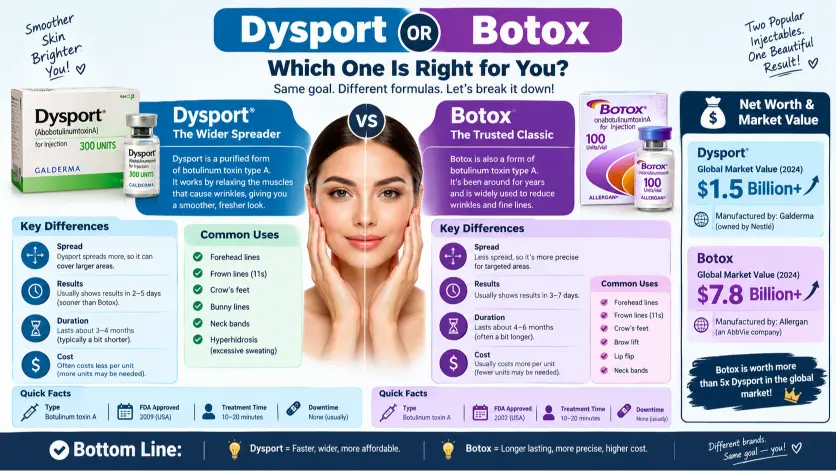
Choosing between Dysport or Botox can feel confusing, especially when both treatments are designed to soften wrinkles and create a smoother, more refreshed appearance. They belong to the same family of injectable treatments, but they are not exactly identical. Differences in formulation, how they spread, how quickly results may become noticeable, treatment areas, and individual response can all influence which option is appropriate.
The right choice should be based on your facial anatomy, aesthetic goals, medical history, and the recommendation of a qualified, experienced healthcare professional not simply on price or popularity.
In this guide, we’ll break down Dysport vs. Botox in straightforward language, including their similarities, differences, expected results, duration, potential side effects, and other factors worth discussing before treatment. While online information can help you prepare, a licensed medical professional should evaluate you personally and explain the risks and benefits. Neither injectable is automatically “better” for everyone, and realistic expectations are an important part of a safe, informed decision.
Dysport or Botox: What Is the Difference?
Dysport and Botox are brand names for two different botulinum toxin type A products. Dysport contains abobotulinumtoxinA, while Botox contains onabotulinumtoxinA. Both work by temporarily reducing nerve signals to targeted muscles, which decreases muscle contraction and can soften dynamic wrinkles.
The important point is that these products are similar, but they aren’t identical.
Botox is commonly associated with cosmetic treatment of forehead lines, glabellar lines between the eyebrows, and crow’s feet. Dysport is also approved for glabellar lines and has other medical indications, including cervical dystonia and spasticity. Exact approved uses vary by country, so treatment decisions should always be based on the product labeling applicable where you live.
| Feature | Dysport | Botox |
|---|---|---|
| Generic name | AbobotulinumtoxinA | OnabotulinumtoxinA |
| Toxin type | Botulinum toxin type A | Botulinum toxin type A |
| Common cosmetic use | Glabellar lines | Glabellar, forehead, and lateral canthal lines |
| Main action | Temporarily reduces muscle activity | Temporarily reduces muscle activity |
| Units | Product specific | Product specific |
| Unit conversion | Not directly interchangeable | Not directly interchangeable |
| Prescription | Yes | Yes |
| Typical cosmetic duration | Several months | Several months |
| Main variable | Dose, anatomy, technique, formulation | Dose, anatomy, technique, formulation |
Mini Recap
Dysport and Botox belong to the same general treatment family.
They contain different forms of botulinum toxin type A.
Their units should not be treated as equivalent.
The best choice depends on anatomy, treatment goals, injector technique, and medical history.
Is Dysport or Botox a Grammar, Vocabulary, or Usage Issue?
This is not a grammar issue in the traditional sense. It is primarily a vocabulary and usage distinction involving two proper brand names.
You wouldn’t normally use Dysport and Botox interchangeably when discussing medical treatment because each name identifies a specific commercial formulation.
In casual conversation, people sometimes use “Botox” as a general term for cosmetic wrinkle injections. That usage is understandable because Botox is one of the best known brands in the category. However, medically and technically, using Botox as a generic label for every botulinum toxin product can create confusion.
In professional writing, academic research, medical communication, and patient education, precision is more important. If a treatment involved abobotulinumtoxinA, calling it Botox may be inaccurate.
Casual usage might sound like this:
“I’m thinking about getting Botox for my forehead.”
That statement may simply mean the person is considering a botulinum toxin treatment.
A more precise clinical statement would identify the actual product being administered.
This distinction becomes especially important when discussing dosage. Dysport and Botox units are product specific and should not be converted casually. Official prescribing information states that the units for these products are not interchangeable.
What Is Dysport?
Dysport is the brand name for abobotulinumtoxinA, a prescription botulinum toxin type A product.
As a neuromodulator, it temporarily reduces communication between nerves and targeted muscles. When injected into selected muscles, this reduced signaling can decrease muscle activity.
For cosmetic treatment, Dysport is particularly associated with glabellar lines, the vertical lines that appear between the eyebrows when a person frowns.
Clinical research has demonstrated that Dysport can produce noticeable improvement relatively quickly. In one Phase III study involving 301 participants, the median reported onset was two days, with 34 percent of participants reporting an effect on the first day. At one month, 65.8 percent achieved the study’s specified two grade improvement response compared with none in the placebo group.
Workplace Example
Someone might say:
“I had Dysport before an important presentation because I wanted my frown lines to look softer.”
Here, Dysport functions as a proper noun and brand name.
Academic Example
An academic paper might discuss:
“AbobotulinumtoxinA was evaluated for moderate to severe glabellar lines.”
This is more precise than simply saying “Botox,” because the research is identifying the specific active product.
Technology Example
A technology focused article might explain how an electronic medical record system records the exact botulinum toxin product and dose used during a cosmetic procedure.
The software shouldn’t assume that every botulinum toxin injection is Botox.
Usage Recap
Use Dysport when you specifically mean the abobotulinumtoxinA product.
Don’t use the word as a generic replacement for every neuromodulator.
In clinical communication, the exact product and dose matter.
What Is Botox?
Botox is the brand name for onabotulinumtoxinA.
It is one of the most recognized botulinum toxin products worldwide. In cosmetic medicine, Botox is used to temporarily improve the appearance of several types of facial lines, including glabellar lines, lateral canthal lines commonly called crow’s feet, and forehead lines, according to United States prescribing information.
Like Dysport, Botox works by reducing nerve signaling to selected muscles. The resulting reduction in muscle activity can soften lines that are strongly influenced by repeated facial movement.
Workplace Example
A workplace article might say:
“Botox treatments are often discussed in relation to cosmetic procedures.”
That is acceptable when specifically referring to the Botox brand.
Academic Example
In a scientific context, a researcher would generally use the generic name onabotulinumtoxinA when the distinction between products matters.
For example:
“The study evaluated onabotulinumtoxinA for the treatment of glabellar lines.”
That wording tells the reader exactly which formulation was studied.
Technology Example
A cosmetic clinic’s scheduling platform might display Botox as a selectable treatment option. However, its clinical records should still document the precise product, dose, injection sites, and other relevant details.
Usage Recap
Use Botox when you mean onabotulinumtoxinA.
The word is a brand name, not a universal synonym for all botulinum toxin products.
For scientific or clinical writing, the generic product name can provide greater precision.
Dysport or Botox: Which One Works Faster?
One of the most common questions is whether Dysport produces results faster than Botox.
There is some evidence that Dysport can have a relatively rapid onset, but the answer isn’t as simple as saying one product always works faster.
Clinical studies have produced different findings depending on the formulation, dose, injection technique, patient population, and definition of onset.
A randomized study involving 180 people compared different botulinum toxin type A preparations. For female participants, the reported median onset was approximately 5.3 days for both onabotulinumtoxinA and abobotulinumtoxinA in that particular study.
Other studies have reported earlier onset with abobotulinumtoxinA. For example, a study of 300 participants reported a median onset of two days for abobotulinumtoxinA.
So the better conclusion is this: Dysport may appear to take effect quickly in some patients, but individual response varies, and onset alone shouldn’t determine which product is better.
Dysport or Botox: Which Lasts Longer?
Both products can provide effects lasting several months, but there is no universal winner for every patient.
Duration can be influenced by the treated muscle, dose, injection technique, metabolism, individual muscle strength, and the definition used to measure the end of treatment effect.
A pooled analysis of abobotulinumtoxinA studies found that some measures of improvement remained detectable for several months, although the proportion of patients maintaining a response declined over time.
This illustrates why online claims such as “Dysport always lasts longer” or “Botox always lasts longer” are too simplistic.
A qualified injector evaluates the person rather than relying on a brand comparison alone.
Dysport or Botox: Are the Units the Same?
No.
This is one of the most important facts to understand.
Dysport units and Botox units are not directly interchangeable. Their potency units are based on product specific testing systems. Official prescribing information specifically warns against treating their units as equivalent or simply converting one product into another.
This means a higher numerical number of Dysport units does not automatically mean that Dysport is stronger.
The numbers belong to different dosing systems.
That distinction prevents one of the most common misunderstandings in cosmetic treatment discussions.
When You Should NOT Use Dysport or Botox
There are several situations where casual comparison or self directed use is inappropriate.
1. Don’t treat the units as interchangeable
A Dysport unit isn’t simply a Botox unit with a different number attached.
2. Don’t choose solely because someone online prefers one brand
Personal experiences don’t predict how every person’s muscles will respond.
3. Don’t assume faster onset means better treatment
Speed is only one factor.
4. Don’t treat brand reputation as a medical recommendation
A famous brand isn’t automatically the correct choice for every person.
5. Don’t use Botox as a generic term in clinical documentation
If another product was actually administered, the record should identify it accurately.
6. Don’t assume every wrinkle responds the same way
Dynamic lines caused by muscle movement can respond differently from lines caused primarily by skin changes, volume loss, or structural changes.
7. Don’t ignore medical history
Botulinum toxin products have contraindications, warnings, and precautions that require professional assessment.
8. Don’t compare prices without comparing treatment plans
The number of units, injection areas, practitioner expertise, and treatment goals all influence cost.
Common Mistakes With Dysport and Botox
| Correct sentence | Incorrect sentence | Explanation |
|---|---|---|
| I received Dysport. | I received Botox when I actually received Dysport. | The products are different. |
| My doctor used onabotulinumtoxinA. | My doctor used any Botox type. | The generic name identifies the specific formulation. |
| Dysport units are product specific. | One Dysport unit equals one Botox unit. | Units aren’t directly interchangeable. |
| Botox is a brand name. | Botox is the generic name for every toxin injection. | Botox identifies a specific product. |
| Results can vary by patient. | Dysport always works faster. | Individual response differs. |
| Treatment should be individualized. | Everyone should receive the same dose. | Anatomy and treatment goals vary. |
Decision Rule Box
If you mean the specific product containing abobotulinumtoxinA, use Dysport.
If you mean the specific product containing onabotulinumtoxinA, use Botox.
If you mean the treatment category generally, use botulinum toxin or botulinum toxin type A when medically appropriate.
Dysport and Botox in Modern Technology and Tools
Modern cosmetic medicine increasingly uses digital photography, facial mapping, electronic records, treatment planning systems, and modern technology assisted image analysis.
These tools can help practitioners document facial anatomy and compare photographs over time. However, software should not treat Dysport and Botox as identical products.
A system that analyzes treatment records needs to preserve the exact product name and dose. A system that simply categorizes everything as Botox could introduce errors into documentation or research datasets.
Technology can assist with organization and analysis, but clinical judgment remains essential.
Etymology and Origin of the Names
The word Botox comes from the combination of “botulinum” and “toxin” and became a trademarked brand name associated with onabotulinumtoxinA.
Dysport is a brand name associated with abobotulinumtoxinA.
The deeper scientific term is botulinum toxin, which refers to a group of neurotoxins produced by bacteria of the genus Clostridium. Botulinum toxin type A is the relevant toxin type in both of these products.
The brand name therefore tells you which commercial product is being discussed, while the generic name tells you which specific active substance formulation is involved.
Expert Style Insight
“The safest comparison is not simply which brand is better, but which product, dose, technique, and treatment plan are appropriate for the individual.”
That principle captures why experienced clinicians don’t reduce treatment decisions to a popularity contest between two brand names.
Two Evidence Based Case Studies
Case Study 1: Rapid Onset of AbobotulinumtoxinA
A Phase III randomized study evaluated abobotulinumtoxinA in 224 participants receiving 50 units for moderate to severe glabellar lines. The median onset was two days, and 34 percent reported an effect on the first day. At month one, 65.8 percent met the study’s composite response definition compared with zero participants receiving placebo.
The practical lesson isn’t that everyone should expect results in exactly two days. Instead, it demonstrates that measurable improvement can begin relatively quickly in some patients.
Case Study 2: Comparative Evidence
A pivotal Phase III study involving 520 Chinese participants compared abobotulinumtoxinA with placebo and an active onabotulinumtoxinA comparator. At day 29, abobotulinumtoxinA demonstrated superiority to placebo and non inferiority to the active comparator according to the study’s predefined measures. The median onset was two days, and 17 percent of treated participants remained responders after six months.
The lesson is important: evidence supports both products as effective options, but that doesn’t mean their units, formulations, or treatment plans are identical.
Error Prevention Checklist
Always Use Dysport When
You specifically mean abobotulinumtoxinA.
You’re discussing a treatment that was documented as Dysport.
You’re comparing the product with other botulinum toxin formulations.
You need precise terminology in educational or clinical writing.
Never Use Botox When
You actually mean Dysport.
You’re describing another botulinum toxin product.
You’re comparing doses without identifying the product.
You’re suggesting that Botox units and Dysport units are automatically equivalent.
Related Grammar Confusions You Should Master
Understanding brand names versus generic terms can help with many other language questions.
Here are related distinctions worth mastering:
- Brand name versus generic name
- Trademark versus common noun
- Effect versus affect
- Advice versus advise
- Practice versus practise
- Further versus farther
- Fewer versus less
- Lay versus lie
- Compliment versus complement
- Principle versus principal
These pairs and categories cause confusion because everyday speech often blurs distinctions that become important in professional writing.
The same principle applies to medical terminology. A word may be widely understood in casual conversation while still being technically imprecise.
FAQs
What is the main difference between Dysport and Botox?
Dysport contains abobotulinumtoxinA, while Botox contains onabotulinumtoxinA. Both are botulinum toxin type A products, but their formulations and dosing units differ.
Is Dysport stronger than Botox?
It isn’t accurate to compare strength by simply looking at the numerical unit count. Dysport and Botox use product specific potency units that aren’t directly interchangeable.
Does Dysport work faster than Botox?
Some studies have reported relatively rapid onset with Dysport, but research results vary. Patient response, dose, injection technique, treatment area, and study design can all affect the reported onset.
Which lasts longer, Dysport or Botox?
Both can produce effects lasting several months. There isn’t a universal rule that one always lasts longer for every patient.
Can Dysport and Botox units be converted?
They should not be treated as directly interchangeable units. Product specific prescribing information should guide dosing rather than an informal conversion formula.
Is Dysport basically the same as Botox?
They belong to the same general category and both contain botulinum toxin type A, but they are different prescription products. Calling them identical is technically inaccurate.
Which is better for forehead lines, Dysport or Botox?
The appropriate treatment depends on facial anatomy, muscle activity, treatment goals, medical history, and the practitioner’s technique. Botox has United States cosmetic indications that include forehead lines, while Dysport’s United States cosmetic indication is specifically for glabellar lines.
How long does Dysport take to work?
Clinical studies have reported onset within a few days, with some participants noticing effects as early as the first day. Individual results can differ considerably.
How long does Botox take to work?
Botox does not produce its full visible effect immediately. Changes generally develop progressively after treatment, and the exact timing varies by individual and treatment area.
Is Botox the generic term for wrinkle injections?
No. Botox is a specific brand name for onabotulinumtoxinA. Other products, including Dysport, are separate botulinum toxin formulations.
Conclusion: Dysport or Botox
Dysport and Botox are closely related but distinct botulinum toxin type A products. Dysport contains abobotulinumtoxinA, while Botox contains onabotulinumtoxinA. Both can temporarily reduce targeted muscle activity, but their dosing systems are product specific and shouldn’t be treated as interchangeable.
The most useful comparison isn’t simply which brand is better. The better question is which product is appropriate for the individual’s anatomy, treatment area, goals, medical history, and clinical plan.
For patients, the smartest approach is to discuss the exact product, intended treatment area, expected onset, potential duration, dose, and risks with a qualified medical professional rather than relying on brand comparisons alone.









