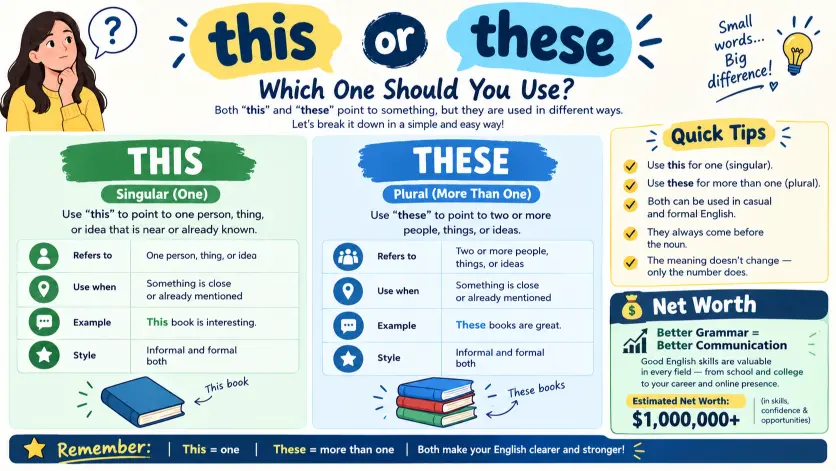
Have you ever paused while writing a sentence and wondered, “Should I use this or these?” You’re not alone. These two words look simple, but choosing between them can become confusing when you’re writing quickly or learning English grammar. The basic rule is actually easy: “this” is generally used with one person, place, thing, or idea, while “these” is used with more than one.
However, understanding how they work in real sentences can help you avoid common mistakes and make your English sound more natural. Whether you’re a student, professional writer, English learner, or simply trying to improve your everyday communication, knowing the difference between this and these is an essential grammar skill.
In this guide, we’ll explain this or these in clear, practical language with simple examples you can remember. You’ll learn when to use each word, how singular and plural nouns affect your choice, and which common errors to watch for. The goal is not just to memorize a grammar rule but to understand how native English speakers use these words naturally in everyday communication. By the end, choosing between this and these should feel much easier and more intuitive.
This or These: What’s the Difference?
This is a demonstrative determiner or demonstrative pronoun used for a singular noun or singular idea.
Examples include:
“This chair is comfortable.”
“This explanation is helpful.”
“This is my favorite option.”
These is a demonstrative determiner or demonstrative pronoun used for plural nouns or plural ideas.
Examples include:
“These chairs are comfortable.”
“These explanations are helpful.”
“These are my favorite options.”
The simplest distinction is singular versus plural.
| Feature | This | These |
|---|---|---|
| Part of speech | Demonstrative determiner or pronoun | Demonstrative determiner or pronoun |
| Number | Singular | Plural |
| Refers to | One person, object, idea, or situation | Two or more people, objects, ideas, or situations |
| Example | This document is important. | These documents are important. |
| Verb agreement | Usually takes a singular verb | Usually takes a plural verb |
| Typical meaning | One nearby or currently discussed thing | Multiple nearby or currently discussed things |
Mini Recap
This normally refers to one thing.
These normally refers to more than one thing.
The noun after the demonstrative must agree in number.
“This report” is correct, while “these report” is incorrect.
“These reports” is correct, while “this reports” is incorrect.
Is This or These a Grammar, Vocabulary, or Usage Issue?
The distinction between this and these is primarily a grammar and usage issue, rather than a vocabulary problem.
The words belong to the same grammatical family, but they have different number forms. English uses this for singular reference and these for plural reference.
They aren’t normally interchangeable.
Consider these examples:
“This problem needs attention.”
“These problems need attention.”
Changing this to these changes the number of the noun. The sentence therefore needs a corresponding change from singular to plural.
The difference becomes particularly important with verbs:
“This is difficult.”
“These are difficult.”
“This was surprising.”
“These were surprising.”
In casual conversation, speakers may sometimes use demonstratives loosely, especially when pointing or speaking quickly. Standard written English, however, requires agreement between the demonstrative and the noun.
In academic writing, careful usage is especially important because demonstratives can refer to abstract ideas as well as physical objects.
For example:
“This argument is convincing.”
“These arguments are convincing.”
In workplace communication, correct usage makes writing clearer and more professional.
The distinction is therefore simple but significant. This and these express related meanings, but number determines which one belongs in a standard sentence.
When to Use This
Use this when referring to one singular person, object, idea, event, or situation.
Workplace Example
“This report needs one more revision.”
Here, report is singular, so this is appropriate.
Another example is:
“This meeting has been moved to Friday.”
The word meeting represents one event.
Academic Example
“This theory provides a useful explanation of human behavior.”
The noun theory is singular, so the demonstrative must also be singular.
You can also use this before abstract nouns:
“This evidence supports the conclusion.”
“This approach has several advantages.”
“This argument deserves further consideration.”
Technology Example
“This application is easy to use.”
“This feature improves security.”
“This device supports wireless charging.”
In each sentence, the demonstrative introduces one singular noun.
This as a Pronoun
This doesn’t always need to appear directly before a noun.
For example:
“This is my laptop.”
“This looks promising.”
“This was unexpected.”
Here, this stands alone as a demonstrative pronoun.
Usage Recap
Use this for one thing.
Use it with singular countable nouns and many singular uncountable or abstract nouns.
It can also stand alone as a pronoun.
The following structure is useful:
This + singular noun + singular verb
For example:
“This solution works.”
When to Use These
Use these when referring to two or more people, objects, ideas, events, or situations.
Workplace Example
“These reports need revision.”
Because reports is plural, these is required.
Another example:
“These meetings are important for the project.”
The noun meetings refers to multiple events.
Academic Example
“These findings support the original hypothesis.”
The word findings is plural, so these is correct.
You can also write:
“These arguments are difficult to ignore.”
“These studies provide useful evidence.”
“These examples demonstrate the principle.”
Technology Example
“These applications are compatible with the device.”
“These settings control your privacy options.”
“These features improve the user experience.”
In each case, these introduces more than one item.
These as a Pronoun
Like this, these can stand alone.
For example:
“These are mine.”
“These look better.”
“These were expensive.”
The word replaces or represents plural nouns that are understood from context.
Usage Recap
Use these for two or more things.
Use it with plural nouns and plural verbs.
It can also function independently as a demonstrative pronoun.
A useful structure is:
These + plural noun + plural verb
For example:
“These options work.”
When You Should NOT Use This or These
Knowing when not to use a word can be just as useful as knowing when to use it. Watch for these common situations.
1. Don’t Use This With a Clearly Plural Noun
Incorrect:
“This books are expensive.”
Correct:
“These books are expensive.”
2. Don’t Use These With a Singular Noun
Incorrect:
“These book is expensive.”
Correct:
“This book is expensive.”
3. Don’t Ignore Verb Agreement
Incorrect:
“These is my documents.”
Correct:
“These are my documents.”
4. Don’t Use This as a Substitute for These
If you’re referring to multiple items, changing these to this creates a number error.
Incorrect:
“This are the files I requested.”
Correct:
“These are the files I requested.”
5. Don’t Use These for One Item
Incorrect:
“These is my phone.”
Correct:
“This is my phone.”
6. Don’t Confuse Demonstratives With Articles
This and these provide information about number and reference. The article the doesn’t work in exactly the same way.
Compare:
“This document”
“The document”
The first points out or identifies a particular document, while the second simply uses the definite article.
7. Don’t Change the Verb Without Checking the Noun
If you change this to these, you may also need to change the verb.
“This is useful.”
“These are useful.”
8. Don’t Assume Similar Spelling Means Identical Grammar
The words are related, but they aren’t interchangeable forms. Their grammatical number matters.
Common Mistakes With This and These
| Correct sentence | Incorrect sentence | Explanation |
|---|---|---|
| This book is useful. | These book is useful. | Book is singular. |
| These books are useful. | This books are useful. | Books is plural. |
| This is my answer. | These is my answer. | One answer requires singular this. |
| These are my answers. | This are my answers. | Multiple answers require plural these. |
| This idea works well. | These idea works well. | Idea is singular. |
| These ideas work well. | This ideas work well. | Ideas is plural. |
| This device is fast. | These device is fast. | Device is singular. |
| These devices are fast. | This devices are fast. | Devices is plural. |
Decision Rule Box
Use this when you mean one person, object, idea, event, or situation.
Use these when you mean two or more people, objects, ideas, events, or situations.
Check the noun and verb after the demonstrative to make sure they agree in number.
This rule solves most everyday questions about this or these.
This and These in Modern Technology and Tools
Modern technology has created countless situations where demonstrative words are used to identify digital objects, settings, features, files, and results.
Consider:
“This tool generates accurate summaries.”
“These tools generate accurate summaries.”
The first sentence refers to one tool. The second refers to several tools.
The same distinction appears in Modern technology interfaces:
“This prompt produces a better result.”
“These prompts produce better results.”
It also appears in software documentation:
“This setting controls notifications.”
“These settings control notifications.”
Clear demonstrative usage is particularly important in technical writing because users need to know whether an instruction applies to one feature or several.
For example:
“Select this option” tells the reader to select one specific option.
“Review these options” tells the reader to consider multiple choices.
A small grammatical difference can therefore affect how accurately instructions are understood.
Etymology of This and These
This and these belong to the long established family of English demonstratives.
The history of both forms can be traced through earlier stages of the English language and related Germanic languages. Their modern forms developed over centuries as English changed its grammatical system.
Historically, English had a much more extensive system of demonstrative forms than modern English does. Many of those older forms disappeared or changed as the language evolved.
Today, this serves as the common singular form, while these serves as its plural counterpart.
Their close relationship explains why learners often recognize their similarity immediately. Their grammatical distinction, however, remains essential in modern standard English.
An Expert View of This and These
A useful principle for understanding demonstratives is that grammar should reflect the meaning the writer intends.
“Good grammar makes relationships between words visible to the reader.”
In the case of this and these, that relationship is especially straightforward. The demonstrative should signal whether the writer is referring to one item or multiple items.
This is why the distinction matters beyond grammar exercises. It contributes to clarity in professional, academic, technical, and everyday communication.
Two Practical Case Studies
Case Study 1: Workplace Reporting
Imagine a manager writing:
“This reports show that customer satisfaction has improved.”
The sentence contains a number mismatch. Reports is plural, so these is required.
The corrected sentence is:
“These reports show that customer satisfaction has improved.”
The correction changes only one word, but it immediately makes the sentence grammatically consistent.
Case Study 2: Academic Writing
Suppose a student writes:
“These study demonstrates a relationship between sleep and performance.”
The noun study is singular, so this should be used.
Correct:
“This study demonstrates a relationship between sleep and performance.”
If the writer means several studies, both the noun and verb must change:
“These studies demonstrate a relationship between sleep and performance.”
These examples demonstrate an important lesson: choosing between this and these can require checking the entire noun phrase and its verb, not just the demonstrative itself.
This or These: Error Prevention Checklist
Always Use This When
☐ You are referring to one singular object.
☐ You are referring to one person.
☐ You are referring to one idea.
☐ You are referring to one event or situation.
☐ The following countable noun is singular.
☐ The accompanying verb requires singular agreement.
Never Use These When
☐ You mean only one item.
☐ The following countable noun is singular.
☐ The sentence requires a singular verb.
☐ You are replacing one specific object with a demonstrative pronoun.
Always Use These When
☐ You are referring to multiple objects.
☐ You are referring to multiple people.
☐ You are referring to multiple ideas.
☐ The following noun is plural.
☐ The accompanying verb requires plural agreement.
Related Grammar Confusions You Should Master
Once you understand this or these, several other English grammar distinctions become easier to learn.
1. That vs Those
That is generally singular, while those is plural.
“That book is mine.”
“Those books are mine.”
2. Is vs Are
Is normally accompanies singular subjects, while are accompanies plural subjects.
“This is useful.”
“These are useful.”
3. Was vs Were
The same number distinction appears with past tense forms.
“This was helpful.”
“These were helpful.”
4. Much vs Many
Much generally accompanies uncountable nouns, while many accompanies plural countable nouns.
5. Less vs Fewer
Fewer is traditionally used with plural countable nouns, while less is commonly used with uncountable quantities.
6. A vs An
Both are indefinite articles, but pronunciation determines which form is normally appropriate.
7. Its vs It’s
Its indicates possession, while it’s is a contraction of “it is” or “it has.”
8. Your vs You’re
Your indicates possession, while you’re means “you are.”
9. Then vs Than
Then generally relates to time or sequence, while than is associated with comparison.
10. Who vs Whom
These forms can create confusion because they perform different grammatical functions in formal English.
Learning related distinctions together can significantly improve grammar accuracy.
Advanced FAQs
What is the difference between this and these?
This is generally used for one singular person, object, idea, or situation, while these is used for two or more people, objects, ideas, or situations.
Is this singular or plural?
This is singular. It is normally used with a singular noun or as a pronoun referring to one thing.
Is these singular or plural?
These is plural. It is used with plural nouns or as a pronoun referring to multiple things.
Should I say this are or these are?
You should normally say these are when referring to multiple things. For example, “These are my documents.” The combination this are is grammatically incorrect in standard English.
Should I say this is or these is?
Use this is for one thing and these are for multiple things. For example, “This is my book” and “These are my books.”
Can this and these be pronouns?
Yes. Both can function as demonstrative pronouns.
For example:
“This is beautiful.”
“These are expensive.”
They can also function as determiners when they appear directly before a noun.
Is this or these more formal?
Neither is inherently more formal. Both are standard English words used in casual, professional, academic, and formal communication. The correct choice depends on whether the reference is singular or plural.
How do I know whether to use this or these?
Look at the noun you are describing. If it is singular, use this. If it is plural, use these. Also check the verb to ensure that it agrees with the noun.
Can this refer to an idea?
Yes. This can refer to an abstract idea, argument, situation, statement, or previously mentioned point.
For example:
“This explains why the results changed.”
Can these refer to ideas?
Yes. These can refer to several previously mentioned ideas, arguments, situations, or findings.
For example:
“These explain why the results changed.”
Conclusion:
The difference between this or these is simple once you focus on grammatical number. This normally identifies one person, object, idea, event, or situation, while these identifies two or more. The most reliable approach is to look at the noun that follows the demonstrative. If the noun is singular, choose this. If it is plural, choose these. Then check the verb because number agreement often affects the rest of the sentence.
For example, “This document is important” is correct because document is singular. “These documents are important” is correct because documents is plural. This small distinction has a major impact on clear English. Whether you’re writing an academic essay, workplace email, technical guide, website article, or everyday message, using the correct demonstrative helps readers understand exactly what you mean.
When in doubt, remember the simplest rule: one thing takes this, while multiple things take these.









