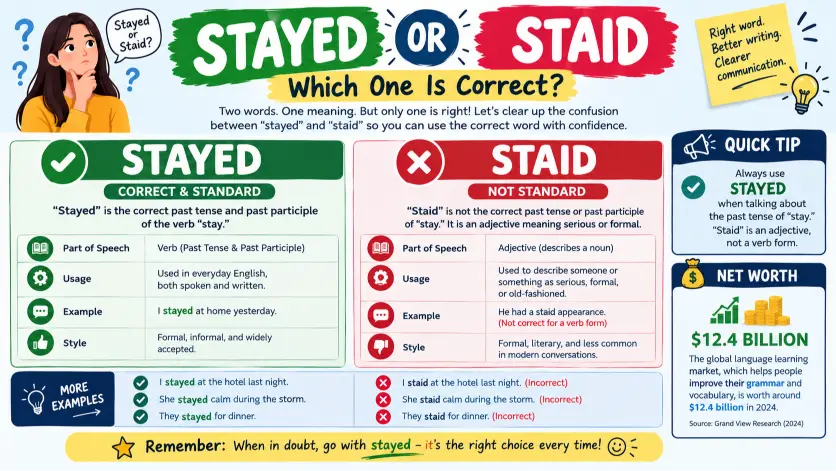
Have you ever typed “stayed” or “staid” and wondered whether you chose the right word? You are not alone. These two words look and sound similar, but they have completely different meanings and grammatical uses. Stayed is the past tense and past participle of stay, while staid is an adjective traditionally used to describe someone or something serious, respectable, calm, or somewhat old-fashioned. A single letter can therefore change the meaning of an entire sentence.
Understanding this difference is especially useful when writing emails, essays, articles, social posts, or professional communication where accurate word choice matters. In this guide, we’ll break down stayed vs. staid in clear, practical language. You’ll learn their definitions, pronunciation, parts of speech, common sentence patterns, and real-world examples so you can recognize the difference confidently.
Rather than relying on confusing grammar rules, we’ll use straightforward explanations and context-based examples to show exactly when each word belongs. By the end, choosing between stayed or staid should feel simple and natural.
Stayed vs Staid: What Is the Difference?
The difference between stayed and staid is simple once you understand what each word does in a sentence.
Stayed is a verb. It is the past tense and past participle of stay. It tells us that a person or thing remained in a place, continued in a particular condition, or did not leave.
For example:
She stayed at home all evening.
In this sentence, stayed describes an action. The person remained at home instead of leaving.
Staid is an adjective. It describes the character, appearance, behavior, style, or atmosphere of a person or thing. It usually means serious, calm, traditional, restrained, respectable, or somewhat conservative.
For example:
She has a staid personality.
Here, staid describes her personality. It does not tell us that she remained somewhere.
The most important difference is therefore grammatical as well as semantic. Stayed tells you what someone or something did. Staid tells you what someone or something is like.
| Word | Part of Speech | Meaning | Example |
|---|---|---|---|
| Stayed | Verb | Remained, continued, or did not leave | We stayed at the hotel. |
| Staid | Adjective | Serious, restrained, traditional, or conventional | The hotel had a staid atmosphere. |
The Difference in Simple Terms
Stayed means remained.
Staid means serious, restrained, or conventional.
Stayed is an action word.
Staid is a describing word.
If you can replace the word with remained, use stayed.
If you can replace it with serious, traditional, or conventional, use staid.
Stayed vs Staid: Why Are They Confused?
The main reason these words cause confusion is pronunciation.
In many varieties of English, stayed and staid are pronounced the same way. They are therefore known as homophones. Homophones are words that sound alike but have different spellings and meanings.
English contains many such pairs. For example, their, there, and they’re sound similar, but they serve different purposes. The same basic problem occurs with stayed and staid.
When someone hears the sentence rather than sees it written, there is no obvious way to know which spelling is intended.
Consider this sentence:
He stayed in the office.
If you only hear the sentence, you cannot determine the spelling from pronunciation alone. You need to understand the meaning. The sentence says that he remained in the office, so stayed is correct.
Now consider:
He has a staid manner.
The word describes his personality or behavior, so staid is correct.
This is why spelling these words correctly requires more than listening to pronunciation. You need to identify the meaning and grammatical function first.
What Does Stayed Mean?
Stayed is the past tense and past participle of the verb stay.
The basic meaning is remained instead of leaving.
For example:
We stayed at the restaurant until midnight.
The sentence means that we remained at the restaurant until midnight.
However, stayed has several related uses.
It can describe remaining in a physical location.
They stayed in London for three weeks.
It can describe continuing in a particular condition.
The weather stayed warm throughout the afternoon.
It can describe something remaining unchanged.
The price stayed the same.
It can also describe remaining with another person.
She stayed with her aunt during the summer.
In every example, the central idea is continuation or remaining.
Workplace Example
The manager stayed late to complete the financial report.
Here, stayed means the manager remained at work instead of leaving at the normal time.
Academic Example
The researchers stayed at the laboratory until the experiment was complete.
Again, the word describes the action of remaining somewhere.
Technology Example
The application stayed open while the computer installed the update.
In this sentence, stayed describes a continuing state.
More Examples of Stayed
I stayed home because it was raining.
The students stayed after class.
She stayed calm during the interview.
The temperature stayed below freezing.
We stayed in contact after graduation.
The machine stayed operational throughout the test.
All of these examples involve the idea of remaining or continuing.
Usage Recap
Use stayed when you are talking about an action or continuing condition.
A useful test is to replace stayed with remained.
If the sentence still makes sense, stayed is probably the correct choice.
What Does Staid Mean?
Staid is an adjective used to describe something that is serious, calm, restrained, respectable, traditional, conventional, or conservative in character.
It is generally used to describe people, organizations, institutions, environments, styles, traditions, or reputations.
For example:
The professor had a staid personality.
The word tells us that the professor was serious, reserved, or conventional.
Another example is:
The company has a staid image.
This means the company’s public image is traditional, conservative, or restrained.
Unlike stayed, staid does not describe the act of remaining somewhere.
Workplace Example
The company was known for its staid corporate culture.
Here, staid describes the company’s traditional and restrained working environment.
Academic Example
The university maintained a staid academic tradition.
The adjective describes the institution’s conventional and traditional character.
Technology Example
The company replaced its staid website design with a more modern interface.
The word staid describes the old design as conservative, restrained, or lacking excitement.
More Examples of Staid
He was known for his staid manner.
The restaurant had a staid atmosphere.
The organization had a staid reputation.
Her clothing style was elegant but staid.
The magazine was considered too staid for younger readers.
The institution had a long and staid history.
In every example, staid describes a quality rather than an action.
Usage Recap
Use staid when you need an adjective that describes something as serious, restrained, traditional, conventional, or conservative.
A useful test is to replace staid with serious, traditional, or conventional.
If the meaning remains logical, staid may be the correct word.
Stayed vs Staid: Full Grammar Difference
The clearest way to understand these words is to examine their grammatical roles.
Stayed Is a Verb
A verb tells us about an action, occurrence, or state.
In the sentence:
The children stayed inside.
Stayed tells us what the children did.
In:
The price stayed constant.
Stayed tells us that the price continued in the same condition.
Because stayed is a verb, it can appear with subjects and other grammatical elements associated with verbs.
Examples include:
I stayed.
She stayed.
They stayed.
We stayed.
He stayed behind.
The students stayed after class.
Staid Is an Adjective
An adjective describes a noun or pronoun.
In:
He has a staid personality.
Staid describes the noun personality.
In:
The institution seemed staid.
Staid describes the institution.
In:
She wore a staid outfit.
Staid describes the outfit.
Because staid is an adjective, it commonly appears before a noun or after a linking verb.
Examples include:
A staid person
A staid institution
A staid atmosphere
A staid tradition
The company seems staid.
The style looks staid.
The Simplest Grammar Test
Ask yourself:
Is the word describing an action of remaining?
If yes, use stayed.
Ask yourself:
Is the word describing a person, place, organization, style, or atmosphere as serious or conventional?
If yes, use staid.
Common Mistakes With Stayed and Staid
This is where many writers make errors because both spellings are legitimate English words. A spell checker may accept either one, so understanding the meaning is essential.
Mistake 1: Writing Staid When You Mean Remained
Incorrect:
We staid at the hotel for three nights.
Correct:
We stayed at the hotel for three nights.
Why?
The sentence describes people remaining at a hotel. Stayed is the past tense of stay, so it is the correct verb.
Mistake 2: Writing Stayed When You Mean Conventional
Incorrect:
The company had a stayed image.
Correct:
The company had a staid image.
Why?
The writer is describing the company’s image as traditional or conservative. This requires the adjective staid.
Mistake 3: Assuming Staid Is a Formal Version of Stayed
Some writers mistakenly think that staid is simply a more formal spelling of stayed.
It is not.
These are two different words.
Stayed means remained.
Staid means serious, restrained, conventional, or traditional.
Using one in place of the other can completely change the intended meaning.
Mistake 4: Choosing the Word Based on Sound
Because the words can sound identical, writers sometimes choose a spelling based on what they hear.
This approach is unreliable.
Instead, identify the meaning first.
For example:
She stayed after the meeting.
The meaning is that she remained, so stayed is correct.
She has a staid personality.
The meaning is that her personality is serious or restrained, so staid is correct.
Mistake 5: Using Staid as a Verb
Incorrect:
They staid in the classroom until noon.
Correct:
They stayed in the classroom until noon.
Staid is not the normal modern verb form needed in this sentence.
Mistake 6: Using Stayed as an Adjective
Incorrect:
The institution was stayed and traditional.
Correct:
The institution was staid and traditional.
Here, the writer is describing the institution’s character. Staid is the adjective needed.
Mistake 7: Using Staid When Talking About Time
Incorrect:
We staid until the meeting ended.
Correct:
We stayed until the meeting ended.
The sentence describes remaining until a particular time, so stayed is required.
Mistake 8: Using Stayed to Describe a Personality
Incorrect:
He is a stayed man.
Correct:
He is a staid man.
If the intended meaning is serious, reserved, or conventional, staid is appropriate.
Mistake 9: Confusing Spelling With Meaning
A common proofreading mistake is to ask only whether the word exists.
Both words exist.
The better question is:
Does this word express the meaning I intend?
That question immediately separates the two.
Mistake 10: Trusting Automatic Correction Too Much
Grammar and spelling tools can identify obvious errors, but these words are legitimate spellings. A software tool may not always know which meaning you intended.
For example:
The customer staid at the website.
A basic spell checker may not flag staid because it is a correctly spelled English word.
However, if the intended meaning is that the customer remained on the website, the correct sentence is:
The customer stayed at the website.
More naturally, you could write:
The customer stayed on the website.
Human understanding of context is therefore essential.
Stayed vs Staid: Correct and Incorrect Sentences
| Correct Sentence | Incorrect Sentence | Why It Is Incorrect |
|---|---|---|
| We stayed at home. | We staid at home. | The sentence means remained at home. |
| She stayed after work. | She staid after work. | The word describes an action. |
| He has a staid personality. | He has a stayed personality. | The word describes his personality. |
| The company has a staid image. | The company has a stayed image. | The word describes the company’s character. |
| They stayed until midnight. | They staid until midnight. | The sentence describes remaining until a particular time. |
| The institution seemed staid. | The institution seemed stayed. | The adjective describes the institution. |
| The price stayed stable. | The price staid stable. | The price continued in the same condition. |
| She had a staid manner. | She had a stayed manner. | The word describes her manner. |
| The students stayed in class. | The students staid in class. | The students remained in class. |
| The traditional organization seemed staid. | The traditional organization seemed stayed. | The organization is being described as conventional. |
Stayed or Staid: A Simple Decision Rule
When you aren’t sure which word to choose, use this three step method.
Step 1: Identify the meaning
Ask what you are trying to say.
Do you mean someone or something remained?
Or do you mean someone or something was serious, traditional, or conventional?
Step 2: Check the grammar
If the word describes an action, you probably need stayed.
If the word describes a quality, you probably need staid.
Step 3: Use the replacement test
Replace the word with remained.
If the sentence makes sense, choose stayed.
Then try replacing it with serious, traditional, or conventional.
If that makes sense, choose staid.
Quick Decision Box
Use STAYED when you mean:
Remained
Did not leave
Continued
Kept being in a particular condition
Use STAID when you mean:
Serious
Calm
Restrained
Traditional
Conventional
Conservative
Stayed and Staid in Modern Technology
The distinction between stayed and staid remains relevant in modern digital writing.
Search engines, grammar applications, spell checkers, and writing tools can recognize both words, but recognition does not always mean correct usage.
For example:
The visitor staid on the webpage.
If the writer means that the visitor remained on the webpage, the correct word is stayed.
The problem exists because staid is a valid English word. A system that checks spelling alone may not identify the semantic error.
writing tools can face a similar challenge when context is incomplete. This is why writers should always review generated or automatically corrected text for meaning rather than relying solely on software suggestions.
This matters especially in professional writing. A sentence can contain correctly spelled words and still communicate the wrong idea.
Understanding homophones gives writers greater control over accuracy, tone, and clarity.
Formal and Informal Use of Stayed and Staid
Stayed is common in both formal and informal English.
You can use it naturally in conversation:
I stayed home yesterday.
You can also use it in professional writing:
The employees stayed after the scheduled training session.
It is an ordinary and highly versatile English verb.
Staid is less common and generally has a more formal, literary, or descriptive tone.
For example:
The institution has a staid reputation.
This sounds more formal than:
The institution is very traditional.
In casual conversation, speakers may choose simpler alternatives such as serious, quiet, traditional, conservative, or reserved.
That does not make staid incorrect. It simply means that the word has a more specialized tone.
The Etymology of Stayed and Staid
The history of these words helps explain why they can look related while having different modern meanings.
Stayed comes from the verb stay, which has long been associated with remaining, stopping, or continuing in a particular place or condition. Its regular past form is stayed.
Staid developed historically from an older form associated with staying or being settled. Over time, it became an adjective describing a person or thing as sober, steady, respectable, restrained, or conventional.
Their historical relationship may explain why the words look similar, but their modern meanings are clearly different.
The important point for modern writers is not their historical development but their present grammatical functions.
Stayed or Staid in Academic Writing
Academic writers should pay close attention to this distinction because precision is especially important in formal writing.
Consider:
The participants stayed in the research facility.
This sentence describes where the participants remained.
Now consider:
The research institution had a staid administrative culture.
This sentence describes the institution’s character.
The two words therefore communicate completely different information.
Using staid when you mean stayed could make an academic sentence grammatically and semantically incorrect. Using stayed when you mean staid could make a description unclear or nonsensical.
Stayed or Staid in Workplace Writing
Professional writing requires the same distinction.
Correct:
The team stayed late to complete the project.
Here, stayed describes an action.
Correct:
The organization has a staid corporate culture.
Here, staid describes the organization’s character.
Incorrect:
The team staid late to complete the project.
Incorrect:
The organization has a stayed corporate culture.
The first incorrect sentence uses an adjective where a verb is required. The second uses a verb where an adjective is required.
Understanding the grammatical role of each word prevents these mistakes.
Error Prevention Checklist
Always use Stayed when:
You mean remained.
You mean did not leave.
You are describing someone remaining in a location.
You are describing something continuing in a condition.
You can replace the word with remained.
Always use Staid when:
You mean serious.
You mean restrained.
You mean conventional.
You mean traditional.
You mean conservative in character.
You are describing a personality, atmosphere, organization, style, or reputation.
Never use Staid when:
You mean someone remained somewhere.
You mean someone did not leave.
You are describing an action.
You are talking about continuing until a particular time.
Never use Stayed when:
You mean serious or reserved.
You mean conventional or traditional.
You are describing a personality or atmosphere.
You are describing a conservative style.
Related Grammar Confusions You Should Master
English contains many words that are easy to confuse because they sound alike or look similar.
Passed or Past
Passed is generally a verb, while past commonly refers to time, position, or something that has already happened.
Affect or Effect
These words have different meanings and grammatical functions, although both can appear in formal writing.
Than or Then
Than is commonly used for comparisons, while then usually relates to time, sequence, or consequence.
Your or You’re
Your shows possession, while you’re means you are.
Their, There, or They’re
These three words have different meanings and grammatical functions even though they can sound similar.
Its or It’s
Its usually shows possession, while it’s is a contraction of it is or it has.
Advice or Advise
Advice is a noun, while advise is a verb.
Compliment or Complement
A compliment is an expression of praise, while a complement is something that completes or enhances another thing.
Principal or Principle
A principal can refer to a person or something of primary importance. A principle is a rule, belief, or guiding idea.
Stationary or Stationery
Stationary means not moving, while stationery refers to writing materials.
Frequently Asked Questions
Is stayed or staid correct?
Both words are correct, but they have different meanings. Stayed means remained or continued and functions as a verb. Staid is an adjective meaning serious, restrained, traditional, or conventional.
What is the difference between stayed and staid?
The primary difference is meaning and grammatical function. Stayed is the past tense of stay and means remained or continued. Staid is an adjective used to describe something as serious, restrained, traditional, or conventional.
Is staid the past tense of stay?
No. In modern standard English, the past tense of stay is stayed. Staid is a separate adjective with a different meaning.
What does staid mean?
Staid means serious, calm, restrained, respectable, conventional, traditional, or conservative in character. It can describe a person, institution, atmosphere, style, reputation, or organization.
What does stayed mean?
Stayed means remained, continued, or did not leave. It is the past tense and past participle of the verb stay.
Why do stayed and staid sound the same?
They are homophones in many forms of English. Their pronunciation can be the same even though their spellings, meanings, and grammatical roles are different.
Can stayed and staid be used interchangeably?
No. They generally cannot be used interchangeably. Stayed describes remaining or continuing, while staid describes something as serious, restrained, traditional, or conventional.
Is staid a formal word?
Yes. Staid is less common than stayed and often has a formal, literary, or descriptive tone. It is particularly useful when describing something traditional, conservative, restrained, or serious.
Which is correct: I stayed home or I staid home?
The correct sentence is I stayed home. The sentence means that the person remained at home, so the past tense verb stayed is required.
How can I remember the difference between stayed and staid?
Remember this simple rule: stayed means remained, while staid means serious or conventional. If you can replace the word with remained, choose stayed. If you can replace it with traditional or serious, choose staid.
Conclusion:
The difference between stayed or staid becomes easy to understand once you focus on meaning and grammatical function. Use stayed when you mean remained, continued, or did not leave. It is the past tense and past participle of the verb stay.
Use staid when you mean serious, restrained, traditional, respectable, conventional, or conservative. It is an adjective that describes a person, organization, atmosphere, style, or other characteristic. The most reliable memory trick is simple:
Stayed means remained.
Staid means serious or conventional.
If you are describing an action, choose stayed. If you are describing a quality or characteristic, choose staid. Although the words may sound exactly alike, their meanings are different. Once you identify what the sentence is actually trying to communicate, choosing the correct spelling becomes much easier.









