The phrase “tits or ass” is commonly used as informal slang when someone asks about a person’s physical preference. Although the wording is blunt and casual, its meaning can change depending on whether it appears in a joke, conversation, dating discussion, meme, or social media post.
Understanding slang is not only about knowing the literal meaning. Context, tone, audience, and platform can completely change how a phrase is interpreted. A phrase that sounds humorous among friends may come across as inappropriate or disrespectful in a professional or unfamiliar setting.
In this guide, we’ll explain the meaning of “tits or ass,” where the expression is commonly encountered, how its tone works, and what readers should consider before using it. The goal is to provide a clear, language-focused explanation so you can understand the phrase accurately and recognize the context in which it appears.
X vs Y: What’s the Difference?
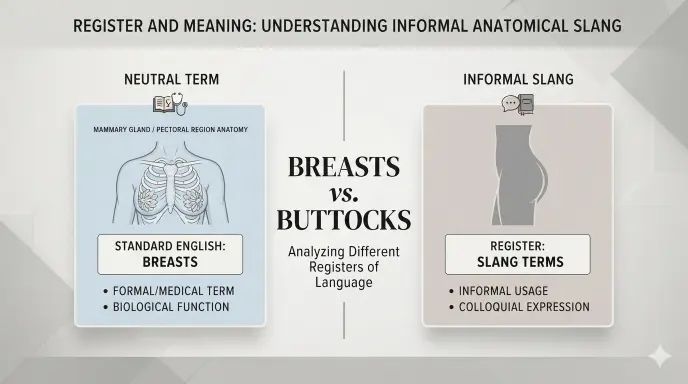
To begin with, tits is a vulgar informal noun referring to breasts, while ass is a vulgar informal noun referring to the buttocks. Therefore, the expression “tits or ass” does not represent two interchangeable words. Instead, it contrasts two different parts of the body.
Moreover, both terms function primarily as nouns in this expression. “Tits” is the plural form of a slang noun, whereas “ass” can have several meanings depending on context. In the phrase under discussion, however, it refers to a person’s buttocks rather than an animal or an insult.
Consequently, “tits or ass” is best understood as a slang comparison rather than a grammatical choice between equivalent vocabulary items.
| Expression | Part of speech | Basic meaning | Register | Typical context |
|---|---|---|---|---|
| Tits | Informal noun | Breasts | Vulgar and casual | Private conversation, slang, humor |
| Ass | Informal noun | Buttocks | Vulgar and casual | Private conversation, slang, humor |
| Breasts | Noun | Female chest anatomy | Neutral | Medical, educational, formal |
| Buttocks | Noun | Anatomical term for the rear | Neutral | Medical, educational, formal |
Mini recap
First, “tits” and “ass” describe different anatomical features.
Next, neither expression is a formal term.
Therefore, the phrase belongs mainly to casual slang.
Finally, neutral words such as “breasts” and “buttocks” work better in professional or educational writing.
Is Tits or Ass a Grammar, Vocabulary, or Usage Issue?
Primarily, this is a vocabulary and usage issue, rather than a difficult grammar problem. The individual words can be grammatically understandable while still being inappropriate for a particular audience.
For example, someone might ask, “Do you prefer tits or ass?” Grammatically, the structure is straightforward. However, the wording is deliberately vulgar and sexual. Therefore, grammatical correctness doesn’t automatically make an expression suitable.
Similarly, formal English normally favors anatomical or neutral vocabulary. Thus, “breasts” and “buttocks” would be more suitable in medical education, journalism, academic writing, or workplace communication.
In contrast, slang may appear naturally among friends who already share an informal communication style. Even then, context matters because the same sentence can sound humorous to one audience and offensive or inappropriate to another.
Furthermore, academic writing requires precision. A researcher discussing body image, anatomy, or cultural attitudes would normally select terminology according to the subject rather than casual slang.
As a result, the central question isn’t simply whether the phrase is grammatically possible. Instead, the more useful question is whether the vocabulary matches the situation.
Tits or Ass in Practical Everyday Usage
In casual speech, “tits” may appear when a speaker is referring to breasts in an intentionally informal or provocative manner.
For instance, someone discussing slang might say, “That phrase uses the word ‘tits’ instead of the more neutral word ‘breasts.’” Here, the term is being analyzed rather than used as a direct comment about another person.
Workplace example
In a workplace, however, this expression generally has no professional purpose. A conversation about an employee’s appearance could create discomfort, distract from the actual subject, or violate workplace communication standards.
Instead, a professional writer would use neutral anatomical terminology when such information is genuinely relevant.
Academic example
Likewise, an academic paper might discuss representations of breasts in advertising, literature, or popular culture. In that setting, “breasts” offers greater precision and neutrality.
Consequently, researchers normally avoid casual slang unless the exact wording itself is part of the subject being studied.
Technology example
Furthermore, online platforms frequently contain slang, abbreviations, memes, and informal discussions. Therefore, users may encounter “tits” in comments, captions, search queries, or humorous posts.
Nevertheless, seeing a slang term online doesn’t mean it is appropriate for every digital environment.
Usage recap
Overall, “tits” communicates a deliberately informal tone.
Therefore, it fits discussions about slang better than professional communication.
When anatomical accuracy matters, “breasts” is clearer.
Ass in Practical Everyday Usage
Similarly, ass is a highly informal word with several meanings in English. Depending on the sentence, it can refer to buttocks, a donkey, or a foolish or unpleasant person.
However, context normally makes the intended meaning clear.
For example, in “He fell on his ass,” the word refers to the buttocks. In “The farmer owns an ass,” it may refer to a donkey. Meanwhile, “Don’t be an ass” uses the term as an insult.
Workplace example
In professional writing, the anatomical meaning is usually better expressed as “buttocks” or, depending on the context, “rear.” Consequently, formal communication benefits from more precise vocabulary.
Academic example
In anatomy, medicine, or scientific discussion, “buttocks” is generally more appropriate than “ass.” Moreover, specialized terminology can eliminate ambiguity.
Technology example
Online conversations, gaming communities, memes, and informal messaging can use “ass” in numerous ways. For example, phrases such as “pain in the ass” are common idiomatic expressions.
However, their presence in everyday internet language doesn’t make them suitable for formal documents.
Usage recap
Overall, “ass” has several meanings.
Therefore, surrounding words determine its interpretation.
In formal contexts, neutral terminology provides greater clarity.
When You Should NOT Use Tits or Ass
Because both terms are strongly informal, several situations call for different vocabulary.
1. Professional emails
First, workplace emails should maintain a respectful and task focused tone. Sexual slang can distract from the intended message.
2. Academic assignments
Second, essays and research papers generally require precise terminology. Consequently, neutral anatomical vocabulary is preferable.
3. Medical communication
Third, medical discussions need clarity. Therefore, anatomical terms such as “breasts” and “buttocks” reduce ambiguity.
4. Job interviews
Fourth, interviews are formal interactions. Thus, sexual slang can shift attention away from professional qualifications.
5. Customer communication
Fifth, customer service messages should accommodate people from different backgrounds. Consequently, vulgar expressions may create unnecessary confusion.
6. Educational material
Sixth, educational content should use terminology that learners can understand without relying on provocative slang.
7. Public announcements
Finally, public communication usually needs broad audience suitability. Therefore, neutral wording is more practical.
Common Mistakes and Decision Rules
Understanding the difference becomes easier when the surrounding purpose is considered.
| Correct sentence | Incorrect sentence | Explanation |
|---|---|---|
| The article discusses breasts in advertising. | The article discusses tits in advertising. | The second version is unnecessarily vulgar for formal writing. |
| The medical text describes the buttocks. | The medical text describes the ass. | The neutral anatomical term provides a more professional tone. |
| The writer analyzes the slang term “tits.” | The writer uses “tits” as formal anatomy. | The first sentence correctly identifies slang as the topic. |
| The study examines cultural views of breasts. | The study examines cultural views of tits. | Academic terminology generally favors neutral vocabulary. |
Decision Rule Box
If you mean breasts in a neutral or formal context, use “breasts.”
If you mean the buttocks in a neutral or formal context, use “buttocks.”
If you’re discussing slang itself, the original terms may be quoted or analyzed when necessary.
If you’re writing for a broad professional audience, choose neutral vocabulary.
Tits or Ass in Modern Technology
Modern digital communication has made slang easier to encounter because people communicate through messaging services, social platforms, forums, gaming communities, and search systems.
Consequently, expressions such as “tits or ass” can appear as search phrases, jokes, memes, captions, comments, or discussions about slang.
However, automated language systems and digital publishing tools generally benefit from contextual interpretation. A phrase can have one meaning when someone asks for its definition and another meaning when it appears as an insult, joke, or sexual comment.
Therefore, anyone creating digital content should consider meaning, audience, intent, and register together.
Most importantly, keyword matching alone doesn’t determine whether wording is appropriate. Context remains essential.
Etymology and Language History
The history of these words also explains why their tones differ from neutral anatomical terminology.
“Tits” developed as an informal word for breasts and is related to older English expressions connected with the breast or nipple. Its modern use is strongly colloquial.
Meanwhile, “ass” has a complicated history because English uses the spelling for more than one concept. The anatomical meaning developed as an informal term for the buttocks, while another meaning refers to a donkey.
Over time, both words became deeply established in spoken English and popular culture.
Nevertheless, their widespread use doesn’t remove their informal character. Language can be common without being appropriate in every setting.
Expert style quotation
“Good word choice depends not only on what a term means, but also on who is reading it, where it appears, and what tone the writer intends.”
This principle is especially useful when dealing with slang.
Two Practical Case Studies
The following examples are illustrative language case studies, designed to demonstrate how register affects communication.
Case Study 1: Workplace Editing
A fictional marketing employee initially wrote a social media draft containing explicit slang. During editorial review, the team replaced the vulgar terminology with neutral wording because the campaign targeted a broad audience.
As a result, the revised copy became easier to use across multiple communication channels without changing the underlying subject.
The lesson is simple: audience awareness can matter as much as dictionary meaning.
Case Study 2: Educational Writing
A fictional student wrote an anatomy assignment using casual slang throughout the paper. The instructor recommended replacing slang with established anatomical terminology.
After revision, the paper used consistent terminology and separated academic explanation from everyday speech.
Consequently, the central argument became clearer.
The lesson is that vocabulary selection influences perceived precision even when the original meaning remains understandable.
Error Prevention Checklist
Before using either expression, consider the purpose of your sentence.
Always use neutral terminology when
You are writing academically.
You are explaining anatomy.
You are preparing medical information.
You are communicating professionally.
You are addressing an unfamiliar audience.
You want a respectful and neutral tone.
Avoid vulgar slang when
The audience is unknown.
The subject is educational.
The setting is professional.
The wording could be misunderstood.
The phrase isn’t necessary to convey the intended meaning.
Related Grammar Confusions You Should Master
Once you understand this distinction, several other vocabulary contrasts become useful.
- Breasts vs chest: anatomical precision versus broader description.
- Buttocks vs bottom: formal anatomy versus everyday neutral language.
- Ass vs arse: American and British informal usage.
- Body vs physique: general reference versus physical description.
- Slang vs colloquial language: overlapping but not identical concepts.
- Vulgar vs informal: tone and social acceptability aren’t always identical.
- Literal vs figurative meaning: context can change interpretation.
- Denotation vs connotation: dictionary meaning versus emotional association.
- Formal vs casual register: vocabulary changes according to situation.
- Anatomical vs euphemistic language: direct terminology versus softer alternatives.
Frequently Asked Questions
What does “tits or ass” mean?
The phrase is informal slang that contrasts breasts with buttocks. It is generally used in casual, provocative, humorous, or sexualized conversation rather than formal communication.
Is “tits or ass” grammatically correct?
The expression can form a grammatically understandable phrase, but grammar isn’t the main issue. Instead, vocabulary choice and social context determine whether the wording is appropriate.
Is “tits” a formal word?
No. “Tits” is an informal and vulgar term for breasts. In professional, medical, and academic writing, “breasts” is normally more suitable.
Is “ass” a formal word?
No. When “ass” refers to the buttocks, it is informal and vulgar. Formal contexts generally favor words such as “buttocks.”
What is the polite word for “tits”?
The neutral anatomical term is breasts. Depending on the context, “chest” may also be appropriate, although it has a broader meaning.
What is the polite word for “ass”?
The standard anatomical term is buttocks. Depending on the sentence, “bottom” can provide a softer everyday alternative.
Why do people say “tits or ass”?
People may use the phrase as slang, humor, provocative conversation, or a way of discussing physical preferences. Its meaning depends heavily on context and speaker intention.
Can “tits” and “ass” be used in academic writing?
They can appear when the academic subject specifically concerns slang, language, popular culture, or a quotation. Otherwise, neutral terminology is generally more appropriate.
Is “tits or ass” offensive?
The expression can be perceived as vulgar or objectifying because of its sexualized wording. However, interpretation depends on audience, setting, relationship, and surrounding language.
Final Conclusion:
Ultimately, tits or ass is an informal slang expression contrasting two different body areas. “Tits” refers vulgarly to breasts, while “ass” commonly refers vulgarly to the buttocks.
Therefore, the distinction isn’t primarily grammatical. Instead, it concerns vocabulary, register, audience, and context. For casual slang analysis, the original wording can be discussed when its meaning is relevant. However, for academic, professional, medical, or educational communication, neutral terminology is generally clearer.
Above all, effective language isn’t only about choosing a word that people understand. It also involves selecting wording that suits the audience, purpose, setting, and intended tone.









