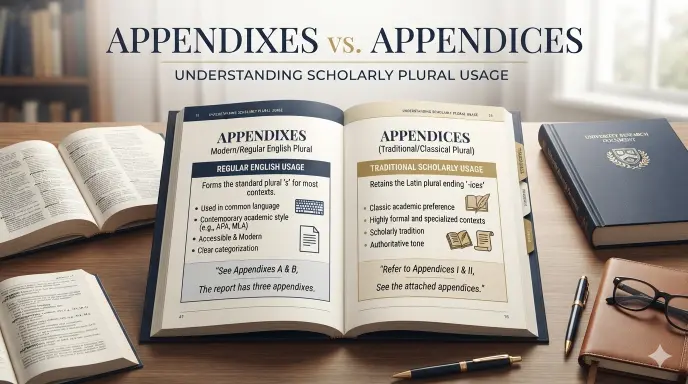
Have you ever wondered whether the plural of appendix should be written as appendixes or appendices? You are not alone. Both forms appear in modern English, but they can differ in usage and context. Understanding the distinction is especially useful when writing academic papers, reports, books, medical documents, or other formal content.
The word appendix has more than one accepted plural form. Appendices follows the traditional Latin plural pattern, while appendixes is an established English plural. The choice may depend on the subject, writing style, and the context in which the word is being used.
In this guide, we will explain appendixes vs appendices in simple language, including their meanings, pronunciation, grammar, examples, and common mistakes. Whether you are a student, professional writer, researcher, or English learner, this comparison will help you choose the appropriate form confidently and use it naturally.
Appendixes or Appendices: The Basic Answer
First, appendix is a singular noun. It can describe extra material placed at the end of a document, or it can refer to the anatomical organ attached to the large intestine. When more than one is meant, English permits two plural forms: appendices and appendixes.
However, the choice can depend on context. In scholarly and formal writing, appendices is particularly familiar because it preserves the traditional Latin based plural. Meanwhile, appendixes follows a regular English plural pattern and remains completely legitimate.
Therefore, neither spelling should automatically be called incorrect. Instead, writers should consider the subject, audience, publication style, and surrounding vocabulary.
This distinction matters because a writer preparing a thesis, annual report, legal document, medical paper, or technical manual may want the form that fits the context most naturally.
Appendixes or Appendices: What’s the Difference?
First, both words are plural nouns. Their singular form is appendix, which functions as a noun when referring to one supplementary section or one anatomical structure.
Next, appendices is the traditional plural borrowed from Latin. It is widely associated with formal, academic, scholarly, and documentary writing.
Meanwhile, appendixes is the regular English plural. It adds the familiar es ending and is also recognized as correct English. Dictionary references list both forms as plurals of appendix.
| Feature | Appendices | Appendixes |
|---|---|---|
| Singular form | Appendix | Appendix |
| Part of speech | Noun | Noun |
| Number | Plural | Plural |
| Meaning | More than one appendix | More than one appendix |
| Common context | Academic and formal documents | General and anatomical contexts |
| Status | Standard | Standard |
| Pronunciation | uh pen duh sees | uh pen dik siz |
Furthermore, appendices is often encountered when discussing several supplementary sections at the end of a report or academic work. For example, a dissertation might contain several appendices containing survey forms, calculations, transcripts, or supporting evidence.
Conversely, appendixes can naturally appear when discussing multiple anatomical structures. Dictionary.com notes that appendixes is commonly used for the anatomical meaning, although usage can vary.
Quick Recap
In short, both forms are correct.
However, appendices is especially familiar in formal and scholarly documents.
Meanwhile, appendixes is a regular English plural and remains fully acceptable.
Therefore, context should guide your choice rather than the assumption that one form is always wrong.
Is Appendixes or Appendices a Grammar, Vocabulary, or Usage Issue?
First, this is mainly a grammar and usage issue, rather than a difference in meaning.
Both words represent the plural of appendix. Consequently, replacing one with the other usually does not change what the sentence means.
However, usage preferences can change according to subject matter.
For example:
The research paper contains three appendices.
Here, appendices sounds natural because the sentence discusses supporting academic material.
Similarly:
The surgeon examined several appendixes during the study.
Here, appendixes can work naturally because the subject involves anatomical structures.
Nevertheless, this distinction should not become an absolute rule. Both plural forms can occur in different contexts, and actual published usage demonstrates variation. Dictionary.com specifically recognizes both forms while noting different tendencies according to meaning.
Formal Versus Informal Usage
Generally, appendices has a more traditional scholarly appearance. Therefore, students, researchers, editors, and professional writers often encounter it in academic material.
Meanwhile, appendixes looks more like a regular English plural. Consequently, it can feel more straightforward in ordinary prose.
Nevertheless, calling appendixes informal would be misleading. It is a recognized standard plural, not slang or an error.
Academic Versus Casual Writing
In academic writing, appendices is a familiar choice.
For example:
The statistical tables are provided in Appendices A and B.
However, a general reader can also understand:
The statistical tables are provided in Appendixes A and B.
Therefore, the central issue is usually consistency with the chosen style rather than grammatical correctness.
How to Use Appendices Correctly
First, appendices works particularly well when referring to multiple supplementary sections attached to a larger document.
Workplace Example
The complete financial calculations are available in the appendices.
Here, the word clearly refers to several supporting sections.
Academic Example
The interviews used for the dissertation are reproduced in the appendices.
Likewise, this sentence uses the traditional plural naturally in scholarly writing.
Technology Example
The software documentation includes several appendices containing configuration details.
Consequently, the word can appear naturally in technical documentation as well.
Usage Recap
Overall, use appendices when discussing multiple supporting sections, especially when your document has a formal or scholarly tone.
Additionally, if a publication guide specifies this form, follow that guide consistently throughout the document.
How to Use Appendixes Correctly
Next, appendixes is also a legitimate plural. Therefore, writers should not mark it as a spelling mistake merely because another editor prefers appendices.
Workplace Example
The compliance manual contains several appendixes with additional procedures.
Here, the regular plural works perfectly well.
Academic Example
The book includes two appendixes containing supplementary exercises.
Although appendices may appear more traditional, appendixes remains grammatically valid.
Technology Example
The technical guide has three appendixes covering advanced settings.
Therefore, technical writers can use either form when no specific house style requires another choice.
Usage Recap
Ultimately, appendixes is not an incorrect plural.
Rather, it is a standard English formation that may be particularly useful when you want a straightforward plural or when your publication style already uses regular English endings.
When You Should NOT Use Appendixes or Appendices
First, avoid choosing between these forms without identifying whether you mean one item or several.
- Do not use a plural when discussing one section. Write: See the appendix for the complete table. Not: See the appendices for the complete table.
- Do not use appendices when only one supplementary section exists. The singular form is appendix.
- Do not assume appendixes is always wrong. It is a recognized plural form.
- Do not automatically replace appendixes with appendices during editing. First, check the publication’s preferred style.
- Do not mix singular and plural forms incorrectly. For example, two appendix is incorrect because the quantity requires a plural noun.
- Do not confuse appendices with unrelated plural formations. The ending may resemble other classical plurals, but every word has its own established usage.
- Do not change the form halfway through a document without a reason. Consistency makes professional writing easier to read.
- Do not treat pronunciation as the only deciding factor. Context and grammatical number matter first.
Common Mistakes: Appendixes or Appendices
Because both forms are valid, the most frequent errors involve number, consistency, or unnecessary correction.
| Correct sentence | Incorrect sentence | Explanation |
|---|---|---|
| The report contains three appendices. | The report contains three appendix. | A quantity greater than one requires a plural noun. |
| The appendix contains the survey. | The appendices contains the survey. | One section requires the singular form. |
| The book has two appendixes. | The book has two appendix. | The plural form is required after two. |
| The appendices provide supporting data. | The appendices provides supporting data. | A plural subject requires the plural verb form. |
| Appendix A contains the questionnaire. | Appendices A contains the questionnaire. | One labeled section requires singular agreement. |
| Appendices A and B contain supporting tables. | Appendices A and B contains supporting tables. | Multiple sections require plural verb agreement. |
Furthermore, writers sometimes believe that appendices is the only acceptable form because it appears frequently in academic documents. That assumption creates unnecessary corrections.
Instead, remember that dictionaries recognize both appendices and appendixes as plural forms.
Decision Rule Box
If you mean one supplementary section or one anatomical structure, use “appendix.”
If you mean several supplementary sections or structures, use “appendices” or “appendixes.”
For formal scholarly material, “appendices” is a familiar traditional choice.
For regular English usage, “appendixes” is also correct.
Appendixes or Appendices in Modern Technology and Intelligent Tools
Today, technical documents frequently contain supplementary material. Consequently, both plural forms can appear in software manuals, product documentation, research reports, data descriptions, and instructional material.
For instance:
The developer guide contains four appendices covering data formats and testing procedures.
Likewise:
The installation manual includes two appendixes with advanced configuration information.
However, consistency remains more important than forcing one spelling into every technical environment.
Furthermore, automated writing and editing software may suggest one form because it recognizes frequency patterns or follows a particular dictionary. Nevertheless, such suggestions should be checked against the publication’s preferred style.
Therefore, a human editor should consider meaning, audience, document type, and consistency before making a correction.
Where Does Appendix Come From?
Historically, appendix comes from Latin and carries the sense of something added or attached. Dictionary.com traces the word to Latin appendix, related to appendere, meaning to add or attach. The English word entered recorded usage in the sixteenth century.
Furthermore, the traditional plural appendices reflects its Latin origin.
Meanwhile, English also developed the regular plural appendixes. Consequently, modern English recognizes both the inherited form and the regular English form.
This history explains why the two spellings coexist rather than one being a simple misspelling of the other.
Expert Style Note
Dictionary editors describe appendices and appendixes as plural forms of appendix, while also identifying differences in their common contextual patterns.
That distinction is useful because it prevents writers from turning a usage preference into an incorrect grammatical rule.
Two Practical Case Studies
Case Study One: University Research Paper
Consider a student preparing a dissertation containing survey questions, interview transcripts, and detailed statistical tables.
Initially, the student writes:
The supporting materials are included in the appendixes.
An editor changes the word to appendices because the document follows a formal academic convention.
The important result is not that appendixes was grammatically wrong. Instead, the revision creates closer alignment with the formal register expected in many scholarly documents.
Thus, the lesson is simple: style preference can influence the choice even when both forms are valid.
Case Study Two: Medical Discussion
Now consider a medical text discussing multiple anatomical structures.
A writer chooses:
The patients had their appendixes examined during the study.
In this context, appendixes is a natural choice because it follows the regular English plural and is associated with anatomical usage in dictionary guidance.
Therefore, changing the word automatically to appendices would not necessarily improve grammatical accuracy.
The practical lesson is that subject matter can influence natural usage.
Error Prevention Checklist
Before submitting your document, check the following points.
Always Use Appendix When
- You mean one supplementary section.
- You are referring to one anatomical structure.
- The sentence describes a single item.
- A document contains only one additional section.
Always Consider Appendices When
- You are writing formal academic material.
- You are naming multiple supplementary sections.
- Your institutional style guide prefers the traditional plural.
- You are labeling several supporting sections in a report.
Always Consider Appendixes When
- Your publication accepts the regular English plural.
- You are discussing several anatomical structures.
- Your house style already uses this spelling.
- You want consistency with nearby terminology.
Never Assume
- Appendixes is automatically wrong.
- Appendices is mandatory in every context.
- A Latin based plural is always more correct.
- A dictionary preference creates an absolute grammar rule.
Related Grammar Confusions You Should Master
Furthermore, understanding related plural patterns can make formal writing considerably easier. Several English nouns preserve older plural forms while also developing regular alternatives.
Consider these useful topics:
- Indexes or indices
- Formulas or formulae
- Matrices or matrixes
- Memorandums or memoranda
- Syllabuses or syllabi
- Cactuses or cacti
- Octopuses or octopi
- Criteria or criterion
- Phenomena or phenomenon
- Data as singular or plural
Moreover, these examples show why English cannot always be reduced to one simple pluralization rule. Historical origin, established usage, professional convention, and ordinary English development can all influence the form writers encounter.
Therefore, learning the pattern behind a word is often more useful than memorizing isolated corrections.
Frequently Asked Questions
What is the plural of appendix?
The plural can be appendices or appendixes. Both forms are recognized in standard English. However, appendices is especially familiar in formal writing concerning supplementary sections.
Is appendices the only correct plural of appendix?
No. Appendixes is also a standard plural. Therefore, calling it an error is inaccurate. The appropriate choice depends on context, style, and intended usage.
Is appendixes grammatically correct?
Yes. Appendixes is grammatically correct as the plural of appendix. It follows a regular English plural pattern and appears in both general and anatomical contexts.
Should I use appendices in academic writing?
Generally, appendices is a familiar choice in academic writing because it has a traditional scholarly appearance. Nevertheless, always follow your university, journal, publisher, or institutional style instructions when they specify a preferred form.
What is the difference between appendix and appendices?
Appendix is singular, meaning one supplementary section or structure. Appendices is plural, meaning more than one. Therefore, the primary grammatical difference is number.
Can I say appendixes in a research paper?
Yes. Appendixes is grammatically valid. However, if your university or publisher prefers appendices, follow that established convention for consistency.
How do you pronounce appendices?
Appendices is commonly pronounced approximately as “uh pen duh sees.” The final sound differs from the regular English pronunciation of appendixes. Dictionary references list these forms separately.
Which is more formal, appendices or appendixes?
Appendices generally has a more traditional formal appearance, particularly in scholarly and documentary writing. Nevertheless, appendixes remains standard and should not automatically be classified as informal or incorrect.
Can appendix refer to something besides a document section?
Yes. The word can refer to an anatomical structure as well as supplementary material attached to a document. Consequently, context determines which meaning the reader understands.
Final Conclusion:
Ultimately, appendixes or appendices presents a choice between two accepted plural forms of appendix. Both are grammatically legitimate, although their usage patterns differ.
For academic papers, dissertations, reports, and other formal documents, appendices is a particularly familiar traditional choice. Meanwhile, appendixes is also correct and can be especially natural in general or anatomical contexts.
Therefore, the safest approach is to identify whether you mean one item or several, then check the style expected by your audience. Most importantly, don’t label appendixes as wrong simply because appendices appears more familiar. In short, one appendix becomes either appendices or appendixes when referring to multiple items.









