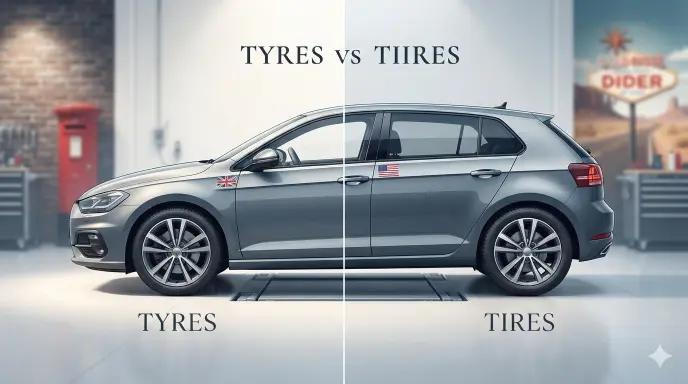
Have you ever wondered whether you should write “tyres” or “tires” when talking about the rubber wheels on a car? You may see both spellings online, in books, and on automotive websites, which can make the difference confusing. The good news is that both words are correct, but they belong to different varieties of English.
The main difference comes down to British and American English. “Tyres” is the standard spelling in British English and is commonly used in the UK and several other countries. “Tires” is the standard American English spelling and is widely used in the United States. The meaning is the same, so the choice usually depends on your audience and preferred English style.
Understanding tyres or tires is useful for writers, students, drivers, bloggers, and anyone creating content for an international audience. In this guide, we will explain the spelling difference, pronunciation, meaning, regional usage, and practical examples so you can confidently choose the right form for your writing.
Tyres vs Tires: What’s the Difference?
At first glance, tyres and tires look like two different words. However, they have the same meaning when they describe the rubber coverings fitted around vehicle wheels.
Tyres is a noun and represents the standard British English spelling. It is commonly used in the United Kingdom, Ireland, Australia, New Zealand, and several other regions influenced by British English.
Tires is also a noun when it refers to vehicle wheels. It is the standard American English spelling and is widely used throughout the United States. In Canadian English, usage can vary depending on the publication and context.
There is also another important point. Tires can be a verb, while tyres cannot normally serve that function in standard English.
For example:
The car needs new tires.
Here, tires means rubber coverings around the wheels.
However:
Driving for ten hours tires me.
In this sentence, tires means causes someone to become tired.
Comparison Table
| Feature | Tyres | Tires |
|---|---|---|
| Meaning | Vehicle wheel covering | Vehicle wheel covering |
| Part of speech | Noun | Noun or verb |
| Main English variety | British English | American English |
| Common in Britain | Yes | No, for this meaning |
| Common in America | No, for this meaning | Yes |
| Refers to vehicle equipment | Yes | Yes |
| Pronunciation | Usually the same | Usually the same |
| Spelling difference | Uses y | Uses i |
| Formal correctness | Correct in British usage | Correct in American usage |
Mini Recap
In short, tyres and tires have the same automotive meaning.
British English generally prefers tyres, whereas American English generally prefers tires.
Consequently, the correct choice depends mainly on regional spelling conventions.
For consistent writing, follow the spelling system used by your intended readers.
Is Tyres vs Tires a Grammar, Vocabulary, or Usage Issue?
The difference between tyres and tires is primarily a spelling and regional usage issue, rather than a difference in meaning.
Both words identify the same part of a vehicle when they function as nouns. Therefore, someone writing in British English would normally choose tyres, while an American writer would normally choose tires.
For example, a British newspaper might write:
The driver replaced all four tyres before the journey.
An American publication would typically write:
The driver replaced all four tires before the trip.
Notice that the meaning remains unchanged. The regional spelling is what changes.
Furthermore, the distinction becomes slightly more interesting because tires has another grammatical role. As a verb, tires means makes someone feel tired.
For instance:
Long meetings tire employees.
Or:
Long meetings tire employees after several hours.
By contrast, tyres does not have this standard verbal meaning.
Formal and Informal Usage
Neither spelling is automatically more formal. Instead, formality depends on the surrounding writing.
A formal British report should use tyres if it follows British spelling conventions. Similarly, a formal American report should use tires.
Academic Usage
Academic writers should maintain consistency. If the paper follows British English, use tyres throughout. If it follows American English, use tires throughout.
Switching between both forms without a clear reason can make a document look inconsistent.
Casual Usage
In everyday communication, readers generally understand both forms. Nevertheless, regional expectations still matter when you want your writing to look polished and natural.
How to Use Tyres Correctly
Tyres is the preferred spelling in British English when discussing vehicle wheels.
For instance:
The mechanic inspected the tyres before the annual service.
Likewise:
These tyres are designed for wet roads.
The word appears frequently in discussions about cars, motorcycles, trucks, buses, bicycles, and commercial vehicles.
Workplace Example
A British automotive company might write:
Please check the condition of the tyres before releasing the vehicle.
Here, tyres fits the company’s regional spelling convention.
Academic Example
A university paper discussing transportation could state:
Properly maintained tyres can contribute to safer vehicle operation.
Therefore, the spelling is entirely appropriate in formal educational writing that follows British conventions.
Technology Example
A vehicle monitoring system designed for a British market might display:
Low tyre pressure detected.
Consequently, software interfaces often reflect the language conventions of the market they serve.
Usage Recap
Use tyres when your writing follows British English conventions.
In particular, choose this spelling for British audiences, British publications, and organizations that officially follow British spelling.
How to Use Tires Correctly
Tires is the standard American spelling for the rubber coverings fitted around vehicle wheels.
For example:
The mechanic checked the tires before the road trip.
Similarly:
Winter tires can provide additional traction in suitable conditions.
Workplace Example
An American repair shop could write:
Our technicians inspect tires for uneven wear.
The spelling fits standard American usage.
Academic Example
A transportation study written in American English might say:
Tire pressure can influence vehicle handling and fuel consumption.
Consequently, tire is the expected form in American academic writing.
Technology Example
A vehicle application intended for American users might display:
Check tire pressure.
Therefore, software localization can influence which spelling appears on dashboards, applications, websites, and digital manuals.
Usage Recap
Use tires when following American English.
Most importantly, choose it consistently when writing for American readers or using an American style guide.
When You Should NOT Use Tyres or Tires
Although both forms can describe the same vehicle component, there are several situations where choosing the wrong spelling can create confusion or inconsistency.
1. Do Not Mix Regional Spellings Randomly
Avoid writing tyres in one paragraph and tires in another when both passages follow the same English variety.
Consistency makes professional writing easier to read.
2. Do Not Assume One Form Is Universally Correct
Neither spelling should automatically replace the other in every publication.
Instead, consider the intended readership.
3. Do Not Use Tyres in American Style Without a Reason
If an American document consistently follows American spelling, tires is normally the appropriate choice.
4. Do Not Use Tires in British Style Without Checking the House Style
British publications generally expect tyres when referring to vehicle equipment.
5. Do Not Confuse Tire With the Verb Tire
In American English, tire can refer to becoming tired or causing tiredness.
For example:
The long journey tires the passengers.
Here, replacing tire with tyre would change the standard grammatical form.
6. Do Not Change Quoted Material
If a quotation uses tyres, don’t automatically change it to tires merely to match your preferred spelling.
The original wording may need to remain intact.
7. Do Not Ignore Brand or Market Conventions
Automotive businesses often create content for specific markets.
Therefore, their spelling should normally match the language expectations of their customers.
8. Do Not Treat the Difference as a Difference in Vehicle Parts
A British tyre and an American tire are not different automotive products simply because their spellings differ.
Common Mistakes: Tyres or Tires
| Correct sentence | Incorrect sentence | Explanation |
|---|---|---|
| The car needs new tyres. | The car needs new tires. | This is inconsistent if the surrounding document follows British spelling. |
| The car needs new tires. | The car needs new tyres. | This is inconsistent in standard American writing. |
| The tires are worn. | The tyres are worn. | The American form is normally tires. |
| The tyres need checking. | The tires need checking. | British writing normally uses tyres. |
| The journey tires me. | The journey tyres me. | Here, tire is functioning as a verb. |
| The tires were replaced. | The tyres were replaced. | American English normally uses tires. |
Decision Rule Box
If you are writing British English, use “tyres” for vehicle wheels.
If you are writing American English, use “tires” for vehicle wheels.
If “tires” means causes someone to become tired, use “tires” regardless of the vehicle spelling issue.
This simple rule handles most everyday situations.
Tyres and Tires in Modern Technology
Modern vehicles increasingly depend on digital systems that monitor wheel related information.
For example, dashboards can display pressure warnings, maintenance reminders, and inspection notifications. However, the wording shown on the screen often depends on the target market.
A system designed for British users may display:
Check tyre pressure.
Meanwhile, an American version may display:
Check tire pressure.
This distinction also appears in automotive applications, service portals, digital manuals, and online shopping interfaces.
Consequently, spelling is not merely a matter of personal preference when creating technical content. Localization matters because users expect familiar terminology.
Moreover, automated writing and editing tools can recognize both spellings, but they may recommend one form based on the selected English variety. Therefore, writers should always check the language setting before accepting spelling suggestions.
Where Did Tyres and Tires Come From?
The two spellings developed through different English spelling traditions.
The word tire has a long history in English and was associated with wheels and related coverings. Over time, British usage increasingly adopted tyre for the vehicle related meaning.
American English retained tire.
This pattern is similar to several other spelling differences between British and American English.
For example, British English commonly uses colour, while American English uses color. British English often uses centre, whereas American English uses center.
Therefore, the difference between tyres and tires fits a much broader historical pattern.
An Expert Style Observation
“When two spellings carry the same meaning, regional consistency matters more than choosing one spelling as universally correct.”
The practical lesson is straightforward. Match your spelling to your audience rather than treating regional variation as an error.
Two Practical Case Studies
Case Study 1: British Automotive Service
Imagine a vehicle maintenance company serving customers throughout Britain.
Its website repeatedly uses British spelling, including terms such as colour, centre, and organisation. If its vehicle pages suddenly switch from tyres to tires, readers may notice the inconsistency.
Using tyres throughout creates a unified language style.
The result is a clearer customer experience because terminology matches the company’s regional audience.
Case Study 2: American Vehicle Application
Now consider a mobile application created primarily for drivers in the United States.
Its interface includes messages such as:
Check tire pressure.
Using tires keeps the interface aligned with ordinary American usage.
If the application instead displayed tyres without a localization reason, users could still understand the message, but the terminology might appear unfamiliar or inconsistent with the rest of the interface.
These examples demonstrate an important principle: audience determines preferred spelling.
Error Prevention Checklist
Always use Tyres when:
- Your document follows British English.
- Your primary audience is British.
- Your company uses British spelling conventions.
- You are writing British automotive material.
- Your publication style specifically requires British spelling.
Always use Tires when:
- Your document follows American English.
- Your primary audience is American.
- Your company follows American spelling.
- You are writing American automotive material.
- You mean the verb that describes causing tiredness.
Never switch forms without a reason
Consistency is the key. Once you establish a regional spelling system, continue using it unless a quotation, proper name, technical specification, or other special circumstance requires the original wording.
Related Grammar Confusions You Should Master
Understanding tyres vs tires becomes easier when you recognize that English contains many regional spelling differences.
Here are several related topics worth learning:
- Colour vs color
- Centre vs center
- Favourite vs favorite
- Organise vs organize
- Travelling vs traveling
- Defence vs defense
- Licence vs license
- Realise vs realize
- Programme vs program
- Grey vs gray
Similarly, some differences involve vocabulary rather than spelling.
For example, British English commonly uses lorry, while American English generally uses truck. Likewise, British speakers may say petrol, while Americans normally say gasoline or gas.
Therefore, learning regional English involves more than memorizing isolated spelling pairs.
Tyres or Tires: Which One Should You Choose?
Ultimately, there is no universal winner between tyres and tires.
Instead, the appropriate spelling depends on the English variety you are using.
Choose tyres for British English and related regional varieties that follow British spelling conventions.
Choose tires for American English.
Furthermore, remember that tires has an additional grammatical function as a verb meaning causes someone to become tired. In that situation, the spelling is not simply an American alternative to tyres.
The safest approach is therefore simple: identify your audience, establish your spelling convention, and remain consistent.
Frequently Asked Questions
What is the correct spelling, tyres or tires?
Both spellings are correct. Tyres is the standard British spelling for vehicle wheels, while tires is the standard American spelling.
Is tyres British or American?
Tyres is primarily British English. It is also used in several other regions that follow British spelling conventions.
Is tires British or American?
Tires is the standard American spelling when referring to vehicle wheels. It is also understood internationally.
Why do British people spell tires as tyres?
British English developed spelling conventions that distinguish tyre from the American form tire for the vehicle component. The difference is historical and regional.
Do Canadians use tyres or tires?
Canadian English can show variation, although tires is commonly used in Canadian contexts. Individual publications may follow their own style conventions.
Is tire also a verb?
Yes. In English, tire can function as a verb meaning to make someone tired or to become tired. The form tires can mean causes someone to become tired.
Should I write tyre or tire in a formal document?
Follow the English variety required by your audience, organization, institution, or style guide. British English generally uses tyre, while American English generally uses tire.
Are tyres and tires different products?
No. When referring to vehicle wheel coverings, the two spellings describe the same basic component. The difference is primarily regional spelling.
Which spelling should a website use?
A website should choose the spelling that matches its target audience and overall language style. Consistency throughout the site is more important than treating either form as universally correct.
Can I use both tyres and tires in one article?
You can, but normally you shouldn’t switch between them randomly. Use one regional spelling consistently unless a quotation, brand name, technical source, or other special context requires another form.
Conclusion:
The difference between tyres and tires is mainly a matter of regional English spelling. British English uses tyres, while American English uses tires when referring to vehicle wheel coverings. Both forms communicate the same automotive meaning.
Therefore, the best choice depends on your audience and writing convention. If your readers expect British English, choose tyres. If they expect American English, choose tires.
Finally, remember that tires can also function as a verb meaning causes someone to become tired. That separate grammatical use makes context especially important. When in doubt, identify your target readers first, select the appropriate English variety, and maintain that spelling consistently from beginning to end.









