English verb forms can be surprisingly confusing, especially when two words look almost identical but follow different grammar patterns. Shrank or shrunk is a common example. Both forms come from the verb shrink, but they are not always interchangeable. If you have ever wondered whether you should write “the shirt shrank” or “the shirt shrunk,” understanding the difference can make your writing more accurate and natural.
The good news is that the rule is easier than it first appears. “Shrank” is generally used as the simple past form of “shrink,” while “shrunk” is commonly used as the past participle, especially with helping verbs such as “has,” “have,” or “had.” This guide explains the distinction in clear, practical English with examples you can use in everyday conversation, academic writing, and professional communication. You will also learn common mistakes, sentence patterns, and a simple rule to help you choose the correct form confidently.
Shrank or Shrunk: What’s the Difference?
The words shrank and shrunk both come from the irregular verb shrink, which means to become smaller or to cause something to become smaller. However, they perform different grammatical jobs.
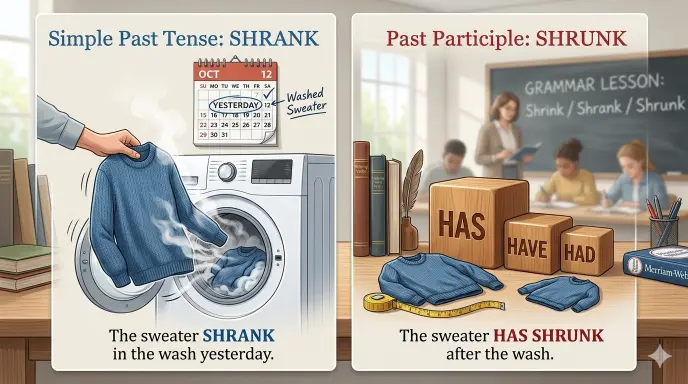
Shrank is the simple past form. It describes an action that happened and finished in the past.
For example:
“The sweater shrank after washing.”
Here, the action happened in the past, and no helping verb is required.
Shrunk, on the other hand, is normally the past participle. It usually appears with a helping verb such as has, have, or had.
For example:
“The sweater has shrunk after washing.”
Therefore, the main difference is not meaning. Instead, the difference concerns verb tense and sentence structure.
| Word | Part of speech | Verb form | Typical use | Example |
|---|---|---|---|---|
| Shrank | Verb | Simple past | Completed past action | The fabric shrank yesterday. |
| Shrunk | Verb | Past participle | Perfect tenses | The fabric has shrunk. |
| Shrink | Verb | Base form | Present or infinitive | Clothes can shrink. |
| Shrinking | Verb form | Present participle | Continuous action | The fabric is shrinking. |
Quick Recap
Shrank normally stands alone as the past tense of shrink.
Shrunk normally works with a helping verb in perfect constructions.
Consequently, “It shrank” is correct for a completed past event.
Meanwhile, “It has shrunk” is correct when using the present perfect.
The choice depends on the structure of the entire sentence, not simply on the meaning of becoming smaller.
Is Shrank or Shrunk a Grammar, Vocabulary, or Usage Issue?
The confusion is primarily a grammar and usage issue, rather than a vocabulary problem. Both forms describe the same basic idea, but their grammatical functions differ.
For instance, “The population shrank last year” uses simple past. The sentence describes a completed event at a definite point in the past.
By contrast, “The population has shrunk considerably” uses the present perfect. The statement connects a past change with the present situation.
Therefore, the two forms aren’t normally interchangeable.
In formal writing, correct tense selection matters because readers expect the verb structure to communicate time accurately. In casual conversation, however, speakers sometimes use the forms incorrectly without causing serious confusion.
Academic writing generally benefits from maintaining the distinction. Similarly, workplace reports, research papers, business summaries, and technical documentation should use each form according to its grammatical role.
Consequently, remember this basic pattern:
Simple past: subject + shrank
Present perfect: subject + has or have + shrunk
Past perfect: subject + had + shrunk
This simple pattern resolves most uncertainty.
When to Use Shrank
Use shrank when you are describing a completed action in the past without a perfect tense construction.
For example, a workplace report might say:
“The department’s operating budget shrank during the previous quarter.”
Here, the event belongs to a completed period.
An academic writer might say:
“The sample size shrank after several participants withdrew from the study.”
Again, the action is presented as a completed past event.
Technology writing can use the same form:
“The application’s storage footprint shrank after the developers removed unnecessary files.”
In each example, the verb describes something that became smaller at a particular point or during a completed period.
Workplace Example
“The company shrank its regional workforce last year.”
This sentence identifies a completed past action. Therefore, shrank is appropriate.
Academic Example
“The experimental group shrank after several subjects left the study.”
Because the event occurred in the past, shrank fits naturally.
Technology Example
“The database shrank after outdated records were removed.”
Here, the reduction occurred after a completed technical operation.
Usage Recap
Use shrank when the sentence tells the reader that something became smaller in the past.
Usually, no helping verb is needed.
Therefore, “The market shrank” is grammatically complete.
Similarly, “The file size shrank” correctly describes a completed reduction.
When to Use Shrunk
Use shrunk when the sentence requires the past participle form of shrink. Most commonly, this happens with has, have, or had.
For example:
“The sweater has shrunk.”
The helping verb “has” signals the present perfect construction.
A workplace report might state:
“Customer demand has shrunk since the policy changed.”
An academic paper could say:
“The population has shrunk significantly over the observed period.”
A technology article might explain:
“The application’s memory usage has shrunk after the latest update.”
The same form also works with the past perfect:
“By the end of the year, the available budget had shrunk considerably.”
In each example, shrunk participates in a larger verb construction.
Workplace Example
“Revenue has shrunk since the market changed.”
The present perfect connects an earlier change with the current situation.
Academic Example
“The population has shrunk over several decades.”
The effect continues to matter in the present, so the present perfect is suitable.
Technology Example
“The installation package has shrunk considerably after compression.”
The statement focuses on the resulting current size.
Usage Recap
Use shrunk when another verb such as has, have, or had requires a past participle.
Therefore, “has shrunk” and “had shrunk” are standard constructions.
However, “It shrunk yesterday” is generally not the preferred standard form in careful English when simple past is intended. In that situation, shrank is the traditional choice.
When You Should NOT Use Shrank or Shrunk
Several common situations create unnecessary mistakes. Therefore, check the sentence structure before selecting either form.
1. Don’t use shrunk as ordinary simple past
Incorrect:
“The shirt shrunk yesterday.”
Better:
“The shirt shrank yesterday.”
The sentence describes a completed event, so simple past is required.
2. Don’t use shrank after has
Incorrect:
“The shirt has shrank.”
Better:
“The shirt has shrunk.”
The verb after “has” needs the past participle.
3. Don’t use shrank after have
Incorrect:
“The fabric have shrank.”
Better:
“The fabric has shrunk.”
Besides the participle issue, the singular subject requires “has.”
4. Don’t use shrunk after a simple past subject without a helping verb
In standard usage, this construction is usually inappropriate:
“The company shrunk last year.”
Prefer:
“The company shrank last year.”
The sentence needs the simple past form.
5. Don’t choose based only on pronunciation
Both forms may sound familiar in everyday speech. Nevertheless, spelling and grammatical position determine the correct written form.
6. Don’t assume every past construction uses the same form
English irregular verbs often change according to tense. Therefore, the past form isn’t always identical to the participle.
7. Don’t confuse tense with meaning
Both words communicate reduction in size, quantity, influence, or extent. Their difference primarily concerns grammatical construction.
8. Don’t rely on casual speech for formal writing
Everyday conversation can contain nonstandard forms. However, academic and professional writing benefits from following established standard usage.
Common Mistakes: Correct Sentence, Incorrect Sentence, and Explanation
| Correct sentence | Incorrect sentence | Explanation |
|---|---|---|
| The shirt shrank yesterday. | The shirt shrunk yesterday. | Simple past requires shrank in standard usage. |
| The shirt has shrunk. | The shirt has shrank. | Has requires the past participle shrunk. |
| The market shrank last year. | The market shrunk last year. | The completed past event takes shrank. |
| The market has shrunk. | The market has shrank. | Present perfect requires shrunk. |
| The budget had shrunk. | The budget had shrank. | Had is followed by the past participle. |
| The company shrank rapidly. | The company shrunk rapidly. | The sentence uses simple past. |
| The population has shrunk. | The population has shrank. | Has requires the participle. |
Decision Rule Box
If you mean a completed past action, use “shrank.”
If you need a past participle after has, have, or had, use “shrunk.”
This rule works in most standard English sentences.
For example:
“The business shrank in 2024.”
“The business has shrunk since 2024.”
“The business had shrunk before the merger.”
Therefore, look for the helping verb first. If has, have, or had appears before the verb, shrunk will normally be the appropriate choice.
Shrank and Shrunk in Modern Technology
Modern technology writing frequently describes reductions in storage, file size, memory use, data volume, staffing, processing requirements, and system complexity.
For example:
“The file size shrank after the conversion.”
However, a current state may be expressed differently:
“The file size has shrunk after compression.”
Likewise, technical documentation might state:
“The application’s memory footprint shrank after the previous release.”
A later report could say:
“The application’s memory footprint has shrunk considerably.”
Consequently, the same technical subject can require either form depending on the time relationship being expressed.
This distinction becomes especially useful in software documentation because technical writers frequently compare previous conditions with current results.
The Etymology of Shrink, Shrank, and Shrunk
The verb shrink has a long history in English and belongs to a group of irregular verbs whose forms developed through earlier stages of the language.
Over time, English speakers retained different vowel patterns for various forms. Consequently, modern English has the familiar sequence shrink, shrank, shrunk.
This pattern resembles other irregular verbs that change internally rather than simply adding an ending.
For example, we have:
“sing, sang, sung”
“drink, drank, drunk”
“begin, began, begun”
Likewise:
“shrink, shrank, shrunk”
Understanding this pattern can make the forms easier to remember.
An Expert Style Principle
“Choose the verb form according to its grammatical position, not merely according to the meaning you want to express.”
This principle applies far beyond shrank and shrunk. It is particularly useful when learning irregular verbs because tense and participle forms often look different.
Two Practical Case Studies
Case Study 1: Workplace Report
Imagine a company comparing its annual expenses. In the first report, the writer states:
“The department shrank its operating costs during the previous year.”
The sentence describes a completed period, so the simple past form fits.
In the following report, the writer wants to connect that earlier reduction with the current position:
“The department has shrunk its operating costs significantly since the restructuring.”
The grammatical structure changes because the writer is now using the present perfect.
The practical result is clearer time information. Readers can distinguish a completed historical event from a change that remains relevant.
Case Study 2: Technical Documentation
Suppose a software team reduces the size of an application package.
A release note may say:
“The installation package shrank after unused resources were removed.”
This describes the completed development event.
Later, a product page may state:
“The installation package has shrunk considerably compared with earlier releases.”
Here, the present result matters.
The practical result is improved clarity. Users can understand whether the writer is reporting a past event or describing a present condition connected to an earlier change.
Error Prevention Checklist
Before publishing or submitting a sentence, check the following.
Always use shrank when
The action happened in the past.
The sentence describes a completed event.
No perfect tense construction is present.
You can naturally include a past time expression such as yesterday, last year, or during the previous quarter.
Never use shrunk when
You are trying to form ordinary simple past without a helping verb.
The sentence clearly requires the simple past form.
You are replacing “shrank” merely because both forms sound familiar.
Always use shrunk when
The sentence contains has before the verb.
The sentence contains have before the verb.
The sentence contains had before the verb.
The sentence requires a past participle.
Why This Confusion Happens
The uncertainty exists because English irregular verbs don’t always follow one predictable pattern.
With regular verbs, learners usually add “ed” for the past and past participle. For example, “walked” serves both functions.
However, shrink behaves differently.
Its common forms are:
Shrink: present form
Shrank: simple past
Shrunk: past participle
Because the final two forms refer to past events, learners sometimes treat them as interchangeable.
Nevertheless, their grammatical roles remain different.
Once you identify whether the sentence needs simple past or a past participle, the choice becomes much easier.
Related Grammar Confusions You Should Master
Learning this distinction also provides a useful opportunity to review other irregular verb pairs and commonly confused forms.
1. Drink or Drank
“Drink” is the base form, while “drank” is simple past.
2. Drank or Drunk
“Drank” is simple past, while “drunk” is generally the past participle.
3. Sing or Sang
“Sing” describes the base form, whereas “sang” describes simple past.
4. Sang or Sung
“Sang” is simple past, while “sung” normally requires a helping verb.
5. Begin or Began
“Begin” is the base form, while “began” is simple past.
6. Began or Begun
“Began” functions as simple past, while “begun” is the past participle.
7. Swim or Swam
“Swim” is the base form, whereas “swam” is simple past.
8. Swam or Swum
“Swam” is simple past, while “swum” generally functions as a participle.
9. Ring or Rang
“Ring” is the base form, while “rang” is simple past.
10. Rang or Rung
“Rang” works as simple past, while “rung” generally requires a helping verb.
These comparisons reveal a broader pattern. Once you understand how irregular verb forms operate, distinguishing shrank and shrunk becomes much more intuitive.
Frequently Asked Questions
Is shrank or shrunk correct?
Both forms are correct, but they have different grammatical functions. Shrank is normally the simple past form of shrink, while shrunk is normally the past participle used with helping verbs such as has, have, and had.
Is “the company shrank” grammatically correct?
Yes. “The company shrank” is grammatically correct when describing a completed past event. For example, “The company shrank significantly during the recession” uses the simple past form appropriately.
Is “the company has shrank” correct?
No, not in standard English. The correct construction is “The company has shrunk.” After “has,” the past participle is required.
Should I say “it shrank yesterday”?
Yes. “It shrank yesterday” is the standard construction because the sentence describes a completed event at a specific past time.
Should I say “it has shrunk”?
Yes. “It has shrunk” is correct because “has” is followed by the past participle.
What is the past tense of shrink?
The standard simple past form is shrank. Therefore, you can write, “The fabric shrank after washing.”
What is the past participle of shrink?
The standard past participle is shrunk. It appears in constructions such as “has shrunk,” “have shrunk,” and “had shrunk.”
Can shrunk ever be used without has, have, or had?
In some varieties of English, usage can vary, and informal speech may produce alternative patterns. However, for standard formal writing, shrank is the safer choice for simple past, while shrunk is normally used as the past participle.
How can I remember the difference between shrank and shrunk?
Use a simple sequence: shrink, shrank, shrunk. Think of “shrank” as the ordinary past event and “shrunk” as the form that usually follows a helping verb.
Final Answer: Shrank or Shrunk
The correct choice depends on the grammatical structure.
Use shrank for a completed past action:
“The sweater shrank yesterday.”
Use shrunk when the sentence needs the past participle:
“The sweater has shrunk.”
Therefore, the easiest way to decide is to examine the words around the verb. If has, have, or had appears before it, shrunk is normally correct. If you’re describing a completed past event without a helping verb, shrank is the standard choice. Once this distinction becomes familiar, many similar irregular verb questions become easier to solve.









