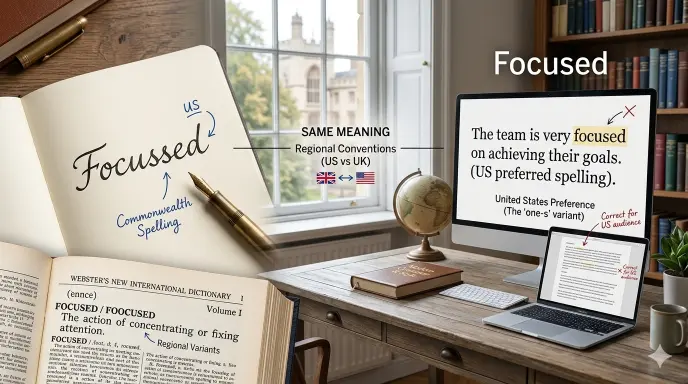
When you are writing an email, school assignment, resume, or professional document, a small spelling difference can make you stop and wonder: is it “focussed” or “focused”? Both forms appear in English, which makes the confusion understandable. The key difference is largely connected to regional spelling conventions rather than a completely different meaning. Understanding which form is preferred in American or British English can help you write more naturally and consistently.
In this guide, we will explain focussed or focused in simple terms, including their meaning, spelling rules, pronunciation, and everyday usage. You will also see clear examples showing when each form is commonly used. From a language perspective, both spellings can be correct depending on the variety of English you are following. By learning the regional preference and keeping your writing consistent, you can avoid unnecessary spelling mistakes in academic, workplace, and everyday communication.
Focussed or Focused: What Is the Difference?
The confusion between focussed or focused usually comes from a difference in spelling conventions rather than a difference in meaning. Both forms come from the verb focus, which means to direct attention, effort, thought, or a physical device toward something specific.
Focused is the more common spelling internationally, especially in American English. Meanwhile, focussed is also correct and appears regularly in British English and some other varieties that follow British spelling conventions.
Grammatically, both words can function as the past tense and past participle of the verb focus. For example, you can say, “She focused on the assignment yesterday,” or “She has focused on the assignment all week.”
| Feature | Focused | Focussed |
|---|---|---|
| Part of speech | Verb form | Verb form |
| Base verb | Focus | Focus |
| Meaning | Concentrated attention or effort | Concentrated attention or effort |
| American English | Standard and preferred | Less common |
| British English | Common and accepted | Common and accepted |
| Past tense | Yes | Yes |
| Past participle | Yes | Yes |
| Meaning difference | None | None |
Mini Recap
Both spellings describe the same action.
However, focused is generally the safer choice for international and American audiences.
Meanwhile, focussed remains a legitimate spelling, particularly in British usage.
Therefore, the distinction is mainly regional and stylistic, not grammatical.
Is Focussed or Focused a Grammar, Vocabulary, or Usage Issue?
The difference between focussed and focused is primarily a spelling and usage issue, rather than a difference in vocabulary or grammar. Both forms represent the same verb and communicate the same basic idea.
For example, “The student focused on mathematics” and “The student focussed on mathematics” have the same meaning. Consequently, changing one spelling to the other does not alter the grammatical structure of the sentence.
However, regional conventions matter. American English generally favors focused, while British English permits both focused and focussed.
Furthermore, formal writing benefits from consistency. If a document follows American spelling conventions, focused is normally the appropriate choice. Conversely, if the document follows a British style, either form may be acceptable, although the chosen spelling should remain consistent throughout the text.
In academic writing, consistency becomes particularly important because readers expect carefully controlled language. Likewise, professional communication should follow the spelling standards used by the organization, institution, or publication.
In casual communication, either form can be understood easily. Nevertheless, focused may look more familiar to a broader international audience.
When to Use Focused
Focused is the most widely recognized spelling of the two forms. Therefore, it is often the safest option when you aren’t required to follow a particular regional convention.
In American English, focused is the normal spelling. For example, an employee might say, “I stayed focused on the project despite several interruptions.”
Likewise, in academic writing, you might read, “The research focused on the effects of sleep deprivation.” Here, the word describes where the research concentrated its attention.
The spelling is also common in technology related writing. For instance, a software description might state, “The new update is focused on improving performance.” In this context, focused indicates the primary purpose or concentration of the update.
Additionally, focused can describe a person’s state of concentration. A manager could tell a team, “We need to remain focused on the customer experience.”
Usage Recap
Use focused when writing for American readers.
Also, choose it when you want the more broadly familiar spelling.
Moreover, it works naturally in professional, academic, technical, and everyday contexts.
When to Use Focussed
Focussed has the same meaning as focused, but it is more closely associated with British spelling conventions. Consequently, you may encounter it in British publications, educational materials, professional documents, and institutional writing.
For example, a British workplace document might state, “The department remained focussed on improving customer service.” The meaning is exactly the same as the version using focused.
Similarly, an academic sentence could read, “The study remained focussed on environmental policy.” Again, the spelling does not change the meaning or grammatical function.
In technology related writing, you might encounter wording such as, “The development team is focussed on improving accessibility.” This usage is acceptable when the publication follows British conventions.
However, American readers may be more accustomed to focused. Therefore, if your intended audience is primarily American, using focused can reduce the possibility that readers perceive the spelling as unusual.
Usage Recap
Use focussed when it fits the spelling convention of your audience.
It is especially appropriate in British English contexts.
Nevertheless, it should not be treated as a different word.
When You Should NOT Use Focussed or Focused
Although both forms are legitimate, several situations can create unnecessary confusion.
1. Don’t Switch Between Both Forms Randomly
Consistency matters. If one paragraph uses focused and another uses focussed, readers may wonder whether the change was intentional.
Therefore, choose one convention and maintain it throughout the same document.
2. Don’t Treat Them as Different Meanings
Neither spelling indicates a different level of concentration. Both forms describe the same concept.
Consequently, you shouldn’t choose one simply because you believe it expresses stronger attention.
3. Don’t Use Focussed Automatically in American Writing
Although focussed is valid, American readers generally expect focused.
Therefore, American workplace documents, essays, reports, and general publications will normally look more natural with focused.
4. Don’t Assume Focused Is Incorrect in British English
British English accepts focused as well. Therefore, it would be inaccurate to claim that British writers must always use focussed.
5. Don’t Change the Spelling Without Checking the Style Guide
Organizations often establish their own language conventions. Consequently, the style guide should take priority when one exists.
6. Don’t Correct Focussed as a Grammar Error
If someone writes focussed, correcting it simply because you prefer focused can be misleading.
Instead, consider whether the document requires a particular regional convention.
7. Don’t Mix Regional Standards in One Formal Document
A document that consistently follows one variety of English usually appears more polished.
Therefore, select the convention appropriate for your readers before editing the entire text.
8. Don’t Assume Spelling Changes the Verb Form
Both spellings can be used as the past tense and past participle of focus. The doubled consonant does not create a separate grammatical form.
Common Mistakes: Focussed or Focused
| Correct sentence | Incorrect sentence | Explanation |
|---|---|---|
| She focused on the presentation. | She focused in the presentation. | The usual construction is focused on when describing directed attention. |
| The study focused on language development. | The study focussed language development. | The verb normally takes on before the subject of attention. |
| He remained focused during the meeting. | He remained focussed during the meeting. | The second sentence is not grammatically wrong, but it may conflict with an American spelling convention. |
| The team focused on quality. | The team focused to quality. | On is the natural preposition in this construction. |
| The report was focused on safety. | The report was focus on safety. | The participial form requires focused or focussed. |
The most important point is that some apparent errors involve the surrounding sentence rather than the spelling itself.
Decision Rule Box
If you mean concentrated attention, either “focused” or “focussed” can be correct.
If you follow American English, normally choose “focused.”
If you follow British English, both forms are accepted, so follow the style convention used by your publication or organization.
Focussed or Focused in Modern Technology and Intelligent Tools
Modern technology frequently uses focused when describing functions, development priorities, research objectives, and user experiences.
For example, a product description might say that an application is “focused on privacy.” Likewise, a development team could explain that its current project is “focused on improving accessibility.”
In British oriented technical writing, focussed may appear instead. However, the meaning remains unchanged.
Furthermore, technical documentation benefits from consistency because users may read several pages from the same product or service. A mixture of regional spellings can make the documentation feel less unified.
Therefore, technology writers should identify their intended audience first. Once the preferred variety of English has been established, the same convention should be applied throughout the documentation.
The Etymology Behind Focused and Focussed
The modern verb focus comes from the Latin word focus, meaning “hearth” or “fireplace.” Over time, the word developed a scientific sense associated with the point where rays of light meet.
Later, English adopted broader figurative meanings involving concentration, attention, and central importance.
The spelling variation developed from different approaches to forming past tense and participial forms. English has historically allowed variations in consonant doubling, especially across regional standards.
Consequently, focused and focussed emerged as accepted forms rather than completely separate vocabulary items.
Today, the distinction is primarily associated with spelling preference and regional English.
An Expert Style Explanation
A useful way to understand the difference is this:
“Focused and focussed express the same meaning; the important distinction is the spelling convention used by the writer and audience.”
This principle prevents an unnecessarily complicated grammar rule. Rather than memorizing two definitions, writers should identify their intended variety of English and apply its spelling convention consistently.
Two Practical Case Studies
Case Study 1: An American Research Report
Imagine a university researcher preparing a report for an American institution. The document repeatedly discusses how a study focused on student reading habits.
Because the intended audience follows American English, focused provides the expected spelling.
If the researcher repeatedly changed between focused and focussed, the meaning would remain clear. Nevertheless, the inconsistency could make the document appear insufficiently edited.
Therefore, the practical result is straightforward: selecting focused throughout produces a consistent presentation.
Case Study 2: A British Workplace Document
Now consider a British organization preparing an internal report. The document uses British spelling throughout and describes how a department remained focussed on customer satisfaction.
In this context, focussed fits the organization’s established convention.
However, replacing every occurrence with focused would not necessarily make the document grammatically wrong. Both forms remain valid.
The practical result is therefore different from the first example: the organization’s established style should guide the final choice.
Error Prevention Checklist
Before publishing your sentence, check the following points.
Always Use Focused When
You are following standard American English.
Your readers are primarily American.
Your organization specifically prefers the single consonant spelling.
You want the more broadly familiar spelling for an international audience.
Your existing document consistently uses focused.
Never Use Focussed When
Your style guide specifically requires focused.
You are editing a document that consistently follows American spelling.
You are changing the word merely because you think focussed has a different meaning.
You are using it inconsistently beside focused in the same formal document.
Related Grammar Confusions You Should Master
Once you understand focussed or focused, several other spelling and usage contrasts become easier to recognize.
1. Cancelled or Canceled
Both forms are used across regional varieties, with cancelled especially common in British English and canceled standard in American English.
2. Travelled or Traveled
Regional spelling conventions determine whether the final consonant is doubled.
3. Labelled or Labeled
Again, British and American conventions can differ.
4. Centre or Center
The distinction reflects regional spelling rather than a difference in meaning.
5. Colour or Color
British English generally uses colour, while American English generally uses color.
6. Organise or Organize
Both forms occur in English, although regional and institutional preferences determine which spelling is appropriate.
7. Practice or Practise
This distinction can involve both regional usage and grammatical function, making it more complicated than the present example.
8. Licence or License
British English traditionally distinguishes the noun and verb forms, while American English generally uses license for both.
9. Program or Programme
Regional conventions and subject matter can influence the preferred spelling.
10. Judgement or Judgment
Both forms occur, with regional and style preferences influencing the choice.
Frequently Asked Questions
Is focused or focussed correct?
Both are correct spellings of the past tense and past participle of focus. However, focused is the usual American spelling, while British English accepts both focused and focussed.
Is focussed British English?
Yes. Focussed is an accepted spelling in British English. However, focused is also used in British English, so it isn’t accurate to say that British writers must use the doubled consonant form.
Is focused American English?
Yes. Focused is the standard spelling generally preferred in American English. Therefore, American writers will usually choose focused in academic, professional, technical, and everyday writing.
Which is more common, focused or focussed?
Focused is generally more widespread, particularly because American English uses it as its standard spelling. Nevertheless, focussed remains established in British usage and related spelling traditions.
Does focussed mean something different from focused?
No. Both forms have the same meaning. They describe directing attention, effort, thought, or activity toward a particular subject or objective.
Should I use focused or focussed in academic writing?
The answer depends on the English variety and institutional style guide. For American academic writing, focused is normally preferred. For British academic writing, either form may be accepted, provided the spelling is consistent.
Is focussed grammatically wrong?
No. Focussed is not inherently grammatically wrong. It is an accepted spelling of the verb form, although it may be less appropriate when a particular style convention requires focused.
Why does focused have one s while focussed has two?
The difference comes from regional spelling conventions surrounding consonant doubling. English permits both forms in this case, although their frequency differs across varieties.
Can I use focused and focussed in the same article?
You can, but it is usually better not to. Formal writing should maintain a consistent spelling convention. Therefore, select the form appropriate for your audience and use it throughout the article.
Final Verdict: Focussed or Focused?
The choice between focussed or focused isn’t really a question of right versus wrong. Instead, it is mainly a matter of regional spelling and editorial consistency.
Focused is the safest general choice, particularly for American English and international readers. Meanwhile, focussed is an accepted British English spelling and may be the preferred form in publications that follow that convention.
Ultimately, the best approach is simple: identify your audience, check the relevant style standard, and remain consistent. Once that principle is understood, this spelling question becomes much easier to handle confidently.









