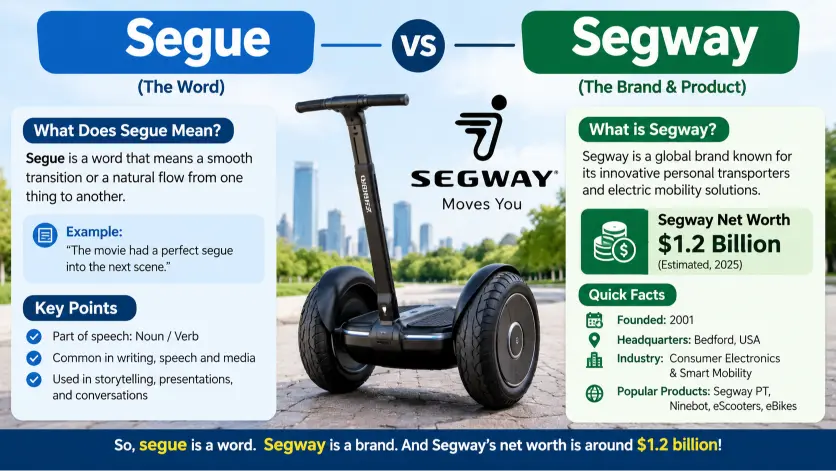
Have you ever written “segway” when you actually meant to describe a smooth transition from one topic to another? You are not alone. Segue and Segway sound almost identical, but they have completely different meanings and uses. The word segue is commonly used in writing, speaking, music, film, and presentations to describe a smooth transition from one idea or subject to another. Segway, on the other hand, is a proper brand name associated with a type of two-wheeled personal transporter. Understanding this difference can help you avoid an easy spelling mistake and choose the right word with confidence.
The confusion usually happens because segue is pronounced like “Segway,” even though its spelling looks completely different. In this guide, we will clearly explain segue or segway, including their meanings, pronunciation, origins, sentence examples, and common mistakes. Whether you are writing an email, preparing a presentation, creating content, or simply improving your English vocabulary, knowing when to use each term will make your communication more accurate and professional.
Segue or Segway: What’s the Difference?
The confusion between segue or segway mainly comes from pronunciation. Both terms can sound almost identical in everyday speech, yet their meanings are completely unrelated.
Segue is primarily a noun or verb. As a noun, it describes a smooth transition from one subject, section, scene, or activity to another. As a verb, it means to move smoothly from one thing into another.
Segway is a proper noun used for a branded type of two wheeled electric personal transporter. It refers to a physical device rather than a transition between ideas.
| Term | Part of Speech | Meaning | Typical Context | Example |
|---|---|---|---|---|
| segue | Noun | A smooth transition | Writing, speech, music, conversation | Her introduction provided a natural segue into the discussion. |
| segue | Verb | To move smoothly from one subject to another | Presentations, conversations, writing | The speaker segued into the next topic. |
| Segway | Proper noun | A two wheeled personal transportation device | Transportation, recreation, tours | The visitors explored the park on a Segway. |
The key distinction is simple.
Segue concerns transition.
Segway concerns transportation.
Therefore, if you’re describing a change in subject, segue is the spelling you need. If you’re discussing the branded vehicle, Segway is appropriate.
Is Segue or Segway a Grammar, Vocabulary, or Usage Issue?
The difference is primarily a vocabulary and usage issue, although spelling also plays an important role.
These words aren’t interchangeable. Substituting one for the other changes the meaning entirely. For example, saying, “That was a great Segway into the next topic” uses the transportation brand where a transition is intended.
In formal writing, segue is the accepted term for a smooth progression between ideas. It appears naturally in essays, reports, presentations, journalism, speeches, and professional communication.
Meanwhile, Segway belongs to a much narrower context. It identifies a particular type of personal transporter and is generally capitalized because it originated as a brand name.
In casual conversation, pronunciation can hide the distinction. However, once either term appears in writing, the spelling immediately reveals whether the writer means a transition or a vehicle.
Formal versus casual usage
For academic and professional settings, use segue when describing a connection between topics.
For transportation related discussions, use Segway when referring to the device.
Consequently, context determines the correct choice rather than pronunciation alone.
How to Use Segue Correctly
A segue creates continuity. Instead of abruptly jumping from one subject to another, a speaker or writer uses a segue to make the movement feel natural.
For example, imagine a manager discussing employee productivity before introducing a training program. The manager might say:
“Now that we’ve examined the current challenges, let’s segue into some practical solutions.”
Here, segue functions as a verb because it describes an action.
As a noun, it can appear in a sentence such as:
“The final paragraph offers a useful segue into the conclusion.”
In that example, segue names the transition itself.
Workplace example
During a business presentation, a speaker could say:
“Let’s segue from customer feedback to the proposed service improvements.”
The expression signals that the presenter is moving smoothly into a related subject.
Academic example
A student might write:
“The historical background provides a natural segue into the causes of the conflict.”
Here, the word helps connect two sections of an argument without making the shift feel abrupt.
Technology example
A software presenter could say:
“After explaining the dashboard, we can segue into the reporting features.”
The meaning remains the same even though the subject involves technology.
Usage recap
Use segue when an idea, discussion, section, scene, or activity flows into another.
It can function as both a noun and a verb.
The central concept is smooth transition.
How to Use Segway Correctly
Segway refers to a branded personal transportation device. Unlike segue, it doesn’t describe a transition between ideas.
For instance:
“The tourists traveled around the historic district on Segways.”
Here, the word identifies the transportation equipment.
Because Segway is a brand name, capitalization is normally appropriate when referring specifically to the company or its branded products.
Workplace example
A company organizing an outdoor event might write:
“Employees can use Segways during the guided campus tour.”
The term refers to transportation equipment.
Academic example
A research paper about personal mobility could mention:
“Segways became a recognizable example of compact electric personal transportation.”
Again, the reference is physical rather than linguistic.
Technology example
A technology article might discuss:
“The Segway uses sensors and motorized wheels to help maintain balance.”
This usage concerns engineering and transportation.
Usage recap
Choose Segway when you’re discussing the personal transporter.
Don’t use it to describe a transition between paragraphs, subjects, or ideas.
When You Should NOT Use Segue or Segway
Understanding incorrect contexts can make the distinction much easier to remember.
1. Don’t write Segway when discussing a topic transition
Incorrect:
“Let’s take a Segway into the next chapter.”
Correct:
“Let’s take a segue into the next chapter.”
2. Don’t write segue when discussing transportation
Incorrect:
“We rented a segue for the city tour.”
Correct:
“We rented a Segway for the city tour.”
3. Don’t use Segway as a general synonym for transition
A transition isn’t a Segway simply because the words sound alike. The transportation brand has no general grammatical meaning connected with changing subjects.
4. Don’t lowercase a specific brand reference unnecessarily
When referring specifically to the Segway brand or its products, standard brand capitalization should be retained.
5. Don’t assume pronunciation determines spelling
Sound alone isn’t a reliable guide. Many English words have unusual spellings, borrowed forms, or brand specific conventions.
6. Don’t replace segue with Segway in professional documents
A presentation containing “Segway into the next section” can appear careless because the intended meaning is immediately clear from context.
7. Don’t replace Segway with segue in transportation writing
A sentence about riding a vehicle needs the transportation term, not the linguistic expression for transition.
8. Don’t treat the two forms as spelling variants
They aren’t alternative spellings of one word. They represent two distinct concepts.
Common Mistakes: Segue or Segway
| Correct sentence | Incorrect sentence | Explanation |
|---|---|---|
| Let’s segue into the next subject. | Let’s Segway into the next subject. | A topic transition requires segue. |
| Her speech created a smooth segue. | Her speech created a smooth Segway. | The sentence describes a transition. |
| We toured the park on a Segway. | We toured the park on a segue. | The sentence describes transportation. |
| The presenter segued into the final section. | The presenter Segwayed into the final section. | Segued is the appropriate verb form. |
| They used Segways during the tour. | They used segues during the tour. | The intended meaning is vehicles. |
| The paragraph provides a useful segue. | The paragraph provides a useful Segway. | A paragraph can create a transition, not provide transportation. |
Decision Rule Box
If you mean the action of moving smoothly from one idea or subject to another, use “segue.”
If you mean the person transporting device or branded vehicle, use “Segway.”
This distinction works in nearly every ordinary writing situation.
Segue or Segway in Modern Technology and Digital Communication
Modern communication has made segue especially useful because presentations, podcasts, videos, online courses, and digital articles often move rapidly between subjects.
A presenter might segue from an explanation into a demonstration. A podcast host might segue from an interview into a closing discussion. A writer may use a carefully planned segue to connect two sections.
Segway, meanwhile, remains connected with personal transportation and related mobility discussions.
The difference becomes particularly important in digital text because spellcheckers may not always recognize the intended context. Both forms can look like legitimate English words, so human understanding remains important.
Consequently, writers should consider meaning first and spelling second.
Where Did Segue and Segway Come From?
The history of segue helps explain why its spelling looks unusual.
The word comes from Italian, where segue means “follows.” It entered English with a sense connected to smoothly following one musical passage with another. Over time, its meaning expanded beyond music.
Today, it can describe smooth movement between ideas, conversations, scenes, activities, or subjects.
Segway, on the other hand, is a brand name associated with a self balancing personal transporter. Its spelling was deliberately created as a distinctive commercial name.
Therefore, the two forms developed through entirely different linguistic paths.
An expert style quotation
“When pronunciation creates confusion, meaning should guide the spelling.”
This principle is especially useful with words that sound alike but belong to different semantic categories.
Two Practical Case Studies
Case Study 1: The Business Presentation
Consider a manager preparing a quarterly presentation. The first section covers customer satisfaction, while the next discusses product development.
The manager writes:
“Now we can Segway into product development.”
The intended meaning is obvious to readers, but the spelling is incorrect because no transportation device is involved.
After changing the sentence to:
“Now we can segue into product development.”
the expression accurately communicates a smooth movement between presentation topics.
Result: The wording becomes grammatically and semantically appropriate for professional communication.
Case Study 2: The Travel Description
A travel writer describes a guided city tour and writes:
“Visitors can ride a segue through the historic district.”
That spelling suggests a linguistic transition rather than a vehicle.
The corrected version is:
“Visitors can ride a Segway through the historic district.”
Result: The transportation meaning becomes immediately clear, eliminating ambiguity.
These examples show why context matters more than pronunciation.
Error Prevention Checklist
Before publishing or submitting your writing, check the intended meaning.
Always use segue when:
- You mean a smooth transition.
- You’re changing subjects.
- You’re connecting sections of an article.
- You’re moving between scenes.
- You’re describing a transition in music.
- You’re discussing a conversational shift.
- You’re introducing a related idea naturally.
Never use Segway when:
- You’re describing a topic transition.
- You’re writing about paragraph connections.
- You’re discussing movement between ideas.
- You’re describing a presentation shift.
- You’re referring to a conversational transition.
Always use Segway when:
- You’re referring to the branded transporter.
- You’re discussing personal mobility equipment.
- You’re describing a Segway tour.
- You’re writing about the company’s products.
- You’re discussing the device’s technology.
Related Grammar Confusions You Should Master
Once you understand segue or segway, several other commonly confused terms are worth learning.
- Affect or effect: One commonly functions as a verb, while the other frequently functions as a noun.
- Complement or compliment: One means something that completes or enhances another thing, while the other expresses praise.
- Principal or principle: One can refer to a person or something primary, while the other describes a fundamental rule or belief.
- Stationary or stationery: One describes something that isn’t moving, while the other concerns writing materials.
- Advice or advise: One is generally a noun, while the other is a verb.
- Then or than: One usually concerns time or sequence, while the other commonly appears in comparisons.
- Its or it’s: One shows possession, while the other is a contraction.
- Compliment or complement: Pronunciation and spelling are close, but their meanings differ substantially.
- Accept or except: One commonly describes receiving or agreeing, while the other indicates exclusion.
- Lose or loose: One generally describes failing to keep something, while the other describes something that isn’t tight.
Learning these distinctions improves precision because correct vocabulary depends on meaning, not merely sound.
Frequently Asked Questions
Is segue or Segway correct?
Both are correct words, but they have different meanings. Segue describes a smooth transition between subjects or activities. Segway refers to a branded two wheeled personal transportation device.
Is it segue into or Segway into?
The correct expression is segue into when you mean moving smoothly into another subject. For example, “Let’s segue into the next section.”
What does segue mean in simple English?
Segue means to move smoothly from one topic, activity, scene, or idea to another without an abrupt change.
Is segue a noun or a verb?
Segue can be both a noun and a verb. As a noun, it means a transition. As a verb, it means to move smoothly from one thing into another.
What does Segway mean?
Segway is a brand name associated with a type of self balancing personal transporter. It belongs to the vocabulary of transportation and mobility.
Why do segue and Segway sound the same?
Their similar pronunciation is the main reason people confuse them. However, their meanings and origins are different, so spelling must be determined by context.
How do you pronounce segue?
In standard English usage, segue is generally pronounced like “segway.” This similarity explains why writers sometimes choose the wrong spelling.
Can segue be used in academic writing?
Yes. Segue can work well in academic writing when describing a smooth connection between ideas, sections, arguments, or subjects. However, it should be used naturally rather than inserted simply to sound sophisticated.
Should Segway always be capitalized?
When referring specifically to the Segway brand or branded product, capitalization is appropriate. Generic transportation descriptions may require different wording depending on the intended meaning.
What is an easy way to remember segue versus Segway?
Think of segue as a smooth shift and Segway as a vehicle. If the sentence involves ideas, topics, or transitions, choose segue. If it involves riding or transportation equipment, choose Segway.
Final Answer: Segue or Segway?
The correct spelling depends entirely on what you mean.
Use segue when you describe a smooth transition between ideas, topics, scenes, conversations, or activities. It works as both a noun and a verb and is common in professional, academic, creative, and conversational contexts.
Use Segway when you mean the branded two wheeled personal transportation device.
Although the pronunciation is similar, these aren’t interchangeable spellings. Therefore, remembering the meaning behind each term is the easiest way to avoid mistakes.
Topic transition = segue.
Personal transporter = Segway.
Once that distinction becomes familiar, choosing the right form becomes almost automatic.









