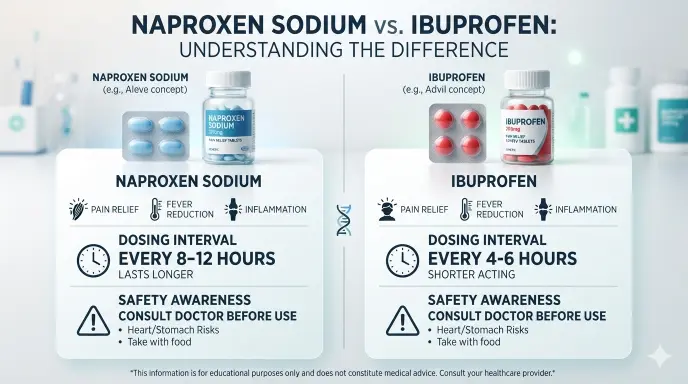
When you have a headache, muscle ache, fever, or everyday pain, choosing between Aleve or Advil can feel surprisingly confusing. Both are common over the counter pain relievers, and both belong to the nonsteroidal anti inflammatory drug (NSAID) family, but they contain different active ingredients and can differ in how long they work. Understanding these differences can help you make a more informed choice instead of simply picking the most familiar brand.
In this guide, we will compare Aleve and Advil by looking at their active ingredients, common uses, duration of action, potential side effects, dosing considerations, and important safety precautions. The goal is to explain the differences in clear, practical language based on established medication information and general pharmacology. Because individual health needs, other medicines, age, and medical conditions can affect which option is appropriate, this information should not replace advice from a doctor or pharmacist.
Aleve or Advil: What’s the Difference?
Aleve is a brand name associated with naproxen sodium, an NSAID. Advil is a brand name associated with ibuprofen, another NSAID. Both medicines reduce substances involved in pain, fever, and inflammation.
| Feature | Aleve | Advil |
|---|---|---|
| Active ingredient | Naproxen sodium | Ibuprofen |
| Drug class | NSAID | NSAID |
| Main uses | Pain, fever, inflammation | Pain, fever, inflammation |
| Common OTC strength | 220 mg naproxen sodium | 200 mg ibuprofen |
| Typical adult OTC interval | Every 8 to 12 hours | Every 4 to 6 hours |
| Common forms | Tablets, capsules, liquid gels | Tablets, capsules, liquid forms and other preparations |
| Key distinction | Longer dosing interval | Shorter dosing interval |
| Can it be combined with another NSAID? | Generally no unless specifically directed | Generally no unless specifically directed |
The table shows the central distinction: naproxen sodium and ibuprofen are different active ingredients, even though both are NSAIDs.
Furthermore, standard OTC labels give naproxen sodium a longer dosing interval, whereas ibuprofen is generally taken more frequently when needed.
Therefore, the decision shouldn’t be based simply on which brand sounds stronger. Instead, consider the particular symptom, duration of relief needed, personal risk factors, and directions on the package.
Is Aleve or Advil a Grammar, Vocabulary, or Usage Issue?
This isn’t a grammar distinction. Rather, it’s primarily a vocabulary and medication usage distinction.
Aleve and Advil are brand names, while naproxen sodium and ibuprofen are their relevant active ingredients. Consequently, saying that one word is grammatically correct and the other is incorrect would miss the actual issue.
In casual conversation, someone might say, “I took Advil for my headache.” Another person might say, “I usually use Aleve for my back pain.” Both expressions can be linguistically natural when the speaker means the corresponding product.
However, formal medical communication is more precise when the active ingredient is identified. For example, a pharmacist may need to know whether a person is taking ibuprofen or naproxen, particularly when checking interactions.
Similarly, academic writing usually favors generic drug names instead of commercial branding. Meanwhile, everyday conversation often uses familiar brand names because they’re easier to recognize.
Are They Interchangeable?
Not exactly.
Both medicines are NSAIDs, but they contain different active ingredients. Therefore, they should not be treated as identical simply because both relieve pain and inflammation.
Aleve: Practical Usage and Meaning
Aleve is associated with naproxen sodium. Standard OTC naproxen sodium products are labeled for temporary relief of minor aches and pains, including headaches, muscular aches, backache, toothache, menstrual cramps, minor arthritis pain, and some cold related discomfort. They can also temporarily reduce fever.
Workplace Example
Suppose an employee experiences occasional back discomfort after a physically demanding day. They might tell a colleague, “I took Aleve for the pain.” In professional communication, however, a healthcare worker would generally benefit from knowing the active ingredient rather than relying only on the brand name.
Academic Example
In an academic health article, a writer might state, “Naproxen sodium is an NSAID used for temporary relief of certain minor aches and pains.” This wording identifies the actual substance instead of treating a commercial name as the medicine itself.
Technology Example
A medication reminder application may record “naproxen” rather than simply “Aleve.” This can make medication lists clearer because different brands can contain different ingredients.
Usage Recap
Aleve refers to a branded product associated with naproxen sodium. Therefore, use the brand name when discussing that product specifically. For medical records, educational material, or medication reviews, identifying naproxen sodium can provide greater precision.
Advil: Practical Usage and Meaning
Advil is associated with ibuprofen. OTC ibuprofen is used for temporary relief of minor aches and pains and for temporary fever reduction. Common labeled uses include headaches, muscular aches, toothaches, backache, menstrual cramps, minor arthritis pain, and cold related discomfort.
Workplace Example
Imagine someone has a mild headache during a busy workday. They might casually say, “I took Advil.” In a healthcare setting, the more informative statement would be that they took ibuprofen, particularly if another medicine is being considered.
Academic Example
An academic discussion might state, “Ibuprofen is an NSAID commonly used for pain, fever, and inflammatory symptoms.” This is more precise than treating Advil as the generic name.
Technology Example
A digital health record may list ibuprofen as the active medication while separately identifying the commercial product. This distinction can help prevent accidental duplication when several products contain related ingredients.
Usage Recap
Advil identifies a familiar commercial product associated with ibuprofen. Therefore, use “ibuprofen” when accuracy about the active ingredient matters, particularly during medication reviews or formal health discussions.
When You Should NOT Use Aleve or Advil
There are several situations where casually choosing either medicine can create problems.
- Do not assume they are the same medicine. Their active ingredients differ.
- Do not take them together simply because one seems ineffective. Both belong to the NSAID class, and combining NSAIDs can increase adverse effect risks.
- Do not ignore stomach bleeding warnings. NSAIDs can cause ulcers and gastrointestinal bleeding, with greater risk among certain people.
- Do not exceed package directions. Higher amounts or prolonged use can increase serious risks.
- Do not overlook other medicines. Blood thinners, steroids, aspirin, and other NSAIDs can affect safety considerations.
- Do not assume an OTC label makes a medicine suitable for everyone. Certain medical conditions require professional guidance.
- Do not overlook pregnancy considerations. Naproxen and other NSAIDs have important pregnancy related warnings, particularly later in pregnancy.
- Do not continue self treatment indefinitely. Persistent pain or fever can require evaluation rather than repeated OTC dosing.
If you have a history of ulcers, kidney problems, cardiovascular disease, take blood thinning medicines, or have other significant medical conditions, consult a healthcare professional before choosing an NSAID.
Common Mistakes: Aleve or Advil
| Correct sentence | Incorrect sentence | Explanation |
|---|---|---|
| Aleve contains naproxen sodium. | Aleve contains ibuprofen. | The active ingredients are different. |
| Advil contains ibuprofen. | Advil contains naproxen. | Advil is associated with ibuprofen. |
| Both are NSAIDs. | They are exactly the same drug. | They share a drug class but contain different ingredients. |
| I checked the active ingredient. | I only checked the brand name. | Ingredient information can matter for medication safety. |
| Follow the package directions. | More medicine means faster relief. | Exceeding directions can increase risks. |
| Ask before combining pain medicines. | Taking two NSAIDs together is always fine. | Combining NSAIDs can increase adverse effects. |
Decision Rule Box
If you mean the naproxen sodium product, use “Aleve.”
If you mean the ibuprofen product, use “Advil.”
If you mean the actual medicine rather than the brand, use “naproxen sodium” or “ibuprofen.”
This simple distinction prevents many everyday misunderstandings.
Aleve or Advil in Modern Technology
Medication databases, electronic health records, pharmacy systems, and digital reminders commonly distinguish a brand name from an active ingredient.
For example, a medication database may identify Advil as a product associated with ibuprofen, while another record may focus on the generic ingredient. Likewise, an application could display naproxen sodium even when the package a person purchased carries a brand name.
Therefore, when entering medicine into a digital system, check the exact product and active ingredient. This is especially important when several pain relievers are being tracked at the same time.
Etymology and Drug Naming
The names “naproxen” and “ibuprofen” are generic drug names established within pharmaceutical naming systems. Meanwhile, Aleve and Advil function as commercial brand names.
This distinction explains why a brand name isn’t necessarily interchangeable with the generic ingredient.
In practical terms, brand names identify marketed products, whereas generic names identify the active medicinal substance. That difference becomes especially useful when comparing products from different manufacturers.
Expert Style Explanation
A useful medication literacy principle is:
“The active ingredient matters more than the brand name when identifying what medicine a product actually contains.”
This principle reflects an important practical point. Consumers may recognize familiar packaging immediately, yet healthcare professionals often need the generic ingredient to evaluate duplication, interactions, and suitability.
Case Study 1: Choosing Based on the Dosing Schedule
Consider an adult who experiences occasional minor muscle discomfort.
They notice that OTC naproxen sodium products are generally labeled for dosing every 8 to 12 hours, while standard OTC ibuprofen products are generally labeled for dosing every 4 to 6 hours.
The concrete difference here is the labeled dosing interval, not proof that one medicine is universally stronger or better.
Therefore, the person should follow the product label and consider personal medical factors rather than selecting solely according to convenience.
Case Study 2: Accidentally Treating Two NSAIDs as Different Categories
Imagine a person takes ibuprofen and later considers naproxen because the first product hasn’t provided the relief they expected.
Although the packages look different, both products belong to the NSAID category. Official drug information warns against taking naproxen with other NSAIDs, including ibuprofen, unless a healthcare professional directs otherwise.
The practical result is that checking the active ingredient and drug class before adding another pain reliever can help prevent unnecessary duplication.
Error Prevention Checklist
Always Use Aleve When
You specifically mean the branded product associated with naproxen sodium.
You are discussing that particular commercial product rather than ibuprofen.
You have verified the package directions and active ingredient.
Never Use Advil When
You actually mean naproxen sodium.
You are using “Advil” as though it were a generic term for every NSAID.
You have not checked whether another medicine you’re taking already contains an NSAID.
More importantly, don’t rely on brand recognition alone when medication safety is involved.
Related Grammar Confusions You Should Master
Although this topic concerns medicines rather than grammar, several related terminology distinctions are useful to understand:
- Brand name vs generic name
- Active ingredient vs product name
- Ibuprofen vs naproxen
- NSAID vs acetaminophen
- Prescription vs over the counter medicine
- Dose vs dosing interval
- Pain relief vs inflammation reduction
- Side effect vs drug interaction
- Tablet vs capsule
- Symptom relief vs treatment of an underlying condition
Understanding these distinctions improves everyday medication literacy and makes conversations with pharmacists and healthcare professionals more precise.
Frequently Asked Questions
Is Aleve or Advil better for pain?
Neither should be described as universally better. Aleve contains naproxen sodium, while Advil contains ibuprofen. Both are NSAIDs, and the appropriate choice depends on the type of discomfort, individual risk factors, other medicines, and package directions.
Is Aleve stronger than Advil?
Strength cannot be determined simply by comparing the milligram numbers on the packages because naproxen sodium and ibuprofen are different substances. Their labeled doses and dosing intervals also differ.
Can you take Aleve and Advil together?
They should not be combined casually because both are NSAIDs. Naproxen information specifically warns about taking it with other NSAIDs such as ibuprofen. Ask a healthcare professional before combining them.
Is Aleve ibuprofen?
No. Aleve is associated with naproxen sodium, whereas ibuprofen is the active ingredient associated with Advil.
Is Advil naproxen?
No. Advil is associated with ibuprofen. Naproxen sodium is associated with products such as Aleve.
Which lasts longer, Aleve or Advil?
Their standard OTC labels use different dosing intervals. Naproxen sodium products commonly direct dosing every 8 to 12 hours, while ibuprofen products commonly direct dosing every 4 to 6 hours.
Can I take Aleve if I already took Advil?
Don’t assume that switching between the two is safe simply because they’re different brands. Both are NSAIDs. Ask a pharmacist or healthcare professional about timing and your individual circumstances before taking another NSAID.
Are Aleve and Advil the same type of medicine?
Yes, in the broad sense that both are NSAIDs. However, they are not the same active ingredient. Aleve is associated with naproxen sodium, while Advil is associated with ibuprofen.
Which is safer for long term use?
Neither should be assumed to be safe for prolonged self treatment. NSAIDs can cause serious gastrointestinal, cardiovascular, and kidney related problems, particularly with longer use or higher amounts.
Conclusion
Understanding Aleve or Advil becomes much easier once you focus on their active ingredients. Aleve contains naproxen sodium, while Advil contains ibuprofen. Although both belong to the NSAID family and can provide temporary relief from pain, fever, and inflammation, they are not the same medicine and should not be treated as interchangeable.
Therefore, always check the active ingredient, follow the package directions, and consider your other medicines and health conditions before using either product. In particular, avoid combining NSAIDs unless a healthcare professional specifically advises you to do so. When symptoms continue, worsen, or require frequent medication, professional medical guidance is important.
Ultimately, knowing the difference between naproxen sodium and ibuprofen helps you make more informed medication choices and avoid common dosing or ingredient mistakes.









