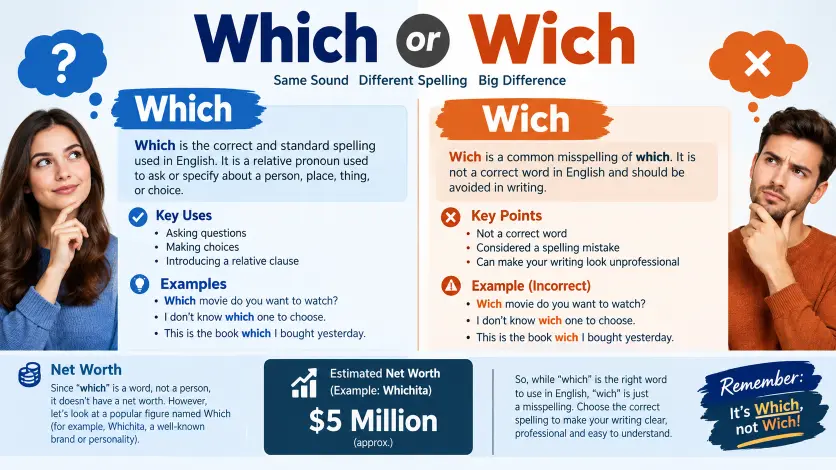
Have you ever typed “wich” instead of “which” and wondered whether both spellings are correct? You are not alone. This is a common English spelling confusion, especially when writing quickly, texting, or learning English. Although the two forms look almost identical, they do not have the same status in standard English.
Understanding which or wich is important because choosing the wrong spelling can make your writing look careless or unclear. In standard modern English, “which” is the correct spelling when you are asking about a choice, identifying something, or referring to a particular thing. “Wich” is generally not the standard spelling of this everyday English word.
In this guide, we will explain the difference clearly, explore the meaning and grammar of “which,” and provide simple examples you can remember. Whether you are a student, writer, professional, or English learner, this explanation will help you use the correct form confidently.
Which or Wich: What’s the Difference?
First, which is the correct standard English spelling when you are asking about a choice, identifying a particular thing, or referring back to something previously mentioned. Grammatically, it can function as a determiner or pronoun.
For example, consider the question, “Which book do you want?” Here, which comes before the noun book and identifies a choice. Similarly, “Which is yours?” uses which as a pronoun because it stands independently.
On the other hand, wich is generally not the correct spelling for these ordinary uses. Therefore, writing “Wich color do you prefer?” is considered incorrect in standard English. The correct sentence is “Which color do you prefer?”
However, there is an important detail. Wich can appear as part of certain historical or proper names. For instance, some place names contain the element wich because of older English naming traditions. Nevertheless, that specialized appearance doesn’t make wich a substitute for which in ordinary writing.
| Feature | Which | Wich |
|---|---|---|
| Standard English word | Yes | No, in ordinary usage |
| Main grammatical role | Pronoun and determiner | Usually not a standard modern word |
| Used for choices | Yes | No |
| Used in questions | Yes | No |
| Used in relative clauses | Yes | No |
| Common in formal writing | Yes | No |
| May appear in historical names | Rarely relevant | Yes |
| Example | Which option is correct? | Wich option is correct? |
Mini Recap
Therefore, which is the standard spelling used in normal English.
Meanwhile, wich should not replace which in questions or ordinary sentences.
As a result, choose which whenever you are asking about a selection or identifying something.
However, remember that wich may occur in certain historical names and place names.
Is Which or Wich a Grammar, Vocabulary, or Usage Issue?
Primarily, this is a spelling and usage issue rather than a situation where two interchangeable vocabulary choices exist.
In standard English, which has an established grammatical function. It can introduce a question, identify one item from several possibilities, or introduce a relative clause.
For example, “Which jacket belongs to you?” asks the reader to identify one jacket. Likewise, “The car, which was recently repaired, runs smoothly” uses which to add information about the car.
Conversely, wich doesn’t perform these grammatical functions in contemporary standard English. Thus, you can’t normally exchange the two forms simply because they sound similar.
Furthermore, the distinction matters in both formal and casual communication. In a relaxed text message, a spelling mistake might be understood through context. Nevertheless, repeated errors can create a poor impression in professional communication.
In academic writing, the difference becomes even more important. Essays, research assignments, applications, and reports require conventional spelling. Therefore, which should be used consistently whenever the intended meaning calls for it.
Formal and Casual Usage
In workplace writing, standard spelling supports clarity and credibility. Similarly, academic readers expect familiar grammatical forms.
Although casual conversations allow occasional typing errors, that doesn’t make wich an accepted alternative. Instead, it remains a spelling error when used in place of which.
Consequently, the practical rule is straightforward: use which for standard grammatical purposes, regardless of whether your writing is formal or informal.
How to Use Which Correctly
First, use which when you need to ask someone to select or identify something.
For example:
“Which meeting should I attend?”
“Which document contains the final figures?”
“Which design do you prefer?”
In each case, which introduces a choice.
Workplace Example
Consider a manager asking an employee, “Which report should I send to the client?” The word which identifies a selection among multiple reports.
Likewise, you might write, “Please confirm which version contains the updated figures.” Here, which introduces the specific item being identified.
Academic Example
In academic writing, which frequently appears in explanatory clauses.
For instance, “The experiment produced unexpected results, which required further analysis.”
Here, which refers back to the preceding idea and introduces additional information.
Technology Example
Modern technology provides many everyday examples.
You might ask, “Which browser are you using?” or “Which setting controls notifications?” In both questions, which identifies a particular option from several possibilities.
Usage Recap
Therefore, use which when asking someone to identify an option.
Also, use it when referring to something within a relative clause.
Finally, remember that which works naturally in questions, explanations, instructions, and formal writing.
How Wich Is Commonly Misused
Because wich resembles the pronunciation and appearance of which, it can easily appear as a typing error.
For example, someone may quickly type, “Wich one should I choose?” However, the standard spelling is “Which one should I choose?”
Similarly, “Wich laptop is better?” should become “Which laptop is better?”
The problem isn’t usually the sentence structure. Instead, the error comes from selecting the wrong spelling.
Workplace Example
Incorrect: “Wich file should I send?”
Correct: “Which file should I send?”
Academic Example
Incorrect: “Wich theory supports this argument?”
Correct: “Which theory supports this argument?”
Technology Example
Incorrect: “Wich browser works best for this website?”
Correct: “Which browser works best for this website?”
Usage Recap
Consequently, don’t treat wich as an informal alternative to which.
Instead, whenever the sentence asks about a choice, selection, or identification, which is the appropriate standard form.
When You Should NOT Use Which or Wich
Although the difference is simple, several situations regularly create mistakes.
1. Don’t replace which with wich in questions
For example, “Wich movie are you watching?” is incorrect in standard English. Use “Which movie are you watching?”
2. Don’t assume pronunciation determines spelling
English spelling doesn’t always follow pronunciation perfectly. Therefore, hearing a word isn’t always enough to determine its written form.
3. Don’t use wich in academic assignments
School and university writing should follow conventional spelling. Consequently, wich should be corrected before submission.
4. Don’t use wich in professional emails
A small spelling mistake can distract from an otherwise clear message. Therefore, professional correspondence should use which.
5. Don’t treat wich as a casual version of which
Casual writing can contain abbreviations and informal expressions, but wich isn’t a recognized casual alternative.
6. Don’t change which simply because the sentence sounds informal
For example, “Which one do you want?” remains correct in everyday conversation.
7. Don’t assume every appearance of wich is an error
Some historical names and place names contain wich. Thus, context matters when you encounter the unusual form.
8. Don’t rely entirely on spellcheck
Although digital writing tools can catch many mistakes, understanding the underlying rule helps you recognize errors independently.
Common Mistakes and Decision Rules
The following examples show how this spelling confusion usually appears.
| Correct sentence | Incorrect sentence | Explanation |
|---|---|---|
| Which book is yours? | Wich book is yours? | Which introduces a choice |
| Which route should we take? | Wich route should we take? | The question asks for selection |
| Which answer is correct? | Wich answer is correct? | Which identifies one option |
| The phone, which I bought yesterday, is new. | The phone, wich I bought yesterday, is new. | Which introduces additional information |
| Which setting controls sound? | Wich setting controls sound? | Which identifies a technology option |
| Which course are you taking? | Wich course are you taking? | Which introduces alternatives |
Decision Rule Box
If you are asking about a choice, identification, or selection, use which.
If you are introducing additional information about something already mentioned, use which.
Do not use wich as the ordinary spelling of which.
This simple rule handles nearly every everyday situation.
Which and Wich in Modern Technology
Modern writing increasingly happens through keyboards, mobile devices, voice input, predictive text, and writing assistants. Consequently, spelling mistakes can occur quickly, especially when people type at speed.
For example, predictive keyboards may sometimes interpret a fast sequence of letters incorrectly. Similarly, voice recognition can produce unexpected spellings when pronunciation is unclear.
Nevertheless, digital tools don’t change the underlying English rule. The standard word remains which when the intended meaning involves selection, identification, or a relative clause.
Furthermore, search engines and online forms generally recognize which as the conventional spelling. Therefore, learning the correct form remains more useful than depending entirely on automated correction.
Where Did Which Come From?
The history of which reaches back to older forms of English and Germanic languages. Over centuries, English spelling and pronunciation changed, while the grammatical function of the word remained important.
The spelling developed through historical forms associated with words used for questioning and identifying things. Consequently, modern English inherited which as a familiar interrogative and relative form.
By contrast, wich has a different historical background when it appears in certain names. The element can be connected with older place naming traditions, especially in English locations associated with particular industries or settlements.
Therefore, the two forms shouldn’t be treated as ordinary spelling alternatives.
An Expert Style Explanation
“In standard English, spelling should reflect the established grammatical form rather than a sound based guess.”
This principle is especially useful for learners because English contains many words whose pronunciation doesn’t provide an obvious spelling pattern.
Two Real World Case Studies
Case Study One: Professional Communication
Imagine an employee preparing an email containing the sentence, “Wich document should I send to the customer?”
The intended meaning is perfectly understandable. However, the spelling error may distract the reader and make the message appear less carefully prepared.
After correcting it to “Which document should I send to the customer?”, the sentence becomes standard and professional without changing its meaning.
The result is clearer communication because the correct grammatical form immediately signals a question involving selection.
Case Study Two: Academic Writing
Now consider a student writing, “Wich explanation best supports the evidence?”
Again, the meaning is understandable. However, academic writing requires conventional spelling.
After changing the sentence to “Which explanation best supports the evidence?”, the sentence follows standard written English.
The practical result is straightforward: the student communicates the intended question without introducing an unnecessary spelling error.
Error Prevention Checklist
Before publishing or submitting your writing, use this quick checklist.
Always Use Which When
You are asking someone to select something.
You are identifying one option from several.
You are asking about a particular object or person.
You are introducing a relative clause.
You are writing a formal email or academic sentence.
Never Use Wich When
You mean the standard interrogative word.
You are asking a question about alternatives.
You are introducing additional information with a relative clause.
You are writing an essay, report, application, or professional message.
You are checking whether a sentence follows standard English.
However, if wich appears within a historical name or established place name, examine the specific name rather than automatically changing it.
Related Grammar Confusions You Should Master
Once you understand this distinction, several other commonly confused forms become easier to study.
- Their and there
- Your and you’re
- Its and it’s
- Then and than
- Affect and effect
- Fewer and less
- Who and whom
- Further and farther
- Advice and advise
- Complement and compliment
These pairs demonstrate an important feature of English: words that look or sound similar may have different grammatical roles and meanings.
Consequently, successful writing depends not only on recognizing individual words but also on understanding how they function within a sentence.
Frequently Asked Questions
Is which or wich correct?
Which is the correct standard English spelling for the ordinary word used to ask about choices, identify something, or introduce certain relative clauses. Wich is generally a misspelling in these contexts.
What is the difference between which and wich?
Which is a standard English pronoun and determiner. It can introduce questions and relative clauses. Wich isn’t normally used as a standard modern English word for these purposes, although it may appear in historical names.
Is wich a real English word?
Wich can appear as an element in certain historical names and place names. However, it isn’t normally a substitute for which in ordinary English sentences.
How do you spell which correctly?
The standard spelling is which, with the letters w, h, i, c, and h. For example, “Which color do you prefer?” is correct.
Why do people spell which as wich?
Usually, the mistake happens because people type quickly, rely on pronunciation, or overlook the second h. Since the two forms look similar, the error can happen during casual writing.
Should I use which in formal writing?
Yes. Which is the established standard form for questions involving selection and for appropriate relative clauses. It is suitable for academic, workplace, professional, and everyday writing.
Is wich ever correct?
Wich can be correct within certain proper names and historical place names. Nevertheless, it should not normally be used instead of which in an ordinary sentence.
Which is correct in a question?
Which is correct when a question asks someone to identify or select something. For example, “Which option should we choose?” follows standard English usage.
Can which and wich be used interchangeably?
No. They aren’t interchangeable in standard English. Which has an established grammatical function, whereas wich isn’t the ordinary spelling for that function.
How can I remember the correct spelling?
A useful memory trick is to associate which with choice. Whenever you are asking “which one,” remember that the standard spelling includes the second h.
Final Conclusion
Ultimately, which is the correct standard spelling when you ask about a choice, identify something, or introduce an appropriate relative clause. Therefore, sentences such as “Which option should I choose?” and “The book, which I bought yesterday, is excellent” follow conventional English usage.
By comparison, wich should not normally replace which. Although the shorter form may appear in certain historical names, that specialized use doesn’t make it an alternative spelling for ordinary questions.
Most importantly, remember the simple rule: when you mean a choice or identification, write which. This small spelling distinction can make professional emails, academic assignments, online content, and everyday messages clearer and more polished.









