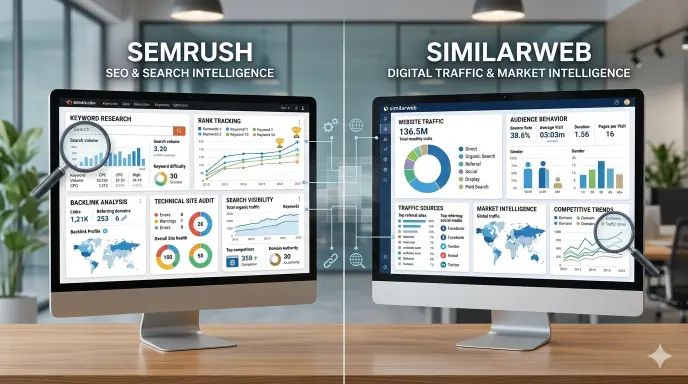
Choosing between Semrush or Similarweb can be confusing when both platforms offer powerful tools for SEO, competitor research, keyword analysis, and website performance insights. The real question is not simply which platform has more features, but which type of data and workflow matches your goals. Semrush currently combines keyword research, competitor analysis, site auditing, backlink analysis, market research, and AI visibility features within its broader marketing platform.
Similarweb takes a strong approach to website traffic intelligence, competitor benchmarking, search behavior, traffic sources, and keyword-level insights. Its current tools can help users examine search traffic, engagement, competing websites, keyword trends, and traffic-driving channels.
In this guide, we’ll break down Semrush vs Similarweb using practical factors such as SEO research, traffic analysis, competitor insights, keyword data, usability, and current features, so you can understand the differences before choosing a platform for your digital marketing strategy.
Semrush or Similarweb: What’s the Difference?
Semrush is a digital marketing research platform that provides data for keyword discovery, ranking analysis, competitor research, backlink investigation, website auditing, and market research. In grammatical terms, Semrush and Similarweb are both proper nouns, because each identifies a specific software brand.
Similarweb is also a digital intelligence platform, but its strongest emphasis is on understanding how websites and digital markets perform. Its traffic and engagement tools can show estimated visits, engagement patterns, rankings, traffic sources, and competitive trends across websites.
Therefore, the two platforms aren’t simply interchangeable versions of the same product. They overlap in several areas, yet they approach digital research from different directions.
| Feature | Semrush | Similarweb |
|---|---|---|
| Primary emphasis | Search and marketing research | Digital traffic and market intelligence |
| Keyword research | Extensive | Available |
| Ranking research | Strong | Available |
| Backlink analysis | Strong | Available in relevant research areas |
| Website traffic estimates | Available | Major strength |
| Audience analysis | Available | Major strength |
| Competitor research | Strong | Strong |
| Market research | Available | Major strength |
| Technical website auditing | Strong | More limited focus |
| Traffic source analysis | Available | Major strength |
| Content research | Strong | Available |
| Advertising research | Strong | Strong |
| Industry benchmarking | Available | Strong |
Semrush describes its research capabilities around keyword research, competitor analysis, backlink analysis, market analysis, technical auditing, and ranking measurement. Meanwhile, Similarweb highlights website traffic, engagement, rankings, traffic distribution, audience behavior, and competitive market comparisons.
Mini recap: Semrush is particularly useful when the question centers on search visibility and website optimization. Similarweb is particularly useful when the question centers on traffic, audiences, markets, and competitive digital behavior. Because their capabilities overlap, the right choice depends on the question being investigated rather than the brand name alone.
Is Semrush or Similarweb a Grammar, Vocabulary, or Usage Issue?
This is primarily a vocabulary and usage issue, not a grammar problem.
Both names refer to software platforms, so neither word is a grammatical replacement for the other. You wouldn’t normally substitute Similarweb for Semrush simply because both can be used for competitor research.
For example, consider these sentences:
“I’m using Semrush to investigate keyword opportunities.”
“I’m using Similarweb to examine estimated traffic patterns.”
Both sentences are grammatically correct. However, replacing one platform name with the other changes the intended meaning because each platform emphasizes different research areas.
In formal writing, business reports, academic research, presentations, and professional documentation, the names should remain capitalized because they are brand names. In casual conversation, people may shorten the explanation and simply say that they’re checking competitors or researching traffic.
The important distinction is therefore context rather than grammar. If someone asks which website receives more estimated visits, a traffic intelligence platform may be more relevant. If the question concerns keyword difficulty, ranking positions, or backlink opportunities, a search research platform may provide more directly relevant information.
Usage recap: Don’t treat the two names as synonyms. Use the platform name that accurately describes the research method being discussed.
When Semrush Is the More Relevant Research Platform
Semrush has a broad collection of tools covering keyword discovery, competitor research, ranking measurement, backlinks, technical website analysis, market research, and content related workflows. Its current feature set includes keyword research, competitor analysis, market analysis, backlink analysis, position tracking, and site auditing.
Workplace Example
Suppose a marketing manager wants to understand which search phrases competitors rank for. The manager can examine keyword portfolios, identify gaps, investigate ranking opportunities, and organize findings into a research plan.
For example:
“Our team used Semrush to compare competitor keywords before planning the next content campaign.”
Here, the brand name accurately identifies the platform being used for the research task.
Academic Example
A researcher studying online visibility could use Semrush data to examine keyword patterns across a selected group of websites.
For instance:
“The researcher examined keyword trends across competing websites using Semrush.”
However, academic work should clearly explain the methodology and distinguish estimated third party measurements from directly observed website data.
Technology Example
A technical marketing team might use Semrush to investigate website health, ranking changes, backlink profiles, and keyword performance. Its Site Audit functionality is designed to identify technical problems, while its keyword tools support research into search demand and competition.
Usage recap: Semrush fits naturally into conversations about keyword research, ranking visibility, backlinks, technical website health, and search focused competitor investigation.
When Similarweb Is the More Relevant Research Platform
Similarweb places considerable emphasis on digital traffic intelligence. Its website analysis tools provide information concerning estimated traffic, engagement, rankings, traffic sources, and competitive comparisons.
Workplace Example
Imagine a business development manager investigating competitors before entering a new market.
A useful question might be:
“How much estimated traffic does this competitor receive, and where does that traffic appear to come from?”
Similarweb is designed around this type of digital market investigation.
Academic Example
A student researching online consumer behavior might compare estimated visits, engagement patterns, traffic channels, and changes over time across several websites.
For example:
“The study compared estimated website traffic and engagement trends across five competing brands.”
Such research should explain that platform measurements are estimates rather than direct access to every website’s private analytics.
Technology Example
A technology company evaluating competitors may examine traffic distribution, audience characteristics, digital rankings, and market trends. Similarweb’s Traffic and Engagement resources specifically describe the ability to compare traffic volume, distribution, reach, engagement, and trends across competitors.
Usage recap: Similarweb is particularly relevant when the central question involves estimated traffic, audience behavior, competitive market activity, or digital channel distribution.
When You Should NOT Use Semrush or Similarweb
There are several situations where casually treating these platforms as identical can create misleading conclusions.
1. Don’t use Semrush as a substitute for private analytics
A competitor research platform doesn’t give you the same first party information as the owner’s private analytics account.
2. Don’t treat Similarweb traffic estimates as exact accounting records
Estimated traffic can be valuable for comparison, but it shouldn’t automatically be presented as a competitor’s verified internal visitor count.
3. Don’t choose a platform only because a competitor uses it
Your research question should determine the tool. Different projects require different measurements.
4. Don’t confuse rankings with actual traffic
A strong ranking position doesn’t automatically reveal the complete traffic picture.
5. Don’t assume keyword volume equals visits
Search demand is not identical to actual website traffic.
6. Don’t present estimated numbers as audited facts
When reporting third party measurements, clearly identify them as estimates.
7. Don’t use either platform as the only source for a major business decision
Market research becomes stronger when platform data is considered alongside first party analytics, customer research, financial information, and other reliable evidence.
8. Don’t compare metrics without checking definitions
Two platforms may use different methodologies, databases, estimation systems, or reporting periods. Consequently, identical labels don’t necessarily mean identical measurements.
Common Mistakes and Decision Rules
The following examples demonstrate how wording can change depending on the intended meaning.
| Correct sentence | Incorrect sentence | Explanation |
|---|---|---|
| We used Semrush to research ranking opportunities. | We used Similarweb to research ranking opportunities. | The second sentence may be unsuitable when the specific task depends on Semrush’s search research features. |
| We used Similarweb to examine estimated traffic trends. | We used Semrush to verify the competitor’s private traffic. | Neither platform should be described as providing another company’s private analytics without qualification. |
| The report compares estimated traffic across competitors. | The report compares exact competitor traffic. | Estimated measurements shouldn’t be presented as verified internal records. |
| The team investigated keyword gaps. | The team investigated audience size. | Keyword gaps and audience measurement represent different research questions. |
| The analyst examined traffic sources. | The analyst examined ranking positions. | These are separate categories of digital information. |
Decision Rule Box
If you mean keyword research, ranking visibility, backlinks, technical website analysis, or search focused competitor research, Semrush may be the relevant platform.
If you mean estimated website traffic, audience behavior, traffic distribution, market trends, or digital competitive intelligence, Similarweb may be the relevant platform.
This rule isn’t an absolute limitation. Both platforms contain overlapping capabilities, so always check the specific feature required before making a final selection.
Semrush and Similarweb in Modern Technology and AI Tools
Modern digital research has expanded beyond traditional keyword and traffic measurements. Both platforms have continued developing broader research capabilities.
Semrush currently describes features involving visibility across conversational systems and AI Overviews, alongside keyword research, competitor analysis, market analysis, backlinks, technical auditing, and other research functions.
Similarweb also publishes current research concerning generative search, digital markets, consumer behavior, and changing online discovery patterns. Its 2026 reports include research into generative visibility and the changing digital shopping journey.
Consequently, the distinction between the two platforms isn’t completely fixed. Software products evolve, features move between product areas, and new data sources appear over time.
For users, that means an older comparison can become inaccurate surprisingly quickly. Before selecting a platform for an important project, check the exact feature, database, geographic coverage, reporting period, and methodology available at that time.
Etymology and Brand Naming
Semrush is a brand name rather than a conventional English vocabulary item. Therefore, it doesn’t have a normal dictionary definition comparable to words such as “research,” “traffic,” or “ranking.”
Similarweb follows the same general pattern. It is a proprietary brand name that communicates an idea related to similarity and the web rather than functioning as an ordinary interchangeable noun.
Because both names identify companies and products, capitalization matters in professional writing.
An appropriate sentence is:
“Semrush and Similarweb provide different forms of competitive digital research.”
An inappropriate approach would be to lowercase the names or treat them as ordinary common nouns.
Expert Style Quotation
“The quality of a comparison depends on matching the measurement to the question.”
This principle is especially important when working with estimated digital data. A number can appear precise while still representing an estimate based on a particular methodology.
Two Case Studies With Concrete Results
Case Study One: Semrush Based Search Research
A published Semrush customer story involving BestSelf Co. reported a 40 percent increase in organic traffic over the previous three months, along with a 17 percent increase in leads from organic traffic. The reported average ranking position improved from 48 to 33, while 74 keywords reached the top 10 during the project.
The important lesson isn’t that a particular platform automatically produces those outcomes. Rather, the documented project combined technical auditing, keyword research, page optimization, and implementation. Therefore, the results should be understood in the context of the entire campaign.
Case Study Two: Similarweb Based Competitive Intelligence
Similarweb publishes customer examples showing how organizations use its traffic intelligence and sales research capabilities. For example, the company reports that DHL Express achieved a 506 percent annual return on investment through a sales intelligence use case involving lead sourcing and offer targeting.
That example illustrates a different research purpose. Instead of focusing primarily on keyword ranking work, the use case involves identifying and prioritizing commercial opportunities.
These cases shouldn’t be interpreted as direct head to head performance tests. They represent different projects, goals, methods, time periods, and measurements.
Error Prevention Checklist
Always use Semrush when
☐ Your main question concerns keyword opportunities.
☐ You need to investigate ranking visibility.
☐ You want detailed backlink research.
☐ You need technical website auditing.
☐ You are comparing keyword portfolios.
☐ You want search focused competitor research.
Never use Similarweb when
☐ You actually need another company’s private analytics.
☐ You intend to present estimates as audited figures.
☐ You haven’t checked how the metric is calculated.
☐ You are assuming traffic estimates equal verified visits.
Always use Similarweb when
☐ Your research centers on estimated website traffic.
☐ You need traffic distribution information.
☐ You are studying audience behavior.
☐ You are comparing digital market activity.
☐ You need broader competitive traffic intelligence.
Related Grammar Confusions You Should Master
Although Semrush versus Similarweb is mainly a brand and usage distinction, learning related terminology can prevent similar mistakes.
- Traffic vs visits: These terms can describe related but different measurements.
- Users vs sessions: One person can generate multiple sessions.
- Ranking vs visibility: Ranking describes positions, while visibility can involve broader exposure.
- Keyword vs query: A keyword is often a research term, while a query refers to what a person enters into a search system.
- Organic vs paid: These describe different acquisition channels.
- Audience vs visitors: Audience analysis can involve characteristics beyond simple visitor counts.
- Estimate vs measurement: An estimate is not necessarily a directly recorded figure.
- Competitor vs market: A competitor is an individual business, whereas a market includes a broader commercial environment.
- Traffic source vs traffic channel: These expressions can overlap, but reporting systems may define them differently.
- Domain vs website: A domain identifies an address structure, while website can refer to the broader online property.
Understanding these distinctions makes reports more precise and prevents misleading comparisons.
FAQs
What is the difference between Semrush and Similarweb?
Semrush emphasizes search research, keywords, rankings, backlinks, website auditing, and competitor analysis. Similarweb places stronger emphasis on traffic intelligence, engagement, audience behavior, market trends, and digital competitive analysis.
Is Semrush or Similarweb better for keyword research?
The answer depends on the research objective, but Semrush provides extensive keyword research capabilities, including keyword ideas, difficulty information, competitive keyword analysis, and ranking research.
Is Similarweb accurate for website traffic?
Similarweb provides estimated traffic and engagement information. These figures are useful for competitive comparison, but they shouldn’t automatically be treated as the exact private analytics of another website.
Can Semrush show competitor traffic?
Semrush includes traffic related research and market analysis capabilities. However, users should distinguish estimated competitor information from first party analytics collected directly by the website owner.
Can Similarweb research keywords?
Yes. Similarweb provides search related research capabilities, although its broader platform positioning includes traffic intelligence, market research, audience analysis, and competitive digital insights.
Which tool is used for competitor analysis?
Both platforms support competitor analysis, but they emphasize different dimensions. Semrush provides strong search and keyword oriented competitor research, while Similarweb provides substantial traffic, audience, and market intelligence.
Are Semrush traffic estimates exact?
No third party traffic estimate should automatically be treated as the private, verified traffic record of another website. Estimated figures should be labeled appropriately when used in reports.
Should I use both Semrush and Similarweb?
Using both can make sense when a project requires different types of evidence. One platform can provide search focused information while the other can add traffic, audience, and market context.
Which one should a beginner learn first?
Start with the research question rather than the brand. If your work centers on keywords, rankings, backlinks, and website optimization, study the relevant Semrush workflows. If your work centers on traffic, audiences, market comparisons, and digital trends, study the corresponding Similarweb workflows.
Final Meaning
The central distinction in Semrush or Similarweb is the type of digital question you want to answer. Semrush has a strong concentration on keyword research, ranking visibility, backlinks, technical website analysis, and search focused competitor research. Similarweb has a strong concentration on estimated traffic, engagement, audience behavior, market intelligence, and competitive digital trends.
Neither name should be treated as a universal replacement for the other. Instead, identify the metric you need first, then select the platform whose methodology and available data best match that question.
Most importantly, distinguish estimated third party information from private first party analytics. That single habit can make competitive research substantially more accurate and responsible.









