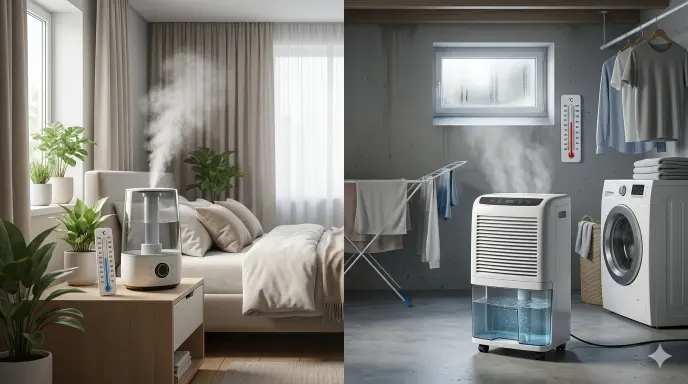
Choosing between a humidifier or dehumidifier can be confusing, especially when both appliances affect the moisture level inside your home. A humidifier adds moisture to dry indoor air, while a dehumidifier removes excess moisture. Using the wrong one can make your indoor environment less comfortable, so understanding the difference matters. Whether your room feels unusually dry, damp, stuffy, or uncomfortable, the right appliance depends on your actual humidity conditions.
This guide explains the difference in simple language so you can make a more informed choice. Indoor humidity can affect comfort, condensation, odors, and the overall condition of your living space. A practical approach is to check your indoor humidity level before choosing an appliance rather than relying only on symptoms.
Humidifiers are generally designed for dry environments, while dehumidifiers are intended for spaces with excessive moisture. In this guide, we’ll compare how both devices work, where they are commonly used, their potential benefits and drawbacks, and how to determine which option makes sense for your room.
Humidifier or Dehumidifier: What’s the Difference?
A humidifier is a noun that describes a device designed to add moisture to the air. Consequently, it is commonly used when indoor conditions are unusually dry. Dry air may feel uncomfortable, particularly during colder weather or in rooms affected by constant heating.
A dehumidifier is also a noun, but its function is the opposite. Instead of introducing moisture, it extracts water vapor from indoor air. Therefore, it is useful when a room feels damp, sticky, or poorly ventilated.
| Feature | Humidifier | Dehumidifier |
|---|---|---|
| Main function | Adds moisture | Removes moisture |
| Best for | Dry indoor air | Damp indoor air |
| Humidity effect | Raises humidity | Lowers humidity |
| Common location | Bedroom, nursery, office | Basement, bathroom, laundry area |
| Typical concern | Excessive dryness | Excessive dampness |
| Main measurement | Relative humidity | Relative humidity |
Mini Recap
A humidifier increases indoor moisture.
A dehumidifier reduces indoor moisture.
Therefore, neither appliance is automatically better than the other.
The correct option depends on the actual humidity level and conditions inside the room.
Is Humidifier or Dehumidifier a Grammar, Vocabulary, or Usage Issue?
The difference is primarily a vocabulary and usage issue, rather than a grammar problem. Both words are grammatically correct nouns, yet they describe opposite functions.
For example, saying, “The room is extremely dry, so I need a humidifier,” is logical because the device adds moisture. Conversely, saying, “The basement feels damp, so I need a dehumidifier,” is appropriate because the appliance removes moisture.
Therefore, these terms aren’t interchangeable. Replacing one with the other can completely change the meaning of a sentence.
In formal writing, technical discussions, academic assignments, product descriptions, and workplace communication, precise terminology is especially important. Meanwhile, casual conversations may use broader phrases such as “air moisture machine,” although that wording is less precise.
Formal Versus Casual Usage
In formal communication, use humidifier when referring to a moisture adding device. Likewise, use dehumidifier when discussing equipment that removes excess moisture.
For instance:
“The laboratory uses a dehumidifier to maintain controlled humidity levels.”
That wording is more precise than saying:
“The laboratory uses a machine to dry the air.”
Therefore, accurate vocabulary improves clarity in both professional and everyday communication.
How to Use Humidifier Correctly
A humidifier is appropriate when indoor air contains insufficient moisture. For instance, someone may use one during winter when indoor heating makes the atmosphere noticeably dry.
Workplace Example
Suppose an office becomes uncomfortable because heated air feels excessively dry. Consequently, employees may notice dry skin, irritated nasal passages, or static electricity. In that situation, a humidifier can increase moisture and improve general comfort.
Academic Example
In a science assignment, you might write:
“A humidifier increases the amount of water vapor present in indoor air.”
This sentence clearly explains the device’s purpose without creating ambiguity.
Technology Example
Modern humidifiers may include humidity sensors, automatic settings, timers, and digital controls. Therefore, some models can monitor room conditions and adjust their operation accordingly.
Usage Recap
Use humidifier when the intended meaning is adding moisture.
Remember this simple association: humidifier means moisture goes up.
However, excessive humidity isn’t automatically beneficial. Therefore, adding moisture without monitoring the room can create an overly damp environment.
How to Use Dehumidifier Correctly
A dehumidifier performs the opposite task. It removes excess water vapor from indoor air, making it particularly useful in damp environments.
Workplace Example
Imagine an office located in a humid building where windows frequently develop condensation. Consequently, employees may describe the room as sticky or uncomfortable. A dehumidifier can help reduce excessive moisture.
Academic Example
A suitable academic sentence would be:
“A dehumidifier lowers relative humidity by extracting moisture from indoor air.”
This wording is direct, precise, and easy to understand.
Technology Example
Many modern dehumidifiers have digital humidity displays, automatic shutoff features, timers, drainage systems, and adjustable humidity settings. As a result, users can manage moisture more conveniently.
Usage Recap
Use dehumidifier when the intended meaning is removing moisture.
Remember the opposite relationship: dehumidifier means moisture goes down.
Therefore, if your room already feels damp, adding moisture would move conditions in the wrong direction.
When You Should NOT Use Humidifier or Dehumidifier
Although both appliances can improve indoor comfort, choosing the wrong one can create an unnecessary problem. Therefore, consider these common misuse situations.
1. Don’t use a humidifier in an already damp room
If windows frequently collect condensation and the room feels clammy, adding more moisture may worsen the situation.
2. Don’t use a dehumidifier in an extremely dry room
Removing additional moisture can make an already dry environment even less comfortable.
3. Don’t choose based only on outdoor weather
Outdoor conditions don’t always represent indoor humidity. Heating, cooling, ventilation, cooking, and building materials can significantly change indoor conditions.
4. Don’t assume visible condensation always requires one appliance
Condensation can have several causes, including temperature differences, poor ventilation, and cold surfaces. Therefore, identify the underlying condition first.
5. Don’t use either device without maintenance
Dirty filters, stagnant water, and neglected components can reduce performance. Consequently, regular cleaning and proper care are essential.
6. Don’t confuse cooling with moisture removal
An air conditioner may reduce humidity while cooling a room, but its primary purpose isn’t identical to that of a dedicated dehumidifier.
7. Don’t add moisture simply because the air feels cold
Cold air isn’t necessarily dry enough to require a humidifier. Instead, consider actual indoor humidity.
8. Don’t remove moisture simply because the room feels warm
Warmth alone doesn’t prove excessive humidity. Therefore, temperature and moisture should be considered separately.
Common Mistakes and Decision Rules
The following examples show how easily the two terms can become confused.
| Correct sentence | Incorrect sentence | Explanation |
|---|---|---|
| I need a humidifier because the room is too dry. | I need a dehumidifier because the room is too dry. | A humidifier adds moisture. |
| The basement needs a dehumidifier. | The basement needs a humidifier. | A damp basement generally requires moisture reduction. |
| This humidifier adds water vapor. | This dehumidifier adds water vapor. | The functions are opposite. |
| The dehumidifier removes excess moisture. | The humidifier removes excess moisture. | A dehumidifier lowers moisture. |
| The office uses a humidifier during dry conditions. | The office uses a dehumidifier during dry conditions. | Dry conditions call for added moisture when appropriate. |
Decision Rule Box
If you mean adding moisture, use “humidifier.”
If you mean removing moisture, use “dehumidifier.”
Therefore, the easiest way to remember the difference is to focus on the direction of moisture.
Humidifier means more moisture.
Dehumidifier means less moisture.
Humidifier or Dehumidifier in Modern Technology and Smart Tools
Today, these appliances can do considerably more than simply turn on and off. For example, many models include built in humidity sensors, digital displays, automatic modes, programmable timers, and alerts.
Furthermore, some smart home systems can monitor indoor humidity and trigger connected equipment when conditions change. Consequently, homeowners can maintain a more consistent indoor environment without constantly adjusting settings manually.
A humidity sensor is particularly useful because appearance alone isn’t always reliable. A room may feel comfortable while still having unusually high or low relative humidity.
Therefore, technology makes moisture management more measurable. Instead of guessing whether the atmosphere is too dry or too damp, users can examine a numerical humidity reading and make a more informed choice.
Why the Words Humidifier and Dehumidifier Mean What They Do
The words become easier to remember when you examine their construction.
The term humidifier comes from the idea of making something humid. The ending “ifier” relates to something that causes a condition or transformation. Therefore, a humidifier is something that makes air more humid.
Meanwhile, dehumidifier contains the prefix “de,” which commonly indicates removal, reversal, or reduction. Consequently, a dehumidifier is a device that reduces humidity.
This word structure provides a useful memory trick. When you see “humidifier,” think adding humidity. When you see “dehumidifier,” think taking humidity away.
“The simplest rule is to identify the direction of moisture first, then choose the word that describes that direction.”
That principle works in everyday conversation, technical writing, school assignments, and product discussions.
Two Practical Case Studies
Case Study 1: A Dry Bedroom
Consider a bedroom where indoor humidity measures around 25 percent during a period of heavy heating. The occupants notice static electricity, dry skin, and an uncomfortable sensation when breathing.
Because the environment is relatively dry, increasing moisture may be appropriate. After introducing controlled humidification, suppose the measured humidity rises from 25 percent to approximately 40 percent.
The important lesson isn’t the appliance itself. Rather, the measurement helped identify the direction of the problem.
Case Study 2: A Damp Basement
Now consider a basement where humidity measures approximately 70 percent. The space has a musty smell, and condensation occasionally appears on cooler surfaces.
Because the moisture level is considerably higher, adding humidity would move conditions in the wrong direction. Instead, moisture reduction becomes the logical approach.
Suppose the measured humidity falls from approximately 70 percent to 50 percent after controlled dehumidification. The result demonstrates why identifying the starting condition matters before selecting equipment.
These examples are practical illustrations rather than universal targets. Actual requirements vary according to climate, building design, temperature, ventilation, and individual circumstances.
Error Prevention Checklist
Use this quick checklist whenever you’re unsure which term belongs in a sentence.
Always use humidifier when:
☑ You mean a device that adds moisture.
☑ The surrounding context describes dry indoor air.
☑ You are discussing increasing water vapor.
☑ Your sentence concerns moisture addition.
Never use dehumidifier when:
☑ The intended meaning is adding moisture.
☑ You are describing equipment designed to increase humidity.
☑ The room is already dry and your meaning is moisture restoration.
Always use dehumidifier when:
☑ You mean a device that removes excess moisture.
☑ The context describes damp indoor conditions.
☑ You are discussing humidity reduction.
Never use humidifier when:
☑ The intended meaning is moisture removal.
☑ You are describing equipment designed specifically to lower humidity.
Therefore, checking the verb behind the noun can prevent most mistakes.
Related Grammar Confusions You Should Master
Once you’ve understood these two terms, several similar vocabulary distinctions are worth learning. They involve words that look or sound related but perform different functions.
- Affect or effect: one commonly functions as a verb, while the other frequently functions as a noun.
- Fewer or less: both concern quantity, yet traditional usage distinguishes countable items from uncountable amounts.
- Advice or advise: one is generally a noun, while the other is a verb.
- Breath or breathe: one identifies the act or substance of breathing, while the other describes the action.
- Loose or lose: one commonly describes something not firmly attached, while the other describes misplacement or failure to retain something.
- Compliment or complement: one involves praise, while the other refers to something that completes or enhances another thing.
- Further or farther: both can indicate greater distance, although usage distinctions often appear in formal writing.
- Principal or principle: one can refer to a person or primary element, while the other refers to a rule or fundamental belief.
- Stationary or stationery: one means remaining still, while the other commonly refers to writing materials.
- Practice or practise: spelling and grammatical roles vary according to the variety of English being used.
Learning these distinctions improves precision because the problem usually isn’t grammar alone. Instead, it often involves selecting the word that accurately matches the intended meaning.
People Also Ask Questions
Is a humidifier or dehumidifier better?
Neither is universally better. A humidifier adds moisture, whereas a dehumidifier removes it. Therefore, the appropriate choice depends on the humidity conditions inside the room.
Should I use a humidifier or dehumidifier for a damp room?
A damp room generally points toward moisture reduction rather than moisture addition. Consequently, a dehumidifier is the relevant type of appliance when excessive indoor moisture is the issue.
What is the difference between a humidifier and dehumidifier?
A humidifier increases moisture in indoor air. In contrast, a dehumidifier removes excess moisture. Therefore, their primary functions are opposites.
Can a humidifier and dehumidifier be used together?
They can technically operate in the same building, but using both in the same room at the same time may work against itself. Therefore, the actual humidity condition should guide operation.
Does a dehumidifier make a room colder?
A dehumidifier is designed primarily to remove moisture rather than provide cooling. Depending on the equipment and room conditions, its operation can affect perceived temperature differently.
When should I use a humidifier?
A humidifier is generally considered when indoor air is unusually dry. Therefore, checking indoor humidity can help determine whether additional moisture is actually needed.
When should I use a dehumidifier?
A dehumidifier is generally considered when indoor air contains excessive moisture. Signs can include persistent dampness, condensation, or a musty atmosphere.
Can a humidifier remove moisture?
No. A humidifier is designed to add moisture. Therefore, it should not be confused with a dehumidifier, whose purpose is moisture removal.
Can a dehumidifier add humidity?
No. A dehumidifier is designed to reduce moisture in indoor air. Consequently, it isn’t the appropriate term for a device intended to increase humidity.
Conclusion
Choosing between a humidifier or dehumidifier becomes much easier when you focus on one question: Does the room need more moisture or less moisture?
If the atmosphere is excessively dry, a humidifier adds moisture. Conversely, if the environment is damp, a dehumidifier removes excess moisture. Therefore, the words aren’t interchangeable, even though both appliances deal with indoor humidity.
Most importantly, don’t rely solely on how a room feels. Instead, consider measured humidity, condensation, ventilation, temperature, and the building’s specific conditions. Once you identify whether moisture needs to increase or decrease, the correct term and appliance become much clearer.









