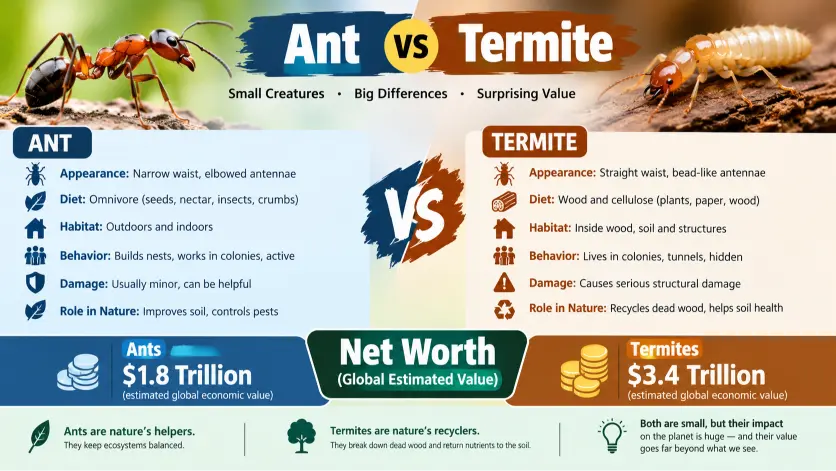
Seeing a tiny insect crawling across your wall or floor may seem harmless, but knowing whether you have an ant or termite can make a big difference. These pests can look surprisingly similar at first glance, especially when they have wings or appear in large numbers.
However, ants and termites have important differences in their body shape, antennae, waist, nesting habits, feeding behavior, and the type of damage they can cause. Identifying the insect correctly is the first step toward choosing the right response.
This guide explains the difference between an ant or termite in simple, practical language, using commonly recognized pest identification characteristics. You’ll learn what each insect looks like, where it lives, what it eats, how to recognize wings and trails, and which signs may indicate a potential termite problem. Whether you are a homeowner, renter, student, or simply curious about insects, this comparison will help you make a more informed identification without relying on guesswork.
Ant or Termite: What’s the Difference?
An ant is a social insect belonging to the family Formicidae. Ants have three distinct body regions, including a head, thorax, and abdomen, with a noticeably narrow waist between the thorax and abdomen. Their antennae are usually bent or elbowed.
A termite is a social insect belonging to the order Blattodea. Termites have a comparatively straight body profile because the connection between the thorax and abdomen is broad rather than pinched. Their antennae are generally straight and beadlike.
The easiest distinction involves several features rather than one characteristic. Therefore, checking the waist, antennae, wings, body color, and behavior together provides a much more dependable identification.
Mini Recap
An ant normally has a narrow waist and bent antennae.
A termite usually has a broad waist and straight antennae.
Winged ants often have unequal wing lengths.
Winged termites usually have wings of similar length.
Is Ant or Termite a Grammar, Vocabulary, or Usage Issue?
The distinction between ant and termite is primarily a vocabulary and identification issue, rather than a grammar problem. Both words are nouns, and each identifies a different type of insect.
They aren’t interchangeable because they refer to separate biological groups. Therefore, replacing one with the other can change the meaning of a sentence completely.
For example, saying, “I found termites in the kitchen,” suggests a very different situation from saying, “I found ants in the kitchen.” The first statement may raise concerns about wood or cellulose damage, whereas the second commonly describes insects searching for food.
In formal writing, scientific discussion, school assignments, inspection reports, and professional communication, using the precise term is especially important. In casual conversation, people sometimes call any small crawling insect an ant or termite based on appearance. However, casual labeling doesn’t make the terms equivalent.
Academic writing should therefore use the biological name that matches the evidence. Likewise, workplace communication should identify the insect carefully when maintenance, construction, property inspection, or pest management is involved.
How to Use the Word Ant Correctly
The word ant refers to an insect from the family Formicidae. Thousands of ant species exist, and they occupy a wide range of environments.
At home, ants may appear around food, moisture, cracks, windows, gardens, or waste areas. Consequently, their presence doesn’t automatically indicate structural damage.
Workplace Example
“Several ants were observed near the break room sink.”
This sentence works because it identifies the insects without making an unsupported claim about the cause.
Academic Example
“Ant colonies demonstrate complex social organization and division of labor.”
Here, ant functions as a common biological noun in an academic context.
Technology Example
“An image recognition application classified the insect as an ant.”
This usage describes a digital identification process without confusing the insect with another species group.
Usage Recap
Use ant when referring to Formicidae.
Use the word when the insect has characteristics consistent with ants.
When certainty is unavailable, describe visible features instead of making an absolute identification.
How to Use the Word Termite Correctly
The word termite identifies a social insect associated with colonies that consume cellulose based materials. Termites can live in soil, wood, or protected environments depending on the species.
Because some termite activity occurs out of sight, discovering them near a building deserves closer attention. However, seeing one pale insect does not automatically prove that a structure has extensive damage.
Workplace Example
“The inspector found evidence consistent with termite activity beneath the wooden flooring.”
This sentence is appropriately cautious because it connects the observation with evidence rather than making an unsupported claim.
Academic Example
“Termites play an important ecological role by breaking down dead plant material.”
Here, termite refers to the organism in an ecological context.
Technology Example
“The monitoring device recorded increased termite activity near the wooden structure.”
This sentence demonstrates how the word can appear naturally when technology is used for observation.
Usage Recap
Use termite when evidence points toward a termite species.
Use the word when discussing termite biology, colonies, feeding behavior, or structural activity.
When identification remains uncertain, inspect physical characteristics before reaching a conclusion.
When You Should NOT Use Ant or Termite
Several situations commonly produce incorrect identification. Therefore, consider the following examples before choosing either word.
1. Don’t call every small brown insect an ant
Size and color alone aren’t reliable identification features. Instead, examine the waist and antennae.
2. Don’t call every winged insect a termite
Winged ants can appear during reproductive flights and may resemble termites. Therefore, wings alone aren’t enough.
3. Don’t identify an insect solely by location
Finding an insect near wood doesn’t automatically make it a termite. Ants can also nest around wooden structures.
4. Don’t rely only on body color
Termites can vary in appearance, while ants also occur in numerous colors.
5. Don’t assume sawdust proves termites
Wood particles may have several causes. Carpenter ants, construction activity, moisture damage, and other factors can produce confusing evidence.
6. Don’t use the terms as synonyms
An ant colony and a termite colony aren’t the same biological system. Consequently, substituting the words can create factual errors.
7. Don’t diagnose structural damage from one insect
A single insect provides limited evidence. Look for additional signs such as galleries, shelter tubes, discarded wings, or repeated activity.
8. Don’t depend entirely on photographs with poor detail
A blurry image may hide the exact features needed for identification. Whenever possible, examine the waist, antennae, and wings clearly.
Common Mistakes and Decision Rules
The following examples demonstrate how incorrect terminology can change the meaning of a statement.
Decision Rule Box
If the insect has a narrow waist and bent antennae, consider ant first.
If the insect has a broad waist and straight antennae, consider termite first.
If wings are present, compare their lengths and examine the body shape as well.
If identification remains uncertain, don’t treat appearance alone as conclusive evidence.
Ant and Termite in Modern Technology
Digital identification tools can help users distinguish insects from photographs. However, image based classification works best when the photograph clearly shows the entire body.
A useful image should capture the antennae, waist, wings, legs, and overall body shape. Furthermore, a second photograph from another angle can provide additional evidence.
Although automated identification can be convenient, it shouldn’t replace careful observation when the distinction has practical consequences. For example, a homeowner investigating possible termite activity should consider physical evidence around the structure rather than relying entirely on a single image result.
Technology is therefore best treated as a supporting resource. Human observation, biological knowledge, and professional inspection can provide important context that one photograph may not reveal.
Ant or Termite: Etymology and Word History
The word ant has very old Germanic roots and developed through earlier forms of English before reaching its modern spelling. Its long history reflects how common these insects have been in human environments.
The word termite entered English much later and is connected to terminology used for these wood and cellulose consuming insects. Its development reflects scientific attempts to classify organisms more precisely.
Therefore, the two words have separate linguistic histories as well as different biological meanings. Knowing their origins isn’t necessary for identification, but it reinforces the fact that they represent distinct concepts.
An Expert Style Observation
“Accurate insect identification begins with structure rather than assumption: examine the waist, antennae, wings, and behavior together before assigning a name.”
This principle reflects a fundamental practice in biological identification. A single visible feature can mislead, whereas several matching characteristics provide stronger evidence.
Two Practical Case Studies
Case Study 1: Winged Insects Near a Window
A homeowner noticed dozens of winged insects around a bright window after warm weather. At first, they were described as termites because of their pale appearance.
Closer observation showed narrow waists and bent antennae. The wings also differed in relative length. Therefore, the physical evidence was more consistent with winged ants.
The concrete result was a change in the investigation. Instead of assuming termite activity, the homeowner focused on locating the ant colony and identifying the source of the insects.
Case Study 2: Insects Around Wooden Material
In another situation, insects were discovered near a wooden structure. Initial identification based only on location suggested ants.
Further examination revealed a broad body connection, straight antennae, and wings of similar length on reproductive insects. Additional inspection found evidence consistent with termite activity.
The concrete result was that the investigation shifted from general insect control toward a structural inspection. This example shows why location alone isn’t enough for identification.
Error Prevention Checklist
Always use ant when
The insect has a distinctly narrow waist.
The antennae appear bent or elbowed.
The body structure matches known ant characteristics.
The evidence supports identification as a Formicidae member.
Never use termite when
You are relying only on brown or dark coloration.
You haven’t examined the body shape.
You are assuming every winged insect is a termite.
You are calling an insect a termite simply because it was found near wood.
Always use termite when
The insect displays the broad body profile associated with termites.
The antennae are straight and beadlike.
The wings are similar in length when reproductive forms are present.
Additional evidence supports termite activity.
Related Grammar Confusions You Should Master
Although ant and termite aren’t grammar alternatives, learning related vocabulary distinctions can improve precise English.
Here are several useful comparisons:
Bee vs wasp: Both are flying insects, but they have important physical and behavioral differences.
Moth vs butterfly: Wing position, antennae, activity patterns, and body characteristics can help distinguish them.
Flea vs tick: These pests differ considerably in body structure and feeding behavior.
Beetle vs cockroach: Their body shape and wing structure provide useful identification clues.
Spider vs insect: Spiders aren’t insects because they belong to a different biological class.
Louse vs lice: These forms differ grammatically because one is singular and the other is plural.
Mouse vs mice: This is primarily a singular and plural distinction.
Species vs specie: These words have different meanings and shouldn’t be treated as interchangeable.
Larva vs larvae: One refers to a single immature form, while the other is plural.
Phenomenon vs phenomena: These commonly confused nouns differ in number.
Frequently Asked Questions
How can you tell an ant from a termite?
Look first at the waist and antennae. Ants generally have narrow waists and bent antennae, whereas termites generally have broader bodies and straight antennae. If wings are present, compare their lengths as well.
Is a termite an ant?
No. Termites and ants are different insects belonging to different biological groups. Although they can appear similar, their anatomy, behavior, colonies, and ecological roles differ.
Are winged ants mistaken for termites?
Yes. Winged ants can closely resemble reproductive termites, especially when observed quickly. Therefore, examine the waist, antennae, and wing structure instead of relying on wings alone.
Do termites have a narrow waist?
Generally, no. Termites have a broad connection between the thorax and abdomen. A strongly pinched waist is more characteristic of ants.
Do termites have straight antennae?
Yes. Termite antennae are generally straight and beadlike. In contrast, ant antennae are commonly bent or elbowed.
Are ants harmful to wooden houses?
Some ants can damage or excavate wood, particularly when they establish nests in damp or weakened material. However, their relationship with wood differs from the cellulose feeding behavior associated with termites.
What does termite damage look like?
Possible signs include damaged or hollow sounding wood, shelter tubes, discarded wings, mud structures, or other evidence of colony activity. However, similar signs can sometimes have different causes, so inspection is important.
Which is bigger, an ant or a termite?
There isn’t one universal answer because both groups contain many species with different body sizes. Consequently, size alone isn’t a dependable identification method.
Can ants and termites live near each other?
Yes. Their habitats can overlap, particularly around soil, vegetation, buildings, and wooden materials. Their presence in the same general area doesn’t mean they are the same insect.
What is the easiest way to identify an ant or termite?
The quickest reliable approach is to inspect the waist and antennae first. A narrow waist with bent antennae points toward an ant, while a broad body connection with straight antennae points toward a termite.
Final Takeaway
The difference between ant or termite becomes much easier once you focus on structure rather than color or location. Ants generally have narrow waists and bent antennae, while termites usually have broad waists and straight antennae.
Furthermore, winged specimens require extra attention because both insects can produce reproductive forms with wings. Comparing wing length, body shape, and antennae together provides a stronger identification method.
Ultimately, accurate terminology matters because an ant and a termite represent different insects with different behaviors and potential implications around buildings. Therefore, when the evidence is unclear, careful examination is preferable to guessing.









