Have you ever written “puddy” when you actually meant “putty”? This small spelling difference can easily cause confusion, especially when you hear the word in everyday conversation rather than seeing it written. If you are searching for puddy or putty, you probably want a clear answer about which spelling is correct, what the word means, and how to use it naturally.
In this guide, we will break down puddy vs. putty in simple English, explain the meaning and standard usage of each form, and show you practical examples so you can avoid the mistake in writing. Understanding spelling is not only about memorizing letters; context, pronunciation, regional usage, and established dictionary forms can all matter.
Whether you are writing for school, work, online content, or everyday communication, this comparison will help you choose the appropriate word with confidence. By the end, you will know exactly when putty is the standard choice and why puddy can sometimes appear.
Puddy or Putty: What’s the Difference?
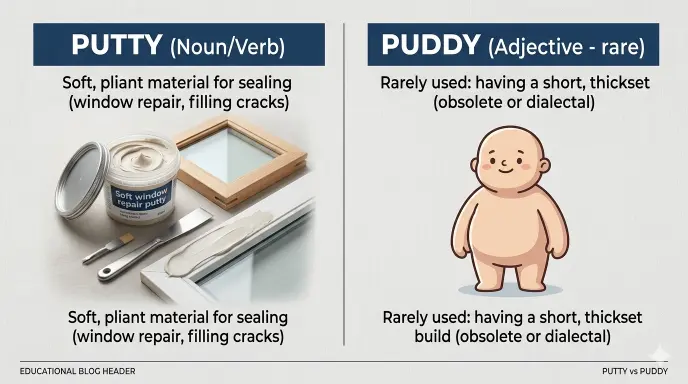
The two words look remarkably similar, yet their meanings are different. Putty is a noun and, in some contexts, a verb. As a noun, it describes a soft substance that can be shaped or applied before becoming firm. Cambridge Dictionary describes it as a claylike material commonly used around window glass or for filling small holes in wood.
By contrast, puddy is a rare adjective. Collins defines it as meaning short and podgy. Therefore, it describes a physical appearance rather than a repair substance.
| Word | Part of speech | Main meaning | Typical context | Standard spelling |
|---|---|---|---|---|
| Putty | Noun | Soft material used for filling, sealing, or glazing | Repairs, construction, crafts | Putty |
| Putty | Verb | To apply putty to something | Repair work | Putty |
| Puddy | Adjective | Short and podgy | Rare descriptive usage | Puddy |
The distinction is therefore straightforward.
Putty refers to a material or the act of applying that material.
Puddy is a rare descriptive adjective concerning physical shape or build.
Consequently, if you are talking about repairing wood or securing glass, putty is the appropriate choice.
Is Puddy or Putty a Grammar, Vocabulary, or Usage Issue?
Primarily, this is a vocabulary and spelling issue, although grammar becomes relevant because the words can serve different grammatical roles.
First, putty commonly functions as an uncountable noun. For example, you might say, “We need some putty for the window.” You can also use it as a verb, as in “The worker will putty the damaged frame.”
Meanwhile, puddy functions as an adjective. It isn’t normally used as another spelling of putty. Therefore, replacing putty with puddy can change the meaning completely.
In formal writing, technical documentation, academic work, workplace instructions, and educational material, putty should be used whenever the intended meaning involves the repair compound.
Conversely, puddy belongs to much rarer descriptive vocabulary. Because it is uncommon, many readers may not recognize it immediately. In casual conversation, a writer might encounter regional or personal variations, yet standard writing still requires attention to the intended definition.
Thus, the two words aren’t interchangeable. The difference is semantic rather than simply stylistic.
How to Use Putty Correctly
Putty is the familiar term when discussing a soft compound used for repair, filling, glazing, or similar work. Traditionally, window putty has been associated with securing glass within frames. Modern formulations can also serve different repair purposes depending on their ingredients and intended application. Cambridge specifically identifies window frames and small holes in wood among its common uses.
Workplace example
A maintenance supervisor might write:
“Apply fresh putty around the damaged section before reinstalling the glass.”
Here, the noun clearly identifies the material required for the task.
Academic example
A student writing about traditional building methods could say:
“Traditional window construction often used putty to secure glass within wooden frames.”
The term works because the sentence concerns a physical building material.
Technology example
Technology related writing can also use putty when discussing physical devices, repair materials, or product descriptions:
“The technician used putty to fill the small gap around the enclosure.”
The exact material may differ according to the application, but the spelling remains putty when that substance is intended.
Usage recap
Use putty for a soft filling or glazing material.
Use putty as a verb when describing the act of applying it.
Use the word in technical, academic, workplace, and everyday repair contexts when the meaning matches.
How to Use Puddy Correctly
Although puddy is much less common, it is a genuine dictionary word. Collins lists it as a rare British adjective meaning “short and podgy.”
That means it can describe someone’s physical build in contexts where this uncommon vocabulary is appropriate. However, because the word is rare, many readers may be unfamiliar with it.
Workplace example
A descriptive passage could theoretically say:
“The character was portrayed as puddy and compact.”
However, in professional communication, clearer alternatives such as short, stocky, or compact may communicate the idea more naturally.
Academic example
In a historical linguistics discussion, a writer might mention puddy as an uncommon adjective and explain its meaning. That usage is especially appropriate when the word itself is the subject of study.
Technology example
A technical manual would rarely have a legitimate reason to use puddy. If a product description accidentally says puddy when it means a repair substance, the intended word is almost certainly putty.
Usage recap
Puddy is an adjective.
It describes something as short and podgy.
It is rare and should not replace putty when discussing repair material.
When You Should NOT Use Puddy or Putty
Understanding when a word should be avoided is just as useful as learning when it belongs.
- Do not use puddy for window repair material. The correct word is putty.
- Do not use puddy in a product description for filling compound. Readers expect putty in that context.
- Do not replace putty with puddy simply because the pronunciation sounds similar. Meaning determines spelling.
- Do not use putty to describe someone’s body shape. If the intended dictionary sense is the rare descriptive adjective, puddy is the relevant form.
- Do not assume every unfamiliar spelling is a typo. Puddy does exist, although it is uncommon.
- Do not use puddy in a school assignment without explaining it when the audience may not know the term. A rare word can create unnecessary ambiguity.
- Do not treat the pair as ordinary spelling alternatives. Their meanings are separate.
- Do not rely entirely on autocorrect. Spellcheck systems may recognize one word while failing to explain the semantic difference.
Common Mistakes: Puddy or Putty
| Correct sentence | Incorrect sentence | Explanation |
|---|---|---|
| The carpenter applied putty to the frame. | The carpenter applied puddy to the frame. | The sentence refers to repair material. |
| We need putty to fill the small hole. | We need puddy to fill the small hole. | The filling compound is called putty. |
| The window needs fresh putty. | The window needs fresh puddy. | Window glazing commonly uses putty. |
| The rare adjective puddy means short and podgy. | The rare adjective putty means short and podgy. | The descriptive sense belongs to puddy. |
| The technician used putty around the opening. | The technician used puddy around the opening. | The material is putty. |
| The dictionary records puddy as a rare adjective. | The dictionary records putty as a rare adjective meaning podgy. | The two entries have different meanings. |
The most reliable approach is to identify the object or idea before choosing the spelling. If you can replace the word with repair compound, choose putty. If the intended meaning is the rare adjective describing a short, podgy build, puddy may be appropriate.
Decision Rule Box
If you mean the repair or filling material, use PUTTY.
If you mean the rare adjective meaning short and podgy, use PUDDY.
The commonly requested rule about using one word for an action and another for a person or tool doesn’t fit this pair. Neither word is simply the action or person form of the other.
Puddy or Putty in Modern Technology and Digital Tools
Modern writing tools can make spelling choices easier, yet they don’t always explain meaning. Consequently, a person may see puddy flagged as unusual without understanding why.
Digital writing systems usually evaluate words according to dictionaries, language models, and surrounding context. Therefore, a rare word such as puddy may receive less predictable treatment than the much more common putty.
For example, if you type “window puddy,” a correction tool may suggest “window putty” because the surrounding words strongly indicate a repair material. Similarly, a technical document containing “apply puddy” may be corrected because the context points toward putty.
However, automated correction should remain a supporting tool rather than the final authority. Meaning, audience, subject matter, and dictionary evidence should guide the final decision.
Where Do Puddy and Putty Come From?
The history of these words also helps explain why they should not be treated as simple variants.
Putty has a long history connected with a soft substance used in glazing and repair. Its modern dictionary meaning centers on a material that can be worked while soft and later become firm. Cambridge records its use with windows and wooden surfaces.
Puddy, on the other hand, has a separate lexical identity. Collins records it as a rare British adjective meaning short and podgy.
Therefore, the similarity in spelling doesn’t mean that one developed simply as a misspelled version of the other.
“When two similar looking words carry different meanings, context should control the spelling rather than sound alone.”
That principle is useful well beyond this particular pair.
Two Practical Case Studies
Case Study One: A Window Repair Instruction
Imagine a property maintenance company preparing instructions for replacing damaged glass.
The original sentence reads:
“Remove the old puddy and apply fresh material around the glass.”
Because the task concerns glazing material, the correct wording is:
“Remove the old putty and apply fresh material around the glass.”
The concrete result is improved clarity. A technician immediately understands that the instruction concerns a physical compound rather than an adjective.
Case Study Two: A Dictionary Exercise
Now imagine a vocabulary student encounters this sentence:
“The character was described as puddy.”
The student initially changes it to putty, assuming the spelling is wrong.
However, checking a reputable dictionary reveals that puddy is a rare adjective meaning short and podgy.
The concrete result is different from the first case. Here, changing the spelling would remove the intended descriptive meaning. Therefore, context must come before automatic correction.
Error Prevention Checklist
Always use putty when:
You mean a soft repair compound.
You are discussing window glazing material.
You are describing material used to fill small holes.
You are using the word as a repair related verb.
You are writing instructions for maintenance or construction.
Never use puddy when:
You mean window glazing compound.
You mean a filling material.
You are describing a repair product.
You are writing technical instructions about applying putty.
You simply chose the spelling because it sounds similar.
Consider puddy when:
You specifically need the rare adjective meaning short and podgy.
You are discussing vocabulary or dictionary usage.
The surrounding context clearly supports that unusual descriptive meaning.
Related Grammar Confusions You Should Master
Learning one confusing pair often reveals several other areas where sound and spelling can cause problems. Therefore, these related distinctions are worth studying:
- Affect or effect
- Fewer or less
- Altar or alter
- Stationary or stationery
- Principal or principle
- Compliment or complement
- Advice or advise
- Practice or practise
- Loose or lose
- Breath or breathe
These pairs demonstrate an important pattern. Similar pronunciation, spelling, or appearance does not guarantee identical meaning or grammatical function.
Frequently Asked Questions
Is puddy the correct spelling of putty?
No, not when you mean the repair material. Putty is the standard spelling for the soft substance used for glazing, filling, and related repair purposes. Puddy is a separate and rare adjective meaning short and podgy.
What does puddy mean in English?
Puddy is a rare adjective meaning short and podgy. It is therefore descriptive rather than a name for a repair compound. Collins identifies the word as rare British usage.
What does putty mean?
Putty is a soft material used especially for holding glass in window frames or filling small holes in wood. It can also function as a verb describing the application of this substance.
Is putty a noun or a verb?
It can be both. As a noun, putty names the material. As a verb, putty describes applying that material to a surface.
Is puddy a real word?
Yes. Although uncommon, puddy appears in established dictionary sources as a rare adjective meaning short and podgy.
Why do people spell putty as puddy?
The confusion can arise because the words look and sound similar. Additionally, people may spell an unfamiliar word according to how they hear it. However, the meanings are different, so context should determine the correct form.
Is puddy another name for window putty?
No. In standard dictionary usage, puddy does not mean window putty. Putty is the relevant word for the glazing or filling material.
How do I remember the difference between puddy and putty?
Think of putty as the practical material used for fixing, filling, and glazing. Then remember that puddy is a rare descriptive adjective. If the sentence involves a window, hole, frame, repair, or filling compound, putty is the appropriate choice.
Which spelling should I use in formal writing?
For almost every situation involving repair material, use putty. Use puddy only when you specifically intend its rare dictionary meaning. In formal writing, explaining the uncommon term may help readers understand your meaning.
Final Answer
The correct spelling depends entirely on meaning. Putty is the standard word for a soft material used for glazing, filling, sealing, and repair. Puddy is a separate, rare adjective meaning short and podgy.
Therefore, if you’re writing about windows, woodworking, repairs, filling holes, or a similar substance, choose putty. On the other hand, if you are deliberately using the uncommon adjective describing a short and podgy person or thing, puddy can be correct. Ultimately, the safest rule is simple: material means putty; the rare descriptive adjective means puddy.









